VIP event transportation is more than just moving people from one place to another – it’s about creating a smooth, stress-free experience that leaves a lasting impression. Whether you’re organizing a corporate conference, a wedding, or a high-profile event, transportation can make or break the guest experience. Here’s what you need to know:
- Why It Matters: Transportation shapes the first and last impressions of your event. Delays or logistical issues can overshadow all other efforts.
- Key Differences: VIP transportation prioritizes privacy, punctuality, and security. Tailoring services to guest profiles is essential.
- Budgeting Tips: Costs depend on vehicle types, service duration, and event complexity. Plan ahead, allocate a contingency fund, and book early (3–6 months in advance).
- Choosing Providers: Verify credentials, insurance, and driver records. Opt for experienced providers with reliable communication systems.
- Logistics: Build detailed schedules, plan routes with contingencies, and ensure smooth coordination for arrivals and departures.
- On-Site Management: Appoint dedicated coordinators, use real-time tracking, and prepare for disruptions with backup plans.
VIP transportation requires precise planning, the right vehicles, and reliable providers to ensure everything runs smoothly from start to finish.
Key Considerations for VIP Event Transportation
What Makes VIP Transportation Different
VIP transportation is a step above standard shuttles, emphasizing privacy, punctuality, and discretion as non-negotiable priorities.
"Seamless VIP transportation comes down to timing, personalization, and removing every possible point of confusion before the guest even arrives." – Hosts Global
What this means in practice varies greatly depending on the guest. A corporate traveler values efficiency – think quiet cabins, Wi-Fi, and power outlets for staying productive while on the move. On the other hand, attendees of a wedding gala care more about the ambiance, from the vehicle’s design to the mood it creates. A C-suite executive arriving for a board meeting and a celebrity heading to a private celebration have completely different expectations. Treating these groups the same way is a recipe for failure.
Security is another key factor that standard event transport doesn’t typically address. For high-profile individuals, this could mean verified driver credentials, GPS tracking, and even armored vehicles. Getting security wrong isn’t just inconvenient – it’s a liability.
Once guest expectations are clear, the next step is to focus on the logistical details that ensure everything runs smoothly.
Assessing Event Details and Logistics
Before selecting vehicles or contacting providers, it’s crucial to understand the event’s logistical framework. Start with the basics: guest count and arrival windows. From there, dig into specifics about the venue.
Venue access is a detail that often trips up planners. Large motor coaches, for example, require ample turning space, and many venues enforce strict time slots for loading and unloading. To avoid last-minute surprises, secure site maps and coordinate with the venue’s operations team well in advance.
"The difference between a good event transport partner and a great one is that the great one has already driven your route, met your venue coordinator, and built contingency into the plan before you even asked." – RideScouts
Keep an updated passenger manifest with key details like pickup locations, contact numbers, accessibility needs, and VIP statuses. Also, don’t forget return logistics. Departure plans require just as much attention as arrivals, and ignoring this can lead to post-event confusion and delays.
Event Types That Require Specialized Transportation
The type of event also heavily influences transportation needs. Some events consistently demand specialized VIP transport solutions:
| Event Type | Primary Demand | Recommended Vehicles |
|---|---|---|
| Corporate Conference | Precision & scalability | Executive sedans, Sprinter vans, coaches |
| Wedding / Private Gala | Experience & aesthetics | Luxury limos, vintage cars, luxury SUVs |
| Award Ceremony | Prestige & timing | Executive SUVs, stretch limousines |
| Music Festival / Convention | Volume & crowd flow | High-capacity shuttles, motor coaches |
| VIP / Executive Transfer | Security & discretion | Luxury sedans, armored SUVs |
Film productions and high-profile private events also fall into this category, especially when talent, executives, or sponsors are involved. These often require staggered arrivals, private staging areas, and close coordination with security teams – all of which must be planned well ahead of time.
sbb-itb-161ccc1
Budgeting and Service Scope
With logistics sorted out, the next step is defining your budget and understanding the scope of services you’ll need.
What Drives Transportation Costs
When it comes to VIP transportation, the structure of the event often has a bigger impact on pricing than the distance traveled.
"Corporate event transportation pricing is influenced more by how an event is structured than by distance alone." – LA Coach
The main factors affecting costs include the type of vehicle, service duration, and the complexity of the event. For example:
- Executive sedans: $85–$200 per hour
- Cadillac Escalades: $100–$250 per hour
- Executive Sprinter Vans: $175–$400 per hour
- Motor coaches: $250–$600 per hour
Keep in mind that many luxury vehicles and coaches have minimum hourly requirements – typically 4 to 8 hours – which can make even short trips more expensive than expected.
Additional expenses can also add up quickly. These might include fuel surcharges, driver gratuities, cleaning fees, and overtime charges. If your itinerary involves multiple stops or extended wait times, costs will increase further. Special security measures, such as GPS tracking or verified driver credentials, also come with added fees.
Timing plays a role, too. If you’re booking during busy seasons – like major sporting events, graduations, or award shows – and with less than 30 days’ notice, expect higher rates and fewer options.
How to Set a Realistic Budget
To create an effective budget, start by mapping out every transportation detail: airport pickups, hotel-to-venue transfers, VIP rides, and departures. Each leg of the journey comes with its own costs, and managing departures can be just as pricey as arrivals.
One cost-saving approach is the mixed fleet strategy. Use executive sedans or luxury SUVs for high-profile guests like VIPs and C-suite executives, while opting for Sprinter vans or mini coaches for larger groups. This way, you maintain a premium experience where it matters most without unnecessarily inflating costs.
Professional event planners often suggest these two tips:
- Overestimate vehicle capacity to avoid scrambling for last-minute solutions.
- Allocate a 10%–15% contingency fund for unexpected expenses.
Additionally, booking vehicles 3–6 months in advance helps secure better rates and ensures availability for specific vehicle types.
A clear and well-thought-out budget not only keeps costs under control but also makes scheduling and routing much smoother.
Service Tier Comparison
Your budget will also depend on the service tier you choose, as each comes with its own benefits and trade-offs.
"Transportation gets you from Point A to Point B. Logistics is the architectural framework that guarantees it happens flawlessly." – LevelOne Logistics Team
Here’s a breakdown of the main service tiers to help you decide:
| Service Tier | Best Fit | Key Limitation |
|---|---|---|
| Mixed Luxury Fleet | Complex events with multiple guest profiles and vehicle types | Higher overall cost |
| Executive Car Service | Board meetings, investor visits, C-suite arrivals | Limited capacity for group movement |
| Shuttle/Coach Company | Large-scale attendee movement on fixed routes | Lacks executive presentation for VIPs |
| Rideshare/App-Based | Low-stakes individual overflow | No control over vehicle quality, driver vetting, or timing |
For most VIP events, a mixed luxury fleet provider offers the best balance of flexibility and professionalism. These providers can handle everything from private chauffeured rides to group shuttles under one coordinated plan. Many top-tier companies also follow a "Certainty Protocol" – providing proactive updates at key intervals: 24 hours, 1 hour, 15 minutes before, and upon trip completion. This level of communication can make the difference between a seamless event and a chaotic one.
Choosing the Right Vehicles and Providers
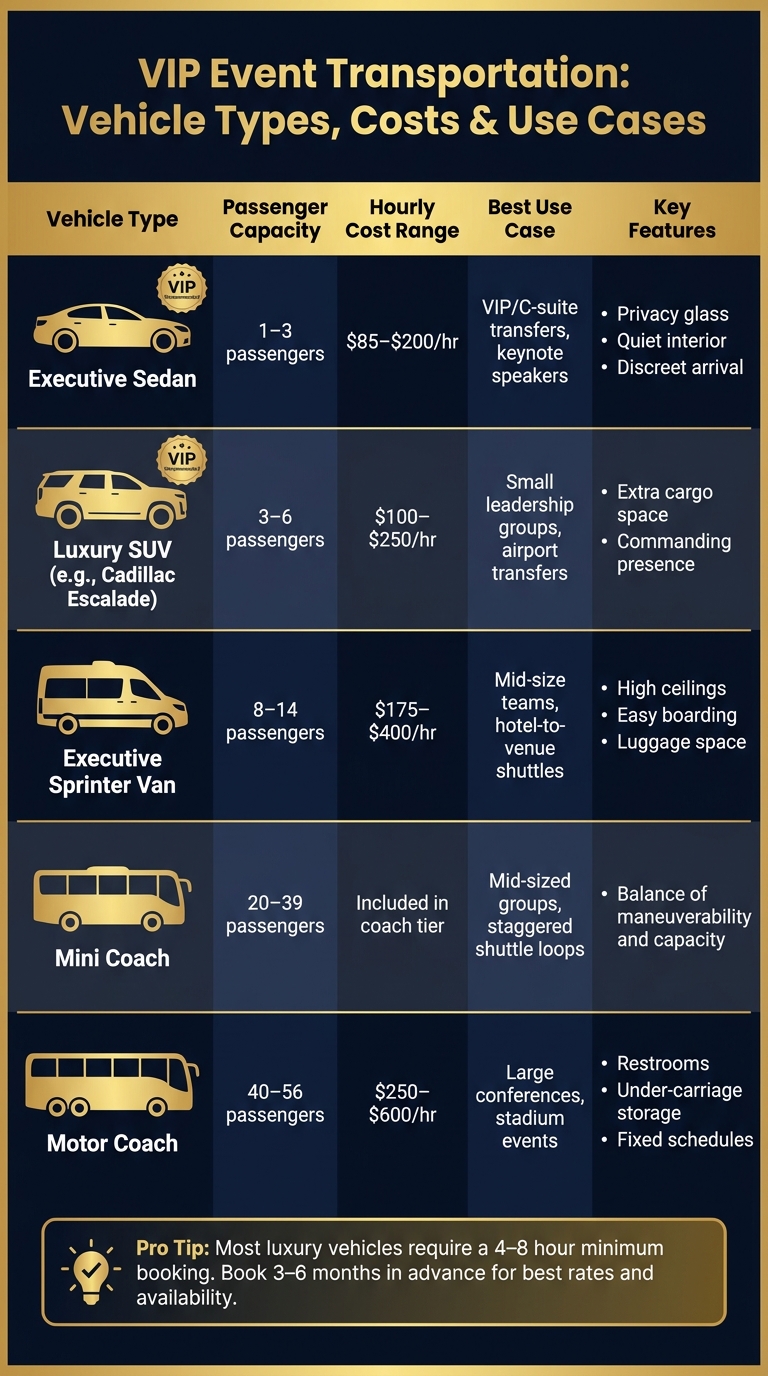
VIP Event Transportation: Vehicle Types, Costs & Use Cases
Once you’ve nailed down your budget and service scope, the next step is choosing vehicles and providers that will elevate your guests’ experience. These decisions are key – they shape the event’s tone and ensure smooth logistics.
Matching Vehicles to Guest Profiles
Your budget sets the boundaries, but the right vehicle choice depends on who’s riding, not just how many. For example, C-suite executives and keynote speakers often expect a high level of privacy, comfort, and sophistication. An executive sedan like the Mercedes S‑Class or BMW 7 Series is a solid choice for these VIPs. For small leadership groups, a luxury SUV such as a Cadillac Escalade or Lincoln Navigator offers a perfect balance of comfort and extra cargo space.
Mid-size teams traveling between hotels and venues benefit from the practicality of an Executive Sprinter Van. With its high ceilings, easy access, and room for luggage and laptops, it’s a great fit. On the other hand, larger groups heading to conferences or stadium-scale events will need a mini coach or a full motor coach to accommodate everyone comfortably.
Always err on the side of caution when estimating capacity. For instance, if you have 14 passengers, a 14-passenger vehicle leaves no room for unexpected needs. Booking slightly larger ensures you’re prepared for last-minute changes.
Also, keep accessibility in mind. Ensure that chauffeurs are trained to assist passengers with visual impairments and can accommodate service animals, ensuring ADA compliance.
Once you’ve matched vehicles to your guests’ needs, the next step is finding service providers who can meet your expectations.
How to Evaluate Service Providers
Even the best vehicle is only as good as the person behind the wheel.
"A $100,000 vehicle operated by an amateur is still a $100,000 liability." – Level One Logistics Team
Start by confirming the provider’s USDOT/FMCSA registration through the FMCSA database. Make sure they carry commercial insurance that exceeds state minimums. Request proof of driver drug testing records and vehicle maintenance logs. For vehicles carrying 16 or more passengers, providers must comply with strict federal DOT and FMCSA standards – this is non-negotiable.
Credentials are just the start. Look for operational reliability: a single point of contact, real-time GPS tracking, and a detailed contingency plan for issues like breakdowns or driver delays. If the provider hasn’t worked at your event venue before, require a pre-event site visit to assess loading zones and turning space for larger vehicles. To avoid surprises, test GPS and notification systems 24–48 hours before the event.
Vehicle Comparison Table
| Vehicle Type | Capacity | Best Use Case | Key Features |
|---|---|---|---|
| Executive Sedan | 1–3 passengers | VIP/C-suite transfers, keynote speakers | Privacy glass, quiet interior, discreet arrival |
| Luxury SUV | 3–6 passengers | Small leadership groups, airport transfers | Extra cargo space, commanding presence |
| Executive Sprinter | 8–14 passengers | Mid-size teams, hotel-to-venue shuttles | High ceilings, easy boarding |
| Mini Coach | 20–39 passengers | Mid-sized groups, staggered shuttle loops | Balance of maneuverability and capacity |
| Motor Coach | 40–56 passengers | Large conferences, stadium events | Restrooms, under-carriage storage, fixed schedules |
Lastly, request photos and detailed specifications of the exact vehicles assigned to your event. Generic fleet descriptions can be misleading – knowing what will show up ensures there are no surprises on the day of the event.
Scheduling and Routing for Smooth Execution
Once your vehicles and providers are secured, the next hurdle is timing. A well-organized fleet is only as effective as its schedule.
Building a Transport Timeline
The best way to create a reliable transport schedule? Work backward from when your guests need to be seated and set departure windows accordingly.
Not all arrivals are equally urgent. Prioritize fixed arrivals – like board members, keynote speakers, or executives who are critical to starting the event. These individuals should have dedicated vehicles and locked time slots. On the other hand, flexible arrivals, such as general attendees, can be staggered without much impact. This group can absorb minor delays without disrupting the event flow.
Compile all trip details into a master plan. This should include the assigned driver, vehicle information, passenger contact details, and precise pickup and drop-off locations. Don’t forget to build in a 15–20-minute buffer for pickups, or 30–45 minutes in areas with heavy traffic.
Return logistics are equally important. A smooth departure plan can make or break the end of an event.
"The return trip phase is what the industry calls a ‘hidden second logistics cycle,’ and planning return trips as a fully separate scheduling phase is the difference between a smooth close and a chaotic scramble outside the venue at midnight." – Louis, Fort Lauderdale VIP Car Service
Treat departures as a separate scheduling task, assigning specific time slots and vehicle capacities. Avoid leaving this step to improvisation.
Once your timeline is set, the next step is to refine your route plans to minimize delays.
Planning Routes and Pickup Sequences
Good route planning goes beyond choosing the fastest path. It’s about anticipating potential roadblocks before they happen. Identify backup routes for every transfer to prepare for unexpected issues like road closures, accidents, or local events such as marathons or festivals.
To avoid curbside congestion, stagger VIP arrivals. For instance, scheduling Tier 1 executives to arrive 15 minutes before other guests ensures a smooth check-in process without bottlenecks. Coordinate with venue managers to get detailed site maps showing loading zones, turning radii for larger vehicles, and restricted access times. For high-profile attendees, consider using private or secondary entrances to avoid general traffic.
For large-scale events with constant guest movement, looped shuttle systems are often more effective than rigid schedules. While fixed schedules work well for one-time VIP transfers, continuous loops handle unpredictable arrival waves better and help prevent overcrowding at staging areas.
With these route plans in place, you’re ready to address potential disruptions.
Planning for Delays and Last-Minute Changes
Even with a detailed schedule, disruptions are inevitable. That’s where rapid response planning comes in.
Use real-time flight tracking and assign a dedicated transport monitor to handle delays as they occur. Set aside 10%–15% of your transportation budget for contingencies and station backup vehicles at key locations to address emergencies. The table below outlines common disruption scenarios and how to handle them:
| Incident Type | Example | Response Strategy |
|---|---|---|
| Vehicle/Fleet | Mechanical breakdown on route | Deploy pre-positioned backup vehicle |
| Route/Traffic | Road closure or accident | Switch to a designated backup route |
| Crowd/Zone | Loading zone overcrowding | Redirect vehicles to a secondary staging area |
| Comm/System | Dispatch app failure | Use radio backup or direct phone contact |
"A well-rehearsed incident response turns a potential disaster into a minor footnote. The events that go smoothly are the ones where teams practiced what to do when things go wrong." – RideScouts
On-Site Coordination and Day-of Adjustments
Communication and Coordination on Event Day
Once all the planning is done, the real test comes on the event day. This is where on-site coordination ensures everything runs like clockwork. To make this happen, appoint an On-Site Commander – someone dedicated entirely to managing live communication among drivers, dispatchers, and event staff. Their role is to keep everything on track in real time.
For larger events with multiple pickup zones, it’s smart to have Zone Captains stationed at each location. These individuals, connected through group messaging or radios, can make quick decisions on the spot without waiting for central approval. A live digital manifest is a must-have for keeping everyone on the same page – no one wants to deal with outdated paper lists. Also, don’t forget to test GPS tracking and guest notification systems at least 30 minutes before the first vehicle departs.
"Your anxiety lives in the silence. Our Certainty Protocol is designed to eliminate it. You will never have to ask, ‘Where is my vehicle?’ You will already know." – LevelOne Logistics Team
The Certainty Protocol is a well-structured notification system that keeps everyone informed at key moments: 24 hours before (confirmation), 1 hour before (en route), 15 minutes before (on-site), when guests are on board, and after the trip is completed. This rhythm ensures smooth communication without the need for constant updates, allowing teams to focus on delivering an exceptional experience.
Handling Disruptions and Emergencies
Even with the best-laid plans, things can go sideways. A well-prepared team, ready to respond quickly, can make the difference between a smooth recovery and complete chaos.
One effective tool is a severity matrix, which helps classify incidents and determine the best course of action immediately. Flexibility is key, especially in cases like weather-related challenges. For example, during a winter storm affecting 1,700 attendees, Hosts Washington, DC, adjusted on the fly by using all-wheel-drive vehicles, reorganizing manifests, and implementing a looped shuttle system that adapted to delayed arrival times. For events involving six or more vehicles, keeping a backup driver in rotation is a lifesaver – standby drivers can step in quickly to avoid guest delays.
"The difference between a good event transport partner and a great one is that the great one has already driven your route, met your venue coordinator, and built contingency into the plan before you even asked." – Ridescouts
By pairing these strategies with a proactive approach, event teams can handle disruptions with confidence and keep everything running smoothly.
How Essentialyfe Supports On-Site Event Coordination
Essentialyfe takes the stress out of event logistics by combining luxury venues, dedicated shuttle services, security, and on-site management into one streamlined solution. From the moment guests arrive to their final departure, every detail is managed seamlessly to create a flawless experience.
Conclusion: Delivering a Flawless VIP Transportation Experience
Creating a seamless VIP transportation experience takes more than luck – it requires careful planning, reliable vendors, and a team ready to adapt when the unexpected happens. As Olivia Foster from Savoya explains: "Transportation is often the first and last impression an organization makes. A delayed pickup, missed connection, or lack of communication can disrupt meetings, frustrate executives, and create unnecessary stress."
To get it right, there are a few essential steps to follow. Start your RFP process 6–12 months in advance for large events. Allocate a 10–15% contingency fund within your transportation budget. And don’t overlook the importance of return trips – schedule them with the same precision as arrivals. These aren’t just best practices; they’re the foundation for managing high-pressure events successfully.
Choosing the right provider is just as important. Always verify a vendor’s USDOT number, insurance coverage, and driver records before signing any contracts. Failing to meet DOT and FMCSA standards can lead to a fleet shutdown during the event – a disruption that no amount of backup planning can fully fix.
"Transportation is the invisible thread connecting every part of a corporate event. When it works, nobody notices. When it fails, everyone remembers." – Superior Executive Services
For those seeking a streamlined solution, Essentialyfe offers an all-in-one approach. Their services combine shuttle coordination, security, event management, and concierge support, removing the hassle of juggling multiple vendors and ensuring the focus remains on delivering an exceptional guest experience.
FAQs
How many vehicles should I book?
When organizing transportation, it’s essential to match the number and type of vehicles to your guest count, itinerary, and specific needs. A mixed fleet often works best:
- Use executive sedans or SUVs for VIPs.
- Opt for Sprinter vans or buses to accommodate larger groups.
Key Considerations
- Staggered Arrivals: Factor in varying arrival times to streamline pick-ups and drop-offs.
- Accurate Headcounts: Confirm the number of passengers to avoid overcrowding.
- Time Buffer: Build in a 30% time cushion to handle unexpected delays.
- Backup Plan: If you’re managing more than six active vehicles, consider having a backup unit on standby to keep everything running smoothly.
By planning carefully, you can ensure the transportation logistics are seamless and stress-free.
What should my backup plan include?
A solid backup plan for VIP transportation revolves around being prepared and staying adaptable. Work closely with your transportation provider to ensure backup vehicles are on standby and that alternative routes are mapped out to handle unexpected traffic or road closures. It’s also smart to include a written contingency plan in your contracts and set up clear communication protocols, such as having a dedicated dispatcher to manage last-minute changes. For larger events, you might want to go a step further by arranging for a standby driver and ensuring access to taxis or rideshare apps as extra safety nets.
What should I verify before hiring a provider?
Before selecting a transportation provider, it’s essential to confirm they meet all federal and state licensing requirements. This includes verifying their USDOT number and ensuring their insurance is current and active. Look into driver qualifications – check for valid commercial licenses, completed background checks, and any relevant training.
Additionally, review the provider’s vehicle maintenance records and inspection reports to ensure their fleet is in top condition. Assess their service standards to gauge reliability. Finally, make sure they have detailed contingency plans in place for handling delays or breakdowns and that they are well-acquainted with your venue and the local area.