Secure chauffeur services are reshaping film production logistics by prioritizing safety, privacy, and reliability for both talent and equipment. These services employ law enforcement-trained drivers who ensure secure transport while addressing unique challenges like tight schedules, public interference, and equipment protection.
Key highlights:
- Talent Transport: Focuses on safety, discretion, and punctuality. Drivers are trained to handle threats, follow NDAs, and adjust to last-minute changes. Premium vehicles with privacy features enhance the experience.
- Equipment Security: Protects high-value gear using risk-assessed routes, secure vehicles, and professional oversight. This minimizes delays and ensures gear arrives intact.
While these services excel in safeguarding productions, their higher costs and regulatory requirements (like DOT compliance) can be challenges for smaller productions. However, for productions prioritizing security and efficiency, these services are a game-changer.
1. Talent Transport
Getting cast and crew to and from filming locations isn’t just about logistics – it’s about ensuring safety, privacy, and punctuality every step of the way.
Drivers bring a unique blend of law enforcement experience and executive protection skills. This means they’re trained to assess risks, map out alternate routes, and handle potential threats calmly and effectively. As Ruben Banuelos, Vice President at ESS, puts it:
"Our team works quietly behind the scenes so your spotlight can shine safely."
Discretion is key. Chauffeurs adhere to strict NDAs, while premium vehicles come equipped with features like privacy partitions, soundproofing, and blinds. These ensure that talent can review scripts, make calls, or simply relax without interruptions. This attention to detail not only protects individuals but also mirrors the same level of care applied to other aspects of production security.
Given the unpredictable nature of filming, drivers coordinate closely with production managers. Their 24/7 availability and ability to adapt to last-minute schedule changes are crucial for keeping everything running smoothly.
Pricing structures typically include hourly rates, minimum booking requirements, and firm cancellation policies. These measures ensure a professional and reliable service that meets both the personal needs of talent and the overarching security demands of the production.
Next, let’s dive into how these services safeguard high-value equipment on set.
sbb-itb-161ccc1
2. Equipment Security
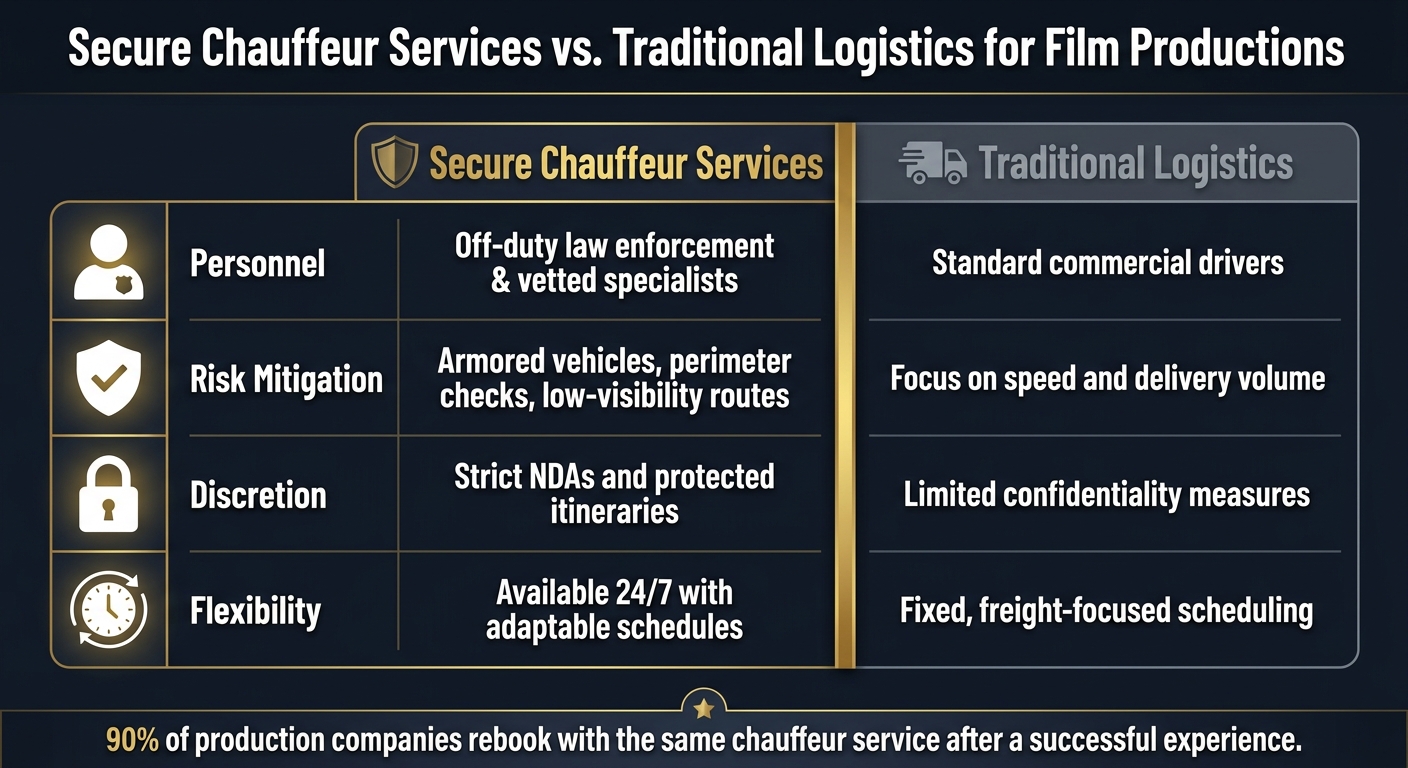
Secure Chauffeur Services vs. Traditional Logistics for Film Productions
Protecting high-value equipment is just as important as ensuring the safety of the talent when it comes to keeping a production running smoothly.
Film equipment often comes with a hefty price tag and can be irreplaceable. Losing or damaging essential gear, like cameras, during transit can throw a wrench into production schedules. That’s why secure transport solutions are a must.
Unlike traditional logistics companies that prioritize efficiency and volume, secure chauffeur services treat equipment transport as a specialized protection task. Many of these drivers are off-duty law enforcement officers or licensed professionals skilled in risk assessment, surveillance, and VIP protection. Their job isn’t just to deliver the equipment – it’s to actively monitor the environment, plan routes that minimize risk, and coordinate with on-site security teams during loading and unloading.
Here’s a quick comparison of how secure chauffeur services differ from traditional logistics:
| Factor | Secure Chauffeur Services | Traditional Logistics |
|---|---|---|
| Personnel | Off-duty law enforcement and vetted specialists | Standard commercial drivers |
| Risk Mitigation | Armored vehicles, perimeter checks, low-visibility routes | Focus on speed and delivery volume |
| Discretion | Strict NDAs and protected itineraries | Limited confidentiality measures |
| Flexibility | Available 24/7 with adaptable schedules | Fixed, freight-focused scheduling |
These enhanced protocols highlight why secure chauffeur services are better suited for safeguarding expensive film equipment.
Confidentiality is another key focus, especially for high-profile productions. Drivers and staff undergo rigorous background checks and sign NDAs to keep equipment locations and schedules under wraps.
For productions working with particularly valuable gear, secure fleets offer options like armored vehicles and high-end SUVs – think Cadillac Escalade or Range Rover – equipped with advanced safety systems and tracking technology. Some services even go a step further by providing 24-hour surveillance and ensuring secure access to destinations, whether it’s a soundstage, private estate, or an off-the-grid outdoor set.
Pros and Cons
When it comes to safeguarding talent and equipment during film productions, secure chauffeur services offer both advantages and challenges. These trade-offs require careful consideration to align with the unique needs of each production.
Secure chauffeur services bring undeniable benefits to film productions, particularly in ensuring safety and maintaining order. Drivers with backgrounds in law enforcement not only provide reliable transport but also deter unwanted attention and manage potential disruptions like paparazzi or crowds. Their ability to de-escalate tense situations while working closely with on-set security teams is a major asset for high-profile productions. However, the expertise that comes with such personnel can significantly increase costs, making it harder for productions on a tight budget to justify this expense for every cast or crew member.
On the other hand, protecting equipment introduces a different set of challenges, particularly when it comes to regulatory and logistical demands. Secure transport services help reduce risks to valuable gear and prevent delays, ensuring that equipment arrives on time and in good condition. However, moving heavy production equipment often requires specialized vehicles and compliance with Department of Transportation (DOT) and Federal Motor Carrier Safety Administration (FMCSA) regulations. For example, when vehicles exceed a Gross Vehicle Weight Rating (GVWR) of 10,001 pounds, productions are classified as motor carriers. This triggers additional requirements such as maintaining Driver Qualification Files, securing medical certificates, stopping at weigh stations, and, for vehicles over 26,001 pounds, employing drivers with a Commercial Driver’s License (CDL).
"The biggest mistake smaller productions make is not realizing that the moment you employ the use of a commercial motor vehicle, you may fall under the jurisdiction of the Department of Transportation (DOT)." – Wrapbook Team
The table below highlights the differences between talent transport and equipment security:
| Feature | Talent Transport | Equipment Security |
|---|---|---|
| Primary Objective | Personal safety, privacy, and schedule adherence | Protection and delivery of technical production gear |
| Key Benefit | Professional de-escalation of public confrontations | Prevention of asset damage and production downtime |
| Primary Challenge | Managing high-profile personalities and public interference | Logistical complexity and DOT/FMCSA compliance |
| Personnel Profile | Armed chauffeurs, retired or off-duty law enforcement | Professional drivers, Transport Captains, and grip crews |
| Regulatory Focus | Privacy laws and executive protection protocols | Transportation safety standards and vehicle weight regulations |
Conclusion
Secure chauffeur services aren’t just an optional perk for film productions – they play a critical role in ensuring everything runs smoothly. From protecting high-profile talent from unwanted attention to guaranteeing that valuable camera equipment arrives safely and on time, a well-thought-out transport strategy can make or break a production’s efficiency.
Choosing the right vehicle and driver is key to meeting the varied demands of a production. For instance, premium sedans like the Mercedes S-Class or Range Rover offer privacy and sophistication, perfect for transporting talent. On the other hand, larger vehicles such as the Mercedes V-Class are better suited for moving crew members and equipment. A dedicated Transport Coordinator ensures that each vehicle is matched to its specific task, keeping the production on track.
Interestingly, 90% of production companies rebook with the same chauffeur service after a successful initial experience. This consistency helps drivers become familiar with the production’s unique pace, preferences, and logistical needs, minimizing potential disruptions and last-minute issues.
"Any delay reflects on us. The driver becomes part of our production team." – Film Producer
When productions treat transportation as a core operational element, they tend to run on tighter schedules, protect their assets more effectively, and allow talent to focus entirely on their work. For productions that demand a secure and seamless filming environment, Essentialyfe offers comprehensive solutions, including security, shuttle services, and specially curated film locations.
FAQs
When should a production hire secure chauffeurs?
Secure chauffeur services are a must when dependable, professional transportation is required to safeguard talent, crew, and equipment. These services play a key role in high-profile productions where maintaining privacy, ensuring security, and practicing discretion are non-negotiable. Additionally, they help protect expensive equipment during transit, reducing the chances of theft or damage, while also allowing talent to travel in comfort and avoid unnecessary public attention.
Do secure chauffeurs handle DOT/FMCSA compliance for gear transport?
Secure chauffeurs are primarily tasked with ensuring safe and secure transportation for their clients. However, managing DOT/FMCSA compliance related to gear transport doesn’t typically fall under their responsibilities. Their focus lies in facilitating smooth travel while prioritizing safety and security, leaving regulatory matters to other specialized personnel or teams.
How are talent routes and schedules kept confidential?
Talent routes and schedules are kept private through secure transportation plans, restricted access, and careful, discreet coordination. These steps help reduce the chances of leaks and maintain privacy during the production process.