VIP transport isn’t just about getting from point A to point B – it’s about delivering a flawless experience. However, common issues like delays, privacy concerns, discomfort, and safety risks can disrupt even the best plans. Here’s how professional chauffeurs tackle these challenges:
- Delays: Chauffeurs use real-time flight tracking, arrive early, and adjust for traffic or event disruptions to stay on schedule.
- Privacy Risks: Secure pick-up locations, encrypted communication, and strict confidentiality measures ensure discretion.
- Comfort Issues: Chauffeurs prepare vehicles with amenities like Wi-Fi, charging ports, and climate control, tailoring each ride to client preferences.
- Safety Concerns: Rigorous driver training, vehicle maintenance, and planned routes prioritize passenger security.
- Communication Gaps: Centralized coordination and clear updates keep all parties informed and aligned.
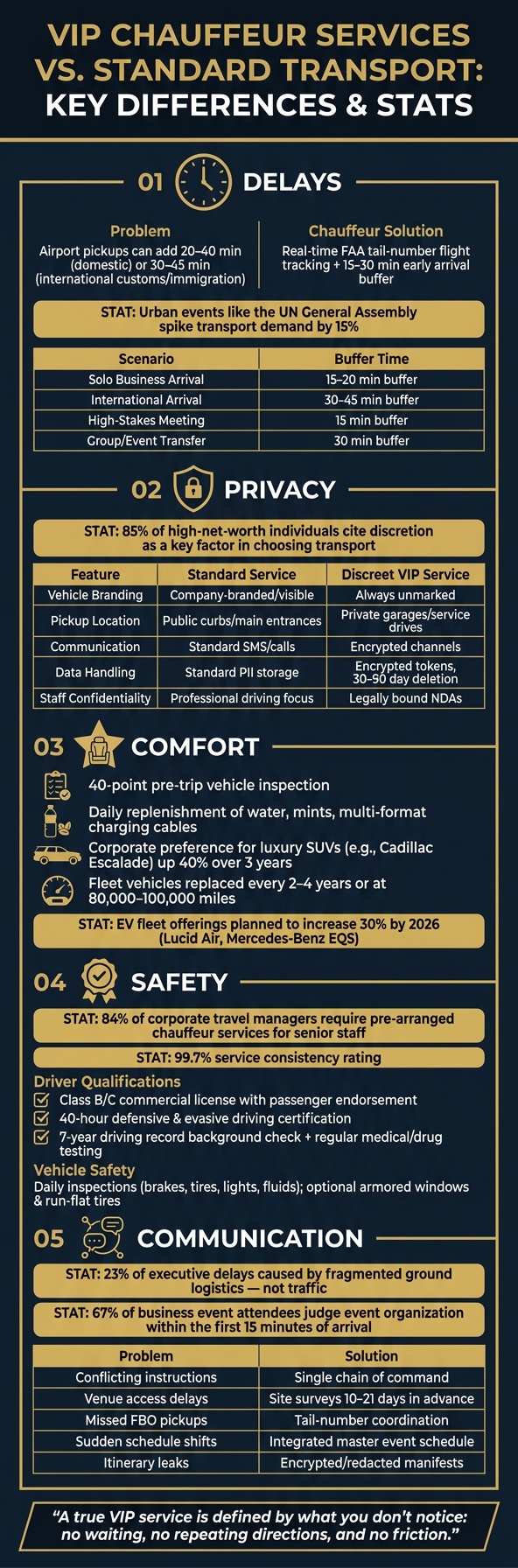
VIP Chauffeur Services vs. Standard Transport: Key Differences & Stats
Delays in VIP Transport
Common Situations That Cause Delays
VIP transport delays often stem from a series of small but impactful issues. Take, for instance, a flight arriving ahead of schedule while the chauffeur, unaware due to a lack of real-time flight tracking, leaves the guest waiting at the curb. Or consider a bustling downtown area, where a major event causes unexpected traffic jams, making fixed pickup times nearly impossible to stick to.
Airport pickups are especially tricky. Factors like last-minute gate changes, lengthy taxi times, or baggage claim delays can tack on an extra 20–40 minutes. For international travelers, customs and immigration add another 30–45 minutes to the wait time.
Urban traffic makes things even more complicated. In cities like New York, events such as the UN General Assembly can cause transport demand to spike by as much as 15%, leading to gridlock that even the best GPS systems struggle to predict. Construction work, filming closures, or sporting events can turn a perfectly planned pickup into a logistical headache.
"A ten-minute delay at the curb can ripple into late meetings, missed connections, or rushed transitions." – Royal Executive Limo
Understanding these challenges, professional chauffeurs rely on specific strategies to stay punctual.
How Chauffeurs Stay on Schedule
To combat these delays, experienced chauffeurs take a proactive approach. One essential tool is real-time flight tracking, which uses FAA data and specific aircraft tail numbers rather than just the scheduled arrival time. Many chauffeurs also arrive 15–30 minutes early to account for unexpected setbacks. For clients with fluid schedules, such as back-to-back meetings, luxury rentals and hourly services keep the chauffeur on standby, ready to move whenever needed.
Clear and precise communication is another critical factor. Instead of vague updates like "running late", chauffeurs provide milestone notifications such as "customs cleared" or "bags in hand", ensuring both parties can coordinate timing effectively.
| Transfer Scenario | Recommended Buffer | Key Strategy |
|---|---|---|
| Solo Business Arrival | 15–20 minutes | Flight monitoring, curbside staging |
| International Arrival | 30–45 minutes | Customs tracking, flexible wait window |
| High-Stakes Meeting | 15 minutes | Early curbside positioning |
| Group or Event Transfer | 30 minutes | Single-point meeting coordination |
"A driver follows a GPS; a chauffeur masters the terrain and anticipates the client’s needs." – Sedanz
While technology and time management are crucial, local knowledge sets seasoned chauffeurs apart. By leveraging insights about local traffic patterns, construction zones, or even school dismissal times, chauffeurs can navigate challenges that GPS systems might overlook. This expertise ensures clients reach their destinations smoothly, even in the most unpredictable situations.
sbb-itb-161ccc1
Privacy and Discretion in VIP Transport
Privacy Risks During VIP Transport
When it comes to VIP transport, privacy is just as important as punctuality. A striking 85% of high-net-worth individuals consider discretion a key factor when choosing a transportation provider. Even minor slip-ups can inadvertently disclose a VIP’s whereabouts.
Common practices like using branded vehicles or public pick-up points can lead to unwanted attention. For instance, parking a marked car near a private entrance could unintentionally signal a VIP’s location. Additionally, unencrypted communications or leaked travel plans pose serious risks, as standard SMS or phone calls can leave sensitive details exposed.
"In Manhattan, luxury chauffeur service for celebrities is primarily an exercise in exposure management." – VIP NYC Transfers
Just as chauffeurs expertly handle delays, they also employ specific strategies to ensure their guests’ privacy is never compromised. These measures are critical for avoiding breaches of confidentiality.
How Chauffeurs Protect Guest Privacy
Professional chauffeurs go beyond vehicle selection to focus on operational protocols that safeguard privacy. These measures are designed to minimize risks while maintaining the highest level of discretion.
To prevent identity mishaps, chauffeurs confirm a guest’s identity using pre-arranged code names or digital tokens, avoiding the need to call out full names in public spaces. Communication is conducted through encrypted channels, ensuring that sensitive details like contact information remain secure. Additionally, operational logs for sensitive trips are kept for only 30–90 days before being securely deleted.
All personnel involved, from chauffeurs to dispatchers, sign legally binding Non-Disclosure Agreements (NDAs) to uphold confidentiality. Pick-ups are carefully planned at low-visibility locations, such as private garages, service drives, or backstage entrances, rather than public areas. For air travelers, Fixed Base Operator (FBO) transfers allow guests to avoid crowded public terminals entirely.
"True discretion means anticipating client needs before they articulate them, reading situations accurately, and making split-second decisions that preserve both safety and privacy." – Industry veteran, Link Executive Transfers
The following table highlights how discreet VIP chauffeur services stand apart from standard ones in terms of privacy:
| Feature | Standard Chauffeur Service | Discreet VIP Chauffeur Service |
|---|---|---|
| Vehicle Branding | Often company-branded or highly visible | Always unmarked and understated |
| Pickup Location | Main entrances / public curbs | Controlled zones and private access points |
| Communication | Standard phone calls / SMS | Encrypted channels and phone masking |
| Data Handling | Standard PII collection and storage | Data minimization and encrypted tokens |
| Staff Confidentiality | Professional driving focus | Legally bound by NDAs |
My honest advice on avoiding common mistakes as a Chauffeur (easy to fix)
Comfort and Vehicle Quality in VIP Transport
While punctuality, privacy, and safety are crucial, what truly sets VIP transport apart is the level of comfort and the quality of the vehicle.
Common Comfort Problems in VIP Transport
Even the most punctual and private service can fall short if the vehicle isn’t perfectly prepared. Guests often encounter minor yet frustrating issues, like cramped interiors caused by mismatched vehicle sizes – such as squeezing luggage into the cabin or assigning a sedan to a group. Other discomforts include lingering odors, inconsistent temperatures, or intrusive road noise, all of which can disrupt rest or focus. Missing or malfunctioning amenities, like broken charging ports, unreliable Wi-Fi, or the absence of bottled water, can be particularly inconvenient, especially for guests needing to prepare for meetings during the ride. Additionally, excessive driver interaction – like unnecessary small talk or asking for directions – can detract from the professional atmosphere. Addressing these comfort challenges requires a highly detailed and personalized approach from chauffeurs.
"The difference between an ordinary ride and a truly premium one often reveals itself in moments so small they are easy to miss until they are missing." – Revenues & Profits
How Chauffeurs Customize the Ride Experience
Professional chauffeurs approach vehicle preparation with the same diligence as route planning. Each trip begins with a thorough 40-point inspection to ensure all mechanical and cabin features – like HVAC systems, charging ports, Wi-Fi, and acoustic glass – are in perfect working order. Essentials such as chilled water, mints, and multi-format charging cables are replenished daily to maintain impeccable standards.
Personalization is key to creating a seamless experience. Vehicle selection is tailored to the guest’s specific needs. Over the last three years, corporate clients have increasingly preferred luxury SUVs like the Cadillac Escalade, which offers ample cargo space to keep luggage out of the passenger cabin – a preference that has grown by 40%. For larger groups, Sprinters are often chosen to ensure a spacious and uncluttered environment.
Before pickup, chauffeurs prepare the cabin to match the guest’s preferences. This includes setting the temperature, adjusting the lighting, and being briefed on the guest’s communication preferences – whether they prefer a quiet ride or light conversation. Features like "quiet mode" enable guests to take confidential calls or simply relax without distractions. This level of preparation ensures a smooth and premium experience that defines VIP chauffeur service.
Fleet quality is another critical factor. High-end providers replace vehicles every two to four years or once they reach 80,000–100,000 miles, guaranteeing that guests always ride in modern, dependable cars. In response to growing corporate sustainability goals, many executive fleets are planning to increase their electric vehicle (EV) offerings by 30% by 2026, with models like the Lucid Air and Mercedes-Benz EQS leading the charge.
Safety in VIP Transport
Safety Risks in VIP Transport
When it comes to VIP transport, safety is just as critical as comfort and privacy – if not more. After all, what good are luxury and discretion if the journey itself isn’t secure? VIP transport presents unique safety challenges that go well beyond the scope of standard driving.
One of the most frequently overlooked risks is vehicle maintenance failure. A breakdown doesn’t merely cause inconvenience; it can leave high-profile passengers stranded in unfamiliar or potentially unsafe areas, posing both security and reputational threats. Equally troubling is the issue of driver quality. Without the proper training, drivers may engage in risky behaviors like aggressive driving, poor lane discipline, or working while fatigued – all of which heighten the likelihood of accidents. For public figures like celebrities or executives, predictable pickup locations or poorly planned routes can inadvertently expose sensitive routines or associations, making them vulnerable to unwanted attention from the public or media.
The situation worsens when unvetted services are involved. Basic background checks offered by rideshare platforms fall short of the stringent standards required for VIP transport. This is why 84% of corporate travel managers now insist on pre-arranged chauffeur services for their high-ranking staff, reducing the risks associated with gig-economy drivers.
How Chauffeurs Keep Passengers Safe
Professional chauffeurs don’t just provide a smooth ride – they are the backbone of a safe VIP transport experience. They address safety through meticulous driver training, rigorous vehicle maintenance, and careful route planning.
Driver qualifications are a cornerstone of this safety-first approach. Top-tier chauffeurs typically hold a Class B or Class C commercial driver’s license with a passenger endorsement, complete a 40-hour certification in defensive and evasive driving, and undergo regular medical exams and drug testing. Additionally, reputable companies conduct extensive background checks, often reviewing driving records for the past seven years. As BlackWingz Limo puts it:
"A chauffeur’s value is built on trust. Rigorous background checks and defensive driving training are not optional extras – they are the baseline expectation for any client who values their safety and privacy."
On the vehicle side, professional fleets operate with strict maintenance protocols. Daily inspections check critical systems like brakes, tires, lights, and fluids, while event-specific checks ensure features like privacy glass and first-aid kits are in top condition. This commitment to detail contributes to an impressive 99.7% service consistency rating. For high-risk scenarios, vehicles can even be equipped with advanced safety features like armored windows, run-flat tires, and ballistic-grade protection.
Route planning is another vital safety measure. Chauffeurs meticulously pre-plan multiple routes, considering factors like traffic, road closures, and security concerns. They also rely on real-time navigation tools to adapt to changing conditions on the go. These combined efforts ensure that every aspect of the journey prioritizes passenger safety, making it a seamless and secure experience from start to finish.
Communication and Logistics in VIP Transport
Communication and Coordination Problems
Even when vehicles and drivers are in top condition, poor communication can derail a VIP transport operation. In fact, industry data reveals that 23% of executive delays are caused by fragmented ground logistics – not traffic or vehicle issues, but failures in coordination.
When multiple stakeholders – like event planners, security teams, and VIP representatives – issue separate instructions without a clear chain of command, confusion is almost inevitable. One common issue is the "initial barrier problem", where unbriefed venue security or parking staff stop the vehicle and request documents the VIP doesn’t have. Leonid Bugaev, a business communications expert, explains:
"A moderator who knows that the VIP may arrive 15–20 minutes late is prepared for it. A moderator who wasn’t warned is not." – Leonid Bugaev, Expert in Business Communications
Another challenge arises when transport is treated as a series of disconnected rides rather than as part of a cohesive movement plan tied to the event’s master schedule. On top of that, unsecured itineraries that leak to the press can turn a simple communication lapse into a privacy nightmare.
To tackle these issues, professional chauffeurs rely on streamlined, centralized communication methods to keep everyone on the same page.
How Chauffeurs Keep Communication Clear
Professional chauffeurs prevent coordination problems by using structured communication systems. A single point of contact manages all driver communications, ensuring that clients, security teams, and venue staff operate with consistent information. For large-scale events, a specialized event chauffeur manager works closely with personal assistants, hotel concierges, and venue security to align pickup and drop-off plans and secure access ahead of time. VIP guest lists and vehicle license plates are shared with venue security at least 24 hours before the event to avoid last-minute surprises at entry points.
Itineraries are centralized and updated in real time. Chauffeurs are also trained to exercise discretion, often opting for quick text updates instead of interrupting clients who may be on calls or working. This attention to detail matters: 67% of business event attendees judge an event’s organization based on their experience in the first 15 minutes after arrival. A chauffeur who handles a sudden schedule change smoothly can make all the difference in creating a positive first impression.
This communication system not only minimizes scheduling issues but also protects client privacy and ensures safety throughout the journey.
"The smallest misstep can reflect poorly on your event’s reputation. This is why more organizations are turning to a Dedicated Event Manager… to oversee Executive Guest Service." – Merlux Chauffeur
Here’s a breakdown of common communication challenges and how professional services address them:
| Communication Breakdown | Prevention Strategy |
|---|---|
| Conflicting instructions | Establish a single chain of command: Transport Lead, Security Lead, Client Liaison |
| Venue access delays | Conduct site surveys and secure permits 10–21 days in advance |
| Missed pickups at FBOs | Coordinate directly with private aviation handlers and monitor tail numbers |
| Sudden schedule shifts | Integrate transport timelines with master event schedules and production cue sheets |
| Itinerary leaks | Use encrypted manifests and redacted documents for general distribution |
Conclusion: What Professional Chauffeur Services Deliver for VIP Guests
VIP transport falls short when treated as just another ride. Issues like delays, privacy breaches, discomfort, safety concerns, and miscommunication often arise from poor preparation and lack of discipline. Professional chauffeurs address these challenges by acting as logistical experts rather than mere drivers.
"An elite Executive Chauffeur is not a driver; they are a logistical specialist." – Orlux Rides
What sets a professional chauffeur apart is their attention to detail and use of an integrated system. This includes tail-number flight tracking, ensuring the cabin is pre-set to a comfortable 68°F, conducting route checks in advance, maintaining NDA-level discretion, and providing seamless real-time communication. These aren’t just perks; they’re the foundation of authentic VIP service.
The statistics reinforce this approach. 84% of corporate travel managers now require pre-arranged transportation for senior staff to minimize risks associated with unverified drivers. Additionally, top-tier chauffeur networks boast a 99.7% service consistency rating, achieved through regular audits and strict affiliate guidelines. Such reliability is only possible through meticulous planning and execution.
"A true VIP service is defined by what you don’t notice: no waiting, no repeating directions, and no friction." – VOMOS
For occasions where every detail matters – like those handled by luxury providers such as Essentialyfe, which combines shuttle services with broader concierge and event management – professional chauffeur services go beyond convenience. They become an essential element in crafting an experience that feels smooth and effortless from start to finish.
FAQs
What should I send my chauffeur before pickup to avoid delays?
To avoid any hiccups, make sure your chauffeur has your flight details (like your flight number) and itinerary timing. This allows them to track any changes to your arrival schedule. Also, confirm the exact pickup location – whether it’s at the FBO or a specific meeting point – so they’re prepared and in position when you arrive. This simple step can save you from missed pickups or any confusion at the curb.
How is my location kept private during VIP transport?
Your privacy is safeguarded with careful planning and secure processes. Pickup arrangements are discreet, routes are privately selected, and chauffeurs maintain a high level of professionalism. They only receive the trip details necessary to complete your journey and rely on secure systems to manage booking information. Details such as pickup locations, destinations, and itineraries are handled with strict confidentiality, ensuring your privacy is protected every step of the way.
How do I pick the right vehicle size for people and luggage?
When planning for comfort, start by accounting for everyone in your group, yourself included. An executive sedan typically accommodates three passengers comfortably, though squeezing in a fourth might feel tight. For groups larger than four, a luxury SUV or van is a better choice. If you’re traveling with bulky luggage, golf clubs, or other gear, an SUV or estate vehicle offers the extra space you’ll need. For bigger gatherings, multiple vehicles or shuttle services can keep everyone comfortable while ensuring your outfit stays pristine.