Wedding car rentals are more than transportation – they set the tone for your big day. From vintage classics to luxury SUVs, the right vehicle ensures smooth logistics and adds style to your wedding. Here’s what you need to know:
- Why It Matters: Reliable transportation keeps the schedule on track for the couple, bridal party, and guests.
- Vehicle Options: Choose from vintage cars like a Rolls-Royce Phantom, sleek modern sedans like the Mercedes S-Class, or practical SUVs like the Cadillac Escalade.
- Common Uses: Morning prep runs, ceremony arrivals, guest shuttles, and the couple’s grand exit.
- Key Planning Tips:
- Book 6–12 months in advance, especially for peak wedding seasons.
- Match the car to your wedding style and gown needs (e.g., spacious interiors for ball gowns).
- Create a timeline with a 30% time buffer for delays.
- Budget: Average costs range from $350 to $4,000+ depending on the vehicle and duration. Factor in gratuity, overtime, and cleaning fees.
- Chauffeur vs. Self-Drive: Chauffeur-driven cars reduce stress, while self-drive options provide flexibility for getaways.
Plan early, confirm contracts, and ensure your transportation aligns with your vision and logistics. A well-thought-out transportation plan can keep your day stress-free and memorable.
Advice on choosing your wedding car from our fleet, questions and answers
sbb-itb-161ccc1
Key Factors to Review Before Booking
Before committing to a contract or putting down a deposit, a few critical decisions can determine how smoothly your wedding transportation goes. Making these choices wisely can help you save money, reduce stress, and ensure your transportation is both practical and visually appealing. It’s also worth thinking about how your chosen vehicle aligns with your wedding’s overall style while meeting functional needs.
Choosing a Car That Fits Your Wedding Style
The car you choose isn’t just a ride – it’s part of the story you’re telling. From the photos of your grand entrance to the impression it leaves on your guests, the right vehicle can enhance the mood and theme of your big day.
"The vehicle you choose is more than transport; it’s a storytelling device that complements your style, colors, and the emotional arc of the day." – Kuni Chevy Cadillac
For a formal, black-tie affair, cars like the Rolls-Royce Phantom or Bentley Flying Spur are excellent choices. Vintage-themed weddings pair beautifully with classics like a 1960s Mercedes Pagoda or Jaguar E-Type. For a sleek, modern vibe, consider the Mercedes S-Class or Tesla Model S. If your reception has an urban or rooftop setting, vehicles like the Ferrari 488 Spider or Lamborghini Huracán can make a bold statement. On the other hand, rustic or bohemian weddings often favor vintage VW buses or classic convertibles.
If you’re wearing a voluminous gown – such as a ball gown or A-line style – make sure the car’s rear door opening and interior space can accommodate it comfortably. Cars like the Rolls-Royce Ghost or Cadillac Escalade ESV are often recommended because of their wide doors and spacious seating areas.
Once you’ve chosen a style, it’s time to align your vehicle choice with the practical aspects of your day.
Guest Count, Routes, and Weather
Practical planning is just as important as selecting a stylish vehicle. Your transportation needs to balance aesthetics with the realities of managing guests and navigating routes.
Start by estimating your guest count and the expected usage rate, then add a 10% buffer to account for unexpected needs. Usage rates vary depending on your location: local guests typically have a 40–60% usage rate, rural out-of-town guests fall between 60–80%, and when parking is limited, expect usage rates as high as 80–95%. For a more luxurious experience, consider booking 20% more capacity than your actual guest count to handle last-minute adjustments.
Route conditions are another key factor. Rural venues with gravel roads, steep inclines, or narrow paths may not accommodate low-clearance vintage cars or oversized motor coaches. In urban settings – like Manhattan or downtown Chicago – you’ll need to account for double-parking, loading zones, and potential delays from traffic. Afternoon rush hour in major cities can add 20–45 minutes to your travel time. Weather is also unpredictable: rain can slow down loading, and convertibles or vintage cars may require a backup plan if the forecast looks uncertain.
Chauffeur-Driven vs. Self-Drive Options
Deciding between chauffeur-driven and self-drive vehicles depends on how much control you want to have on your wedding day versus what you’d rather delegate.
| Feature | Chauffeur-Driven | Self-Drive |
|---|---|---|
| Best For | Ceremony arrival and wedding party transport | Getaway shots and multi-day travel |
| Responsibility | Driver handles navigation, parking, and timing | Couple or guest manages all logistics |
| Cost | Higher (includes labor and gratuity) | Lower (rental fee only) |
| Insurance | Covered under the provider’s commercial policy | May require personal policy extensions |
| Stress Level | Low – the driver manages the schedule | Higher – someone must stay focused and sober |
Many couples now choose a hybrid approach: using a chauffeur-driven car for arrivals and switching to a self-drive option for their exit. This gives you the reliability of a professional driver when timing is critical, while still allowing for a private, dramatic getaway in a high-performance car.
If you’re considering self-drive, make sure to assign a transportation captain – someone other than you or your partner – to oversee logistics and keep everything running smoothly. Also, check with the provider ahead of time to confirm whether self-driving is allowed for specialty or vintage vehicles, as many companies restrict these to chauffeur-only use for liability reasons.
Types of Wedding Vehicles and Their Uses
Classic, Vintage, and Luxury Sedans
When it comes to wedding transportation, classic and vintage cars are some of the most popular choices in the U.S. Iconic models like the Rolls‑Royce Phantom and Bentley Silver Cloud bring a timeless "old Hollywood" charm that makes for breathtaking photos and creates a sense of elegance that modern cars rarely achieve.
"The Rolls‑Royce Phantom is the gold standard of luxury wedding cars." – Today’s Luxury Weddings
For formal weddings, such as black-tie events, the Rolls‑Royce Phantom is a standout option, with chauffeur services typically costing $1,500–$4,000 for half-day rentals. If your celebration leans more toward a garden or estate setting, a vintage Bentley or a 1950s Silver Cloud might be a better fit, with rates generally around $900–$1,500 for a 4-hour minimum. Meanwhile, modern luxury sedans like the Mercedes‑Benz S‑Class offer a sleek, understated look. These are perfect for couples seeking sophistication without the grandeur, and they’re more budget-friendly, ranging from $350–$600 for a 4- to 6-hour rental.
One important tip: check the interior space and rear door clearance of your chosen vehicle to ensure it accommodates ball gowns comfortably.
Next, let’s dive into how exotic cars and upscale limousines can add flair to your big day.
Exotic Cars, SUVs, and Limos
For a dramatic and unforgettable exit, exotic cars like the Lamborghini Huracán or Ferrari 488 are hard to beat. They’re visually stunning but are best suited for brief moments, as their low seating and tight interiors limit practicality. Daily rentals for these head-turners typically range from $1,000–$2,500+.
Luxury SUVs, such as the Cadillac Escalade ESV, have become a favorite for modern weddings. These vehicles combine practicality with style, offering spacious interiors that easily accommodate large gowns and seating for up to six passengers. They also photograph beautifully, making them ideal for editorial-style wedding shoots. Rental costs usually fall between $400–$550 for a 4- to 6-hour period. A growing trend is for couples to book multiple SUVs or modern sedans, like the S-Class, instead of opting for a single stretch limousine. This approach allows for smaller, more intimate groups and results in cleaner, more polished photos.
"Couples are increasingly choosing a fleet of 2–3 Escalades or S‑Classes over a single stretch limousine. This gives each vehicle a smaller, more intimate group and photographs better for editorial‑style wedding photos." – Detailed Drivers
Stretch limousines, while traditional, still hold their charm for couples who want a classic wedding vibe. They offer champagne service and can accommodate 8–14 passengers. However, their side-facing seats might cause motion sickness, and brides with voluminous gowns may need to sit in the center to avoid crumpling their dress.
| Feature | Stretch Limousine | Black Car (S‑Class/Escalade) |
|---|---|---|
| Seating | Side‑facing | Forward‑facing |
| Aesthetic | Traditional, "party" vibe | Modern, sleek, editorial |
| Maneuverability | Difficult in narrow driveways | Nimble in urban and estate settings |
| Capacity | 8–14 passengers | 1–6 passengers |
| Estimated Rate | $600–$900 (4–6 hrs) | $350–$650 (4–6 hrs) |
Now, let’s look at how to move larger groups efficiently with specialized transport options.
Group Transport: Party Buses and Vans
For transporting larger groups, such as bridal parties or out-of-town guests, vehicles like Mercedes Sprinter vans and luxury motor coaches are excellent choices. The Mercedes Sprinter seats 7–14 passengers and costs around $500–$750 for a 4- to 6-hour booking. It’s a practical alternative to traditional limos, offering ample space to keep formal wear wrinkle-free while also accommodating essentials like bouquets and emergency kits.
For even larger weddings – think 150 guests at a separate venue – you might need a fleet of 3–4 luxury motor coaches or 10–12 Sprinter vans to handle transportation smoothly. Motor coaches, which can carry 30–55 passengers, cost between $1,500–$4,000 per vehicle. They’re particularly useful for venues with limited parking or when alcohol is served, ensuring guests get to and from the venue safely.
If you’re looking for a one-stop solution, Essentialyfe offers shuttle services as part of their event planning and concierge packages, making it easier to coordinate transportation with other wedding vendors.
Budgeting and Pricing for Wedding Car Rentals
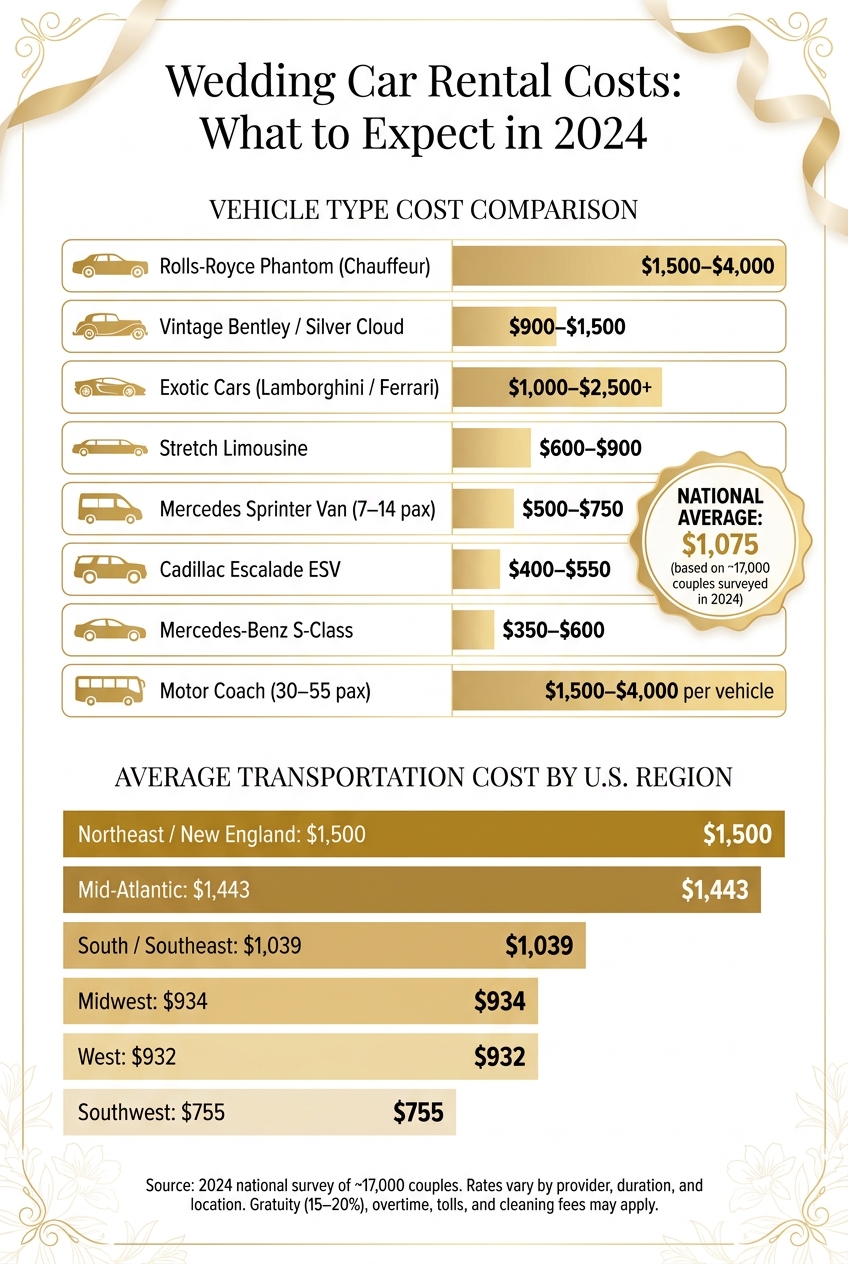
Wedding Car Rental Costs by Vehicle Type & Region (2024)
How Wedding Car Pricing Works
The cost of wedding car rentals in the U.S. depends on several factors, including the type of vehicle, how long you need it, and the timing or location of your event. Most companies charge by the hour and often require a minimum rental of 3 to 4 hours during weekends or peak seasons.
Based on 2024 data from a survey of nearly 17,000 couples, the average cost of wedding transportation is $1,075. However, this figure can vary depending on your guest count and location. For instance:
- Couples with over 100 guests typically spend around $1,200.
- Couples with 50 or fewer guests average closer to $583.
Your location also plays a big role in determining costs. Here’s how transportation expenses generally stack up by region:
| Region | Average Transportation Cost |
|---|---|
| Northeast / New England | $1,500 |
| Mid-Atlantic | $1,443 |
| South / Southeast | $1,039 |
| Midwest | $934 |
| West | $932 |
| Southwest | $755 |
Source: 2024 national survey of ~17,000 couples
The type of service you choose also impacts the price. For example, a transfer-only service (point-to-point) is often less expensive than an hourly standby service, where the driver stays on-site for the duration of your event.
"It stands to reason that the price will begin to creep up the longer you need the car, so run through the timeline thoroughly to make sure you’ve taken everything into account." – Thomas Waters, Owner and Event Planner, The Renaissance
Before locking in your budget, don’t forget to account for any potential add-ons or hidden fees.
Extra Costs and Fees to Watch For
Initial quotes often leave out additional fees, so it’s essential to read the fine print.
- Gratuity: Tips for drivers (usually 15% to 20%) are often not included in the base rate and may be automatically added to your contract.
- Overtime: Charges for exceeding your booked time are typically calculated in 15- or 30-minute increments.
- Cleaning Fees: If the vehicle requires significant interior cleanup, expect an average fee of $150.
- Toll and Parking Fees: These costs are typically passed directly to you.
Fuel policies also vary. Some companies require the car to be returned with a full tank, while others charge a flat refueling fee. If you’re planning to decorate the vehicle, make sure to check their policy first. Items like confetti, glitter, or floral petals can result in additional cleaning or damage fees.
To avoid surprises, request an all-inclusive estimate that covers fuel, gratuity, mileage, and any potential surcharges.
Ways to Reduce Transportation Costs
Once you understand how pricing works and what fees to expect, there are several ways to save on wedding transportation.
- Book Early: Reserving your vehicle 6 to 12 months in advance can help you lock in better rates.
- Bundle Services: Combine transportation for your rehearsal dinner, wedding day, and other events with the same company to potentially reduce costs. This is especially helpful if you’re eyeing vintage or specialty cars, which tend to have limited availability during peak seasons.
- Simplify Guest Transportation: Minimize rental time and mileage fees by consolidating guest pickups to one central location. Some companies, like Essentialyfe, offer shuttle services as part of their event planning packages, streamlining logistics and saving you time.
- Focus on Key Moments: Prioritize professional transportation for the couple and immediate family. For other guests, rideshares or carpools are cost-effective alternatives.
Contracts, Insurance, and Legal Considerations
Once you’ve worked out the costs, the next step is making sure your contract is solid and your insurance coverage is in place.
What to Check in a Rental Agreement
After selecting your vehicle and setting your budget, take a close look at the rental contract. A well-structured agreement helps ensure everything goes smoothly on your wedding day. As Leah Weinberg, Co-founder of Oduberg Law, LLP, explains:
"Wedding transportation contracts are some of the least negotiable of all of the contracts you’re going to be signing for your wedding."
Start by verifying that the contract lists the specific vehicle – including its year, make, model, and color – rather than just a general vehicle "type." It should also outline what happens if a substitution is necessary, ensuring you’ll get a replacement of equal or higher value.
Double-check where billing begins. Ideally, it should start from your location, not the company’s lot, to avoid surprise fees. Review the overtime terms, too. Many companies charge in 15- or 30-minute increments, and some enforce a "hard stop" – meaning the driver leaves at the scheduled end time, even if your event is running late.
"Weddings are notorious for NOT running on time, so make sure you understand your company’s policy on flexibility, overtime and any hard stops." – Leah Weinberg, Co-founder and Partner, Oduberg Law, LLP
Lastly, make sure any verbal agreements are added to the contract in writing before you sign.
Insurance and Liability Coverage
Check that the rental company has commercial auto liability insurance. Ask for their Certificate of Insurance (COI) and operating permit to confirm they’re legally authorized to transport passengers in your area. This step helps you avoid unexpected issues on the big day.
Pay attention to the liability cap clause in the contract. Many companies limit their financial responsibility to the total amount you paid. For example, if they miss a pickup and you’re late to your ceremony, you might only be entitled to a refund – not compensation for the inconvenience. This can be a big gamble on such an important day.
If you’re renting a high-end car like a Rolls-Royce Phantom or Bentley, expect security deposits ranging from $2,500 to $10,000. For self-driving rentals, check if your personal auto insurance covers the vehicle or if you’ll need to purchase coverage from the provider. Also, ensure the contract includes a breakdown contingency clause, which outlines how quickly a replacement vehicle will be provided if something goes wrong.
Once you’ve reviewed the legal and insurance details, turn your attention to the company’s rules about decorations and usage.
Decoration and Usage Policies
Most rental companies have strict guidelines on what you can and can’t do with their vehicles. Confetti, glitter, rice, and adhesive decorations are usually banned, and violating these rules could result in extra cleaning fees or damage charges not included in your original quote.
Stick to safe options like florist tape, magnetic signs, or suction cups for your decorations. Before the vehicle departs, do a quick inspection and take timestamped photos of both the interior and exterior. This can protect you from being charged for any scratches or stains that were already there.
Be sure to review policies on alcohol, smoking, and food, as these vary between companies. If children are part of the ride, check whether car seats are required – some shuttle and bus services won’t transport kids without them.
Day-of Logistics and Execution
With contracts signed and pricing locked in, it’s time to focus on ensuring everything runs smoothly on the big day.
Building a Transportation Timeline
The best way to create a solid timeline is to work backward from your ceremony start time and forward to your final send-off. Be sure to include a 30-minute buffer at each photo stop to account for delays. Also, keep in mind that loading and unloading take time – getting in and out of a vehicle in formal attire can take 3–5 minutes per stop.
"The wedding day timeline is the foundation of your transportation plan. Build it backward from your ceremony time and forward to your final send-off." – Detailed Drivers
For guest shuttles, a staggered wave system works better than a single pickup. Scheduling shuttles at 90, 60, and 30 minutes before the ceremony helps avoid congestion at the venue. For the return trip, plan three waves: an early shuttle 60–90 minutes before the reception ends (ideal for grandparents or families with young kids), a main departure at the end of the event, and a final sweep 15–30 minutes after the reception wraps up.
| Time | Event | Note |
|---|---|---|
| 1:30 PM | Bride’s vehicle departs | 30+ min buffer for photo stops |
| 3:30 PM | Guest Shuttle Wave 1 | Early arrivals and family |
| 3:45 PM | Guest Shuttle Wave 2 | Main guest arrival |
| 4:00 PM | Ceremony begins | All vehicles staged and cleared |
| 10:00 PM | Early Return Shuttle | For grandparents and families |
| 11:30 PM | Grand Exit | Newlyweds depart in getaway vehicle |
| 12:00 AM | Final Safety Sweep | Last shuttle run for remaining guests |
Once your timeline is set, focus on clear communication and route management to keep everything on track.
Managing Routes and Driver Communication
Assign someone reliable to handle driver communication during the day. The couple should not be the ones answering calls from lost drivers. Provide each driver with a detailed itinerary that includes exact pickup and drop-off locations, photo stop addresses, and a contact number for the on-site coordinator. If you’re managing multiple vehicles, consider setting up a group text thread to ensure everyone stays informed.
Test your routes in advance using tools like Google Maps or Waze at the same time and day of the week as your wedding. Traffic can vary widely – especially in cities like New York, where rush hour delays can add 20–45 minutes. Always have at least two alternate routes mapped out in case of unexpected road closures or accidents.
"A plan that looks perfect on Google Maps can still run late if it ignores loading reality." – Albemarle Limousine
A venue walk-through with your transportation provider is essential. Identify loading zones, tight turns for larger vehicles, and idle areas for shuttles. Also, check local event calendars for potential disruptions like parades or construction.
Comfort and Accessibility for All Guests
Transportation isn’t just about schedules – guest comfort matters, too. Increase vehicle capacity by 20% over your guest count to allow for formal attire and last-minute additions. Avoid filling vehicles to their maximum capacity, as guests in suits and gowns need extra space to sit comfortably without wrinkling their clothes. For guests with mobility challenges, consider on-site options like golf carts or electric shuttles, especially at large venues like estates or resorts.
If you’re wearing a ball gown or A-line dress, check the rear door width of your vehicle ahead of time. Models like the Rolls-Royce Ghost, Mercedes S-Class, and Cadillac Escalade are well-suited for wide skirts due to their spacious interiors and door designs. For a seamless experience, providers like Essentialyfe can coordinate everything from exotic car rentals to on-site shuttles, ensuring a comfortable ride for everyone – from the wedding party to elderly relatives.
"For VIPs and wedding party [members], it’s best to keep all of these people together, so people aren’t all over the place. Pre-ceremony transportation is a must, in my opinion." – Michelle Norwood, Principal Designer and Planner, Michelle Norwood Events
To keep guests informed, send out a simple info card – either physical or digital – with details like pickup locations, shuttle wave times, return schedules, and the transportation coordinator’s contact information.
Conclusion: Pulling Your Wedding Transportation Together
Wedding transportation works best when you treat it as a well-planned system rather than an afterthought. Every detail – vehicle selection, timing, communication with drivers, and guest comfort – needs to work together. If one part goes wrong, it can throw off the entire day. To avoid hiccups, book specialty or vintage vehicles 8–12 months in advance if your wedding is between May and October, when demand is highest and options are limited. Add a 30% buffer to all time estimates, covering ceremony runs, photo stops, hotel pickups, and the final send-off. And don’t forget to assign a dedicated transportation coordinator – this ensures the couple won’t be dealing with last-minute calls about lost drivers on their big day.
"Transportation isn’t glamorous. It’s not Instagram-worthy. But when your bridesmaids are stuck in traffic 20 minutes before the ceremony… you’ll wish you’d spent more time on this part of the planning." – RidesOnTime
Using the "four moments" framework – ceremony arrival, wedding party movement, VIP guest pickup, and the getaway exit – can help you organize transportation needs effectively. Pair the right vehicle with each moment, confirm backup plans in writing, and do a route test drive one to two weeks before the wedding. These small but crucial steps can make the difference between a smooth day and a stressful one. By syncing all these elements, you’ll turn transportation into a seamless part of your celebration instead of a source of stress.
FAQs
What’s the best way to choose a wedding car that fits my dress?
Choosing the right wedding car involves more than just picking a stylish ride – it has to work with your dress too. Look for a car with a spacious interior, wide door openings, and enough floor clearance to keep your gown safe and comfortable. If you’re wearing a ball gown or a dress with a wide silhouette, make sure to check the interior width of the vehicle before making any commitments.
Classic choices like the Rolls-Royce Ghost or the Cadillac Escalade are popular for their accessibility and elegance. To protect your hemline, ask for rear wheel covers and, most importantly, test how easy it is to get in and out of the car with your dress before finalizing the booking. Comfort and practicality are key!
How many shuttle seats should I book for guests?
To figure out how many shuttle seats you’ll need, start by calculating your total guest count. Then, subtract the number of people who plan to drive themselves or are staying at the venue.
For arrivals, it’s usually best to aim for a 1:1 seat-to-guest ratio, ensuring every guest has a spot. For departures, go with a 1.2:1 ratio to accommodate guests leaving at different times.
To avoid any last-minute hiccups, consider booking 20% extra capacity – this gives you a buffer for unexpected changes. If you’re looking for help with shuttle coordination, Essentialyfe can assist as part of your event planning.
What should I double-check in the contract before paying a deposit?
Before handing over a deposit, take time to thoroughly review the contract. Double-check that it lists the exact vehicle model, color, and specific details you agreed upon. Pay close attention to the dates, times, and pickup/drop-off locations to ensure everything aligns with your plans.
Make sure the contract clearly outlines the service window, payment terms, and refund policies, as well as any potential extra charges, like fees for overtime, fuel, or cleaning. It’s also essential to confirm that the company is both licensed and insured. Ask about their replacement policies in case the vehicle has any issues, and ensure all verbal agreements are included in writing.