If I own a luxury rental, geothermal can make sense when I plan to hold the property for years, have the budget for a high upfront install, and want quiet heating and cooling with lower utility use.
Here’s the short version:
- I’d expect a high first cost: about $25,500 on average for a 3-ton system, with some projects landing at $35,000 to $50,000+
- I’d expect lower energy use over time: geothermal systems can deliver 3 to 5 units of heating or cooling for every 1 unit of electricity
- I’d expect less visible equipment: no outdoor condenser taking up terrace, roof, or yard space
- I’d expect low yearly service costs: often around $150 to $400
- I’d expect the best fit in a new build or gut renovation, where loop work can be planned early
- I’d choose the loop based on the site: horizontal for open land, vertical for tighter or landscaped lots, and open-loop or pond systems only where site conditions allow
If I were deciding today, I’d focus on four things first:
- Site fit: lot size, drilling access, soil, rock, and groundwater
- Project timing: new construction is usually easier than retrofit
- Tax credits and rebates: the federal residential credit ended after December 31, 2025, so state programs and commercial structures matter more in 2026
- Hold period: geothermal tends to work best when I’m thinking in 5 to 10 years, not just the next booking season
Smart Geothermal Luxury Home in Vail | 463 Beaver Dam Rd
sbb-itb-161ccc1
Quick comparison
| Option | Upfront cost | Site impact | Best fit | Main tradeoff |
|---|---|---|---|---|
| Vertical loop | Higher | Lower | Smaller or landscaped luxury lots | More drilling cost |
| Horizontal loop | Lower | Higher | Large open properties | More excavation and yard disruption |
| Open-loop | Lower to mid-range | Site-dependent | Properties with strong well output and permits | Water supply and permit risk |
| Pond/lake loop | Lower to mid-range | Lower | Homes with the right pond or lake setup | Needs the right water body |
My takeaway: geothermal is less about trend and more about fit. If the property has the right land, the right budget, and a long enough ownership window, it can cut noise, free up outdoor space, and lower HVAC costs over time.
How Geothermal Heating and Cooling Systems Work
A geothermal system heats and cools by moving heat, not by burning fuel. The key difference is underground. Just a few feet below the surface, soil temperatures stay steady enough to support efficient heating and cooling. That steady base is what helps the whole system run so well.
The Three Core Components
Every ground source heat pump system has three main parts:
- The ground loop is a network of high-density polyethylene (HDPE) pipes buried underground. A water-and-antifreeze solution moves through the pipes, pulling heat from the earth in winter and sending heat back into it in summer. The buried loop is built to last 50+ years with very little maintenance.
- The indoor heat pump sits in a basement or utility room. It uses a compressor and heat exchanger to turn stored heat from the loop into usable warmth for the home – or reverse the process to cool it. That setup also helps support quiet, zoned comfort, which fits high-end rentals well.
- The distribution system moves heated or cooled air or water through the property. In high-end rentals, that often means premium radiant floor heating or multi-zone ductwork for tight climate control.
Put together, these parts let the system exchange heat with the ground instead of the outdoor air. A desuperheater can also pull waste heat during cooling and use it to preheat domestic hot water, which can lower water-heating costs.
Seasonal Performance in High-End Homes
In winter, the fluid in the ground loop absorbs heat from the warmer soil. The heat pump then concentrates that energy to warm the home. In summer, the cycle flips. The system removes heat from inside the home and transfers it into the cooler ground.
That’s the big draw: the system shifts heat where you want it to go.
Geothermal systems deliver 3 to 5 units of heating or cooling energy for every 1 unit of electricity used. ENERGY STAR-certified models use 61% less energy than standard HVAC equipment. And because the compressor sits indoors, the system runs quietly while keeping indoor temperatures steady through the year.
That steady performance is exactly why loop design matters just as much as the heat pump itself. The next step is figuring out which loop layout the site can handle.
Choosing the Right Geothermal Loop for a Luxury Property
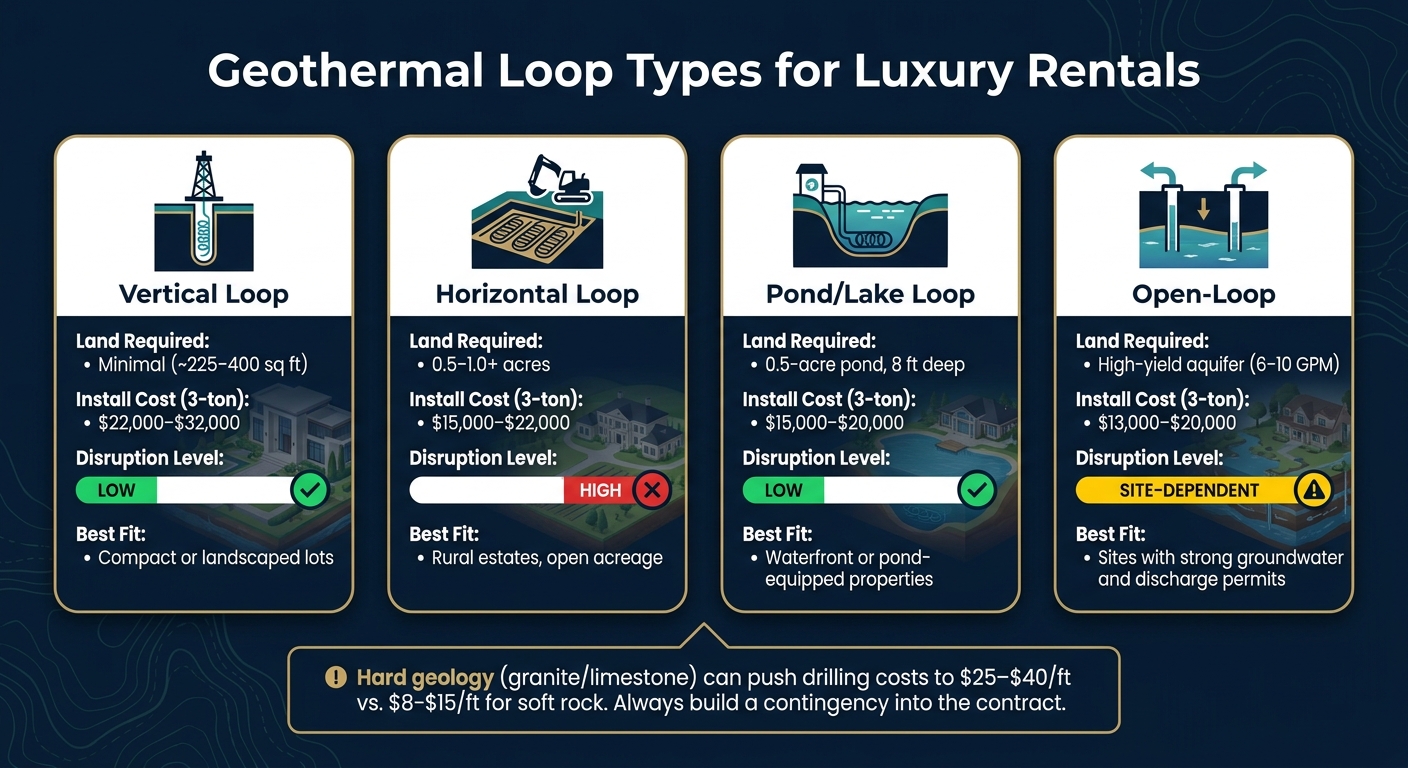
Geothermal Loop Types for Luxury Rentals: Cost, Land & Disruption Compared
The heat pump inside the house is only part of the story. The ground loop outside usually shapes the biggest tradeoffs around cost, site disruption, and long-term performance. It also affects landscape preservation, guest experience, and how soon the property is ready for bookings. In high-end homes, this is often the point where owners either protect the setting or tear it up.
Horizontal, Vertical, and Open-Loop Systems
The best loop depends less on the heat pump itself and more on the property.
Horizontal loops usually cost less at the start – about $15,000–$22,000 for a 3-ton installation – but they need 0.5 to 1.0+ acres of open land and major excavation. Full landscape recovery can take 1–2 years .
Vertical loops cost more upfront – around $22,000–$32,000 for a 3-ton system – but they protect landscaping and tend to run more evenly through the year. Each borehole needs only about a 15×15-foot surface footprint, which helps preserve mature trees, stone patios, and existing hardscaping .
Put simply:
- Horizontal loops fit large, open properties.
- Vertical loops fit compact lots or sites with heavy landscaping.
Open-loop systems pull groundwater straight from a well, use it for heat exchange, and then discharge it. They rely on a high-yield aquifer – usually 6–10 gallons per minute – plus local discharge permits, which can make them less predictable for long-term property operations .
Pond or lake loops are less common, but they can work well in the right setting. Submerged coils in a water body at least 8 feet deep and about 0.5 acre in size can avoid large-scale drilling or trenching .
Property Suitability and Design Tradeoffs
For rentals, event venues, and film locations, installation impact can matter just as much as energy performance. On luxury properties, visibility during installation matters too. If the site is occupied, hosts events, or needs to stay camera-ready, a low-visibility install can be a big deal.
Vertical drilling is often easier to manage in those cases. On a retrofit site, the drill rig needs only about a 10×30-foot access path. Horizontal loop fields, by contrast, bring in heavy equipment and major excavation.
Geology can also change the budget fast. Drilling through soft sedimentary rock runs about $8–$15 per foot, but granite or limestone can push costs to $25–$40 per foot. That’s why it makes sense to build a contingency for hard rock or groundwater into the contract, so surprise site conditions don’t blow up the budget.
| Loop Type | Land Requirement | Installation Cost (3-ton) | Disruption Level | Best Fit |
|---|---|---|---|---|
| Vertical | Minimal (~225–400 sq ft) | $22,000–$32,000 | Low | Compact or landscaped lots |
| Horizontal | 0.5–1.0+ acres | $15,000–$22,000 | High | Rural estates, open acreage |
| Pond/Lake | 0.5-acre pond (8 ft deep) | $15,000–$20,000 | Low | Waterfront or pond-equipped properties |
| Open-Loop | High-yield aquifer | $13,000–$20,000 | Site-dependent | Sites with strong groundwater and discharge permits |
One more thing matters before picking a loop: run a Manual J load calculation and a soil thermal conductivity test first .
Site conditions come first; the next step is planning costs, permits, and lifecycle value.
Benefits, Planning Requirements, and Lifecycle Value
Once the loop type is set, the next call is financial: does geothermal make the property feel better, use the site better, and improve margins over time?
Why Geothermal Fits Premium Rentals
Geothermal removes on-site fuel burning, which helps indoor air quality and gets rid of carbon monoxide risk. The indoor heat pump is also quieter than a standard outdoor condenser. That matters in a premium rental, where peace and privacy are part of what guests pay for.
There’s also a space angle. Without an outdoor condenser unit, owners can use rooftop or yard area for things guests actually notice, like pools, terraces, or solar arrays. On top of that, geothermal can cut heating costs by 30% to 70% and cooling costs by 20% to 50% versus standard systems. Green-certified luxury rentals can also earn 3% to 13% more.
That’s the appeal in plain terms: better comfort, less visible equipment, and lower operating load.
But those gains don’t just happen on their own. The system has to be sized, permitted, and built into the project early.
Installation Planning for New Builds and Renovations
Geothermal is easiest – and usually least disruptive – during new construction or a major renovation. Bringing the loop field into the design phase early can save 30% to 40% compared with adding it later as a retrofit.
Start with Manual J and a soil test. A soil thermal conductivity test, which runs about $1,500 for larger properties, helps size the loop field with more accuracy and lowers the chance of overbuilding or undersizing. Before signing anything, check drilling access, electrical capacity, and site limits. If the property needs a 200-amp electrical service upgrade, that can add about $1,500 to $4,000 to the budget.
Permitting can get tricky fast. State rules for drilling and groundwater discharge are not the same everywhere. Open-loop systems often need separate water rights and discharge permits. Early coordination with architects, HVAC designers, landscapers, and local permitting offices can save a lot of back-and-forth.
Upfront Costs, Incentives, and Long-Term Operating Value
Geothermal takes a big upfront check, but rental owners often care more about the long game. In 2026, the national average for a standard 3-ton geothermal system is about $25,500, and drilling plus excavation usually make up 50% to 70% of the full project cost. If the site has hard geology – like granite – or a high water table, total costs can climb to $35,000 to $50,000+.
The incentive picture has changed. The federal §25D residential tax credit ended for installations completed after December 31, 2025. The §48 Commercial Investment Tax Credit, worth 6% to 30%, is still available for commercial and multi-family owners through third-party ownership structures. Some state programs can still lower the hit in certain markets:
- New York: up to $10,000
- Massachusetts: up to $13,500
- Illinois: up to $6,000
There’s also a financing path. The Fannie Mae HomeStyle Refresh program, effective March 31, 2026, lets owners finance geothermal installations up to 15% of a property’s as-completed value.
Operating costs tend to be lighter after install. Annual maintenance is usually $150 to $400 because there’s no outdoor unit and fewer moving parts. Indoor units often last 20 to 25 years, while the ground loop is built for 50 to 100+ years. On the resale side, geothermal-equipped homes can sell for $8,700 to $15,000 more than similar properties, and in luxury markets that number can reach $20,000.
Against air-source heat pumps and gas systems, geothermal usually costs more upfront but lowers yearly operating and maintenance costs. With incentives, payback often falls in the 5- to 10-year range.
Conclusion: When Geothermal Is the Right Choice for a Luxury Rental
Geothermal makes sense for luxury rentals when the property, budget, and hold period line up with the install. It runs quietly, gets rid of the outdoor condenser, and can cut operating costs over time.
This works best when geothermal is part of the plan from the beginning. A new build or major gut renovation is usually the best time to do it, because loop placement can be coordinated with excavation and landscaping from day one. For portfolio owners, shared ground loops can also lower the per-unit cost in multi-unit projects.
After that, the lot size and landscape limits help decide the loop type. Vertical closed-loop systems are a good fit for smaller lots and can help protect mature landscaping. Final sizing should still come from Manual J and thermal conductivity testing.
In 2026, the choice also depends on state rebates, utility programs, and third-party ownership, not the expired federal residential credit.
The key issue is simple: do the long-term savings justify the upfront premium? For luxury rentals where quiet comfort, green certification, and lower operating overhead matter, geothermal deserves a serious look. Over time, that mix of comfort, savings, and durable infrastructure can justify the added cost.
FAQs
Is geothermal worth it for a luxury rental?
Yes. Geothermal can be a strong fit for luxury rentals. It can cut energy costs by 30% to 70% and deliver quiet, steady climate control that helps guests feel more comfortable.
The main tradeoff is the upfront cost. Installation usually costs more than a standard HVAC system. But geothermal systems can last 25+ years, and the ground loops can last for the life of the building. They also tend to need less maintenance and can lower carbon emissions.
Can geothermal be added to an existing rental?
Yes. You can add geothermal systems to existing rental properties, although the job is usually simpler during new construction.
If a property doesn’t have much open land, vertical loop setups can be a good fit. These systems use boreholes about 150 to 400 feet deep.
That said, retrofitting isn’t cheap. It often involves installing ground loops and making changes to the ductwork, so it’s a major investment.
Which geothermal loop type fits my property?
The right geothermal loop depends on your land, soil conditions, and access to water.
- Horizontal closed-loop: a good fit for properties with plenty of open land
- Vertical closed-loop: works well when yard space is limited
- Submerged loop: often the lowest-cost option if you have a pond or lake that’s at least 8 feet deep
- Open-loop: can work well with clean, reliable groundwater, but local permits and water quality rules still apply