Cloud virtual tours are transforming how properties are showcased, particularly in the luxury market. These tours allow clients to explore properties remotely with 360° or 3D walkthroughs, offering a realistic sense of layout and space. By 2026, 87% of buyers are expected to demand virtual tours before considering in-person visits. Properties with these tours see 87% more views, 12% higher booking conversions, and 14% greater occupancy rates compared to photo-only listings.
Key benefits include:
- Remote exploration: Clients can tour properties from anywhere, saving time and travel costs.
- Pre-qualification: Only serious buyers schedule in-person visits, streamlining the process.
- Stakeholder alignment: Event planners, caterers, and AV teams can collaborate using shared tour links.
- Enhanced engagement: Listings with virtual tours hold visitors’ attention longer and boost decision-making confidence.
For property managers, cloud-hosted tours are browser-based, easy to update, and accessible on any device. They also reduce operational costs by cutting down on site visits and repetitive inquiries. Platforms like Essentialyfe use this technology to showcase high-end properties, including vacation homes and event venues, while integrating amenities like private chefs and exotic car rentals.
Virtual tours are not just visuals – they simplify workflows, improve client experiences, and drive faster, more confident decisions in the luxury property market.
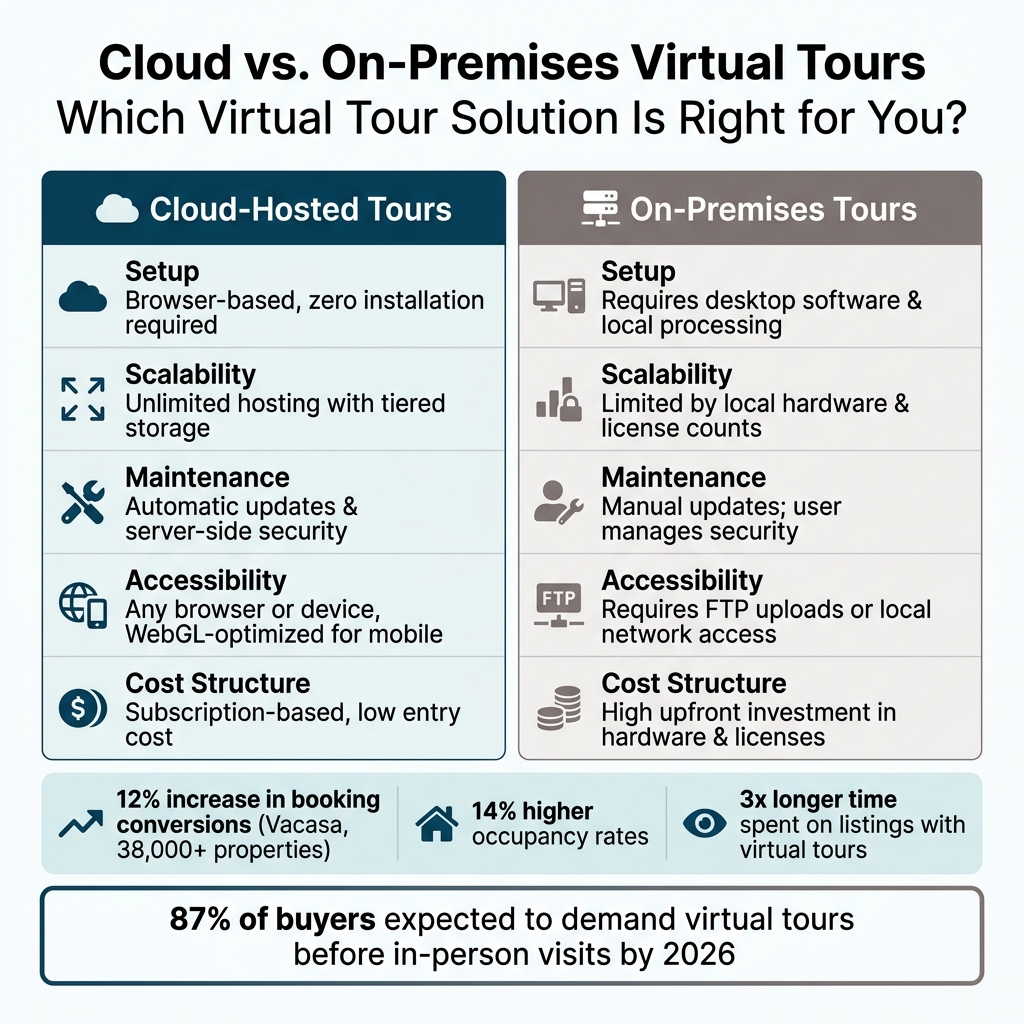
Cloud vs. On-Premises Virtual Tours: Key Differences for Property Managers
Cloud Virtual Tours: What They Are and Why They Matter
What Are Cloud Virtual Tours?
A cloud virtual tour is an interactive 360° or 3D walkthrough hosted on remote servers, accessible through any web browser – no apps or special equipment needed. These tours combine panoramic images into clickable, interactive scenes, allowing users to explore a property at their own pace.
Many modern tours go beyond simple visuals. They include features like interactive floor plans, 3D dollhouse views, and multimedia hotspots with embedded videos or audio. Some even offer measurement tools, letting users check if furniture or equipment will fit specific spaces. Hosted in the cloud, these tours load quickly, work seamlessly on any device, and can be updated instantly without starting from scratch.
Top-performing tours load in under three seconds, meeting the expectations of high-net-worth clients. These advanced features make cloud virtual tours a game-changer for luxury properties, as explored in the next section.
Why Luxury Properties and Event Venues Benefit Most
Cloud virtual tours put the viewer in control, allowing them to explore every detail of a property – whether it’s checking the size of a kitchen or understanding the layout of an estate. This level of transparency is critical when clients are making significant financial commitments.
For large or complex properties, such as sprawling estates, multi-room event venues, or film locations, this clarity is invaluable. Event planners can virtually tour a venue, confirm logistics, and finalize details without ever needing to visit in person. International clients and destination planners especially benefit, as cloud tours eliminate the need for costly site visits.
The data supports this. Vacasa, one of the largest rental managers in North America, implemented 3D tours for 90% of its 38,000+ properties. The result? A 12% increase in booking conversions and 14% higher occupancy rates. Additionally, potential guests spend three times longer on listings with virtual tours compared to photo-only pages.
"The virtual tour gave guests confidence to book our suites sight unseen. It’s become our highest-converting asset." – Digital Marketing Lead, The Apurva Kempinski Bali
Companies like Essentialyfe, which manage properties ranging from cozy vacation homes to massive 20,000-square-foot estates, rely on this technology to attract pre-qualified, confident clients. It’s a win-win for both property managers and their guests.
Cloud vs. On-Premises Virtual Tours: A Side-by-Side Look
For high-end property managers, deciding between cloud-hosted and on-premises virtual tours can significantly affect efficiency and client satisfaction. The key differences boil down to flexibility and cost.
Cloud-hosted solutions are browser-based, require no installations, and handle updates automatically. In contrast, on-premises setups demand local software, manual updates, and dedicated IT resources. Here’s a breakdown:
| Feature | Cloud-Hosted Tours | On-Premises Tours |
|---|---|---|
| Setup | Browser-based, no installation required | Requires desktop software and local processing |
| Scalability | Easily scales with tiered storage; unlimited hosting | Limited by local hardware and license counts |
| Maintenance | Automatic updates and server-side security | Manual updates; user manages hosting security |
| Accessibility | Works on any browser or device; WebGL-optimized for mobile | Often requires FTP uploads or local network access |
| Cost Structure | Subscription-based with low entry costs | High upfront investment in hardware and licenses |
For property managers juggling multiple listings across various locations, cloud-hosted tours are the clear choice. They eliminate IT headaches, allow global client access 24/7, and make it easy to add new properties to the portfolio.
sbb-itb-161ccc1
How to Prepare Luxury Properties for Cloud Virtual Tours
Staging Properties for the Best Visual Results
Creating a standout virtual tour begins well before the camera starts rolling. Start by giving all glass surfaces, mirrors, and windows a thorough cleaning – smudges and streaks are much more noticeable in high-resolution 360° scans. Decluttering is equally important. Clear off countertops and other surfaces to make rooms feel more spacious.
Lighting plays a huge role in how a property looks on screen. Open all curtains, turn on every light, and replace any burned-out bulbs to ensure consistent brightness and color. For waterfront properties, timing is key – schedule the shoot when sunlight streams through the windows at the best angle.
To help prospective buyers picture themselves in the home, remove personal items like family photos or unique decorations. Then, add those luxurious finishing touches: set the dining table with fine china, fluff and arrange throw pillows, and highlight premium features like wine cellars or outdoor pool areas in the tour.
"A luxury 3D tour should answer buyer questions before the buyer asks them." – Pinnacle Real Estate Marketing
Once the property is staged, consider configuring spaces for different types of events.
Setting Up Event-Specific Property Configurations
For properties that host events, showing multiple layout options can make a big difference. For example, a ballroom arranged for a wedding will look entirely different than one set up for a corporate conference. Event planners want to see both possibilities.
Capture the complete guest experience, from the entryway and registration area to breakout rooms, networking spaces, and outdoor zones. Don’t forget to document technical features like AV setups, stage visibility, and rigging points. These details help event planners confirm logistics without needing an in-person visit. Properties that provide this level of detail often see booking times shorten by 35–40%.
"The virtual tour [is] a great resource for Sales and Reservations to reflect the unique features of the resort… [it] had a positive contribution to business." – Luca Guerra, Director of Sales and Marketing, Marriott Hotels Mauritius
After staging and configuring the property, the focus shifts to capturing visuals that truly do it justice.
Getting High-Quality Visuals for Cloud Platforms
To achieve professional results, use high-end 360° cameras like the Matterport Pro2 or Ricoh Theta Z1. These devices ensure spatial accuracy and deliver immersive 3D views. For instance, the Matterport Pro2 can create floor plans with a margin of error as small as 1%, which is invaluable when evaluating whether a 20,000-square-foot estate can accommodate an event setup.
Position the tripod at shoulder height and make sure it’s perfectly level, even on uneven surfaces. Scanning doorways between rooms is another critical step – it improves the stitching of images and makes navigation smoother.
Finally, speed matters. Ensure the virtual tour loads on mobile devices in under three seconds to keep viewers engaged. A slow-loading tour can leave a bad first impression and lead to higher drop-off rates.
"If your virtual tour takes more than a few seconds to become interactive on mobile, expect more drop-off. Speed is not a technical detail; it is part of the listing’s first impression." – Maya Sterling, Senior SEO Content Strategist
Step-by-Step: Create Stunning 360 Virtual Tours with CloudPano
Setting Up Cloud Virtual Tour Software for Efficient Property Management
Once you’ve captured the visuals, it’s time to configure your cloud platform for smooth and effective performance.
Key Cloud Software Features Worth Using
For Essentialyfe’s curated luxury listings, leveraging the right features can elevate client interactions while simplifying management. Start by enabling role-based access controls, shareable links, and embed codes to create professional and integrated virtual tours. Other must-have features include interactive hotspots, custom URL slugs, and a nadir logo overlay to maintain a polished look and feel.
"When [virtual tours are] consistent, it signals an operator behind the curtain." – Cody Admin, RE Luxe Leaders
To ensure quality, high-performing teams rely on a quick 15-minute QA checklist before publishing any tour. This step helps catch common issues like mislabeled rooms, broken links, or inconsistent branding. Following this process can reduce rework rates by over 40% within just two months.
How to Organize Properties and Tours
A well-organized tour library can save time and improve client satisfaction. Categorize properties by type (e.g., penthouse, estate, beachfront villa), location, and use case (vacation rental versus event venue). This makes it easier to quickly locate the right tour when a client reaches out.
For event venues, add tags based on key filters like attendee capacity, square footage, seating style, venue tier, and available amenities. For example, if a client needs a venue for 200 guests with outdoor space and catering options, these tags allow you to surface the perfect match instantly.
Using standardized property templates can also speed up production. By defining consistent capture specs and narrative structures – such as emphasizing luxury details in a penthouse versus highlighting the layout of a 20,000-square-foot estate – teams can publish 95% of tours within 72 hours of capture.
Once organized, the next step is to tailor these tours specifically for U.S. market expectations.
Tailoring Tours for U.S.-Based Clients
U.S. clients expect details that align with local standards. Use measurements like square feet and acres, as these are the norms for U.S. buyers and renters. Using unfamiliar units can lead to confusion and unnecessary hurdles.
To further enhance relevance, include information like attendee capacity, pricing in USD, and time zone details. For properties near major landmarks or entertainment hubs, mention proximity (e.g., "12 miles from SoFi Stadium"). These practical details are especially valuable for out-of-state clients looking to understand the property’s location in context.
How Cloud Virtual Tours Simplify Client Workflows
Cloud virtual tours streamline the process of showcasing luxury properties by making decision-making and planning more efficient. Tailored specifically for U.S. clients, these tours improve day-to-day interactions between clients and teams, transforming how properties are evaluated and booked.
Helping Clients Make Decisions Remotely
With cloud virtual tours, clients can assess properties from anywhere. Unlike static photos, 3D tours offer a true sense of a property’s layout, spatial flow, and ceiling height, giving clients the confidence to make decisions without being physically present. As Ehre Productions explains:
"Photography excels at inspiration. 360° virtual tours for event marketing excel at evaluation and decision-making."
This feature is crucial for Essentialyfe’s clients, many of whom make high-stakes decisions remotely – whether from another state or another country. For instance, a client can explore a beachfront estate or an event venue from their home office late at night. By the time they engage with a team, they are already well-informed and ready to discuss logistics rather than basic property details. This remote accessibility not only boosts client confidence but also facilitates smoother, more focused conversations.
Keeping Multiple Stakeholders on the Same Page
Virtual tours go beyond individual client use by aligning multiple stakeholders. Luxury events often involve input from various parties: event planners, catering teams, AV crews, and, of course, the client. Sharing a single tour link ensures everyone has the same visual reference, reducing misunderstandings and eliminating the need for multiple site visits.
Interactive features within the tours, like hotspots, allow stakeholders to focus on details relevant to their roles. For example, AV teams can review rigging points, caterers can check kitchen access, and planners can evaluate the flow between indoor and outdoor spaces. This collaborative approach not only simplifies coordination but also accelerates the booking process. Venues using immersive tours report booking cycles that are 35–40% faster due to better stakeholder alignment.
Cutting Operational Costs and Time
By reducing the need for in-person visits, virtual tours save both clients and Essentialyfe time and money. These tours pre-qualify prospects, ensuring that only serious clients schedule in-person showings. As Cody Admin from RE Luxe Leaders notes:
"Luxury virtual real estate tours aren’t about impressing people with tech. They’re about compressing decision time, protecting team capacity, and enforcing brand control at scale."
The benefits extend internally as well. Built-in tools allow clients to measure spaces for furniture, equipment, or staging without lengthy discussions or additional visits. This efficiency not only cuts operational costs but also allows teams to focus on delivering a superior client experience.
Connecting Cloud Virtual Tours with Luxury Services
Adding Virtual Tours to Booking Proposals and Listings
Including a virtual tour link in booking proposals allows clients to explore properties instantly, offering a dynamic alternative to static photos. This is especially impactful for high-value events like weddings, corporate retreats, or film productions, where visualizing the space is key.
Properties that incorporate immersive tours have reported 2.3x to 3.1x higher RFP-to-booking conversion rates from leads who engage with the tours. For Essentialyfe’s curated listings, embedding a tour link provides an immediate, immersive preview, eliminating the need for scheduling an in-person visit.
Highlighting Concierge Amenities Inside the Tour
Virtual tours do more than showcase spaces – they bring services to life. Interactive hotspots can connect specific areas of a property with detailed service offerings. For example, a hotspot in a professional kitchen might feature a private chef’s sample menu, while one in the garage could link to an exotic car rental gallery. A hotspot near the massage suite could display in-home spa treatment options and booking details.
By tying services to their physical locations, they feel more real and accessible. Adding ambient audio, like soft lounge music or the hum of activity in the kitchen, enhances the immersive experience even further.
"The virtual tour gave guests confidence to book our suites sight unseen. It’s become our highest-converting asset." – Digital Marketing Lead, The Apurva Kempinski Bali
Using Tour Data to Understand Client Preferences
Interactive tours also provide valuable insights into client preferences. Cloud platforms can track user behavior – such as time spent in specific rooms or clicks on hotspots – to reveal what clients prioritize.
This data can guide follow-up strategies. For instance, if analytics from Google Analytics 4 (GA4) or a platform’s dashboard show consistent interest in spa-related hotspots, emphasizing those amenities in future proposals makes sense. Over time, this data-driven approach ensures property presentations focus on what clients genuinely care about, rather than just what looks appealing on a listing page.
Conclusion: Making Luxury Property Showcases Easier with Cloud Virtual Tours
Cloud virtual tours have become a game-changer for luxury property managers and event venue operators. They simplify processes, save valuable time for teams, and help clients make quicker, more confident decisions.
The numbers speak for themselves: properties featuring virtual tours receive 400% more inquiries compared to those without them. In a market where buyer expectations are soaring, especially looking ahead to 2026, skipping a 3D tour can do more than just lower views – it might even raise doubts about what’s being concealed.
For Essentialyfe’s clientele – offering curated vacation homes, event venues, and film locations paired with concierge services like private chefs and exotic car rentals – cloud virtual tours tie everything together seamlessly. These tours allow clients to fully immerse themselves in a property’s potential from anywhere, long before signing a contract. When designed with consistent quality – featuring quick load times, clear branding, interactive service details, and dependable analytics – virtual tours evolve into scalable systems. They become more than just content; they transform into vital tools that simplify decision-making, reduce expenses, and elevate the way luxury properties are showcased.
FAQs
How do cloud virtual tours help pre-qualify buyers or guests?
Cloud-based virtual tours offer a convenient way for buyers or guests to explore luxury properties without needing to visit in person. This approach helps filter out casual interest, ensuring that only those seriously considering the property move forward with an on-site visit. These tours deliver a detailed and immersive experience, showcasing layouts and finishes in a way that allows clients to assess whether a property meets their needs at their own pace. By including pre-tour qualification questions, these virtual experiences can further narrow the focus to high-intent leads, making the entire process more efficient and targeted.
What should I do before filming a luxury property virtual tour?
Before you start filming, it’s important to have a clear plan. Begin by defining your objective, creating a storyboard to outline the flow, and drafting a detailed shot list to highlight key features of the property.
Make sure the space is in top condition – schedule a deep cleaning, declutter every area, and complete any outstanding maintenance tasks. Keep the staging simple and tasteful with minimal, elegant decor. Replace any burnt-out bulbs and open the curtains to let in as much natural light as possible.
Plan to film during daylight hours for the best lighting, and double-check that your equipment is ready to capture high-quality footage. This includes your camera, a gimbal stabilizer for smooth shots, and a microphone for clear audio.
What analytics should I track from a virtual tour to improve bookings?
To increase bookings, focus on tracking a few important metrics. Start with the tour engagement rate, which shows the percentage of visitors interacting with your virtual tour. Keep an eye on the average time spent viewing the tour, as this indicates how engaged potential customers are. Use tools like heat maps to analyze navigation patterns and discover which property areas attract the most attention. Lastly, measure the booking page click-through rate and the direct booking revenue generated from pages featuring the tour. These insights will help you evaluate the effectiveness of your investment.