AR and VR are transforming luxury hospitality by tailoring services to individual preferences. These technologies allow guests to virtually tour properties, customize event layouts, and engage with immersive experiences – all before booking or attending.
Key Takeaways:
- Virtual Tours: Guests can explore venues remotely, reducing booking uncertainties and boosting confidence.
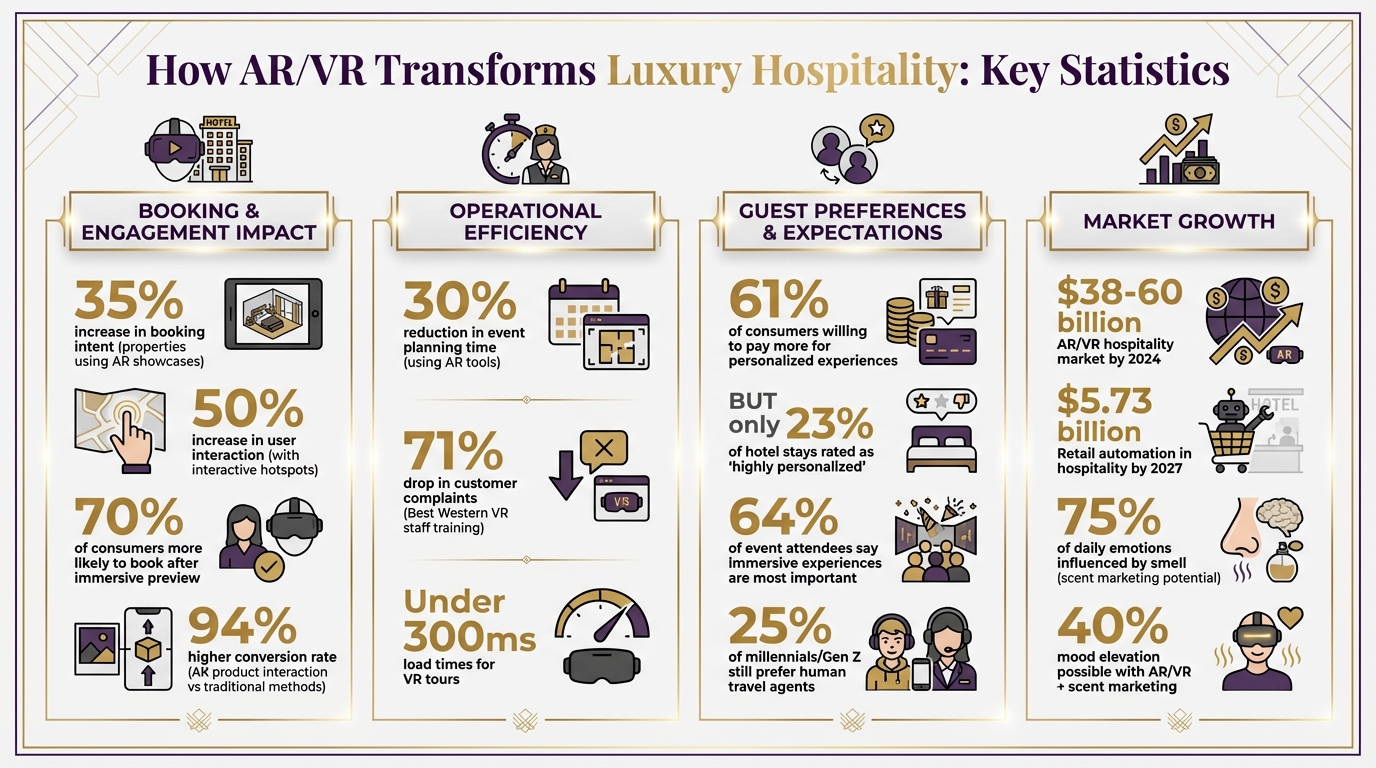
- Event Planning: AR tools streamline setup visualization, cutting planning time by up to 30%.
- Immersive Engagement: Features like AR wayfinding and VR networking enhance guest interaction and satisfaction.
- Data Insights: These tools collect guest preferences, enabling tailored recommendations and services.
As guest expectations rise, AR and VR provide practical solutions for creating personalized experiences, even amidst staffing shortages. These technologies are setting the stage for a new era in luxury travel and event planning.
AR/VR Impact on Luxury Hospitality: Key Statistics and Benefits
Challenges in Delivering Personalized Guest Experiences
Meeting Diverse Guest Preferences
Luxury hospitality providers face a tricky balancing act, often referred to as the personalization paradox – delivering exceptional, tailored experiences while keeping operational costs under control. But the challenge isn’t just financial. Fragmented guest data – spread across loyalty programs, housekeeping notes, and other systems – makes it tough for staff to truly understand individual preferences, whether it’s a specific pillow choice or a favorite wine.
Personalization isn’t one-size-fits-all. Some guests lean toward seamless, tech-enabled check-ins, while others expect round-the-clock access to attentive staff. Interestingly, even among younger, tech-savvy travelers like millennials and Gen Z, 25% still prefer interacting with a human travel agent when booking or modifying trips. Yet, despite 61% of consumers being willing to pay more for tailored experiences, only 23% of hotel stays are rated as "highly personalized".
"Data-driven personalization is no longer optional. Guests expect it, technology enables it, and the brands that ignore it will quickly fall behind." – Saurabh Goel, VP at Astound Digital
These gaps in understanding guest needs, combined with staffing and data hurdles, highlight the urgency for modern solutions. Technologies like AR and VR could pave the way for bridging these gaps.
Scaling Personalized Services in Luxury Settings
The struggle to effectively manage guest data makes it even harder to scale personalized services across multiple properties. Creating consistent, tailored experiences often requires a slow, resource-heavy process involving manual iterations and physical prototypes, which can bog down approvals and sales cycles. Luxury travelers increasingly demand unique, themed experiences, but replicating such moments for larger groups requires significant investment.
Physical constraints add another layer of complexity. At large-scale events, delivering one-on-one interactions for hundreds or thousands of guests is nearly impossible without an overwhelming staff presence or advanced tech solutions. These challenges are compounded by staffing shortages, making it difficult to meet the high expectations for bespoke services in luxury hospitality.
sbb-itb-161ccc1
How AR/VR Solves Personalization Challenges
Virtual Tours for Property Selection
AR and VR take the guesswork out of choosing properties remotely by letting guests explore venues as if they were there in person. Instead of relying on static, often limited photos, potential guests can virtually walk through luxury properties, moving between rooms and even comparing views – whether it’s an ocean horizon or a bustling city skyline – before making a booking decision. Properties that use AR for showcasing have reported a 35% boost in booking intent.
These tools also allow guests to customize spaces to fit their needs. With AR, they can transform a room into a home office, experiment with different color schemes, adjust virtual lighting, or test furniture arrangements to see what works best. This level of interaction doesn’t just enhance the experience – it drives engagement, with interactive hotspots increasing user interaction by up to 50%.
By making property exploration more immersive and flexible, AR sets the stage for event organizers to adopt similar tools for planning unforgettable events.
Interactive Event Planning with AR
Traditional event planning can be slow and resource-intensive, often involving physical mockups and endless revisions. AR changes the game by offering real-time visualization of event setups. Tools like Prismm (formerly Allseated) and Virtual Planner allow planners to create photorealistic 3D "digital twins" of venues. These digital replicas make it easy to experiment with furniture layouts, lighting designs, and branding elements instantly. Ruth Bader, Managing Director at BODENSEEFORUM KONSTANZ, highlights the impact:
"The photorealistic 3D digital twin of our spaces provides virtual, efficient site tours and allows us to enable real-time remote interactions".
This approach can cut event planning time by up to 30%, while also overcoming the physical limitations that often hinder personalized services. Planners can tweak seating arrangements, test decor styles, and adjust layouts – all without lifting a single chair. Platforms such as ShapesXR and Arkio even allow teams to collaborate in VR, creating 3D storyboards where stakeholders can provide feedback on designs. These tools streamline the process and enhance the overall guest experience.
Immersive Experiences for Guest Engagement
AR and VR take personalization a step further by transforming how guests engage with events. VR turns attendees into active participants, while AR features like wayfinding and interactive tokens guide them through complex venues. By scanning these tokens, guests can access personalized content, whether it’s through 3D avatars or video messages. Immersive experiences clearly matter – 64% of event attendees say they’re the most important part of an event, and interacting with products in AR can lead to a 94% higher conversion rate compared to traditional methods.
For remote attendees, VR offers a unique solution: "location independence." Guests can take virtual seats, soak in the venue’s atmosphere, and even network with others through avatars, enabling personalized interactions no matter where they are. The impact is clear – 70% of consumers are more likely to book services after experiencing an immersive preview.
Virtual and Augmented Reality for hotels
Integrating AR/VR with Essentialyfe‘s Luxury Services
By incorporating AR and VR technology, Essentialyfe enhances personalized guest experiences and aligns with the elevated standards of luxury clientele.
Virtual Experiences for Essentialyfe Guests
Essentialyfe provides 360-degree VR tours that allow clients to explore luxury properties virtually. These tours showcase room details, surroundings, and pricing information with lightning-fast load times (under 300 ms) and are available in multiple languages – similar to the approach Hyatt Hotels adopted in 2024. What sets Essentialyfe apart is the accessibility of these VR experiences, delivered directly through its website or messaging platforms. There’s no need for additional app downloads, ensuring a seamless user experience.
For international clients, VR tours eliminate language barriers, offering a straightforward way to explore properties worldwide. Whether someone is booking a Malibu estate or evaluating a downtown film location, they can start their journey with just a click.
In addition to property tours, Essentialyfe uses AR to transform the way clients plan and design events.
Personalized Event Planning with AR
AR technology takes event planning to the next level by allowing clients to visualize their event settings in real time. With AR, planners can overlay 3D graphics and virtual decor onto physical spaces, giving clients a clear view of how their ideas will look before making decisions.
A great example of this potential comes from the Cambria Hotel in Washington D.C., which turned its elevator bay into an interactive digital art installation using immersive LED displays. Essentialyfe can adopt similar strategies to help clients design branded spaces for product launches, weddings, or corporate events. Tools like Adobe Aero and 8thWall make it easy for event planners to create interactive 3D designs without needing coding skills.
For VIP events, Essentialyfe can also develop virtual showrooms where clients preview every element of their event – from table arrangements to entertainment areas – before the setup begins. Combined with Essentialyfe’s concierge services, this approach ensures the planning process feels as luxurious as the event itself.
The Future of AR/VR in Hospitality and Event Planning
The next wave of AR/VR technology is set to bring an even greater level of personalization to the luxury travel and hospitality experience.
Advancements in Immersive Technologies
The AR/VR hospitality market is projected to grow to between $38 billion and $60 billion by 2024, driving forward innovations that go far beyond simple virtual tours. With AI-driven personalization, environments can now adjust elements like surfaces, sounds, and even scents to align with a guest’s mood and preferences. Imagine properties that can adapt in real time to create a fully customized experience tailored to each visitor.
Holographic concierges are another step into the future. These virtual assistants can respond to gestures, translate conversations into over 100 languages, and craft personalized itineraries – all without the need for face-to-face interaction. Pairing this technology with haptic feedback makes digital interactions more immersive, engaging multiple senses at once.
Voice-activated commerce is also changing how guests interact with luxury services. AI-powered systems now allow users to make bookings or service requests using natural language commands, streamlining the process within AR/VR environments. Additionally, research highlights the role of scent in shaping guest experiences – 75% of daily emotions are influenced by smell. Properties are now combining scent marketing with AR/VR to create environments that can elevate guest moods by as much as 40%.
These advancements pave the way for highly personalized experiences, with companies like Essentialyfe already delivering tailored services. As AR/VR technology continues to evolve, it’s setting the stage for a new era in guest engagement.
Long-Term Effects on Luxury Hospitality
AR/VR is reshaping the standards of luxury hospitality, particularly as multi-layer AR integration becomes a hallmark of high-end properties by 2025. These technologies are now central to concierge services, entertainment, and event planning. They’re also redefining the guest experience with features like room customization, seamless navigation, and interactive engagement.
This evolution has given rise to the concept of "Space-as-a-Service", where physical venues integrate AR/VR with sensory elements such as custom audio and scent marketing. This approach is revolutionizing guest expectations in the luxury sector. Jaime Bettencourt, Senior Vice President at Mood Media, captures the essence of this transformation:
"Hotels’ embrace of sensory enhancements represents a paradigm shift in the hospitality industry, ushering in a new era where technology and creativity blend to reinvent guest experiences".
Despite these technological leaps, it’s crucial for luxury brands to maintain a personal touch. Lisa from eHotelier emphasizes this balance:
"The more digital we become, the more guests crave moments of humanity. AR is a tool, not a replacement for care".
These advancements signal a future where technology enhances, rather than replaces, the warm, human elements that define luxury hospitality. AR/VR is not just a tool for innovation – it’s a means to deepen the connection between guests and their experiences.
Conclusion
AR and VR are changing the way luxury hospitality creates personalized experiences. These technologies tackle real-world challenges – like offering virtual property tours to ease booking concerns and creating interactive event spaces where guests actively participate. AR overlays add another layer of customization, tailoring information to each guest’s location and preferences .
The numbers speak volumes. The retail automation market in hospitality is expected to hit $5.73 billion by 2027. Plus, Best Western saw a 71% drop in customer complaints after introducing VR-based staff training . These stats highlight a major shift in how luxury services are delivered.
Essentialyfe is leveraging these advancements to craft tailored luxury experiences. With AR/VR tools, guests can explore properties and personalize their stays even before booking. Multilingual AR guides also help bridge language gaps, improving service without losing the personal touch that defines luxury hospitality .
FAQs
Do guests need a headset to use AR/VR?
Guests typically require a headset to enjoy VR experiences. On the other hand, AR experiences are often more convenient, as they can be accessed through smartphones or tablets, removing the need for any specialized gear.
How is guest data kept private with AR/VR personalization?
Guests’ privacy is safeguarded with AR/VR personalization through the use of secure analytics to track engagement. Instead of requiring app downloads, guests can enjoy AR experiences directly on their own devices, such as smartphones or tablets. This method minimizes data exposure while delivering a smooth and secure experience.
What’s the best first AR/VR feature to add for events?
An interactive AR invitation is a fantastic way to kick off an event with a touch of innovation. By simply scanning a QR code, guests can access immersive 3D scenes or animations that immediately grab their attention. This not only creates a memorable first impression but also sets the stage for a more personalized and engaging experience from the very beginning.