If your guest messages feel generic, your service feels generic too. I’d boil the whole issue down like this: better guest communication comes from one shared guest profile, messages sent at the right time, and clear privacy limits.
Here’s the short version:
- Guests expect relevance, not just their first name.
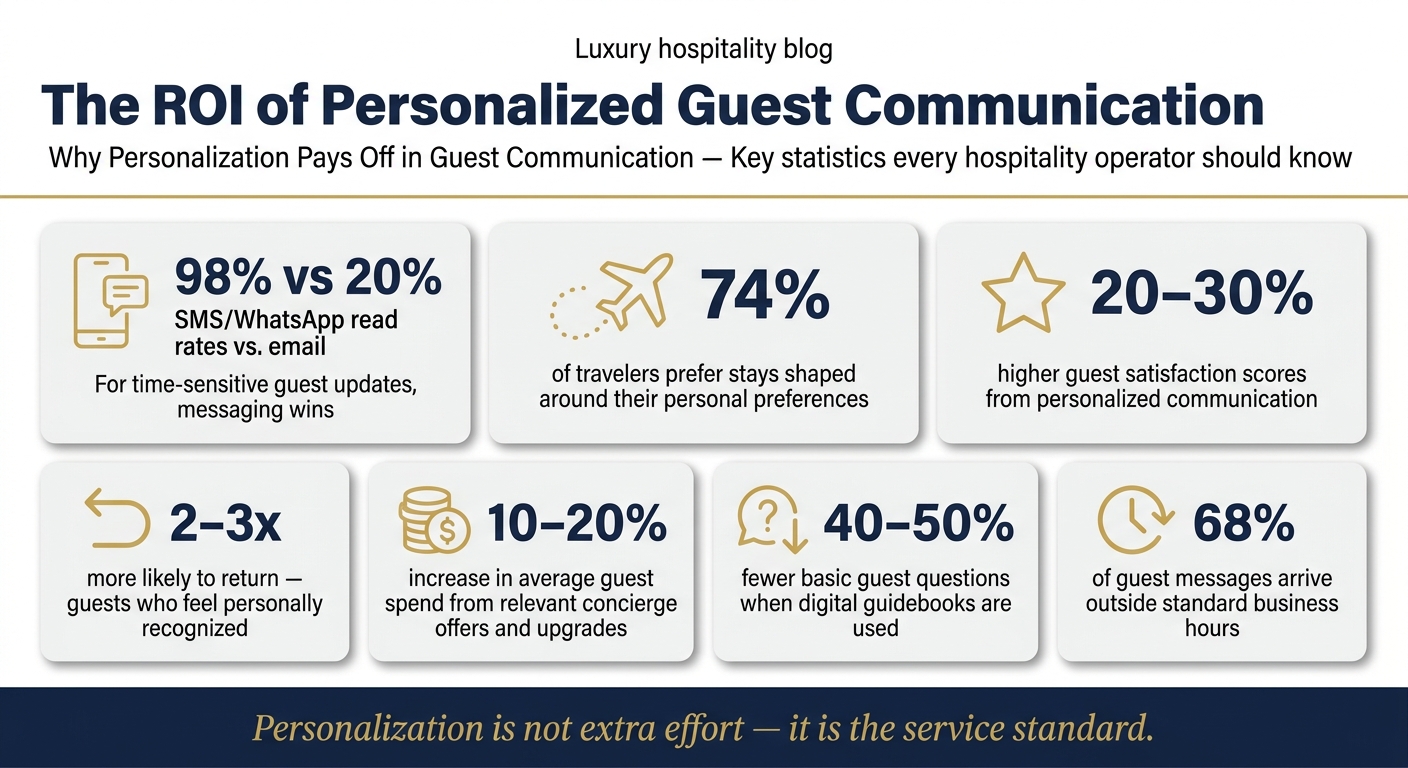
- SMS and WhatsApp can outperform email for time-sensitive updates, with 98% read rates vs. 20% for email.
- 74% of travelers prefer stays shaped around their personal preferences.
- Poor timing, scattered guest notes, and generic copy lead to missed details, repeat questions, and lower trust.
- Personalized service can improve satisfaction by 20%–30%, and guests who feel recognized are 2–3x more likely to return.
- Relevant add-ons like transfers, late checkout, or private dining can lift guest spend by 10%–20%.
- Clear pre-arrival messages and digital guidebooks can cut basic guest questions by 40%–50%.
What works is simple:
- Keep booking details, preferences, and past notes in one place.
- Match each message to the guest’s stage: booking, pre-arrival, arrival, in-stay, and post-stay.
- Let automation handle routine updates, but send sensitive issues to a person.
- Ask for consent, explain data use, and make opt-out easy.
For luxury stays, events, and production bookings, small message mistakes can feel much bigger. That’s why I see personalization as a service standard – not extra effort, but part of doing the job well.
The ROI of Personalized Guest Communication: Key Stats
Why personalized guest experiences matter to Collared Martin Hospitality
sbb-itb-161ccc1
The Core Problems With Impersonal Guest Communication
Impersonal communication hurts engagement, chips away at trust, and can cost you revenue. You see it in missed upsells, softer reviews, and guests who never book again. In most cases, the problem shows up in three areas: tone, data, and timing.
Generic Messages Lower Engagement and Perceived Value
A “Dear Guest” opener or a copy-and-paste confirmation tells people one thing fast: they’re just another booking.
That lands badly in premium settings. If someone booked a luxury property for an anniversary or planned a stay around event logistics, they don’t want the same pre-arrival email sent to everyone else. It feels flat. And once a message feels irrelevant, people tune it out.
That creates a chain reaction. Guests miss key pre-arrival details, show up with open questions, and start the stay with lower trust than they should.
As Sean Rakidzich, a 155-property operator, puts it:
"Automation is not the enemy of personality. Generic copy is. If your messages could belong to any listing in any city, the guest feels processed, not hosted."
Fragmented Guest Data Leads to Missed Details and Inconsistent Service
Most communication problems don’t come from poor effort. They come from scattered information.
A guest’s dietary restrictions might sit in one email thread. Their arrival time might be buried in a reservation note. Their event preferences might live in a separate planning doc. It doesn’t take much for details to slip through the cracks.
Then the stay starts to feel messy:
- Staff ask the same question twice
- Preferences get missed
- Service feels uneven
Too many disconnected tools can make this worse. When teams are juggling conversations across booking platforms, WhatsApp, SMS, and email at the same time, gaps are almost unavoidable. The guest ends up repeating the same story at arrival, during the stay, and even after checkout.
That sends a clear signal: their earlier interactions didn’t matter. And once guest data is spread all over the place, personalization stops being precise and starts becoming guesswork.
Poor Timing and Privacy Missteps Damage Trust
Timing shapes how a message is received.
A check-in code that shows up late is one of the most common sources of friction. And this isn’t a small issue – 68% of guest messages arrive outside of standard business hours. If the message comes too late, or when no one is around to help, stress goes up fast.
Privacy mistakes can do just as much damage. Referencing details a guest never shared directly can feel less like good service and more like overreach. There’s a line between being attentive and being unsettling, and guests notice when that line gets crossed.
What people want is pretty simple: timely, relevant communication that respects boundaries. That means having a clearer system for guest profiles, message timing, and permissions.
How Personalization Improves Guest Experience and Business Results
Personalization does more than cut friction. It can improve loyalty, guest spend, and day-to-day efficiency. And when communication falls short, the damage usually shows up in those same three areas.
Higher Satisfaction, Better Reviews, and More Repeat Stays
Personalized experiences can lead to 20–30% higher guest satisfaction scores. They also make a big difference in repeat business: guests who feel personally recognized are 2–3x more likely to return.
That matters even more for luxury stays and event venues, where one returning guest can be worth far more than a single booking.
You can also see this effect in reviews. Personalized touches are one of the main reasons guests call out specific moments in 5-star reviews. That kind of feedback can improve platform visibility and help more people convert from browsing to booking.
More Revenue From Relevant Concierge Offers and Upgrades
Relevant offers tend to convert at a higher rate. Personalized outreach for add-ons like private chefs, airport transfers, late checkout, or wellness services can increase average spend per guest by 10–20%.
Why does that happen? Simple. The offer fits the stay.
A romantic dinner setup for an anniversary trip feels helpful. It doesn’t feel like a sales pitch. When the timing and context line up, guests are more likely to say yes because the offer makes sense in the moment.
Fewer Clarification Requests and Smoother Day-to-Day Operations
Clear, property-specific messaging can cut down repeated questions in a big way. Automated messages that include exact entry instructions, parking details, or amenity notes reduce follow-up clarification requests by 40%.
The same pattern shows up with digital guidebooks. Properties that use them report 40–50% fewer basic questions about WiFi, parking, and house rules.
That means less back-and-forth for staff and a smoother stay for guests. Instead of answering the same question over and over, teams can spend more time on service that actually needs a human touch.
These gains depend on unified profiles, stage-specific messaging, and careful automation.
| Personalization Outcome | Guest Benefit | KPI to Track |
|---|---|---|
| Higher Satisfaction & Loyalty | Guests feel known, valued, and supported. | Average Review Score (1–5 stars) / Repeat-Stay Rate |
| Increased Ancillary Revenue | Relevant offers like private chefs or late checkouts convert at higher rates. | Upsell Conversion Rate / Average Revenue Per Guest |
| Operational Efficiency | Clearer instructions and proactive updates reduce stress and confusion. | Average Response Time / Clarification Request Volume |
| Improved Search Ranking | Faster responses and better reviews improve platform visibility. | Booking Conversion Rate / Search Impression-to-Booking Ratio |
How to Build Personalized Communication Across the Guest Journey
Personalization works when it’s part of the day-to-day process. That means building a repeatable system around three things: one guest profile, messages tied to each stage of the stay, and automation with guardrails.
Build Unified Guest Profiles and Clear Segments
Start by keeping guest data in one profile. Booking details, group size, trip purpose, past stay history, room location, and dietary needs should all sit in the same place instead of being spread across inboxes and booking tools.
Then segment guests by trip type. A family with kids, a remote worker staying longer, a couple on a getaway, a returning guest, a wedding party, or a film production crew all need different communication. Clear segments make it much easier to build message flows that match the guest’s situation without rewriting every note from scratch.
Once that profile is unified, the next thing to dial in is timing.
Match Messages to Each Stage of the Guest Journey
Use a simple sequence that lines up with the stay. At booking, acknowledge the trip purpose and offer upgrades that fit. Send a mobile-first digital guidebook 48 hours before arrival. Share access codes on the morning of arrival through the guest’s preferred channel. Check in the morning after arrival. Then send a post-stay follow-up that mentions something specific about their experience. For time-sensitive updates, SMS and WhatsApp tend to work well.
Use Automation Carefully and Protect Guest Privacy
Automation should handle routine logistics. People should handle sensitive cases.
A hybrid model usually works best. Automatic sends are a good fit for routine details like WiFi passwords, parking info, and checkout times. Staff review should cover sensitive messages such as complaints, special requests, or financial questions, so someone can check the message before it’s sent. That helps keep response times fast without creating avoidable mistakes.
Privacy needs the same level of care. Guests should understand why data is being collected, give consent before personal preferences are stored, and have a clear way to opt out. Don’t mention details the guest never shared. It also helps to define escalation triggers, such as phrases or sentiment signals like "frustrated", "disappointed", or "urgent maintenance issue", that send the conversation straight to a human.
Operating rule: automate the logistics, review the sensitive, and always give guests a way out.
Applying This Approach at Essentialyfe
Tailoring Communication for Stays, Events, and Productions
At Essentialyfe, personalization should shift based on booking type and urgency. Message content, tone, and timing need to fit the situation: family stays need practical guidance, event bookings need a more logistical tone, and production crews need immediate operations details – load-in instructions, production truck parking details, and security protocols sent at booking, not the day of arrival.
Once the message flow lines up with the booking type, the next move is simple: keep guest preferences in one profile.
Using Concierge and Operations Notes to Anticipate Guest Needs
When dietary, transport, and wellness preferences live in one place, staff stop asking the same questions twice, and guests stop having to repeat themselves. For Essentialyfe, that means better concierge timing and fewer missed requests.
If a guest has booked an in-home massage before or often asks for an exotic car rental, that pattern can prompt a well-timed offer. It’s the kind of detail that makes service feel smooth instead of scattered. Shared operations notes across the team – covering room setup preferences, shuttle timing, and event logistics – also keep private chefs, security staff, and shuttle teams on the same page without last-minute calls.
That only works if operations teams are working from the same guest notes. At a practical level, three habits help keep it steady:
- A unified inbox tied to the property management system
- Pre-arrival forms that build complete guest profiles
- Opt-in preference forms with clear data policies
Conclusion: Personalized Communication Builds Trust, Loyalty, and Smoother Operations
Impersonal communication tells guests their specific needs were not fully considered, and scattered data makes that problem worse once the stay starts. At Essentialyfe, personalization is not extra attention. It is the standard that makes high-touch service work.
FAQs
What guest data should be stored in one profile?
Store guest data in one centralized profile so you have one source of truth for every guest.
That profile can include:
- Profile data: country, language, loyalty status, and communication preferences
- Booking details: channel, stay frequency, length of stay, party size, and room type
- Behavioral data: past feedback, service preferences, dietary restrictions, and past engagement with offers or messages
With all of this in one place, Essentialyfe can deliver more personal and consistent guest communication.
When should messages be automated versus handled by staff?
Use a hybrid approach: automate routine, high-volume messages, and let staff handle complex or sensitive interactions.
Automate standard questions like Wi-Fi passwords, parking instructions, checkout times, upsell timing, and check-in reminders. For complaints, property issues, special requests, or emotional situations, staff should step in with clear escalation rules so they have the full context.
How can you personalize guest messages without crossing privacy lines?
Personalize guest communication with a clear focus on security and transparency. Essentialyfe helps ease privacy concerns with Local-Edge AI that processes data on-site, so sensitive information stays within the property environment.
Paired with quantum-resistant encryption plus centralized guest preferences and stay history, this supports tailored, context-aware communication without putting personal data at risk.