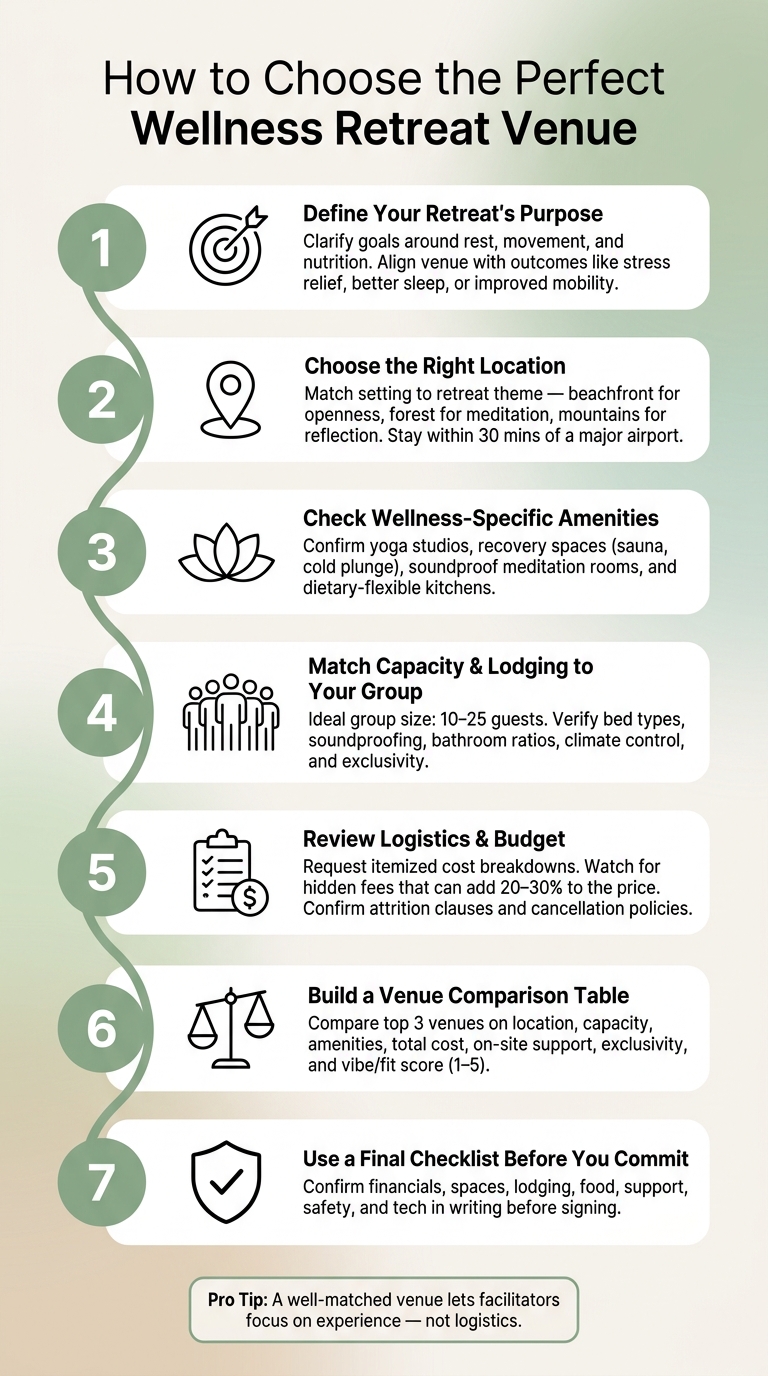
Choosing the right venue for your wellness retreat is crucial – it affects the experience, logistics, and budget. Here’s how to make the best choice:
- Define Your Retreat’s Purpose: Start by outlining what participants should gain (e.g., stress relief, better sleep, or increased mobility). Align the venue with your retreat’s goals.
- Location Matters: Choose a setting that complements your retreat’s theme – beachfronts for openness, forests for meditation, or mountains for reflection. Ensure it’s accessible, ideally within 30 minutes of an airport.
- Wellness Amenities: Evaluate spaces for yoga, recovery (like saunas or cold plunges), and dining. Ensure the venue can accommodate dietary needs and has proper facilities for planned activities.
- Capacity and Lodging: Confirm the venue can comfortably host your group. Look into room configurations, soundproofing, and privacy to meet guest expectations.
- Budget and Logistics: Request an itemized cost breakdown to avoid hidden fees. Check for on-site support, exclusivity, and clear contracts, including cancellation policies.
Pro Tip: Create a comparison table to weigh options based on location, amenities, cost, and alignment with your retreat’s goals. This ensures a well-informed decision.
The right venue isn’t just a location – it sets the tone for a seamless and impactful retreat experience.
How to Choose the Perfect Wellness Retreat Venue: 7-Step Guide
How to Host a Wellness Retreat
sbb-itb-161ccc1
Step 1: Define the Purpose of Your Wellness Retreat
Before diving into venue options, take a moment to outline what you want participants to gain from the experience. Are you aiming to help them sleep better, reduce stress, improve mobility, unplug from technology, or recover from burnout? Starting with clear outcomes ensures you won’t get distracted by stunning venues that don’t fit your retreat’s purpose.
Clarify the Retreat’s Goals
Focus your retreat around three key elements: rest, movement, and nutrition. For instance, a retreat designed to promote stress relief and better sleep might prioritize quiet spaces, spa amenities, and soundproof accommodations. On the other hand, an active retreat aimed at boosting strength or flexibility would need features like hiking trails, yoga platforms, and recovery facilities such as saunas or cold plunges. Deciding which of these pillars is most critical helps narrow down venue options.
"The best wellness stays are not the ones with the most amenities; they’re the ones with the right sequence of amenities. Rest should set up movement, and movement should be supported by nutrition and recovery." – theresort.club
Ask yourself this: What do you want participants to feel when they arrive, and what should they accomplish by the end? If you can’t answer this clearly, your venue search might feel overwhelming.
Consider the Retreat Format
Your retreat’s daily schedule will dictate what kind of venue you need just as much as its theme. For example:
- A yoga retreat requires spacious, open areas with plenty of natural light and access to outdoor decks.
- A workshop or training event needs dependable Wi-Fi, audio/visual equipment, and breakout rooms for smaller discussions.
- A healing or spiritual retreat might call for exclusive access to the property, ensuring privacy and emotional safety for attendees.
Here’s a quick breakdown of how different retreat formats align with venue features and settings:
| Retreat Format | Essential Venue Features | Ideal Setting |
|---|---|---|
| Yoga & Movement | Open floors, natural light, outdoor decks | Coastal or mountain views |
| Workshops/Training | Reliable Wi-Fi, A/V gear, breakout rooms | Modern lodges or urban villas |
| Meditation/Healing | Soundproofing, private spaces, exclusive use | Forest immersion or quiet gardens |
| Creative/Writing | Inspiring views, adaptable furniture | Lakeside or scenic wilderness |
Picture a typical day at your retreat – from an early morning session to an afternoon workshop and an evening gathering. Does the venue’s layout allow for smooth transitions between activities? If the design creates logistical challenges, like long walks between spaces or crowded bottlenecks, it could disrupt the flow of the experience. By defining your goals and format early, you’ll be better prepared to evaluate venues in the next steps.
Step 2: Choose the Right Location
Once you’ve defined the goals for your retreat, the next step is selecting the perfect location. The venue you choose should align with the retreat’s purpose, enhancing both the overall atmosphere and the logistics of the experience.
Evaluate the Natural Setting
Think of your location as an extension of your retreat’s program. For example, a beachfront property fosters a sense of openness and encourages social interaction, making it ideal for yoga or group connection retreats. On the other hand, forest or jungle settings offer a more secluded and grounding environment, perfect for deep meditation or healing-focused activities. Mountain venues, with their sense of stability and expansive views, are great for reflective or introspective retreats.
"Think of your retreat location as the canvas for your masterpiece." – Jamileigh Johnson, Bella Events, LLC
Climate plays a larger role than many organizers anticipate. For instance, high humidity can make physically demanding activities like Vinyasa yoga much more challenging, while drier climates are better suited for high-energy programs. Always research the specific weather patterns for your retreat dates, not just the general season. Even within the same country, weather can vary greatly – like the Pacific and Caribbean coasts of Costa Rica, which experience distinct rainfall patterns. Choosing the right climate ensures your attendees are comfortable and able to fully engage in the retreat.
Photos can also help you gauge whether the setting will resonate with your target audience. If the venue doesn’t evoke an emotional connection, it could be harder to attract attendees – no matter how well-structured your program is.
While the natural setting is crucial, don’t overlook the practicalities of getting there.
Consider Accessibility
Even the most stunning venue can become a drawback if it’s difficult to reach. Long or complicated journeys can leave guests feeling stressed or exhausted, which can disrupt the retreat’s initial sense of relaxation. Choosing a location within a reasonable driving distance – ideally 30 minutes – from a major airport can make a significant difference. It minimizes travel fatigue, reduces the chances of late arrivals, and simplifies coordination.
"A dreamy destination means nothing if it’s hard to reach or confusing to navigate." – Shannon Jamail, Retreat Leader
Plan ahead for transportation logistics. Will guests need to rent cars, use rideshares, or rely on shuttle services? Determine who will handle these arrangements – you, the venue, or the guests themselves. Some venues, such as those offered by Essentialyfe, provide built-in shuttle services, which can simplify planning. Additionally, ensure that paths between lodging and activity areas are well-lit and easy to navigate at night. Don’t forget to check the proximity of emergency services for added peace of mind.
Step 3: Check for Wellness-Specific Amenities
Once you’ve selected your location, it’s time to evaluate whether the venue’s facilities can support the activities planned for your retreat. The venue’s amenities should align with your retreat’s goals and meet guest expectations. A picturesque setting is great, but if the space can’t accommodate your program, it won’t work. Carefully assess the amenities to ensure they match both the practical and experiential needs of your wellness retreat.
Identify Must-Have Spaces
The venue’s spaces should directly support the core activities of your retreat. For yoga or fitness-based retreats, a dedicated movement studio is essential. Look for features like wood flooring, plenty of natural light, and enough room for participants. Purpose-built yoga shalas, for instance, are typically around 90 square meters, which can comfortably fit 16–18 practitioners. If outdoor sessions are part of your program, check for a covered deck or patio that offers weather protection, allowing activities like sunrise yoga to continue even during unexpected rain.
Recovery spaces are just as important. Facilities like hydrotherapy circuits with saunas, cold plunge pools, and hot tubs can help guests physically rejuvenate. For retreats that include spa treatments, ensure the venue has private massage or bodywork rooms, rather than makeshift or repurposed spaces. Meditation or sound healing sessions require quiet, soundproof areas equipped with a high-quality audio system to create the right atmosphere.
Additionally, confirm that the venue provides essential yoga props – mats, blocks, bolsters, straps, and blankets. This eliminates the need for you to coordinate and transport extra equipment.
While activity spaces are critical, don’t overlook the importance of food and program support in creating a seamless guest experience.
Check for Meal and Program Support
Food plays a major role in the overall retreat experience, often accounting for 15–20% of the retreat budget. The meals provided can significantly influence how participants feel throughout the program. Choose venues with on-site kitchens capable of accommodating specialized diets, such as Ayurvedic, vegan, gluten-free, or organic options. Avoid venues that rely solely on basic catering setups with limited flexibility.
Some venues go above and beyond by offering concierge-level services. These can include connections to local wellness practitioners, private chefs, and instructors. For example, Essentialyfe offers private chef services as part of its amenities, enabling you to provide curated, wellness-focused meals without the hassle of managing multiple vendors.
| Amenity Category | Basic Venue | Premium Wellness Venue |
|---|---|---|
| Yoga Space | General meeting room | Dedicated shala with props and scenic views |
| Recovery | Standard pool | Hydrotherapy circuit (sauna, cold plunge, steam) |
| Dining | Self-catering kitchen | Private chef with tailored wellness menus and dietary options |
| Outdoor | Shared lawn | Private fire pits, meditation areas, and nature trails |
The best venues are those where all amenities – spa services, movement spaces, dining options, and quiet zones – work together cohesively. If the amenities seem disconnected or poorly described, take that as a warning sign and address any concerns before making a commitment.
Step 4: Match Venue Capacity and Lodging to Your Group
With the amenities sorted, the next step is making sure the venue can comfortably accommodate your group. A mismatch between your group’s needs and the venue’s capacity can quickly derail the retreat experience.
Verify Guest Capacity
Don’t confuse event capacity with lodging capacity. For instance, a venue might advertise space for 250 attendees but only offer five bedrooms for overnight stays. Research suggests wellness retreats are most effective with groups of 10–25 guests. Smaller groups foster personal attention, stronger connections, and a calmer atmosphere.
"Crowding kills experience. Your venue should support connection, not create friction." – Shannon Jamail, Founder, Retreat Leaders Playbook
When assessing a venue, look beyond the guest count. Confirm the square footage of shared spaces like dining areas, lounges, and activity rooms. Also, check if there are breakout spaces for private coaching, small group activities, or quiet reflection.
Once you’re confident the capacity fits, shift your focus to lodging details to ensure everyone’s comfort.
Evaluate Lodging Quality
After confirming capacity, it’s time to evaluate whether the lodging setup meets your guests’ comfort and privacy needs. Ask for floor plans and photos of every room type. There’s a big difference between a “shared room” with two twin beds and one with bunk beds. Misaligned expectations can lead to frustration that lingers throughout the retreat.
"If someone arrives expecting ‘shared’ to mean ‘two twin beds’ and it means ‘bunk beds,’ you will spend emotional currency repairing something that was preventable." – Lunita Jungle Retreat Center
For mid-range retreats, shared rooms with two twin beds might be fine, but transparency is key. Let guests know exactly what to expect. Also, check the soundproofing between rooms or cabins – poor insulation can interrupt rest.
Other details to confirm include individual climate control, how close sleeping quarters are to activity spaces, and whether the retreat leader has access to a private room. Venues curated through Essentialyfe offer exclusive-use luxury properties with on-site concierge support, ensuring both guests and facilitators enjoy a smooth, comfortable stay.
| Lodging Factor | Why It Matters | How to Verify |
|---|---|---|
| Bed Configuration | Impacts sleep quality and expectations | Request photos of each room type |
| Bathroom Access | Shared bathrooms can disrupt routines | Ask about the guest-to-bathroom ratio |
| Soundproofing | Poor insulation disrupts guest rest | Inquire about wall thickness or spacing |
| Climate Control | Ensures comfort in all conditions | Confirm individual AC/heating per room |
| Exclusivity | Enhances privacy and the retreat vibe | Verify “exclusive hire” in the contract |
Step 5: Review Logistics and Budget
It’s time to dive into the practical details. Getting ahead of potential costs and scheduling issues can save you from unexpected headaches later.
Confirm Scheduling and On-Site Support
First, make sure the venue is exclusively available on your chosen dates. Shared spaces can lead to disruptions like noise, energy interference, or privacy concerns – all of which can throw off the retreat’s vibe. Don’t hesitate to ask: "Will there be other groups on-site during our program?"
Also, check what kind of support the venue offers. Having a dedicated on-site manager can make a world of difference compared to just a check-in desk.
"Venue support staffing is one of the most underestimated factors in retreat success – hosts who are simultaneously managing logistics and facilitating content deliver a demonstrably worse participant experience." – TeamOut
Ensure the kitchen can accommodate changes to meal times if sessions run late. Ask about quiet hours and whether special activities like sound baths, fire ceremonies, or professional photography need prior approval.
Once scheduling and support are locked in, turn your attention to the budget.
Compare Costs and What’s Included
Hidden fees can sneak up on you, adding 20%–30% to the initial price tag. Always request a detailed breakdown of costs before signing any agreements.
"Two quotes that look similar can represent very different financial realities once you add up what’s missing from each." – Gymea Eco Retreat & Spa
Be especially mindful of attrition clauses. These clauses might hold you financially responsible for unfilled rooms. While most venues allow for a 15%–25% shortfall without penalties, cancellations made within 15 days can result in charges for 82% of the hire fees. Here are some additional costs that are often overlooked:
| Potential Hidden Cost | What to Check |
|---|---|
| Attrition Fees | Ask about penalties for falling below 80% room occupancy. |
| Service Charges | Confirm if gratuities and admin fees are already included. |
| AV/Tech Fees | Check if Wi-Fi, projectors, or sound systems are extra. |
| Facility Use Fees | Verify whether amenities like the pool, fire pit, or terrace are included. |
| Transfer Fees | Look into shuttle or airport pickup availability and costs. |
To simplify things, services like Essentialyfe can bundle logistics – such as security, transportation, private chefs, and concierge support – into a single package. This approach can reduce the effort of juggling multiple vendors and allow you to focus on delivering a great retreat experience.
Step 6: Build a Venue Comparison Table
Once you’ve nailed down the logistics and budget, it’s time to organize your options in a way that makes decision-making easier. A structured comparison table helps you avoid relying on gut instinct – or being swayed by a venue’s glossy photos.
How to Set Up Your Comparison Table
Create a table that lists your top three venues across columns, evaluating them against the same set of criteria. Be thorough – factor in all costs, including taxes, cleaning fees, service charges, and any add-ons. Beyond just the numbers, assess each venue on aspects like exclusivity (is it a full property buyout or shared with others?), the quality of on-site support, and how well the space serves your retreat’s purpose. For instance, a resort with multiple pools might not be the best choice if your group needs a quiet space for focused workshops. As Shannon Jamail, Retreat Leader and Author, wisely says, “Your venue should support your schedule, not force you to redesign your retreat around its limitations.”
To go a step further, add a Vibe/Fit Score column. This lets you rate how well each venue aligns with your retreat’s goals on a scale of 1–5. It’s a simple way to capture the intangible qualities that a list of amenities alone can’t convey.
| Criteria | Venue A (Boutique Lodge) | Venue B (Wellness Resort) | Venue C (Private Villa) |
|---|---|---|---|
| Location/Accessibility | 2 hrs from airport; shuttle available | 30 mins from airport; easy access | 4 hrs from airport; remote |
| Comfortable Capacity | 15 guests (all private rooms) | 40 guests (shared options) | 10 guests (shared bathrooms) |
| Wellness Amenities | Yoga shala, organic garden | Full spa, gym, 3 pools | Private pool, open living area |
| Total Cost (Itemized) | $8,500 (all-inclusive) | $12,000 + $50/pp/day resort fee | $6,000 (lodging only) |
| On-Site Support | High (dedicated coordinator) | Moderate (front desk only) | Low (self-service) |
| Exclusivity | Full property buyout | Shared with other guests | Full property buyout |
| Vibe/Fit Score (1–5) | 5 – Deep healing focus | 3 – Busy/corporate feel | 4 – Intimate, private |
Looking at the table, it’s clear that while Venue B might seem appealing at first, the extra resort fees quickly drive up the cost. Plus, sharing the space with other guests could make it harder to maintain a distraction-free environment. This kind of side-by-side comparison ensures you’re making a thoughtful decision, not just an impulsive one.
Step 7: Use a Final Checklist Before You Commit
Once you’ve reviewed costs and logistics, it’s time to pull everything together with a detailed final checklist. This step ensures you don’t miss any small but critical details that could impact the success of your retreat. Use your comparison table as a foundation and dive into the specifics of venue verification.
Key Criteria to Confirm
Start by carefully reviewing the contract. As Shannon Jamail, Founder of Retreat Leaders Playbook, advises:
"If it’s not in writing, it doesn’t exist. A clear contract protects your retreat when plans change – which they sometimes do."
Pay special attention to attrition clauses, which outline penalties if you fail to meet room commitments. Look out for non-refundable deposits and confirm that a force majeure clause is included to cover emergencies. Always request an itemized breakdown of costs – this "true total" should account for all fees, taxes, and gratuities to avoid surprises.
Next, focus on the operational aspects. Ensure the venue can meet all dietary requirements, and get written confirmation for accommodations like vegan, gluten-free, or allergy-friendly options. Double-check the practice space – does it have enough ceiling height, proper ventilation, and good acoustics for activities like yoga or breathwork? Also, confirm that the rooms are soundproofed. As Lunita Jungle Retreat Center points out, "Most retreat tension is not about the workshop. It is about sleep."
This thorough review is essential to delivering the smooth and meaningful experience your retreat attendees expect.
Lastly, evaluate how responsive and clear the venue has been throughout the process. If their communication has been slow or vague, it’s likely to continue after signing the contract. A venue that confidently answers questions like, “How do you handle a guest who’s emotionally overwhelmed at 10 PM?” demonstrates an understanding of the unique needs of transformational retreats – not just basic hospitality.
Final Checklist for Venue Confirmation
| Category | What to Confirm Before Signing |
|---|---|
| Financials | Itemized quote with all taxes, fees, and gratuities; deposit schedule; refund/cancellation policy; attrition terms |
| Spaces | Practice area square footage, ceiling height, ventilation, breakout room availability |
| Lodging | Bed types (no surprise bunks), ensuite vs. shared bathrooms, soundproofing between rooms |
| Food | Written confirmation of dietary coverage (vegan, gluten-free, allergies) and flexible meal timing |
| Support | On-site staff roles, 24-hour emergency contact, communication method (e.g., phone, radio) |
| Safety | Proximity to nearest medical clinic, first aid availability, path lighting, emergency plan |
| Tech | Wi-Fi reliability (or confirmed dead zones for digital detox), AV equipment condition |
This checklist is your final safeguard, ensuring every detail aligns with your retreat’s vision before you commit to a venue.
Conclusion: Choosing a Venue That Sets Your Retreat Up for Success
The venue is more than just a backdrop – it shapes your retreat’s budget, logistics, and overall vibe. Sheri Rosenthal, Founder of Wanderlust Entrepreneur, explains it perfectly:
"An ideal venue supports your retreat’s experience, logistics, and budget."
Each decision you make builds on the groundwork laid by choosing the right space. A well-matched venue allows guests to feel at ease quickly and gives facilitators the freedom to focus on creating meaningful experiences rather than juggling logistical challenges.
For those planning retreats in the Los Angeles area, Essentialyfe offers a handpicked selection of high-end properties. Options range from Woodland Hills estates priced at $4,000/day to luxurious Beverly Hills villas costing up to $60,000/day. These venues come with premium concierge services, including private chefs, in-home massages, and professional event support. This is especially ideal for groups in the 10–25 guest range, a size that many wellness retreats find most effective.
Choosing the right venue lays the foundation for a retreat that leaves a lasting impact.
FAQs
How do I know if a venue truly fits my retreat goals?
When planning a retreat, begin by outlining your vision. Think about your target audience, the type of experience you want to create, and the atmosphere you’re aiming for. The venue plays a key role here – it should complement your retreat’s purpose, offering a layout that works for activities like yoga, group discussions, or workshops. Make sure there’s enough room for everyone to feel comfortable and engaged.
Consider practical details too. Choose a location that’s easy to access, fits within your schedule, and has clear, straightforward policies. If the process feels overwhelming, services like Essentialyfe can help by offering curated luxury venues and tailored services to streamline your planning and ensure the space aligns perfectly with your needs.
What hidden venue fees should I ask about before booking?
To steer clear of surprise expenses, always ask for a detailed breakdown of what’s included in the rental price. Find out about mandatory fees such as service charges, gratuities, and taxes – these can increase costs by as much as 30%. Be sure to clarify specifics like catering minimums, cleaning fees, equipment rental charges, and any wellness facility fees. Additionally, confirm details regarding non-refundable deposits, cancellation policies, liability insurance requirements, and overtime penalties. Companies like Essentialyfe offer luxury venues and planning services to help streamline this process.
What should I check to ensure guests sleep well?
To encourage restful sleep, focus on crafting a cozy, distraction-free space. Aim to keep the room temperature between 60–67°F and maintain humidity levels at 30–50%. Install blackout curtains to block any outside light and minimize noise with soundproofing or soft furnishings like rugs and heavy drapes. Provide medium-firm, high-quality mattresses and a selection of pillows to suit different preferences. Choose breathable, organic bedding to help regulate body temperature for a more comfortable rest. Essentialyfe can assist in turning your space into a luxurious sleep sanctuary.