Luxury rentals can cut trash hard without making the guest stay feel stripped down. In this guide, I’d boil it down to four moves: build waste out of the property, switch daily routines that keep sorting and refills on track, set guest service up with fewer disposables, and track results with simple numbers like under 0.7 lbs. of trash per guest-night and 60% diversion.
Here’s the short version:
- I’d focus first on food waste, packaging, toiletries, linens, and yard waste
- I’d treat landfill as the last option, not the default
- I’d use refillable bath products, built-in sorting bins, filtered water, and reusable kitchen gear
- I’d train staff to log trash, recycling, and compost at each turnover
- I’d give guests QR guides, not paper binders and long rule lists
- I’d line up chefs, cleaners, haulers, and vendors under the same low-waste rules
- I’d review results every month and aim for less waste per stay over time
A few numbers stand out. Short-term rentals can produce about 2x more waste per guest-night than hotels. Visual sorting guides can move recycling use from about 25% to 70%+. And refillable amenity systems can cut per-use cost from $0.50–$2.00 to about $0.02–$0.05.
If I were setting up a luxury rental today, I’d keep the plan simple: reduce first, reuse next, recycle and compost where local rules allow, donate unopened goods, and send as little as possible to landfill.
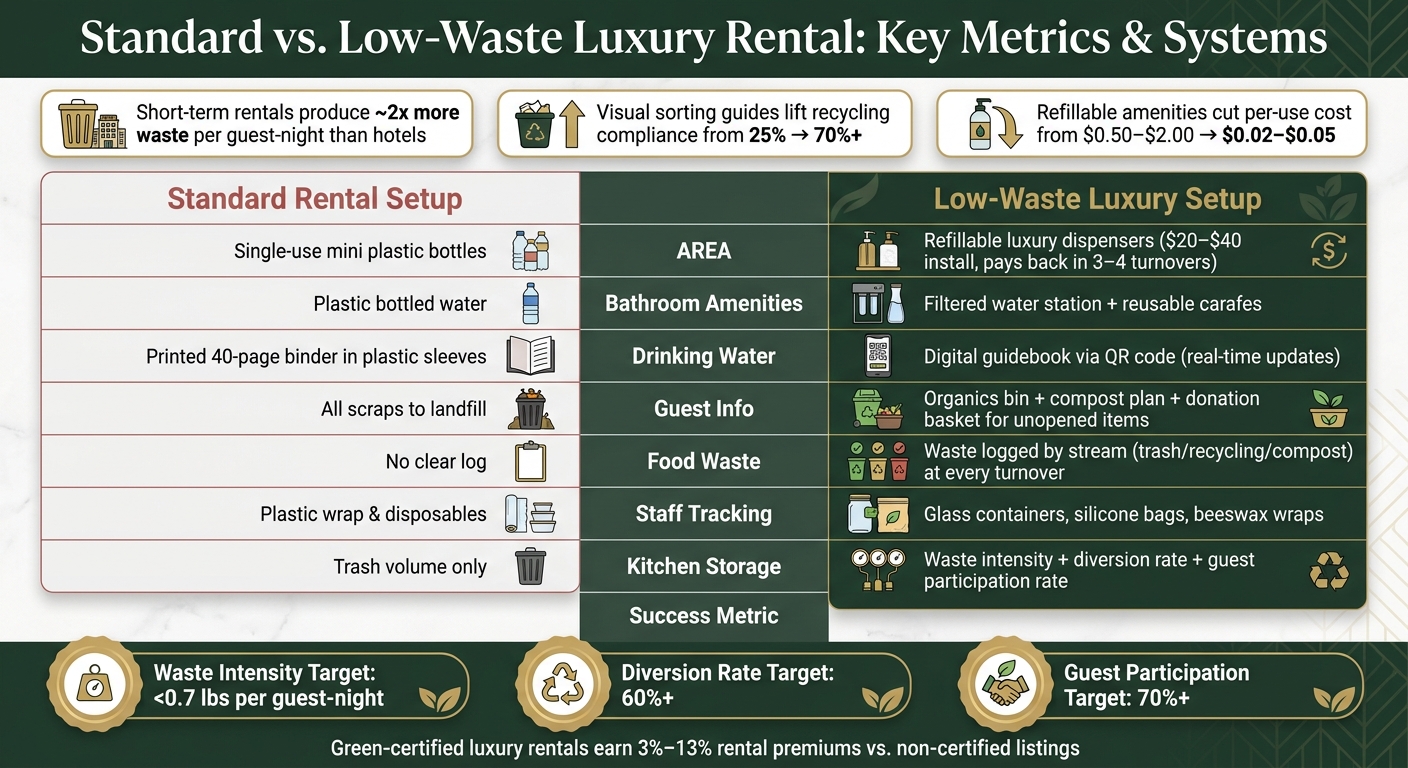
Standard vs. Low-Waste Luxury Rental: Key Metrics & Systems
Quick Comparison
| Area | Standard Setup | Low-Waste Luxury Setup |
|---|---|---|
| Bathroom amenities | Single-use mini bottles | Refillable dispensers or refillable luxury containers |
| Drinking water | Plastic bottled water | Filtered water station + reusable bottles/carafes |
| Guest info | Printed binder | Digital guidebook with QR code |
| Kitchen storage | Plastic wrap and disposables | Glass containers, silicone bags, beeswax wraps |
| Food scraps | Trash bin | Organics bin + compost plan |
| Staff tracking | No clear log | Waste logged by stream at turnover |
| Surplus food | Thrown away | Donate unopened items; compost scraps |
| Success metric | Trash volume only | Waste intensity + diversion rate + guest use |
That’s the full roadmap in plain terms: design, staff systems, guest service, and vendor control all have to line up if you want a luxury rental to send less to landfill and still feel polished.
sbb-itb-161ccc1
Designing Luxury Properties to Prevent Waste
Good design cuts waste before a guest ever checks in. When a property plans for waste reduction from the start, day-to-day operations get much easier. Staff spend less time fixing bad systems, and keeping waste low becomes part of the space itself.
Durable Materials, Repairable, Reusable Interiors, and Circular Furnishings
What you build with matters. It shapes how much gets tossed into a dumpster over the next 10 years.
Using FSC-certified timber, reclaimed wood, and recycled steel lowers the footprint tied to construction and furnishing, while also cutting replacement waste and reorder packaging. The same idea applies to interiors. Furniture that can be repaired, reused, or sourced secondhand keeps good materials in use longer.
There’s also a cost angle here. Vintage or secondhand furniture can cost 40–70% less than new items, and it avoids the waste tied to new manufacturing at the same time.
Textiles are another place where small choices add up. Organic cotton or linen bedding usually costs more at the start, but it tends to last longer. That means fewer replacements, less textile waste, and less frequent reordering.
Built-In Systems for Refills, Sorting, and Water Reduction
The best waste systems don’t need a long explanation. They feel obvious the moment someone uses them.
A three-bin sorting station built into kitchen cabinetry is a good example. With color-coded spaces for trash, recycling, and organics, guests and staff make fewer sorting mistakes. Add simple visual guides, and recycling compliance can jump from about 25% to over 70%. A small benchtop caddy for food scraps near the prep area helps too. If composting is right where the action happens, people are far more likely to do it.
Bathrooms follow the same playbook. Wall-mounted refillable dispensers for shampoo, conditioner, and body wash remove the need for single-use plastic bottles and usually pay for themselves within three to four guest turnovers. Installation is fairly low at $20–$40 per bathroom. After that, the cost per use drops hard, from $0.50–$2.00 for single bottles to $0.02–$0.05 for bulk refills.
Water fixtures matter too. Certified low-flow fixtures can cut water use by 20–30% without a clear drop in pressure. Low-flow showerheads often cost $15–$40 per fixture, with a payback period of 1–3 months. And a filtered water station in the kitchen solves another problem at the source: bottled water. It removes the need for it entirely, which cuts plastic waste before it starts.
Comparison Table: Single-Use Amenities vs. Bulk Dispensers vs. Refillable Luxury Containers
The amenity setup a property picks affects waste, operating costs, and the way guests read the room. In U.S. luxury rentals, the difference can be pretty clear.
| Feature | Single-Use Amenities | Bulk Dispensers | Refillable Luxury Containers |
|---|---|---|---|
| Waste | High (thousands of plastic bottles/year) | Low (bulk jugs only) | Low (bulk jugs only) |
| Guest Perception | Standard/Expected | Often perceived as budget | Premium and wellness-focused |
| Refill Logistics | High (constant restocking) | Low (monthly refills) | Low (monthly refills) |
| Operating Cost | $0.50–$2.00 per guest use | $0.02–$0.05 per guest use | $0.02–$0.05 per guest use |
| Sanitation | High (factory sealed) | Moderate (requires regular cleaning) | High (often tamper-resistant/sealed) |
Refillable luxury containers stand out because they pair low waste with low operating cost and a more polished look. Just as important, these choices make everyday tasks like sorting, refilling, and cleaning much simpler for staff. From here, the focus shifts from design to the staff routines that keep these systems working.
Daily Operating Systems for Waste Reduction and Recycling
The design choices above only hold up if staff follow them day after day. Without steady daily routines, even a well-built setup can start to break down between stays. The aim is simple: make waste reduction automatic, not one more thing staff need to stop and figure out. That helps the property stay polished, efficient, and easy for guests to use.
Waste Audits, Purchasing Controls, and Basic Tracking Metrics
Track Waste Intensity – trash pounds per guest-night. For luxury rentals, a practical target is less than 0.7 lbs per guest-night. During every turnover, housekeeping should weigh or estimate waste by stream – trash, recycling, and compost – and log it on a turnover sheet. When properties stick with this habit, they can cut mixed-waste tonnage by over 50% within six months.
Use a fixed refill schedule for concentrates, then decant them into labeled spray bottles. It also helps to track two more KPIs alongside Waste Intensity:
- Diversion rate of at least 60% – the share sent to compost or recycling instead of landfill
- Guest participation above 70%, measured through QR-code scans or guest-message logs
These numbers give staff a simple way to see whether the system is working or slipping.
Staff Procedures for Housekeeping, Kitchens, and Event Teams
These routines turn low-waste design into a repeatable turnover process. At every turnover, staff should empty all bins. If an electric countertop composter is three-quarters full, they should run a cycle and log that activity on the turnover sheet. Electric countertop composters complete a full cycle in about 6 hours at noise levels of 50 dB or less, which keeps the process quiet and out of the way. To manage compost odor, use odor-control liners or charcoal inserts.
In kitchens, staff should use the property’s color-coded sorting system at every turnover. Surplus food from private chef services or catering should go into a donation basket if the items are unopened. Pairing with food-donation or surplus-pickup apps makes same-day pickup easy to arrange. For leftovers, reusable beeswax wraps, silicone zip bags, and glass containers can replace single-use plastic wrap.
Event and production teams deal with more waste in a shorter stretch of time, so their systems need to be tight. Smart bins with fill-level sensors cut down on pointless checks. Staff get an alert when a bin needs to be emptied instead of walking over on a fixed schedule, which helps prevent overflow and cuts extra trips. Digital guidebooks, accessed by QR code, save hundreds of sheets of paper and plastic sleeve waste each year. They also let staff update recycling instructions in real time without printing new copies. That means less paper waste and fewer outdated directions for guests.
Once these routines are steady, guest-facing guidance is much easier to keep in sync.
Comparison Table: Donate vs. Compost vs. Landfill for Surplus Food and Organics
Each disposal method comes with its own tradeoffs. For properties handling private chef services, catering, or multi-day event bookings, it helps to know which option fits which kind of waste.
| Disposal Method | Regulatory Complexity | Environmental Impact | Cost Implications | Staffing Needs | Best Fit |
|---|---|---|---|---|---|
| Donate | Low; keep receipts for tax deductions | High positive; supports community, reduces methane | Savings; tax-deductible, reduces hauling volume | Low; donation basket or app pickup | Unopened pantry items, sealed goods, gently used linens |
| Compost | Moderate; varies by city | High positive; diverts organics from landfill | Low | Moderate; bin management and cycle logging | Food scraps, coffee grounds, organic prep waste |
| Landfill | Low | High negative; generates methane over time | Highest | Minimal | Non-recyclable, non-compostable waste only |
Donation is often the easiest win for surplus food. It takes little effort, can be tax-deductible, and keeps usable goods out of the waste stream. Composting needs a bit more coordination, especially at properties with frequent chef or catering service. Landfill should be the last resort.
Guest Experience, Events, and Concierge Services With Less Waste
Once daily operations are in good shape, the next step is the guest-facing side of the business. The goal is simple: keep everything feeling easy and high-end while quietly cutting disposables at every touchpoint.
Guest Guidance That Feels Premium, Not Restrictive
A common mistake is turning sustainability into a rulebook. Guests don’t want a lecture. It’s better to present green features as perks, not policies.
Digital guidebooks work well for check-in, house rules, and local recommendations. They cut paper waste, feel upscale, and make updates simple. Staff can change recycling instructions or swap local picks in real time without printing a new binder. A QR code near the recycling station can link guests to a short sorting guide. That small shift matters: guest recycling compliance climbs from about 25% to more than 70% when visual guides replace text-heavy instructions.
Pre-arrival messaging is another easy win. A note that points out solar backup or efficient systems lands as a feature. “Please conserve energy” lands as a restriction.
That same clear approach should carry through to chefs, shuttle teams, and wellness vendors.
Coordinating Chefs, Catering, Transportation, and Wellness Services
Once guest guidance is cleaned up, service providers need to follow the same waste standards. If one vendor uses refillables and another shows up with piles of single-use packaging, the whole system starts to wobble.
Private chefs can take a lot of pressure off from the start. Seasonal menu planning and portion control cut food waste before it happens. Bulk beverage service can replace single-use plastic bottles with filtered water stations and reusable carafes. For shuttle and valet service, vehicles can be stocked with branded stainless steel water bottles and reusable shopping bags.
Essentialyfe can coordinate these services under one low-waste standard across vacation rentals, event venues, and film locations. When event planning, security, shuttle services, private chefs, and concierge amenities are handled through one operator, the same rules can carry across every service. That makes life easier than chasing separate vendors and trying to get each one on the same page for packaging or food handling.
Wellness services should follow that same setup. For in-home massages and similar amenities, ask for organic linens, biodegradable products, and live plants instead of silk or plastic décor.
You can see the difference when you look at the full service flow in our luxury rental blog.
Comparison Table: Standard Concierge Service Flow vs. Low-Waste Service Flow
| Service Element | Standard Concierge Flow | Low-Waste Luxury Flow |
|---|---|---|
| Guest Information | 40-page paper binder in plastic sleeves | Digital guidebook via QR code with real-time updates |
| Toiletries | Single-use plastic mini bottles restocked each stay | Refillable dispensers replenished on a set schedule |
| Hydration | Individual plastic water bottles in rooms and shuttles | Filtered water stations and branded stainless steel bottles |
| Coffee Service | Single-use plastic pods | Locally sourced ground coffee with reusable pods or French press |
| Food Waste Handling | All scraps to landfill | Countertop compost bins for organics collection |
| Cleaning Supplies | Disposable polyester sponges and paper towels | Silicone scrubbers and reusable bamboo or cotton cloths |
| Post-Stay Communication | Checkout instructions only | Impact summary (e.g., "You diverted 12 lbs from landfill") |
These standards only hold up when vendors, haulers, and property teams all follow the same sourcing and sorting rules.
Partnerships, Certification, and Continuous Improvement
Choosing Vendors, Haulers, and Take-Back Partners
Waste reduction often falls apart at the supplier level. You can sort everything well on-site, but too much packaging or an unlicensed hauler can wipe out that effort fast.
That’s why supplier contracts matter. Ask for bulk deliveries, less packaging, and containers that work with refill systems. For batteries, bulbs, cords, and other tricky items, use take-back partners so those materials stay out of the regular trash stream.
Food waste needs the same kind of planning. Place a donation bin near the kitchen for non-perishables. Then pair it with a pickup setup that allows same-day collection for unopened pantry items and surplus food.
Certifications, Reporting, and Property-Level Benchmarks
Once supplier rules are set, your waste data does more than guide operations. It also helps with certification and reporting.
For luxury vacation rentals, the main certification programs include LEED, Green Key, EarthCheck, and ENERGY STAR. These third-party benchmarks help show guests and owners what low-waste performance looks like. Internal tracking helps, sure. But outside validation carries more weight.
Track two KPIs:
- Diversion rate
- Waste intensity per guest-night
For year one, aim for a diversion rate of 60% and waste intensity of under 0.7 lbs per guest-night. Review the numbers on a set schedule: monthly weigh-ins by waste stream, quarterly checks against targets, and an annual room-by-room audit.
There’s also a business upside. Green-certified properties often earn rental premiums of 3% to 13% compared with similar non-certified listings.
Conclusion: The Waste-Free Luxury Rental Roadmap
Waste-free luxury rentals rest on four layers: design, operations, guest service, and outside partners. When those pieces work together, waste goes down and the guest stay stays polished, with no drop in service standards.
FAQs
Where should I start?
Start with a sustainability audit: a simple room-by-room review of your property’s energy, water, and waste output. It usually takes two to four hours and gives you a clear starting point for improvement.
Then go after the quick wins – small, low-cost changes you can make in a single weekend to cut your footprint right away.
How much does a low-waste setup cost?
For Essentialyfe properties, costs can scale up or down based on the setup.
A simple low-waste system, such as a three-bin recycling and compost station, usually costs $30–$60. For a standard 2–3 bedroom property, quick-win upgrades often come in at under $200.
Bigger upgrades – like bulk amenity dispensers, reusable guest supplies, leak detection, and energy-efficient climate control – take more money upfront. But over time, they can cut day-to-day operating costs, utility bills, and even some insurance-related expenses.
How do I keep it feeling luxurious?
Luxury and waste reduction can work hand in hand when the design is smart and the guest experience stays top-tier. Instead of relying on throwaway extras, swap in durable, well-made pieces that look and feel premium, like elegant wall-mounted refillable bathroom dispensers and reusable branded water bottles.
Materials sourced nearby, such as volcanic stone or reclaimed hardwoods, give a space a strong sense of place and polish. They don’t just look good. They help the property feel more grounded and memorable.
When you talk about these practices, frame them around protecting quality and refining the guest experience, not around an eco message. That shift matters. Guests are more likely to see these choices as part of thoughtful hospitality rather than a compromise.