The short answer: plan the retreat around data, travel, food, and site limits first. If you skip those basics, even a high-end event can run into budget issues, guest friction, or weak low-impact results.
If I were planning one, I’d keep my focus on five things:
- Set the brief early: goals, guest count, room needs, daily flow, and firm standards
- Check the venue hard: access, backup space, Wi-Fi, power, fees, and proof behind green claims
- Cut travel impact first: group shuttles matter because guest travel is often the largest share of event emissions
- Build food and vendor plans close to the site: local sourcing, reusable serviceware, and fewer shipped items help lower waste
- Measure the event after: track waste diversion, local sourcing %, transport use, energy use, and guest feedback
A few numbers make the stakes clear. In the U.S., venue rental alone often runs from $1,500 to $8,000 per day, while high-end private estates can reach $15,000 to $25,000 per day. Food and beverage can account for about 25% of the total retreat budget. That means venue fit, transportation, and menu design shape both cost and impact more than small decor choices do.
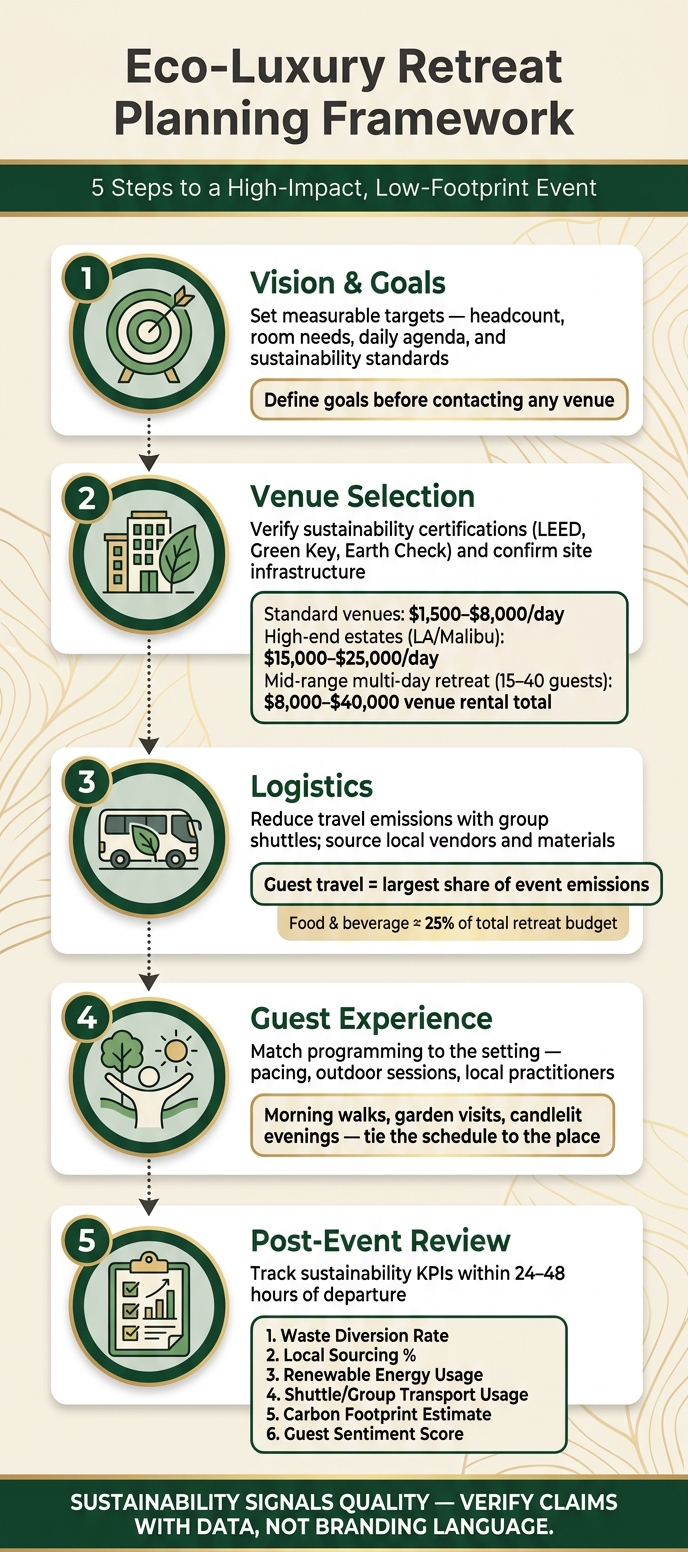
Eco-Luxury Retreat Planning Framework: 5 Steps to a Sustainable Event
Quick overview
- For weddings, I’d focus on privacy, weather backup, and guest room mix.
- For wellness retreats, I’d check quiet spaces, natural light, pacing, and dietary planning.
- For corporate offsites, I’d confirm AV load, breakout areas, backup power, and shuttle timing.
- For brand events, I’d pay close attention to guest arrival flow, photo settings, privacy, and service polish.
Here’s the core idea in one line: don’t treat an eco-luxury retreat like a standard hotel booking. Remote access, utility limits, and proof-based standards change how the whole event should be planned.
Below, I break down how to choose the property, build the guest plan, lower waste, and track results without making the event feel stripped down.
sbb-itb-161ccc1
1. Set the Event Vision, Budget, and Sustainability Standards
Define Event Goals, Guest Count, and Program Format
Before you contact any property, get clear on what the event needs to do. A leadership offsite and a wellness retreat may both be called “retreats,” but they need very different setups. The event’s purpose shapes almost everything: the type of venue, the flow of the day, the number of rooms, and the overall feel.
Lock down three things early: exact headcount, overnight room needs, and the daily agenda. A corporate offsite may need dependable AV, breakout rooms, and structured strategy sessions. A wellness gathering usually needs quiet outdoor areas, natural light, and a slower rhythm. If you miss this at the start, you’ll spend time reviewing venues that were never right in the first place.
If sustainability matters to your audience, build that into both the planning brief and the guest messaging from day one.
Set a Realistic Budget and Non-Negotiables
Eco-luxury retreats can vary a lot in price. In the U.S., venue rental alone usually costs $1,500 to $8,000 per day, depending on the region and level of exclusivity. High-end estates in places like Los Angeles or Malibu can hit $15,000 to $25,000 per day. For a mid-range, multi-day retreat with 15 to 40 guests, plan for $8,000 to $40,000 for venue rental alone.
| Region | Typical Venue Rental (Per Day) | Estimated Per-Guest Range |
|---|---|---|
| West Coast (CA, OR, WA) | $2,000 – $8,000 | $400 – $1,000 |
| South (FL, Southeast) | $1,500 – $6,500 | $300 – $900 |
| Mountain/Midwest (CO, UT) | $1,800 – $5,500 | $250 – $750 |
| Northeast | $2,000 – $7,000 | $350 – $1,000 |
Numbers matter, but so do your deal-breakers. Write down your non-negotiables before you start comparing venues. That way, you’re not tempted by a pretty property that misses the point.
Common non-negotiables include:
- Zero single-use plastics
- On-site renewable energy
- 100% local food sourcing
- Exclusive property use for privacy
- Third-party certifications like LEED, Green Key, or Earth Check
Treat these as hard filters, not nice-to-haves. It also helps to set aside a contingency fund for surprises like peak-season surcharges, exclusivity fees, or charges tied to unused rooms and meals.
Write a Short Planning Brief for Venues and Partners
A short planning brief makes life easier for everyone. It gives venues and vendors enough detail to tell you, fast, whether they’re a fit. Include your event goals, guest profile, preferred atmosphere, date range, headcount, and sustainability standards.
Be specific. Ask for the property’s renewable energy share, waste diversion rate, and local food sourcing percentage. Ask for proof you can measure, not vague promises.
Use the brief to compare properties on capacity, infrastructure, and proof of sustainability before you book site visits.
2. Choose the Right Eco-Luxury Retreat and Confirm Site Logistics
Check Property Fit: Location, Capacity, and Guest Comfort
Once your brief is set, use it as a hard filter during site visits. This is where the process shifts from idea to site check to final venue pick.
Start with access. Check how far the property is from the nearest major airport and whether guests and vendors can get there by shuttle. When it makes sense, group shuttles can cut the event’s carbon footprint and make arrivals much easier. And for remote properties, drive time alone doesn’t tell the whole story. Road conditions can make or break the guest experience.
Then look past the headline bed count. You need to know:
- The mix of private and shared rooms
- The mix of private and shared bathrooms
- Whether there’s enough indoor and outdoor event space for the full program
- Whether there’s an indoor backup space for outdoor sessions
- What cooling and ventilation are available: fans, AC, or both
If any guests have mobility needs, check accessibility before you sign anything. That means pathways, restrooms, and event spaces, not just one or two parts of the property.
Verify Sustainability Claims and Site Infrastructure
Once the property seems like a fit, ask for proof. “Eco-friendly” sounds good on a brochure, but it doesn’t mean much on its own. Check utility records, waste reports, and certification documents. Look for recognized third-party certification. Third-party certification is the clearest proof of sustainable operations.
Then move to the nuts and bolts. Confirm AV power capacity, Wi-Fi reliability, and whether the kitchen can handle specialized dietary needs. Backup power matters too, especially if your program depends on presentations, music, or remote access. And get every fee in writing: buyout, F&B minimums, service charges, cleaning, and gratuities.
Compare Venue Types Before Making a Final Decision
Venue type should match the program. A mountain retreat feels very different from a coastal property, and that difference affects travel, comfort, and the kind of event you can run. Here’s a side-by-side look at four common eco-luxury retreat profiles:
| Retreat Profile | Typical Capacity | Travel Access | Climate | Key Sustainability Features | Best-Fit Event Type |
|---|---|---|---|---|---|
| Coastal (e.g., Oregon Coast) | Varies; often private homes | Remote; 1.5–2+ hrs | Cool, damp, 50–65°F | Habitat restoration, beach protection | Creative resets, high-stakes immersive work |
| Mountain (e.g., Colorado Rockies) | 20–30 guests | 1–2 hrs from hub | Alpine; variable, 45–75°F | Off-grid solar, organic agriculture | Wellness intensives, digital detox, meditation |
| Desert/Ranch (e.g., Texas Hill Country) | ~26 guests | Accessible from major hubs | Arid; 85–105°F summers | Solar power, local farm partnerships | Corporate offsites, team-building, hybrid events |
| Tropical/Island (e.g., Hawaii) | 15–22 guests | Remote; specialized transport | Humid, 75–90°F | Renewable energy, low-impact construction | Transformational retreats, cultural immersion |
One last filter: if a venue can’t guarantee exclusive use for your dates, it’s usually a sign to keep looking.
3. Build Low-Impact Plans for Travel, Vendors, and Food Service
Plan Group Transportation and Arrival Flow
Once the venue is set, transportation becomes the next big logistics job. A chartered shuttle or coach from the arrival airport to the venue is usually a better move than sending guests off in separate rental cars. It cuts down on emissions and gives people a smoother, more polished arrival in a place they may not know well.
It also helps to pick a destination near a major hub airport. That makes nonstop or one-stop flights more likely for most guests. From there, you can build one clear ground transportation plan from the airport to the property instead of piecing things together guest by guest.
Your arrival plan should cover both the main group and anyone landing earlier. If guests are coming in on different schedules, set up separate pickups ahead of time rather than scrambling on the day. Use Essentialyfe to coordinate shuttle timing, security, and event logistics. That keeps communication simpler and cuts down on the number of separate vendors you need to manage. It’s also smart to check road conditions in advance and line up a driver network that can handle delayed flights or last-minute changes.
The same idea applies to vendors and setup materials: keep things close when you can.
Source Local Vendors and Cut Waste During Setup
Start with vendors who are within a reasonable drive of the venue. That includes florists, AV crews, wellness practitioners, and rental partners. Fewer long-distance shipments mean less freight, but there’s a practical upside too: local teams are often easier to coordinate, faster to set up, and less likely to turn your space into a maze of boxes and packaging.
Before you rent or ship anything, find out what the venue already has on-site. Ask for an inventory of reusable props like mats, bolsters, and audio equipment that may already be available. That can trim freight needs right away.
A few small swaps can make setup much cleaner:
- Use reusable signage instead of printed pieces
- Choose durable gifts from local artisans instead of single-use branded items
- Use LED lighting to cut energy use
- Set up refill stations in every session space so bottled water isn’t needed
It’s also worth confirming waste handling responsibilities in writing before the event begins. That way teardown stays orderly instead of turning into a last-minute mess.
Design a Food and Beverage Program That Feels Premium and Responsible
Food and beverage can make up about 25% of a retreat budget. That’s a big line item, so menu choices matter. Local, seasonal sourcing is often the smarter option on both cost and sourcing. Buying produce, protein, and dairy from within a set regional radius can reduce supply chain markups and give you fresher ingredients than a centralized distribution model.
Get dietary restrictions in writing well before the event. Gluten-free, dairy-free, vegan, low-histamine, and medically necessary requests all need planning ahead of time. They’re not the kind of thing you want to patch together at the last minute.
Use reusable serviceware across the event, and match the service style to the tone of the program. Family-style meals can help guests connect. Plated service feels more formal. Buffet service works well when variety and flexibility matter most.
The table below shows three common menu directions:
| Menu Approach | Approx. Cost per Guest (USD) | Execution Complexity | Sustainability Impact |
|---|---|---|---|
| Imported-Heavy | $150–$250+ | High (import logistics) | Low (high carbon footprint) |
| Plant-Forward | $100–$180 | Moderate (seasonal prep) | High (reduced meat, local sourcing) |
| Fully Vegetarian | $80–$150 | Moderate (creative prep) | Highest (lowest footprint) |
A plant-forward menu is often the best middle ground. It helps keep costs in check, works for many dietary needs, and still feels premium.
4. Deliver the Onsite Guest Experience and Manage Risk
Once the logistics are locked in, the focus shifts to what guests will actually feel on-site: how the retreat flows, how safe it is, and how you’ll show what it delivered.
Build a Program That Fits the Setting
Build the schedule around the property itself, not some cookie-cutter event plan.
The strongest eco-luxury retreats feel tied to the place. Morning walks, garden visits, and candlelit evening sessions tend to fit naturally and strengthen the retreat’s character.
Pacing matters just as much as the session lineup. Leave space between sessions so guests can reset instead of rushing from one thing to the next. The schedule should match the retreat’s natural rhythm: morning yoga, sunset meditation, and easy evening programming that winds down on its own. If you’re using ceremonies rooted in local practice, work only with qualified practitioners who respect the tradition.
Small comfort touches matter more than people think. Set up filtered water stations in every session area, make sure outdoor walkways stay well-lit after dark, and have a plan for insect control during outdoor evening sessions.
Protect Guest Safety, Privacy, and Legal Compliance
Safety planning for a remote eco-luxury retreat needs more detail than a standard hotel event. Before you sign anything, confirm the nearest medical clinic and get the venue’s emergency response plan in writing, especially for remote sites. You should also verify that staff have emergency-response training.
Weather backup planning isn’t optional. Any outdoor ceremony or session needs an indoor fallback, and that backup space has to fit your full guest count without cramming people in.
For VIP events, tighten access control, guest lists, and private arrival routing. Use vetted security staff, approved drivers, and clear on-site coordination. Also confirm whether outside teams or equipment need special transport permits.
Once safety and privacy are covered, the next step is simple: measure what the event actually did.
Track Results and Document What to Improve Next Time
Track the same standards you set before booking the venue.
Review shuttle manifests, compare local sourcing percentages against catering invoices, and collect the venue’s waste-diversion reports. Send a short guest survey within 24 to 48 hours after departure, while the stay is still fresh in people’s minds.
The table below shows the main sustainability KPIs to track, where the data comes from, and when to measure each one:
| Core Sustainability KPI | Data Source | Measurement Timing |
|---|---|---|
| Waste Diversion Rate | Venue waste logs / composting reports | Post-event |
| Local Sourcing % | Catering invoices / vendor origin lists | Pre-event (target) & post-event (actual) |
| Renewable Energy Usage | Venue utility dashboards / on-site meters | During event |
| Shuttle / Group Transport Usage | Transport manifests | Post-event |
| Carbon Footprint Estimate | Travel logs / operational data | Post-event (total CO₂e) |
| Guest Sentiment | Post-event surveys | 24–48 hours after departure |
Wrap up the event with a short handoff brief that notes what worked and where things fell short. That review shows whether the standards in your planning brief were met and gives the next event team a clean starting point.
Conclusion: A Simple Framework for Eco-Luxury Event Success
A strong eco-luxury event comes down to five steps: set measurable goals, verify the venue, cut impact across logistics, shape guest experiences around the place, and review results after the event.
Use this framework as a final planning check before you book.
| Phase | What to Do | Why It Matters |
|---|---|---|
| Vision & Goals | Set measurable targets | Accountability from day one |
| Venue Selection | Verify sustainability certifications | Reduces baseline carbon footprint |
| Logistics | Reduce travel and material waste | Cuts emissions and setup waste |
| Guest Experience | Match programming to the setting | Aligns the event with guest values |
| Post-Event Review | Track impact and lessons learned | Builds a stronger baseline for next time |
Sustainability now signals quality, not compromise. That shift matters. Guests notice when an event looks polished and runs with care behind the scenes.
Skip vague claims. Ask for verified data instead of taking broad "eco-friendly" language at face value. The best eco-luxury retreats pair premium service with disciplined operations that can be checked and proven.
Essentialyfe can help with venue sourcing, event logistics, shuttle coordination, and private-chef service. Clear data, tight logistics, and a guest experience that fits the setting are what turn an attractive retreat into one that runs smoothly.
FAQs
How far in advance should I book an eco-luxury retreat?
There’s no set booking window, but locking in your venue early is a big part of event planning.
To give yourself the best shot at getting the right space, start your search well ahead of your target date. Get clear on what your event needs, then shortlist and visit venues as early as you can.
Essentialyfe can help by connecting you with curated luxury properties and offering guidance on sustainable logistics.
What should I ask a venue to prove its sustainability claims?
Ask for recognized third-party certifications like LEED, Green Key, Green Globes, or EarthCheck. Also ask for current, documented data instead of broad claims.
Look for key metrics like:
- Waste diversion rate
- Renewable energy use
- Water consumption per guest night
- Local food and beverage sourcing
Essentialyfe can also help identify properties with verified measures and coordinate group transportation with a lower impact.
How do I balance guest comfort with low-impact event planning?
Use a design-led approach that delivers a high-end hospitality feel while keeping sustainability in view. Pick properties with smart infrastructure, like energy-efficient HVAC systems, along with passive features such as natural ventilation.
Essentialyfe can help coordinate eco-friendly vendors and handle sustainable logistics, including group transportation. Locally sourced, organic catering and digital agendas can also improve the guest experience while reflecting modern values around the environment.