If I had to sum it up in one line: SAF is the only fuel option that works for private jets right now without changing the aircraft.
If you fly private or help plan those trips, the tradeoff is simple. SAF can cut lifecycle CO2 by about 50% to 80%, but it costs more and is still sold at only about 30 U.S. airports. Electric aircraft are limited to short routes, hybrid models still give up range or payload, and hydrogen jets are still years away from normal use.
Here’s the short version:
- SAF is the near-term choice because current private jets can use it without engine changes
- Private aviation has a large emissions gap, with some trips producing far more CO2 per passenger than airline flights
- Cost and supply are the main SAF problems, not aircraft fit
- Electric aircraft work only for short flights today
- Hybrid-electric aircraft may cut fuel burn by 10% to 15%, but they add weight
- Hydrogen aircraft have promise on paper, but fueling and storage are still major barriers
- Trip planning matters: smaller aircraft, fewer empty legs, and SAF access can lower total trip emissions
Quick Comparison
| Option | Works With Current Private Jets | Main Limit Right Now | Near-Term Use |
|---|---|---|---|
| SAF | Yes | High price and low airport supply | Best option now |
| Electric | No | Very short range | Limited |
| Hybrid-Electric | No | Added weight and lower payload/range | Later |
| Hydrogen | No | Fuel storage and airport fueling systems | Much later |
So if I’m looking at private aviation in the U.S. as of June 26, 2026, the answer is pretty direct: use SAF where it’s stocked, use book-and-claim where it isn’t, and plan flights more carefully.
sbb-itb-161ccc1
Why Private Aviation Faces Pressure to Cut Emissions
Private aviation is the most energy-intensive part of air travel. In 2023, it produced at least 15.6 million metric tons of direct CO2, and emissions climbed 46% from 2019 to 2023. The United States alone accounts for 68.7% of all registered private aircraft globally.
For luxury travelers, this isn’t just a public image issue. It affects carbon reporting, trip planning, and even which aircraft makes sense for a given route.
What Recent Studies Say About Private Aviation Emissions
The numbers are hard to ignore. A midsize jet with four passengers flying from New York to Miami creates a per-passenger carbon footprint about 37 times higher than a commercial flight carrying 150 passengers on the same route.
And that’s only part of the picture. Private jets spend 21.4% of flight time above 40,000 feet, where contrails and NOx add more warming through non-CO2 effects. So the climate impact isn’t limited to fuel burn alone.
Short trips stand out too. Nearly 47.4% of private flights are under 500 km, and 4.7% are under 50 km. In many cases, those are distances better handled on the ground.
Researchers have also flagged major events as emissions hotspots:
- Private flights linked to the 2022 FIFA World Cup in Qatar produced an estimated 14.7 kt of CO2
- The 2023 Super Bowl in Arizona produced 1.5 kt from private aviation alone
For luxury travel, these figures now shape routing, aircraft selection, and event planning.
How Luxury Travelers Are Responding
Luxury travelers and corporate clients are tying flight decisions more closely to ESG goals and carbon reporting. Investors and family offices want cleaner, clearer carbon accounting too.
Operators have started to respond in direct ways. NetJets publicly reported purchasing 19.4 million gallons of SAF in 2024 through its Blue Skies program. Flexjet works with 4AIR to offset emissions on every flight at no added cost.
For luxury events and multi-leg itineraries, sustainability is now part of logistics planning, not a side note.
That pressure is pushing more attention toward SAF, the only renewable fuel path ready for existing private jets.
Sustainable Aviation Fuel: The Best Near-Term Option
SAF is the only renewable fuel that can cut emissions right now without changing existing private jets. For private aviation, the main issue isn’t whether this fuel exists. It’s whether enough of it can move through today’s airport and fueling network.
What SAF Is and What Studies Show
SAF is made from waste and low-carbon feedstocks, including waste oils, residues, municipal waste, or synthetic routes using captured CO2 and green hydrogen. Under ASTM D7566, SAF meets the same safety and performance specs as conventional Jet A. That’s why it can run in existing turbine engines and fueling systems without any aircraft changes.
Depending on the feedstock and production pathway, SAF can cut lifecycle emissions by 50% to 80% compared with conventional jet fuel. It also lowers particulate matter, or soot, by 50% to 70%, which may help reduce contrail formation.
At the moment, SAF is approved for use in all turbine engines at blends of up to 50% with conventional Jet A. Work on full 100% SAF certification is moving ahead, but that fuel is not yet sold at commercial scale.
SAF Availability, Cost, and Airport Access in the U.S.
The two biggest roadblocks for SAF in private aviation are simple: price and supply. SAF now costs 2 to 5 times more than conventional Jet A. For a midsize jet burning 250 gallons per hour at a 2% SAF blend, that adds about $25 to $50 per flight hour.
Physical SAF is stocked at about 30 U.S. airports, mostly in California, the Pacific Northwest, and a few East Coast hubs. That matters a lot for charter trips and private itineraries that depend on smaller airports. If the fuel isn’t at the departure point, the aircraft can’t just wish it into the tank.
When physical SAF is not available at the departure airport, book-and-claim programs give operators another path. They can buy the fuel’s emissions benefit and keep proof that the claim was retired. For luxury travel services, then, the limiting factor is usually not jet compatibility. It’s whether SAF can be sourced at the route’s departure airport.
Federal and California incentives can help shrink the price gap, but SAF still costs more than Jet A.
"SAF will not reach price parity with Jet-A through feedstock innovation alone. It will reach parity when petroleum extraction costs increase, government subsidies mature, and refinery scale economics bring production costs down." – Brian Galvan, Founder, The Jet Finder
How Jet A and SAF Pathways Compare for Private Flight Planning
| Feature | Conventional Jet A | SAF – HEFA Pathway | SAF – Synthetic (PtL) |
|---|---|---|---|
| Feedstock | Petroleum/crude oil | Waste oils, fats, greases | Captured CO2 + green hydrogen |
| Emissions reduction | 0% (baseline) | 50%–80% | Up to 99% |
| Works with current jets | Standard | Drop-in (up to 50% blend) | Drop-in (up to 50% blend) |
| Relative Cost | 1x (baseline) | 2x–5x premium | 8x–10x premium |
| Current Availability | Universal | Limited (~30 U.S. airports) | Near-zero commercial scale |
The other renewable paths – electric, hybrid-electric, and hydrogen – run into far tighter limits on range and airport infrastructure.
Electric, Hybrid-Electric, and Hydrogen Aircraft: What Research Shows
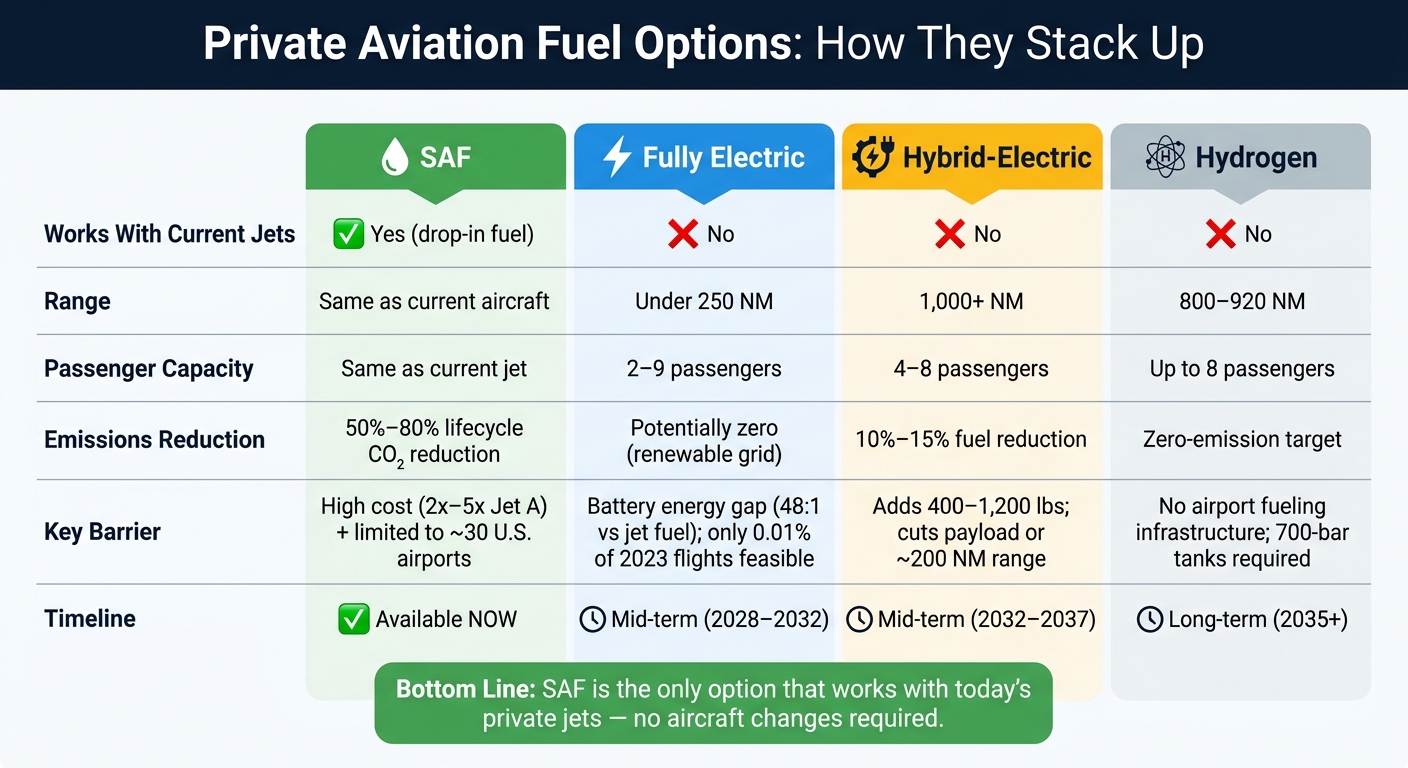
Private Aviation Fuel Options Compared: SAF vs Electric vs Hybrid vs Hydrogen
Electric, hybrid-electric, and hydrogen aircraft still run into major aircraft and airport limits. People talk about them a lot as long-range paths for cleaner private aviation. But the research points to a simple fact: each option comes with hard trade-offs, and those trade-offs matter for luxury travel.
For high-end itineraries, this isn’t just a tech story. It affects which routes work, how many people can fly, how much baggage fits, and which airports can support the trip.
Range and Payload Limits of Electric and Hybrid-Electric Aircraft
The biggest bottleneck is battery energy density. Jet-A fuel stores roughly 11,900 Wh/kg of energy, while current lithium-ion batteries store about 250 Wh/kg. That’s a 48:1 gap.
You can see that limit in aircraft already flying. The Pipistrel Velis Electro, the first EASA-certified electric trainer in 2020, has two seats, about 50 minutes of flight endurance, and a maximum takeoff weight of 1,212 lbs. The Eviation Alice, a nine-passenger all-electric commuter aircraft, completed an 8-minute first flight in September 2022 at Moses Lake, Washington. It is aiming for a 250 NM range and is working toward FAA certification by 2027. Even so, neither aircraft comes close to the range or cabin space people expect from a private jet.
The math gets even tighter at the fleet level. At today’s 350 Wh/kg battery density, only 0.01% of all private jet flights in 2023 could have been flown fully by electric aircraft. That’s not a small gap. It’s a wall.
Hybrid-electric aircraft look more usable in the meantime. They pair electric motors with standard turbines, which can cut fuel burn during power-heavy phases like takeoff and climb. Studies show fuel savings of 10% to 15% on typical missions. But that gain comes with extra mass. Hybrid systems can add 400–600 lbs to light jets and 800–1,200 lbs to midsize jets, which cuts payload or about 200 NM of range.
For luxury travelers, that’s a rough bargain. If the goal is nonstop range, a full cabin, and room for bags, giving up payload or range can be a deal-breaker.
Hydrogen Aircraft: Concepts and Infrastructure Barriers
Hydrogen looks strong on paper. Its energy density is about 33,336 Wh/kg, or roughly three times that of jet fuel. The two main paths are hydrogen combustion and hydrogen fuel cells.
But paper specs don’t tell the whole story.
Hydrogen has much lower volumetric energy density than jet fuel, so the tanks have to be much larger. That adds drag and weight. High-pressure gaseous storage at 700 atmospheres needs about 20 kg of tank weight for every 1 kg of fuel. In plain terms, the fuel may be light, but the storage system is not.
Airport support is another major hurdle. U.S. airports still do not have liquefaction plants, high-pressure fueling stations, or green-hydrogen supply chains in place. On top of that, the FAA and EASA are still developing certification standards for high-pressure and cryogenic systems in private aviation.
Hydrogen may offer more range potential than batteries, but storage and fueling are still the sticking points. In March 2026, French startup Beyond Aero completed the Preliminary Design Review for its BYA-I One hydrogen-electric light jet. The aircraft uses six 400 kW fuel cells, carries eight passengers, and targets a range of 800–920 NM at 300 knots using gaseous hydrogen pressurized to 700 atmospheres. That’s a serious step forward. Still, Beyond Aero is targeting service entry in 2030 and still needs CS-25/Part 25 certification from both EASA and the FAA.
So hydrogen remains a long-range idea, not a near-term answer for private luxury flying.
Comparison Table: SAF, Electric, Hybrid-Electric, and Hydrogen
| Technology | Range | Passenger Capacity | Emissions Profile | Infrastructure Needs | Current Status |
|---|---|---|---|---|---|
| SAF | Same as current aircraft | Same as current jet | Reduced lifecycle emissions | Existing fuel systems | Near-term (available now) |
| Fully Electric | Under 250 NM | 2–9 passengers | Potentially zero if powered by renewable electricity | High-power charging; $5 million–$15 million per FBO | Mid-term (2028–2032) |
| Hybrid-Electric | 1,000+ NM | 4–8 passengers | 10%–15% fuel reduction | Standard FBO + charging | Mid-term (2032–2037) |
| Hydrogen | 800–920 NM | Up to 8 passengers | Zero-emission target | 700-bar H₂ stations or cryogenic plants | Long-term (2035+) |
These limits shape near-term luxury trip planning in a direct way. SAF works with current aircraft and current airport systems. Electric, hybrid-electric, and hydrogen aircraft may play a part later, but for now they sit in the future-facing bucket.
That’s why renewable aviation matters most in trip design, not just aircraft design.
What This Means for Luxury Travel Planning
How Renewable Aviation Affects Trip Planning
The limits of the tech are pretty clear now, so trip planning comes down to three things: fuel access, aircraft assignment, and routing.
If physical SAF is available at the departure airport, use it. If it isn’t, book-and-claim is the next best option so the flight still matches with SAF used elsewhere. That gives you a practical way to lower emissions even when local supply is thin.
Aircraft choice matters too. Matching the smallest suitable aircraft to your actual passenger count can cut fuel burn by 30% to 60%. And if you reduce empty repositioning legs, a trip’s total emissions can drop by up to 30%. At current blend levels, the SAF surcharge usually lands between $500 and $2,000 per flight.
Coordinating Flights, Stays, and On-Ground Services
This same kind of planning doesn’t stop at the runway. It carries through the whole itinerary.
Electric ground transport is showing up more often in end-to-end trip requests. And airports with lower-emission ground procedures, like electric vehicles and better traffic flow, can trim flight-related emissions by another 5% to 12%.
Better coordination also cuts repositioning and reduces schedule friction. Essentialyfe can line up villa check-in, venue access, shuttle timing, private chefs, and car service with SAF-enabled flights, so the air plan and ground plan fit together from the start.
Conclusion: The Most Credible Paths Forward Today
Put all of this together, and one near-term playbook stands out for luxury travel. The most credible path right now is practical: SAF where available, book-and-claim where it isn’t, right-sized aircraft, fewer empty legs, and tighter coordination across air and ground services – with verified SAF certificates to avoid double-counting.
FAQs
How do I know if my departure airport offers SAF?
Contact your charter operator directly. They can confirm recent SAF deliveries and the current storage status at your airfield.
In the U.S., physical SAF is available at about 30 airports. Most are in California, the Pacific Northwest, and a few East Coast hubs like Teterboro.
If SAF isn’t available where you’re flying, ask whether the operator offers a book-and-claim program.
What is book-and-claim in private aviation?
In private aviation, book-and-claim lets travelers pay for the environmental gains tied to sustainable aviation fuel (SAF), even when SAF isn’t available at their departure airport.
Here’s the simple idea: SAF supply is limited and still hard to find at many airports. So instead of fueling that exact flight with SAF, operators pay for an equivalent amount of SAF to be used somewhere else in the fuel system.
That setup helps build demand and support more SAF production, while also helping travelers work toward their sustainability goals.
How much more does SAF usually cost per trip?
Sustainable Aviation Fuel usually costs 2 to 5 times more than standard jet fuel. The exact extra cost depends on the aircraft, the fuel blend percentage, and the route distance.
For example, charter operators may add a $500 to $2,000 surcharge per flight. And that premium can climb fast on longer trips, such as a 7-hour flight.