Luxury chauffeur services are turning to carbon offset programs to address their emissions and appeal to eco-conscious clients. These programs calculate vehicle emissions and invest in projects like reforestation or renewable energy to neutralize the impact. With transportation contributing 73.7% of global fossil CO2 emissions and U.S. per capita emissions at 13.83 tons in 2023, the push for greener solutions is growing.
Key points:
- Offsets are calculated using distance or fuel consumption data, converted into CO2-equivalents.
- Carbon credits fund projects such as forest restoration, clean energy, and waste management.
- Costs vary: $10-$40/ton for nature-based projects, $150-$600/ton for engineered solutions.
- Companies like LUXY Ride and Essentialyfe use offsets to reduce their carbon footprint and improve brand perception.
While offsets help reduce emissions, they must complement direct actions like fleet electrification to achieve long-term goals.
Mercedes EQV – Electric Luxury – 100% Carbon Offset – Chauffeur
sbb-itb-161ccc1
How Carbon Offset Programs Work
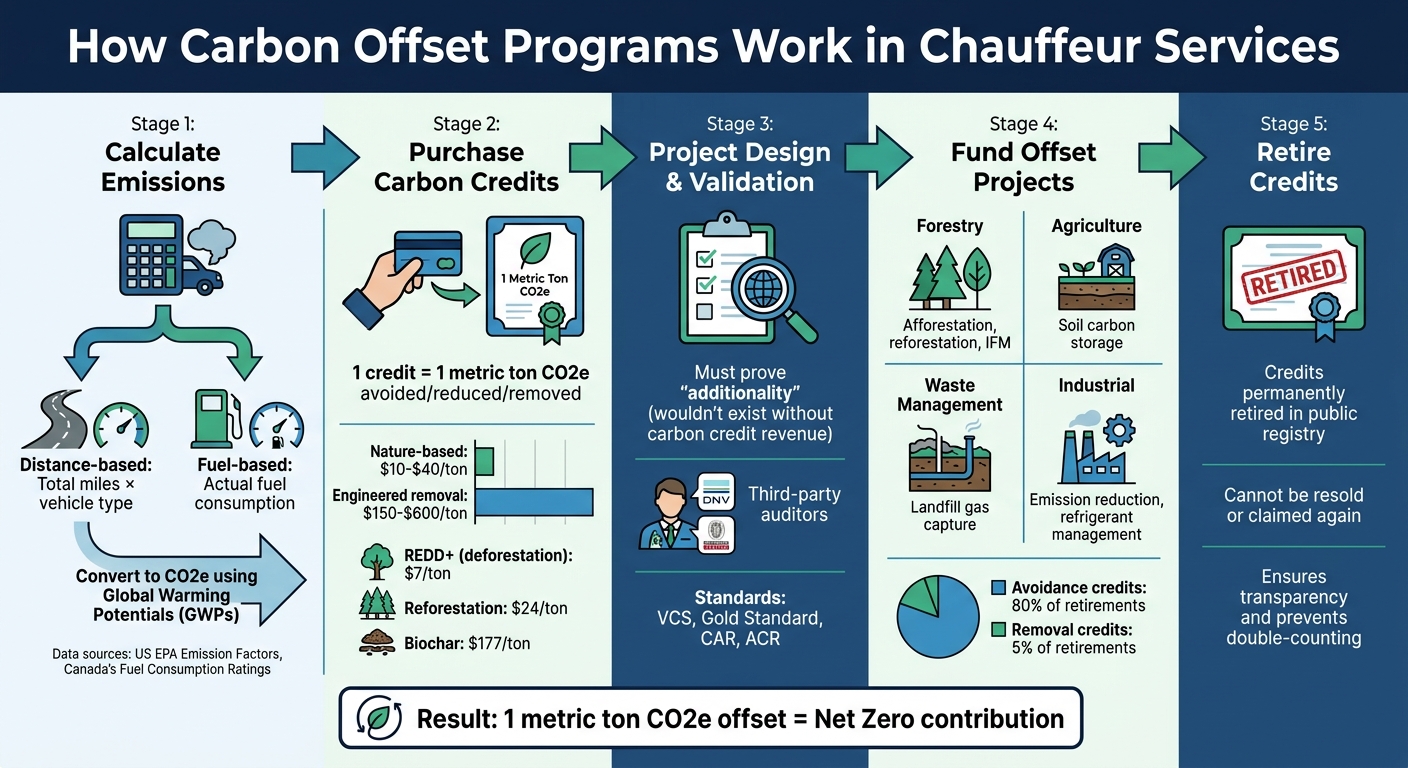
How Carbon Offset Programs Work in Chauffeur Services: 5-Stage Process
Calculating and Offsetting Emissions
Chauffeur services determine their emissions using either distance-based or fuel consumption methods. The distance-based approach calculates emissions based on total miles traveled by vehicle type, while the fuel-based method relies on actual fuel usage data.
These emissions are then converted into CO2-equivalent (CO2e) values using Global Warming Potentials (GWPs). GWPs combine the impact of various greenhouse gases into a single, standardized metric. To make these calculations accurate, services use databases like the US EPA’s Emission Factors for Greenhouse Gas Inventories or Canada’s Fuel Consumption Ratings, which provide vehicle-specific carbon output data.
After calculating emissions, the next step is purchasing carbon credits. Each credit represents one metric ton of CO2e that has been avoided, reduced, or removed from the atmosphere. The process for creating carbon credits involves five stages: project design, applying a specific methodology, third-party validation, registry issuance, and finally, retirement. A credit becomes a true offset only when it’s permanently retired in a public registry, ensuring it cannot be resold or claimed again.
The cost of carbon credits varies depending on the type of project. Nature-based credits typically cost between $10 and $40 per ton, while engineered removal projects are priced much higher, ranging from $150 to $600 per ton. Specific examples include REDD+ projects (focused on avoiding deforestation) at $7 per ton, reforestation at $24 per ton, and biochar at $177 per ton.
These emissions calculations ultimately fund a variety of offset projects.
Types of Carbon Offset Projects
Once emissions and credits are accounted for, offset projects fall into four broad categories: forestry, agriculture, waste management, and industrial. Forestry projects include afforestation, reforestation, and improved forest management (IFM). Agricultural projects aim to boost soil carbon storage. Waste management initiatives focus on capturing and destroying landfill gases, while industrial efforts address issues like nitric acid emission reduction and refrigerant management.
For a project to qualify, it must demonstrate additionality – proving that it wouldn’t be possible without the revenue from carbon credits. Independent auditors like DNV or Bureau Veritas ensure projects meet strict standards for additionality, permanence, and measurability. Programs are further validated by organizations such as the Verified Carbon Standard (VCS), Gold Standard, Climate Action Reserve (CAR), and American Carbon Registry (ACR), which provide transparency through third-party assessments, defined methodologies, and continuous monitoring.
The market divides carbon credits into two main types: avoidance credits and removal credits. Avoidance credits, which prevent emissions from occurring in the first place, account for about 80% of all retirements. Removal credits, which actively extract CO2 from the atmosphere, make up around 5%. Nature-based solutions, while offering biodiversity benefits, provide medium-term permanence. In contrast, engineered solutions, like geological storage, offer long-term permanence – lasting over 1,000 years – but come with much higher costs.
Benefits of Carbon Offset Programs
Carbon offset programs offer a range of advantages for chauffeur services, building on precise emissions calculations to address both environmental and business needs.
Reducing Greenhouse Gas Emissions
These programs provide a practical way to reduce emissions quickly. For every offset purchased, one metric ton of CO2 equivalent emissions is canceled out. The funding supports projects like wind and solar energy, landfill methane capture, and reforestation, all of which actively cut emissions.
Chauffeur fleets, which often rely on fossil fuels, use these programs to balance out emissions they can’t yet eliminate through fleet electrification or operational changes. By purchasing offsets equal to their emissions, these services can achieve "net zero" status while continuing to work on long-term improvements.
Take LUXY Ride, for instance. The company combines direct emissions reductions with offsets to create meaningful results. Since 2018, they’ve eliminated 2,990.68 metric tons of greenhouse gases by optimizing trips to reduce empty ride legs – an issue responsible for 85% of airport ride time. Their approach prioritizes cutting emissions at the source, then offsets the rest. As LUXY Ride puts it:
"By filling empty legs, our partners waste less fuel… It’s a win-win-win, for passengers, drivers, AND the earth".
In addition to environmental benefits, these efforts can significantly boost a company’s reputation.
Improving Brand Image
A strong environmental focus builds trust, especially in the luxury market where clients value sustainability. For chauffeur companies operating in high-GDP regions, this is even more critical. The top six emitting nations – China, the USA, India, the EU, Russia, and Brazil – account for 63.2% of global GDP and 62.7% of global emissions. Clients in these areas increasingly expect businesses to take environmental responsibility seriously.
Carbon offset programs also resonate with international travelers. With global aviation contributing 1.3% of CO2 emissions, many eco-conscious passengers already offset their flights. They naturally appreciate ground transportation providers that share the same environmental commitment, further enhancing brand loyalty among this audience.
This focus on sustainability also aligns with growing regulatory requirements and corporate social responsibility (CSR) initiatives.
Meeting Regulatory and CSR Requirements
Carbon offset programs help businesses stay compliant with reporting obligations, particularly in regions like the European Union, where voluntary carbon market disclosures are required. By using credits from trusted standards like VCS, Gold Standard, CAR, or ACR, companies ensure their emissions reductions are verified and documented, meeting ethical and governance expectations.
These programs also integrate seamlessly into corporate sustainability reports, showcasing a company’s dedication to lowering its environmental impact. Third-party verification ensures that offsets are real, measurable, and permanent, providing transparency and credibility to stakeholders. This evidence-based approach helps businesses avoid greenwashing claims while demonstrating genuine environmental progress.
Case Studies: Carbon Offset Programs in Practice
Real-world examples show how chauffeur services are putting carbon offset programs into action. These efforts not only reduce emissions but also strengthen brand reputation – a benefit previously discussed. Let’s explore some practical examples of these programs in operation.
Forest Restoration Initiatives
LUXY Ride follows a "one ride, one tree" approach, planting a tree for every completed ride in partnership with OneTreePlanted.Org. As of May 2026, LUXY calculates its total rides quarterly and makes donations to support reforestation efforts across North America, Latin America, Africa, Asia, Europe, and the Pacific. These projects help bring life back to degraded forests and promote biodiversity.
CapRelo, part of the JK Moving family, uses the ecolegIT platform to track emissions in real time and fund sustainable forestry projects. In April 2026, JK Moving Services received an SME-B rating from CDP for the second year in a row, reflecting its verified carbon reduction efforts. CEO Chuck Kuhn highlighted the company’s commitment:
"Earth Day is once a year, but our commitment to being great stewards for the environment is core to our culture of care and respect".
Additionally, the company diverts over 4.5 million pounds of waste from landfills annually through its Zero Waste initiatives.
Clean Energy Project Funding
While forest restoration projects focus on repairing ecosystems, clean energy initiatives aim to cut emissions at their source.
Enterprise Mobility collaborates with Terrapass to offer a voluntary carbon offset program. Customers can offset their estimated annual rental emissions by purchasing verified carbon credits. These credits support projects like the Greater New Bedford LFG Utilization Project, which captures and destroys harmful landfill gas, and the Finite Carbon – Batchawana Bay Forest IFM project.
Unlike LUXY Ride, which includes offset costs in every ride, Enterprise Mobility offers an opt-in program. This demonstrates two different ways businesses can integrate environmental responsibility into their operations while supporting verified carbon offset projects.
Challenges and Future Opportunities
Implementation Barriers
Carbon offset programs in the chauffeur industry face some tough hurdles, particularly when it comes to accurately measuring and reporting emissions. One of the biggest issues is transparency. Right now, most emission reports rely on self-reported data, which makes independent verification tricky. Another stumbling block is measurement accuracy. Traditional methods often overlook international emissions, like those from airport transfers or cross-border trips. This happens because territorial reporting only accounts for emissions within specific geographic areas. Considering that international aviation and shipping alone contribute 1.3% and 1.8% of global fossil CO2 emissions, respectively, this is a significant blind spot. Tackling these challenges could pave the way for more advanced tracking technologies.
Growth Potential
The future holds promise, especially with advancements in space-based monitoring expected by the mid-2020s. These technologies could reduce dependence on self-reported data and help address transparency issues.
As global emissions hit record levels, improving tracking systems has never been more important. Fossil fuel combustion remains the main driver of these emissions, putting pressure on luxury chauffeur services to step up with effective offset programs. Collaborating with standardized resources like the EDGAR database – which provides consistent annual estimates of global fossil CO2 emissions – can also help create reliable benchmarks for tracking transportation-related emissions.
Conclusion
Carbon offset programs present a practical solution for chauffeur services aiming to tackle their environmental footprint while transitioning to carbon-neutral fleets. These certificates fund impactful initiatives such as reforestation, renewable energy projects, and waste management – actions that actively remove CO2 from the atmosphere. For luxury transportation providers, offsets can act as a financial stepping stone, helping bridge the cost of adopting greener fleets.
That said, offsets alone aren’t enough to achieve net zero. As Josh Jackman, Lead Writer at The Eco Experts, aptly notes:
"You can’t effectively fight climate change with offsetting, only by cutting emissions to achieve net zero".
The numbers paint a stark picture: global greenhouse gas emissions must drop by 45% by 2030 to limit warming to 1.5°C. Instead, current trends show a worrying 10% increase. This highlights an urgent need to prioritize direct emission reductions alongside offsetting efforts.
Offset programs should complement – not replace – efforts to cut emissions directly. The focus must remain on strategies like fleet electrification and improving operational efficiency to make meaningful progress.
With at least 137 countries committing to carbon-neutral goals by 2050 and 27 nations enacting net-zero targets into law, the regulatory environment is becoming stricter. By combining verified offset programs with tangible emission reductions, providers can meet both customer expectations and legal requirements. Transparency is key – documenting specific impacts, such as the number of trees planted or the clean energy projects funded, will demonstrate a genuine commitment to environmental responsibility.
FAQs
How do chauffeur companies calculate a ride’s CO2 emissions?
Chauffeur services determine the CO2 emissions of a ride by examining several key factors: the type of vehicle used, its fuel efficiency, the total distance covered, and the driving conditions. By evaluating these aspects, they can calculate the trip’s carbon footprint, enabling them to measure and potentially offset emissions more accurately.
How can I tell if a carbon credit is verified and actually retired?
To verify if a carbon credit is legitimate and retired, check the registry where it was originally issued. These registries offer public access to records that detail the credit’s current status and retirement information. Make sure to find clear documentation that confirms the credit has been officially retired – this step is key for maintaining transparency and accountability.
Do carbon offsets really help if the fleet still uses gas vehicles?
Carbon offsets contribute to lowering overall emissions by supporting initiatives such as reforestation or renewable energy projects that either capture or reduce CO2. That said, they don’t directly address the emissions generated by gas-powered vehicles. Instead, offsets are meant to complement efforts to cut down fleet emissions, not replace them.