Helicopter companies are cutting emissions through smarter engines, cleaner fuels, and lighter designs. Here’s how they’re making progress:
- Engine Efficiency: Modern turbine engines emit 50% less CO₂ than older models, with features like "eco-mode" reducing emissions by 15%.
- Sustainable Aviation Fuel (SAF): SAF can lower lifecycle emissions by up to 80%. Helicopters like the Bell 505 and Airbus H225 are testing 100% SAF compatibility.
- Hybrid Systems: Combining gas turbines with electric motors can reduce fuel use by 30%.
- Lightweight Materials: Advanced designs, like the Airbus H160, cut fuel burn by 18%.
- Carbon Offsets: Operators invest in projects like forest conservation to balance emissions.
These efforts aim to meet client demands for greener travel while improving helicopter performance and efficiency.
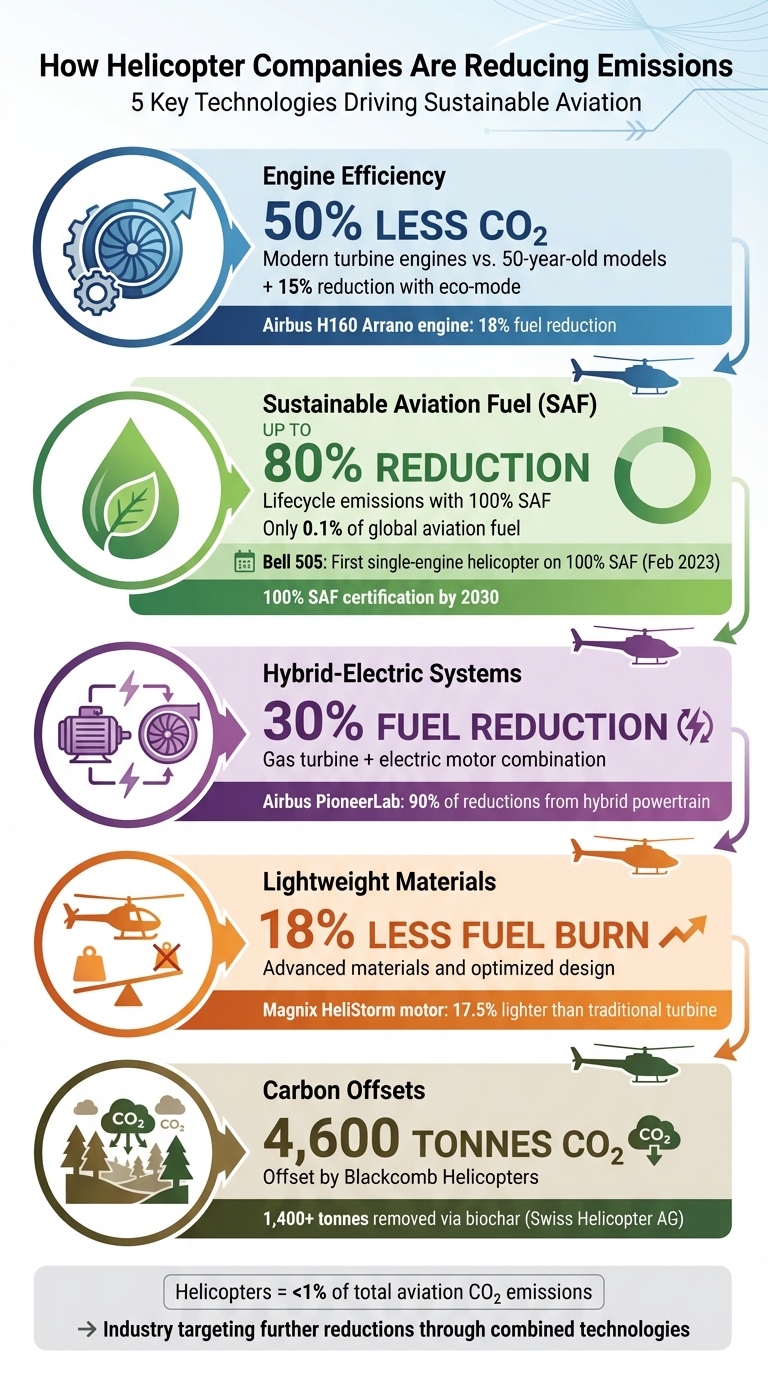
How Helicopter Companies Are Reducing Emissions: Key Statistics and Technologies
Hybridization Eco-mode concept for twin-engine helicopter
sbb-itb-161ccc1
Engine Technology Improvements
Advancements in engine technology are playing a key role in the industry’s efforts to reduce environmental impact. Collaboration between manufacturers and engine developers has led to notable increases in fuel efficiency and power output.
50 Years of Turbine Engine Efficiency Gains
Modern turbine engines have come a long way, now cutting CO₂ emissions by 50% while delivering three times more power than their counterparts from five decades ago. These improvements are largely due to advancements in compression ratios, aerodynamics, and thermodynamic cycles, ensuring that fuel is burned more effectively. Since fuel consumption is the primary driver of CO₂ emissions, even small gains in efficiency can lead to meaningful environmental benefits. For instance, features like "eco-mode", which allows one engine to shut down during cruising, can reduce emissions by an additional 15%.
These technological strides have paved the way for innovative designs, such as the Airbus H160’s Safran Arrano engine.
Airbus H160 and Safran Arrano Engine

The Safran Arrano engine, featured in the Airbus H160, is a standout example of modern engine innovation. It reduces fuel consumption by 18% compared to earlier engine models. In April 2024, Airbus Helicopters reviewed data from 28 H160 aircraft in operation and discovered the Arrano engines performed 3% better than initial forecasts. According to Gilles Armstrong, head of the H160 program, this improvement allows operators to carry approximately 25 kg (about 55 lb) less fuel for a typical mission. This reduction translates into either an extra 60 nautical miles of range or 30 minutes of additional flight time.
The Arrano engine achieves its efficiency through an optimized thermodynamic cycle, supported by features like variable-pitch inlet guide vanes and 3D-printed fuel injectors. Beyond cutting fuel consumption by 18%, it also reduces maintenance time by 50% compared to older engines. After 10,000 hours of testing, the engine received its type certification in June 2019.
"The recently certified H160 is the cleaner and quieter helicopter in its class, paving the way for a reduced environmental footprint in helicopter operations."
- Tomasz Krysinski, Head of Research and Innovation, Airbus Helicopters
Sustainable Aviation Fuel (SAF) Adoption
Helicopter companies are embracing Sustainable Aviation Fuel (SAF) as part of their push to cut emissions further, building on the progress made through advancements in engine technology. SAF is derived from renewable sources like used cooking oil and bio-based materials, offering a cleaner alternative to petroleum-based fuels. Importantly, it works seamlessly with existing helicopter engines, making it a practical solution for reducing aviation’s environmental footprint.
How SAF Reduces Emissions
One of SAF’s key benefits is its compatibility with current helicopter engines, requiring no modifications. When used at full capacity (100%), SAF can slash lifecycle emissions by up to 80%. Airbus has even reported the potential for up to 90% reductions in CO₂ emissions. However, SAF production remains limited, making up just 0.1% of global aviation fuel output, and its cost is significantly higher than conventional kerosene.
Currently, regulations allow SAF to be blended with traditional Jet-A fuel, up to a 50% mix. A critical step toward 100% SAF certification involves incorporating renewable aromatics – compounds that mimic those in petroleum fuel to maintain fuel system integrity and meet aviation standards. In February 2023, a Bell 505 achieved a milestone as the first single-engine helicopter to fly using 100% SAF.
"Our engines are certified to operate on up to 50% SAF and our objective is to certify in the coming years the use of 100% SAF, which can potentially result in carbon lifecycle emissions reductions by up to 80%."
- Valentin Safir, Executive Vice-President, Programs, Safran Helicopter Engines
Current and Future SAF Use in Helicopters
The practical adoption of SAF is already gaining traction. For instance, the Safran Arrius 2R engine is certified to run on blends of up to 50% SAF. Bell Helicopter has also integrated SAF into its operations, with a Bell 505 demonstrator accumulating over 700 flight hours on SAF-blended fuel as of November 2025. Such long-term testing provides valuable data on performance and reliability.
Looking ahead, Airbus and Safran are targeting 100% SAF certification for their helicopter fleets by 2030. In a groundbreaking demonstration in June 2022, an Airbus H225 completed the first helicopter flight powered entirely by 100% SAF in both of its Safran Makila 2 engines. Industry experts predict that SAF could contribute 50–75% of the total CO₂ reductions needed to achieve net-zero emissions by 2050.
Hybrid-Electric Propulsion and Lightweight Materials
Helicopter manufacturers are making strides toward lowering emissions by focusing on two key areas: hybrid-electric propulsion systems and lightweight materials. These approaches aim to optimize power delivery and reduce aircraft weight, tackling emissions from both operational and structural perspectives.
Hybrid-Electric Systems for Fuel Efficiency
Hybrid-electric systems integrate traditional gas turbine engines with electric motors, allowing helicopters to adjust power output based on flight phases. For example, fewer engines operate during cruising, while electric motors provide extra power when needed. This flexibility helps reduce fuel consumption and emissions.
One notable project is Airbus Helicopters’ PioneerLab demonstrator, which reimagines the H145 model. It replaces two 667-horsepower Safran Arriel 2E turboshafts with a single 1,000-horsepower Pratt & Whitney Canada PW210S engine, supplemented by two 250-kilowatt Collins Aerospace electric motors. Spearheaded by Johannes Plaum (Head of R&T) and Dominik Strobel (Project Manager), the PioneerLab aims to cut fuel consumption and CO₂ emissions by 30% by 2027. Impressively, 90% of these reductions stem from the hybrid powertrain itself.
Another example is the Airbus Racer demonstrator, developed under Clean Sky 2 with contributions from 40 partners. Its eco-mode feature can reduce CO₂ emissions by up to 15%. While current hybrid systems are heavier than traditional gas turbine engines, manufacturers offset this with smarter power management and improved aerodynamics, achieving net efficiency gains.
At the same time, efforts to lighten airframes amplify the benefits of these hybrid systems.
Lightweight Materials in Helicopter Design
Reducing an aircraft’s weight is one of the most direct ways to decrease fuel consumption and, consequently, CO₂ emissions. By using advanced materials and refining designs, manufacturers are crafting lighter airframes without compromising on safety or durability.
The Airbus H160 illustrates this principle in action. Thanks to its Safran Arrano engine, enhanced aerodynamics, and optimized design, the H160 reduces fuel burn by 18% compared to older engine models. Similarly, electric propulsion systems offer weight advantages. For instance, the Magnix HeliStorm electric motor weighs just 165 pounds, making it 17.5% lighter than the 200-pound Rolls-Royce RR300 turbine it replaces.
"There are inherent advantages to low-disk loading that will be highly efficient for hovering flight, with fewer restrictions on the time you can hover."
- David Smith, CEO, Robinson
Carbon Offsetting and Research Programs
While the development of advanced engines and hybrid systems is reshaping helicopter sustainability, these innovations take time to fully materialize. In the meantime, carbon offset programs and research demonstrators offer practical ways to reduce emissions today. These efforts act as a bridge, addressing current environmental challenges until technologies like sustainable aviation fuel (SAF) and electric propulsion become mainstream. Together, offset initiatives and research projects are helping the industry cut emissions right now.
Carbon Offset Programs
Carbon offset programs allow helicopter operators to balance out their emissions by supporting environmental initiatives. Two popular methods include preserving forests and producing biochar – both aimed at keeping CO₂ out of the atmosphere.
Take Blackcomb Helicopters in British Columbia, for example. After auditing its operations, the company identified a carbon footprint of 4,600 tonnes of CO₂. To address this, they partnered with the Nature Conservancy of Canada on the Dark Woods Conservancy project, which protects forests in the West Kootenay Mountains from logging for at least 100 years. These forests act as carbon sinks, absorbing CO₂ over time. A representative from Blackcomb Helicopters summed it up by saying:
"Offsetting is not perfect, yet it remains our best current option."
Swiss Helicopter AG has also embraced offsetting, expanding its efforts to include flight school training, check flights, and private charters starting in April 2025. This nearly doubled their offset volume. By early 2026, the company had removed over 1,400 tonnes of CO₂ using biochar. This stable form of carbon, made from organic materials, locks CO₂ away for the long term.
Racer Research Demonstrator

Research demonstrators like the Racer are another way the industry is tackling emissions while waiting for cutting-edge technologies to mature. Developed by Airbus Helicopters as part of the European Union’s Clean Sky 2 program, the Racer (Rapid and Cost-Effective Rotorcraft) brings together over 40 partners from 13 countries to deliver immediate operational benefits.
One standout feature of the Racer is its "eco-mode" system, which works similarly to a car’s start-stop technology. During cruise, one engine shuts down to save fuel and reduce emissions, then restarts instantly when extra power is needed. This system lowers CO₂ emissions and fuel consumption by about 15%. As Stephane Deport, an engineer at Airbus Helicopters, explained:
"This mode of operation not only reduces CO₂ emissions and fuel consumption by around 15%, but also increases the distance that can be covered by the helicopter."
In addition to eco-mode, the Racer’s innovative box-wing design and hybrid metallic-composite airframe cut fuel consumption by 25% compared to similar helicopters. Capable of cruising at speeds over 273 mph (440 km/h) – more than 50% faster than standard helicopters – it combines efficiency with speed. Since its first flight in April 2024, the Racer has logged over 50 flight hours, showcasing its potential to transform helicopter operations.
Conclusion
Helicopter companies are tackling emissions with a mix of immediate actions and forward-looking solutions. Over the years, modern turbine engines have made huge strides, offering more power while reducing CO₂ emissions by 50% compared to engines from half a century ago. Innovations like the Airbus H160’s Arrano engine showcase how advanced technology can lead to meaningful fuel savings.
Sustainable Aviation Fuel (SAF) is another game-changer. When used at full capacity, SAF can cut lifecycle emissions by up to 80%. A great example of this is the Bell 505, which logged over 700 flight hours using blended SAF during a technical study conducted by Bell Textron and Safran Helicopter Engines in March 2025. Alongside SAF, hybrid-electric systems are also making a difference. For instance, the Racer demonstrator’s eco-mode reduces CO₂ emissions by 15%, while lightweight materials further enhance these gains.
Carbon offset programs provide an immediate way to counter emissions. Blackcomb Helicopters, for example, offset its 4,600-tonne carbon footprint by investing in forest conservation projects that absorb CO₂. These programs act as a bridge while the industry continues to refine and roll out new technologies. As Jaspal Jandu, CEO of LCI, put it:
"Sustainability and general social consciousness is becoming a very important factor in how we allocate capital in this sector"
.
The helicopter industry’s commitment is clear: helicopters currently contribute less than 1% of aviation’s total CO₂ emissions, and operators are working hard to reduce that even further. For corporate transfers, these advancements not only help lower Scope 3 emissions but also protect the long-term value of assets. By combining advanced engines, SAF adoption, hybrid systems, and carbon offsets, helicopter operators are proving that luxury and sustainability can go hand in hand. This approach shows how corporate aviation can balance operational efficiency with environmental responsibility.
FAQs
How can I tell if a helicopter flight is actually lower-emission?
Helicopter flights can have a smaller environmental impact if they use sustainable aviation fuel like bio-kerosene blends, which help cut down on soot and particulate emissions. On top of that, using flight paths optimized to reduce fuel consumption can further decrease emissions. It’s a good idea to ask the operator about their sustainability efforts and practices.
What’s the difference between SAF blends and 100% SAF in helicopters?
Sustainable aviation fuel (SAF) is often blended with traditional jet fuel, typically up to 50%. This blend is necessary to meet current certification requirements while ensuring it works seamlessly with existing aircraft engines and fuel systems.
On the other hand, 100% SAF relies solely on sustainable fuel, completely removing fossil fuels from the equation. Though not yet fully certified, progress is being made. Successful test flights have already demonstrated the potential for helicopters powered entirely by SAF, paving the way for significant emission reductions in the coming years.
Are carbon offsets a real solution or just a stopgap?
Carbon offsets are often viewed as a short-term measure rather than a permanent answer to cutting emissions. While they can help reduce environmental impacts temporarily, their success largely hinges on the quality and integrity of the offset projects themselves. Experts emphasize that offsets should serve as a supplement – not a replacement – for direct emission reduction efforts. Innovations such as advanced propulsion systems and more efficient flight paths are seen as more enduring and impactful ways to address emissions in the long run.