Contactless check-ins are transforming the hospitality industry, particularly in luxury properties, where convenience and efficiency are top priorities. By 2026, 68% of travelers prefer hotels offering this feature, and 43% of luxury guests expect to bypass front desk lines entirely. To meet these expectations, properties need hardware that integrates seamlessly with existing systems, supports real-time synchronization, and enhances guest experiences.
Key options for contactless check-in hardware include smart locks, kiosks, and mobile access systems. Each offers varying levels of compatibility, scalability, and cost-effectiveness:
- ASSA ABLOY Vingcard: Enterprise-grade solution with advanced PMS integration and mobile key functionality. Ideal for large luxury properties but comes with higher upfront costs.
- Salto KS: Cloud-based system with NFC/BLE support, suitable for high-traffic venues and large-scale operations.
- dormakaba Legic: Flexible retrofit options for properties transitioning from older systems, with strong third-party integration.
- Yale Assure Lock 2: Affordable, modular system designed for smaller properties or multi-unit rentals.
- Nuki Smart Lock 4.0: Budget-friendly retrofit solution with Matter protocol support, perfect for vacation rentals or smaller-scale use.
Quick Takeaway: For luxury properties, ASSA ABLOY Vingcard and Salto KS offer robust solutions for high-volume operations. Smaller properties or rentals may find Yale or Nuki more cost-effective. Each system balances guest convenience, operational efficiency, and budget considerations.
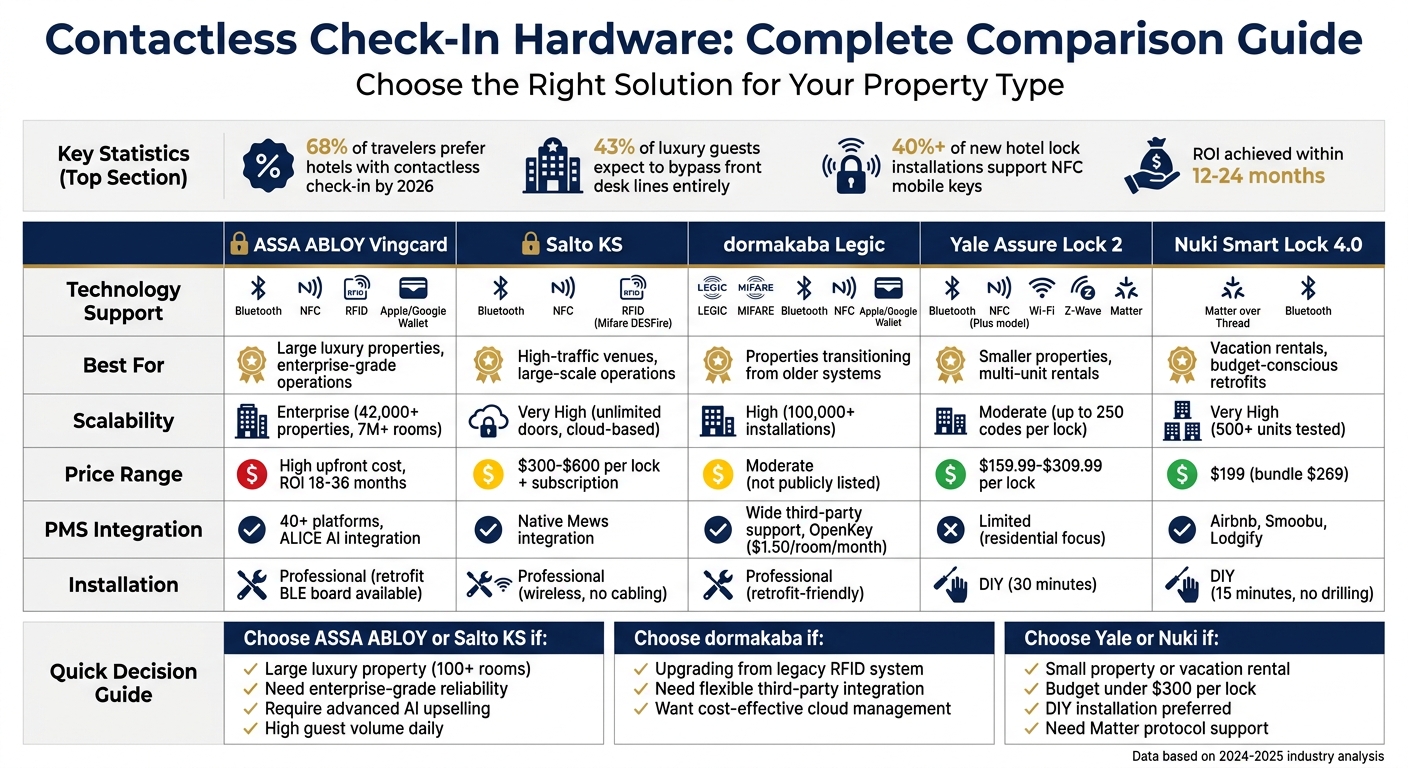
Contactless Check-In Hardware Comparison: Features, Costs, and Best Use Cases
1. ASSA ABLOY Vingcard Vision with Mobile Access
Compatibility with Modern Technologies
The Vingcard Vision system integrates Bluetooth Low Energy (BLE) and Near Field Communication (NFC), enabling guests to use smartphones or smartwatches as digital keys. Existing VingCard RFID locks – such as Classic, Signature, Essence, and Allure – can be upgraded with a BLE board and updated reader electronics. The system uses Seos to ensure secure delivery and revocation of digital keys. Hotels can implement mobile access through SDKs, partner apps, or standalone solutions, provided they have Visionline version 1.21.1 or higher and a Mobile Access license.
Currently, over 40% of new hotel lock installations worldwide support NFC mobile key functionality. NFC operates at 13.56 MHz with a read range of less than 1.6 inches, ensuring secure and reliable access. This advanced compatibility makes it easier for large properties to adopt and scale these systems effectively.
Scalability for Large Properties
For larger properties, Vingcard Vision utilizes Visionline, an online access management system that centralizes control across multiple rooms. With cloud-based deployments now accounting for 63.7% of new 2024 contracts, properties can benefit from centralized management and automated digital key delivery via SMS or email, allowing guests to skip front desk check-ins entirely. Self-service check-in systems equipped with Vingcard hardware can handle guest processing at speeds four to six times faster than traditional counters.
Existing locks can be upgraded to include mobile key functionality using API-based integrations like FLEXIPASS, eliminating the need for full lock replacements. Additionally, the system supports "Wallet Keys", enabling room access through Apple Wallet or Google Wallet without requiring a dedicated app. These features create a scalable and cost-efficient pathway for properties to modernize their systems.
Cost-Effectiveness for US Retrofits
For older VingCard systems, retrofitting involves updating reader electronics and adding a BLE board, avoiding the expense of replacing entire lock units. Hotels can opt for a basic off-the-shelf mobile app to reduce development costs or use the SDK to create a fully customized experience. The return on investment (ROI) for these upgrades is typically achieved within 18–36 months.
With ASSA ABLOY technology already installed in over 42,000 properties worldwide, securing more than 7 million hotel rooms, the system has a proven track record of reliability. Gard Gabrielsen, Global Product Director, highlights the convenience of the Mobile Access App:
Our Mobile Access App guides travelers from app download to room entry.
For independent properties in the US, the off-the-shelf app offers a budget-friendly solution, while cloud-based services enable remote management and over-the-air digital key delivery. This modular approach ensures properties can scale their systems without major upfront costs, protecting their investment while enhancing guest experiences.
sbb-itb-161ccc1
2. Salto KS Hyperconnected NFC Locks
Compatibility with Modern Technologies
Salto KS integrates seamlessly with modern tech, supporting Bluetooth Low Energy (BLE), Near Field Communication (NFC), and RFID (Mifare DESFire). This multi-protocol setup makes contactless access smooth and versatile. For Android users, the system offers tap-to-unlock NFC functionality without needing to open an app. iOS users, on the other hand, rely on BLE connectivity via the Salto KS app. Even smartwatches are part of the mix, allowing guests to unlock doors directly from their wrist.
At its core, the system uses a cloud-based infrastructure connected through an IQ gateway. This hub links wireless locks to the cloud, enabling real-time management and "Keys as a Service" without requiring on-site servers. Each gateway can manage up to 7 nodes, with each node handling 16 doors within a 52-foot range. For scenarios where wall readers are closely positioned, the system includes a Near Detection Mode, which limits the Bluetooth signal range to just 4–6 inches, preventing accidental unlocking of nearby doors.
Marc Handels, Chief Technology Officer at SALTO Systems, highlights the advanced nature of the system:
By incorporating the latest in technology into the XS4 Original+ locking range, SALTO has delivered a product that extends up-to-date and comprehensive electronic access control to any door.
Scalability for Large Properties
Salto KS excels in managing large-scale properties, thanks to its Access Control as a Service (ACaaS) model. This allows for the real-time control of an unlimited number of doors across multiple locations. The system’s Salto Virtual Network (SVN) uses "Data-on-Card" technology, where credentials are stored on the user’s card or device instead of the lock itself. This setup eliminates the need for extensive wiring, making it ideal for large venues like resorts or event spaces.
Real-world examples, such as The Place residential complex and Landhotel Gafringwirt, showcase the system’s flexibility. The Place uses the Host Interface Protocol (SHIP) to integrate features like self-service kiosk access. At Landhotel Gafringwirt, guests can skip the front desk entirely, thanks to over-the-air key delivery.
For properties with complex access needs – like managing entry to shared amenities, private suites, and staff-only zones – Salto KS offers hierarchical access control. It supports a mix of entry methods, including NFC, BLE, RFID, and PIN codes. To enhance security, PIN codes are set to expire after 90 days by default.
Cost-Effectiveness for US Retrofits
Designed with US ANSI profile doors in mind, Salto KS hardware, including the XS4 Original+ and XS4 Mini ANSI, is compatible with mortise, cylindrical, and tubular locks. Hardware costs range between $300 and $600 per lock, with additional software licensing fees based on a subscription model. Two subscription tiers are available: Salto KS Lite for basic cloud access and Salto KS Pro for more advanced features.
The system’s wireless, battery-powered locks eliminate the need for costly cable installations. However, properties should plan for regular battery replacements. The voucher-based subscription model ensures real-time functionality, though offline credentials remain operational even if the subscription lapses. For properties looking to expand, "Additional Seats" vouchers make it easy to add lockers or integrate new users into the system.
3. dormakaba Legic NFC Readers
Compatibility with Modern Technologies
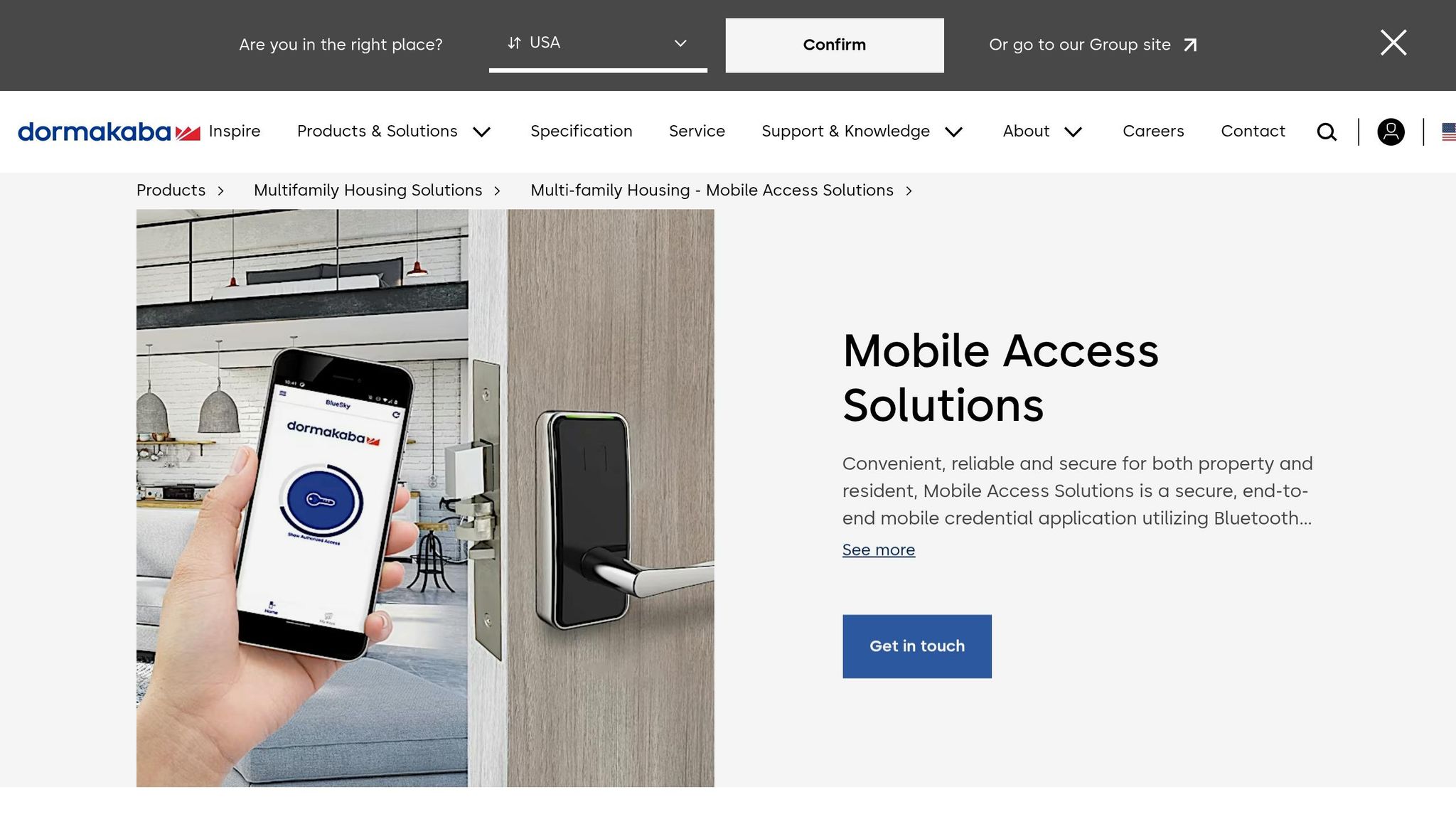
dormakaba’s readers are designed to support both LEGIC and MIFARE RFID standards – two of the most commonly used high-frequency formats in luxury hospitality. Take the desktop reader 91 08, for example. It can read and write to both types of data carriers without requiring additional hardware. This flexibility allows properties to continue using their existing RFID credentials while gradually transitioning to mobile-based systems.
With mobile access powered by BLE and NFC, guests can use their smartphones – or even digital wallets like Apple Wallet and Google Wallet with advanced models such as the Quantum Pixel+ – as room keys. Compact options like the 91 04 reader are versatile enough for both indoor and outdoor use. Additionally, the Quantum RFID lock features a robust 1-inch deadbolt with the option for automatic locking, boosting security.
All dormakaba readers integrate seamlessly with the Ambiance access management software for centralized control. For properties looking to modernize, the Ambiance RX module offers online wireless integration, including remote lock monitoring. Meanwhile, dormakaba’s Keyscan series bridges the gap for properties still using older 125 kHz systems, enabling hybrid credentialing across various formats like fobs, wristbands, cards, and digital credentials. This broad compatibility ensures that properties of all sizes can adopt new technologies at their own pace.
Scalability for Large Properties
dormakaba’s systems are designed to grow alongside a property’s needs, making them suitable for everything from boutique hotels to sprawling resorts. The Access Manager 92 90 unifies the entire dormakaba product lineup into a single access control solution. With LEGIC technology already deployed in over 100,000 installations, the system provides durable hardware and real-time remote lock management through the Ambiance RX system.
For high-traffic environments, dormakaba’s hardware is built to last, featuring wear-resistant finishes and rugged construction. The Ambiance RX system enhances security by offering real-time features like door-ajar alerts and mortise tracking. Remote lock management allows staff to oversee access points across multiple buildings, handling both legacy and modern credentials simultaneously – ideal for large-scale venues with diverse needs.
Cost-Effectiveness for US Retrofits
dormakaba also delivers cost-conscious solutions for retrofitting existing systems. Models like the MT RFID and RT Plus are designed to replace older locks, while the K-SMART3 series works with legacy K-SMART readers, enabling properties to upgrade without replacing all existing credentials. Though hardware costs aren’t publicly listed, the RCI Conekt series is promoted as a budget-friendly 13.56MHz reader option for retrofits.
These readers utilize a standard Wiegand interface, supporting cable runs up to 500 feet and operating on 12 VDC. They are rated to withstand temperatures ranging from -40°F to 150.8°F, making them suitable for various environments. Available in mullion and single-gang mount options, the hardware fits standard US architectural footprints without requiring door modifications. Features like tamper-resistant epoxy potting and weather-resistant construction reduce maintenance needs, while mobile credential support lowers ongoing costs tied to physical fobs and smartcards. These retrofit options allow properties to upgrade incrementally, avoiding the expense of a full system overhaul.
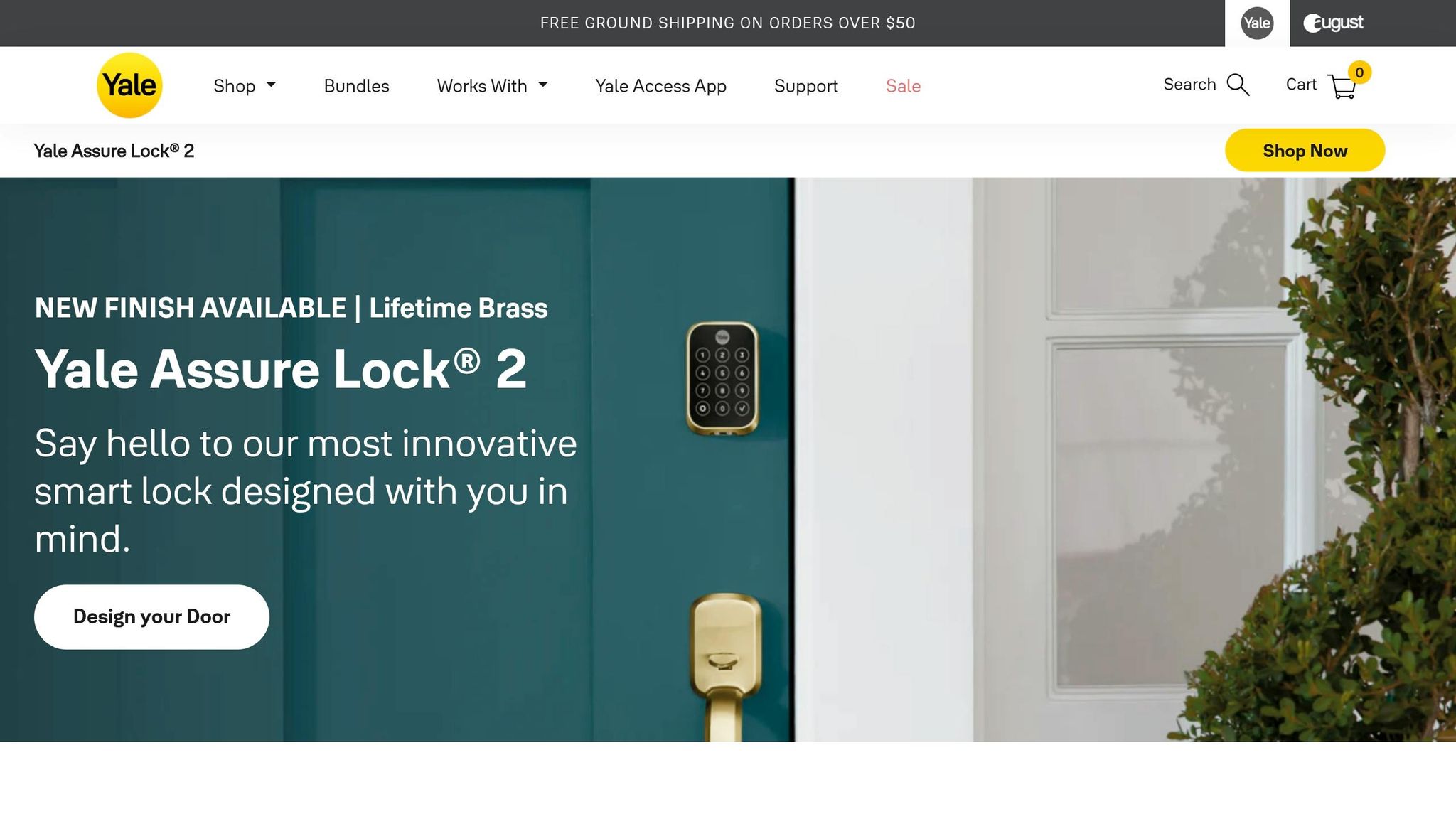
4. Yale Assure Lock 2 Bluetooth/NFC Hybrid
Compatibility with Modern Technologies
The Yale Assure Lock 2 stands out with its swappable Smart Modules, offering support for Wi‑Fi, Z‑Wave, and Matter. Every version of the lock includes Bluetooth and works seamlessly with the Yale Access app. It also integrates with popular smart home platforms like Apple HomeKit, Amazon Alexa, Google Home, and Samsung SmartThings. The Plus model takes it a step further by supporting Apple Home Key, allowing users to unlock doors by simply tapping their iPhone or Apple Watch via NFC.
One convenient feature is the ability to generate temporary access codes that are valid only for the duration of a guest’s stay. Additionally, the Auto-Unlock feature uses geofencing and Bluetooth to detect when a guest approaches, unlocking the door automatically. However, some users have reported occasional inconsistencies with this feature when using the Wi‑Fi module. The modular design of the lock blends advanced connectivity with straightforward operation, making it a practical choice for properties with frequent guest turnover.
Scalability for Large Properties
Thanks to its versatile connectivity, the Yale Assure Lock 2 is well-suited for managing multiple units and handling high guest turnover. It supports up to 250 unique entry codes, making it ideal for properties with a constant flow of visitors. Property managers can monitor activity in real time through the Yale Access app when paired with the Wi‑Fi Smart Module. This feature allows for remote verification of check-ins and check-outs without needing to be physically present.
The lock is built to last, with an ANSI/BHMA Grade 2 certification and an IPX5 rating for weather resistance, capable of withstanding temperatures from –22°F to 140°F. Its slim, 30% smaller design provides a sleek, modern appearance. Key‑free models enhance security by eliminating physical key handovers and offering DoorSense alerts, which notify users of the door’s status. This shift toward digital management streamlines operations for property owners.
Cost-Effectiveness for US Retrofits
Designed to fit standard US entry doors with thicknesses ranging from 1 3/8″ to 2 1/4″ and bore holes of 2 1/8″ or 1 1/2″, the Yale Assure Lock 2 is easy to install. DIY installation typically takes under 30 minutes, helping property owners save on locksmith fees, which can range from $80 to $340 per door. The lock’s pricing starts at $159.99 for the Bluetooth keypad model, with touchscreen versions priced at $179.99. Models with Wi‑Fi integration are available for $239.99 to $279.99, while the Plus model with NFC support costs $309.99. For multi-unit retrofits, Yale offers a "Keyed Alike" service for $4.00 per lock.
Battery life varies depending on the model. Bluetooth-only versions last 6–9 months, whereas Wi‑Fi-enabled models require battery replacement every 3 months. To reduce maintenance, property managers might consider using Z‑Wave or Matter modules instead of Wi‑Fi. Alternatively, the Yale Connect Wi‑Fi Bridge can handle connectivity, easing the load on the lock itself. For emergencies, key‑free models include an external 9V battery terminal to prevent lockouts if the internal batteries fail.
"The Assure Lock 2 is around 30 percent smaller than before… it also sports a more traditional [look], so you don’t have to explain how to unlock the door to visitors." – Sam Rutherford, Reviewer
5. Nuki Smart Lock 4.0 with Matter Protocol
Compatibility with Modern Technologies
The Nuki Smart Lock 4.0 leverages Matter over Thread, a mesh network that connects seamlessly with Matter-enabled hubs like Apple Home, Google Home, Amazon Alexa, and Samsung SmartThings. Matter ensures fast, local communication between the lock and your smart home hub, enhancing both response time and security. Its brushless motor is impressively quick, unlocking doors in under a second. With Matter version 1.2, it can differentiate between "Unlock" and "Open door" commands, a crucial feature tailored for certain US door hardware setups.
Beyond smart home integration, Nuki works directly with platforms like Airbnb, Smoobu, and Lodgify, allowing property managers to automate guest access code generation effortlessly. This robust connectivity makes it an excellent choice for large-scale property management.
"This marks the beginning of a new era for Smart Homes… the basic idea behind Matter is to interconnect smart home devices in a manufacturer-independent and cross-platform manner." – Nuki Home Solutions
Scalability for Large Properties
Thread’s mesh network provides reliable connections, even in large properties. For example, in April 2025, Checkmyguest successfully automated key handovers for over 500 accommodations by integrating Nuki Smart Locks with their property management system (PMS). For multi-unit buildings, the Nuki Opener ensures seamless access from the main entrance to individual units, offering a completely keyless experience.
To simplify access further, the system supports app-free entry through web links, eliminating the need for guests to download an app. Meanwhile, property managers can oversee every door in real time using the Nuki App or Web portal, which also provides detailed activity logs for security reviews. For added convenience, the Smart Hosting service guarantees priority technical support with a three-hour response time and includes an extended three-year warranty.
"We have equipped 500 accommodations with Nuki… We were easily able to integrate Nuki into our PMS and thereby fully automate the entire process." – Biagio, Checkmyguest
Cost-Effectiveness for US Retrofits
The Nuki Smart Lock Ultra offers an affordable retrofit solution, specifically designed for US single-cylinder deadbolts. It installs over existing interior thumb turns in just 15 minutes, requiring no drilling or changes to exterior hardware. This makes it perfect for rental properties, as landlords can retain their original key access. The lock mounts discreetly on the inside of the door, remaining invisible from the outside.
Installation is simple, needing only a Phillips-head screwdriver. The package includes mounting plates and adapters to fit various tailpiece shapes. The lock is priced at $199, while a bundle including the Smart Lock and Keypad 2 costs $269. Its rechargeable lithium-polymer battery lasts three to six months per charge and can be fully recharged in two hours using a magnetic USB-C port – without needing to remove the lock from the door.
For remote Wi-Fi access, a $5.90/month Nuki Premium subscription is available. However, connecting to a Matter-compatible Thread Border Router, such as an Apple TV or HomePod, eliminates this fee.
"We are proud to bring Nuki to the United States – a significant milestone in our journey to make smart, secure, and user-friendly access solutions available to more people around the world." – Martin Pansy, CEO and co-founder of Nuki
How Contactless Hotel Interactions Improve the Guest Experience w/ Tristan Gadsby & Alberto Santana
Pros and Cons
When it comes to scalability and integrating digital solutions for luxury properties, each option comes with its own strengths and trade-offs. These differences often depend on factors like property size, guest preferences, and budget constraints. Let’s break down the key details.
ASSA ABLOY Vingcard stands out for its compatibility with over 40 PMS platforms. It also integrates with ALICE for advanced AI-driven upselling and real-time digital key management. However, its high upfront costs make it a significant investment for properties. On the other hand, Salto KS offers robust cloud-based management with native integration into Mews, making it a solid choice for high-volume properties that need reliable NFC technology.
For budget-conscious properties, dormakaba Legic is a strong contender. It works seamlessly with cost-effective platforms like OpenKey, which starts at just $1.50 per room per month. This makes it an appealing option for those seeking modern features without a hefty price tag. Meanwhile, Yale Assure Lock 2 and Nuki Smart Lock 4.0 are known for their affordability and ease of retrofitting. Nuki, priced at $199, supports the Matter protocol, eliminating the need for subscription fees and making it a favorite for smaller properties or those prioritizing simplicity.
Mobile-first systems are another popular option, offering frequent software updates. However, they face challenges with guest adoption. Luxury hotels report only 45–60% of guests opting for contactless check-ins, meaning traditional front desk support remains essential for many. Physical kiosks, like Virdee ($4,995 upfront, $199/month), are great for handling walk-ins or guests without smartphones, but they come with drawbacks. These include potential single points of failure and the need for specialized technicians for maintenance. For remote properties, phone-based systems often prove to be a more practical solution.
Here’s a quick comparison of the key features for each system:
| Hardware Option | Compatibility | Scalability | AI Integration | Cost-Effectiveness |
|---|---|---|---|---|
| ASSA ABLOY Vingcard | High (40+ PMS platforms) | Enterprise-grade | Advanced (facial recognition, AI upselling) | Moderate |
| Salto KS | High (native Mews/Virdee) | High (cloud-based) | Moderate (platform-dependent) | Moderate |
| dormakaba Legic | High (wide third-party support) | High | Moderate (standard API) | Moderate |
| Yale Assure Lock 2 | Moderate (residential focus) | Low to moderate | Standard (automated codes) | High |
| Nuki Smart Lock 4.0 | High (Matter protocol) | Very high (no physical install) | Standard (smart home ecosystem) | High ($199 base price) |
For larger properties, a hybrid approach often works best. This involves combining mobile check-in options for tech-savvy guests with at least one kiosk for those who might face challenges like dead phone batteries or limited smartphone skills. This setup keeps staffing needs efficient while ensuring service quality for all types of guests.
Conclusion
Choosing the right contactless hardware depends heavily on your property type and operational demands. For large-scale luxury properties handling high volumes of arrivals, ASSA ABLOY Vingcard sets the benchmark. Its robust integration capabilities make it an excellent choice for properties needing enterprise-level reliability and advanced upsell workflows. This solution helps reduce lobby congestion – a critical advantage, as 43% of luxury guests expect a check-in experience free from long lines. For larger properties, this directly impacts guest satisfaction by improving operational flow.
Event venues and properties that see high traffic often benefit from a hybrid model. Combining mobile check-in with physical kiosks allows these venues to handle sudden arrival surges effectively. This approach also accommodates guests without smartphones or those dealing with dead batteries, making it a flexible, guest-friendly solution that balances convenience with efficiency.
In the vacation rental space, Essentialyfe luxury rentals utilize systems like Salto KS and dormakaba Legic, which are both scalable and cost-efficient. These cloud-based options integrate seamlessly with messaging platforms, eliminating the need for app downloads while still delivering the premium experience luxury guests expect. Pairing these systems with highly rated platforms for vacation rentals – like Duve, which boasts a 94% satisfaction rating – ensures a smooth arrival process that aligns with high-end brand expectations. Additionally, the versatility offered by providers like Salto KS, dormakaba Legic, Yale, and Nuki highlights the growing importance of adaptable technology in luxury property management.
For long-term success, properties should invest in hardware that supports Bluetooth, NFC, and emerging standards like Matter. Ensuring native PMS integration is also critical to maintaining secure, real-time data flow and avoiding reconciliation errors. Many properties see a full return on investment within 12 to 24 months, thanks to reduced staffing needs (cutting peak-hour staffing by 20–40%) and the elimination of physical key card expenses.
The contactless check-in market is expected to grow significantly, with projections reaching several billion dollars globally by 2033.
FAQs
How can I tell if my current door locks can be upgraded instead of replaced?
To determine if your door locks are compatible with a smart lock upgrade, check the following:
- Single-cylinder deadbolt: Your lock should be a single-cylinder deadbolt.
- Thumb turn placement: The thumb turn must be separate from the door handle.
- Installation space: Ensure there’s at least 1 inch of clearance for the smart lock.
If your lock meets these requirements, you can likely install a retrofit smart lock without replacing the entire lock.
What PMS integrations are must-haves to avoid sync and key-issuance errors?
For smooth and efficient operations, certain Property Management System (PMS) integrations are a must. These include:
- Automated Digital Key Issuance: Automatically links digital keys to reservations, streamlining the check-in process for guests.
- Real-Time Room Status Updates: Keeps housekeeping and front desk staff on the same page, ensuring rooms are ready when needed.
- Profile-Based Access Management: Grants access based on guest profiles, adding a layer of convenience and security.
These integrations not only improve day-to-day operations but also help avoid synchronization issues and errors during contactless check-ins.
What’s the best backup plan when guests can’t use mobile keys?
Providing physical keys or RFID cards as a backup is a smart way to ensure reliable access to your property. These alternatives offer a dependable solution if mobile keys fail or become unavailable. Keeping these backups easily accessible helps reduce interruptions and ensures your guests can enjoy a smooth and hassle-free experience.