Luxury rentals in 2026 require smart technology to meet guest expectations and simplify property management. Here’s what matters most:
- Access Control: Keyless entry and smart locks (e.g., Schlage Encode) ensure smooth, secure check-ins. Always provide backup options like lockboxes.
- Climate Control: Smart thermostats (e.g., Google Nest, Ecobee) save up to 23% on energy costs by adjusting to occupancy. Pre-set temperatures for guest comfort.
- Safety Features: Devices like Google Nest Protect provide instant alerts for smoke, carbon monoxide, and leaks, protecting your property and guests.
- Entertainment: Smart TVs with features like Roku Guest Mode and voice assistants enhance the guest experience. Wall-mount TVs and include clear usage instructions.
- Lighting: Systems like Philips Hue offer customizable ambiance, energy efficiency, and remote control. Use motion sensors for convenience.
- Centralized Management: Smart hubs (e.g., Aqara Hub M3) connect devices, automate tasks, and streamline operations.
Integrating these technologies improves guest satisfaction, reduces costs, and keeps your property competitive in a tech-driven market.
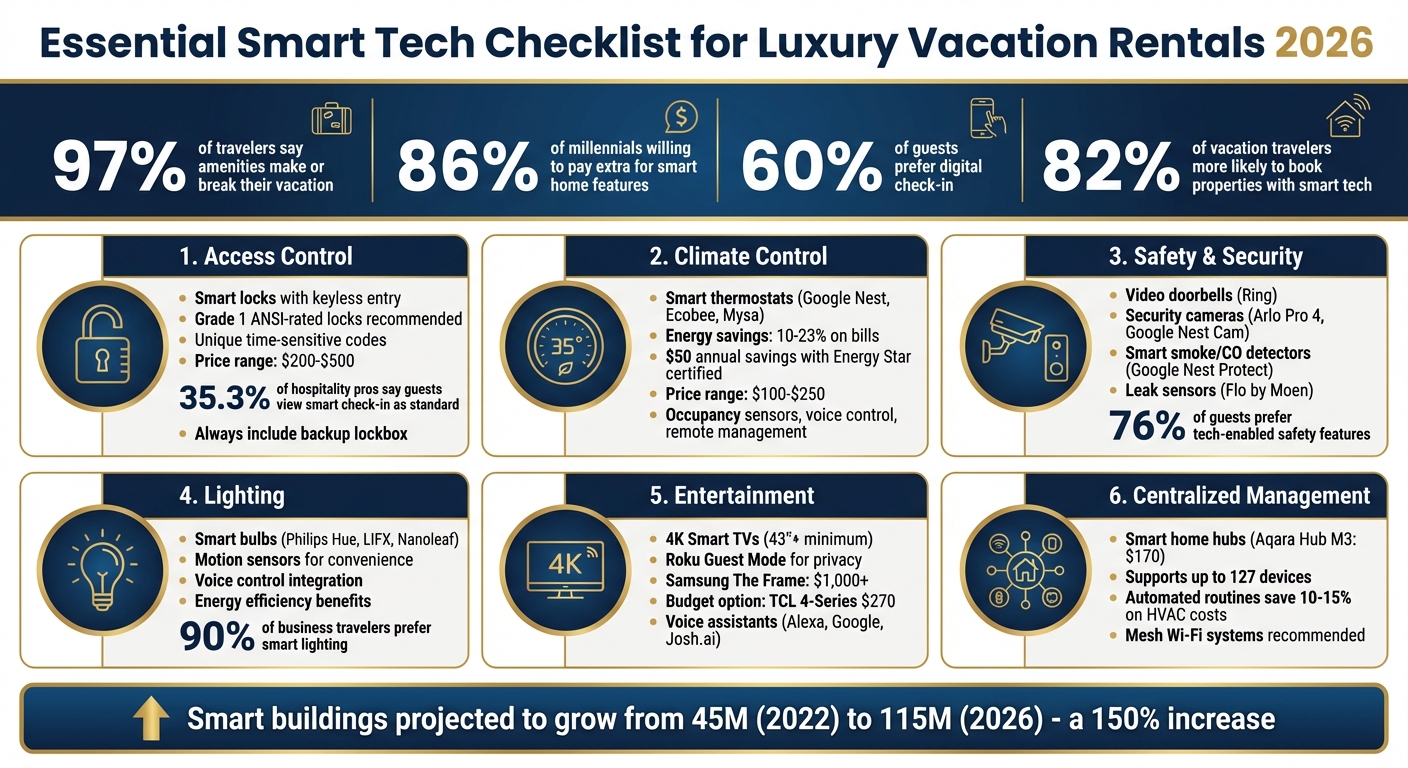
Essential Smart Tech Checklist for Luxury Vacation Rentals 2026
Comparing the top smart home options for short term rentals
sbb-itb-161ccc1
Access Control and Guest Check-in
First impressions matter, and for luxury rentals, that starts right at the door. Smart locks and keyless entry are no longer just perks – they’re expectations. Over 60% of guests now prefer digital check-in over traditional methods, and 35.3% of hospitality professionals say guests view smart self-check-in as a standard feature.
Smart Locks and Keyless Entry
Smart locks simplify the check-in process, eliminating the hassle of coordinating key exchanges while offering a smooth, high-end experience. When paired with property management software, these locks can automatically generate unique, time-sensitive codes sent directly to guests via email or SMS.
For reliability and security, opt for Grade 1 ANSI-rated locks, such as the Schlage Encode, which includes features like PIN randomization and integrated 2K HD cameras for added safety. Entry-level options, like Yale models, are available for under $200, while more advanced systems, such as the Lockly Vision Elite, cost $499.99.
To make things even easier, avoid forcing guests to download apps. Instead, use simple PIN codes or leverage features like Apple Home Key for iOS users. This is particularly appealing to millennial travelers, who are willing to pay up to 20% more for properties equipped with smart technology.
Always have a backup plan. Provide a physical lockbox with a traditional key in case of power outages or Wi-Fi issues. Additionally, set a one-hour pre-check-in buffer and ensure access codes expire promptly at checkout to maintain security and prevent unauthorized entry.
Next up, learn how smart thermostats and sensors can elevate your guests’ comfort even further.
Climate and Environmental Comfort
Controlling the climate isn’t just about comfort – it’s also a smart way to cut energy costs. Luxury rentals with efficient climate systems can save between 10% and 23% on energy bills, and Energy Star certified thermostats alone can reduce utility expenses by about $50 annually.
Smart Thermostats
Smart thermostats are game-changers for creating a seamless guest experience. These devices learn usage patterns automatically, adapting to guests’ habits without manual programming. For example, the Google Nest Learning Thermostat adjusts itself based on guest behavior, while the Ecobee SmartThermostat uses remote sensors to manage temperatures in specific rooms that guests actually occupy. If your property uses baseboard heating, the Mysa thermostat is tailored for high-voltage systems, making it an ideal choice.
Features like occupancy sensors are a must – they switch to eco-mode when no one is home, saving energy effortlessly. Guests can also control the temperature hands-free using Amazon Alexa, Google Assistant, or Apple HomeKit, adding an extra layer of convenience. To ensure guests are comfortable the moment they arrive, set the thermostat to reach the perfect temperature 30–60 minutes before check-in.
Before purchasing, check if your HVAC system includes a C-wire for continuous power. If not, you may need a power adapter, especially in older properties. For budget-friendly options, the Emerson Sensi thermostat costs around $100 and even sends alerts for potential HVAC issues. On the higher end, models like the Ecobee, priced closer to $250, come with advanced features that justify the investment.
But maintaining a comfortable environment isn’t just about temperature – protecting the property from water damage is just as crucial.
Leak and Humidity Sensors
Smart leak and humidity sensors can save property owners from costly repairs by sending instant alerts to your phone the moment an issue arises. Devices like Flo by Moen or Google Nest Protect are excellent choices for catching leaks early. Place these sensors near water heaters, under sinks, or by dishwashers – anywhere plumbing problems are likely to occur.
Humidity sensors are equally important, especially in areas like bathrooms or basements. These devices help prevent mold, keeping the property in pristine condition and meeting the high standards guests expect from a luxury rental.
Lighting and Ambiance
After fine-tuning climate control, smart lighting takes guest experiences to the next level.
Smart lighting has become a game-changer for hospitality. Research highlights that 82% of vacation travelers and 90% of business travelers are more inclined to book properties featuring smart home technology. These systems not only enhance the visual appeal of a space but also boost its competitive edge.
Smart Lighting Systems
Smart lighting systems offer unmatched convenience and control. With smartphone apps, hosts can manage lights remotely, schedule activations to greet guests, and reduce energy consumption. Many systems also integrate with voice assistants like Amazon Alexa, Google Assistant, or Apple Siri, allowing guests to adjust lighting with simple voice commands.
Motion sensors add another layer of convenience and safety by automatically lighting hallways or bathrooms during nighttime. For ambiance, systems with millions of RGB color options and dimming features are a great choice. For example:
- Philips Hue: Offers an expansive ecosystem with features like presence-mimicking, simulating occupancy when the property is empty.
- LIFX bulbs: Deliver vibrant colors without requiring a hub.
- Nanoleaf Shapes: Modular light panels with over 16 million color options, perfect for creating eye-catching accent walls.
"The perks of smart bulbs are more for the host than the guest. With connected lights, you can see if a guest happened to leave lights on when they checked out."
- Taylor Martin, Tech Expert, CNET
When selecting smart lighting, connectivity matters. Wi-Fi bulbs, like TP-Link Kasa, are easy to set up but can strain networks if too many are installed. Zigbee systems, such as Philips Hue or Sengled, operate on dedicated mesh networks, keeping the guest Wi-Fi strong – ideal for larger properties. A practical strategy might involve using smart bulbs for accent lighting while opting for smart switches to control multiple overhead fixtures. For budget-conscious hosts, options like Wyze or Govee work well, while premium properties may prefer the robust Philips Hue ecosystem.
Security and Safety Features
Keeping a property secure with smart technology is just as important as offering a comfortable stay. In fact, 76% of guests prefer accommodations that use tech solutions for safety. Let’s dive into some advanced tools like video doorbells and security cameras that can enhance property protection.
Video Doorbells and Security Cameras
Video doorbells are incredibly handy. They not only help verify a guest’s identity during check-in but also keep track of visitor activity throughout their stay. For instance, Ring Video Doorbells allow two-way communication, making it easy for guests to interact with deliveries or visitors.
Outdoor security cameras, on the other hand, are perfect for monitoring entry points and the property’s perimeter. Models like the Arlo Pro 4 and Google Nest Cam come with AI-powered alerts that can differentiate between people, animals, and general motion. If outdoor power access is a concern, the TP-Link Tapo Wire-Free MagCam, rated 4.5/5 by PCMag, offers features like color night vision and long battery life – perfect for more remote areas.
Transparency is key when it comes to privacy. Hosts should clearly disclose the location of all exterior cameras in their property listing to maintain guest trust and comply with platform rules. Surveillance inside private spaces like bedrooms, bathrooms, or saunas is strictly forbidden. As Sarah, an Airbnb Consultant, wisely points out:
"Effective communication about security is the best policy for hosts over anything else".
But security doesn’t stop at surveillance. Smart detectors can further ensure a safe environment.
Smart Smoke and Carbon Monoxide Detectors
Smart smoke and carbon monoxide detectors are game-changers for safety. These devices send instant alerts to both guests and property managers through smartphone apps, enabling quick action even when no one is on-site. Unlike traditional alarms that only sound locally, options like Google Nest Protect and Kidde Smoke & CO Detectors notify you immediately, helping to prevent serious damage or even save lives.
To maximize safety, install detectors on every floor and in all sleeping areas. For hosts with active Airbnb listings, there’s even more good news: Airbnb offers one free smoke or carbon monoxide detector per listing, making it easier to prioritize safety. For a more advanced solution, consider multi-sensors like the Arlo Dual Sensor, which CNET rated 8.3/10. This device monitors up to eight factors, including motion, smoke/CO alarms, and even water leaks – all in one compact unit.
Entertainment and Connectivity
Smart entertainment and voice control have become essential features in luxury rentals, creating a seamless and memorable guest experience. Guests expect effortless access to content and intuitive control over devices. As Chad Phillis, an Airbnb Co-Hosting Specialist, aptly puts it:
"A television isn’t just another electronic device; it’s a central component of the guest’s experience".
Smart TVs and Streaming Services
In today’s market, 4K resolution is a must for TVs that are 43 inches or larger. Anything less doesn’t meet guest expectations. Guests also value secure access to their streaming accounts, making features like Roku Guest Mode highly desirable. This mode automatically logs guests out of all apps and deletes their credentials on the departure date, ensuring privacy and convenience.
For luxury rentals, Samsung’s The Frame stands out. Starting at $1,000+ for a 55-inch model, it doubles as artwork, adding a touch of elegance to your property and making your listing photos shine. On the more budget-friendly side, the TCL 4-Series Roku TV offers excellent functionality at around $270 for a 50-inch model. Some hosts are going the extra mile with custom welcome screens that greet guests by name, display Wi-Fi details, and provide digital guidebooks directly on the TV. Chandler Spence, CEO of Hostfolio, highlights the impact of this feature:
"The personalized welcome screen displayed on the TV greets my guests with their names, check-in/check-out dates, and helpful info – all in a visually stunning way providing the ‘Wow!’ factor I’ve been seeking".
Practical considerations are just as important. Secure wall mounting prevents theft and accidents, while proper cable management ensures a clean, professional look. To simplify the experience, a laminated guide placed near the TV can explain how to use the streaming services, saving you from unnecessary support calls.
While smart TVs set the stage for entertainment, voice assistants add an interactive layer to the guest experience.
Voice Assistants and Smart Speakers
Voice assistants act as digital concierges, available 24/7 to answer questions or provide information. Guests can ask for the Wi-Fi password, check-out instructions, weather updates, or even local restaurant recommendations – all without reaching for their phones.
One guest praised the AIPEX Virtual Concierge, saying:
"This house has an amazing Amazon Echo… it knows the wifi codes, check-out information, it is like having the reservation agent at standby in the house to answer all the questions. That is first-class technology".
Voice controls also allow guests to manage entertainment, adjust lighting, regulate temperature, and even control motorized shades with simple voice commands. For a personal touch, hosts can customize welcome prompts. Kathleen, a host, shared her experience:
"The customization option is fantastic and I personalize it for every guest in the welcome prompt with Alexa saying their names etc. (People love hearing their names) and it’s totally enhanced their experience".
For high-end properties, Josh.ai offers a privacy-first solution by processing commands on-site, ensuring guest data remains secure. Their sleek architectural microphones, like the Josh Nano, blend seamlessly into sophisticated interiors, maintaining the property’s aesthetic while delivering advanced functionality. However, it’s important to provide physical controls alongside voice options, so guests of all tech comfort levels can enjoy their stay.
Integrated Control and Management
Managing multiple smart devices in a luxury rental becomes much simpler with centralized control. A smart home hub serves as the central command center, connecting devices like lights, thermostats, locks, and security cameras. This setup eliminates the hassle of juggling multiple apps, creating a seamless experience for guests. By consolidating all smart features under one system, you can streamline check-ins and offer a more personalized stay.
Smart Home Hubs
Choosing the right hub for your luxury rental is key to turning a collection of gadgets into a cohesive system. Take the Aqara Hub M3, for instance – it costs $170.00 and supports Matter, Thread, Zigbee 3.0, Bluetooth, and Wi‑Fi. It can manage up to 127 devices, making it a powerful option for larger setups. Another important feature to look for is local automation processing. This ensures that essential systems like lighting and climate control continue to function even during internet outages. For legacy devices like older air conditioners or TVs, hubs with built-in 360° IR blasters, such as the Aqara Hub M2 ($78.00), can integrate these into your smart ecosystem.
For added convenience, consider hubs that sync with vacation rental platforms to automate tasks like generating access codes. Guest-facing displays like the Google Nest Hub or Amazon Echo Show 8 provide an intuitive control panel, while the Google Home app supports over 80,000 smart products, giving you plenty of flexibility.
If you’re managing a larger property, pairing your hub with a mesh Wi‑Fi system like the eero Pro 7 can ensure strong connectivity throughout the space. Automated routines can also make a big difference. For example, setting up the system to reset thermostats and turn off lights at checkout could cut heating costs by 10%–12% and cooling expenses by 15%. As Excellence Luxury Villas puts it:
"The real magic happens when these components work in unison, creating automated routines that simplify your day".
Conclusion
Smart technology has transitioned from being a luxury feature to an essential component of high-end rental properties. The numbers speak for themselves: 97% of travelers believe amenities can make or break their vacation, and 86% of millennials are willing to pay extra for properties equipped with smart home features. By adopting the right technology, you’re not just keeping pace with trends – you’re gaining a competitive edge that attracts more bookings and earns better reviews.
What makes this shift so impactful is how seamlessly these technologies integrate into the guest experience. They don’t just add convenience; they redefine it. As Nick Sheveland from Clear Stay Properties explains:
"Smart devices do more than add a ‘wow’ factor. They solve real pain points for both hosts and guests".
The future of luxury rentals lies in "invisible" technology. Guests want effortless comfort – lights that adapt automatically, climate systems that intuitively adjust, and security that operates quietly in the background. This frictionless experience is what elevates a rental from good to exceptional.
From a property management perspective, smart tech is a game changer. Tools like leak sensors prevent expensive water damage, noise monitors help avoid unauthorized events, and automated climate controls cut down on energy bills. These features not only protect your property but also save you time and reduce stress, allowing you to focus on delivering a premium guest experience. With the number of smart buildings projected to grow from 45 million in 2022 to 115 million by 2026 – a staggering 150% increase – staying ahead of this curve is essential. Modern travelers now expect amenities like high-speed Wi-Fi, keyless entry, and smart climate systems as basic necessities, not optional extras.
FAQs
What smart upgrades give the fastest ROI in a luxury rental?
The quickest return on investment for luxury rentals often comes from targeted upgrades that boost guest convenience while cutting costs. Some top choices include:
- Reliable high-speed Wi-Fi: A must-have for modern travelers, ensuring seamless connectivity.
- Smart locks with keyless entry: Simplifies check-ins and enhances security.
- Smart thermostats: Helps guests customize their comfort while keeping energy expenses in check.
These upgrades not only elevate the guest experience but also help reduce vacancies and make property management more efficient.
How do I keep smart locks working during Wi‑Fi or power outages?
When selecting a smart lock, consider options that work offline using Bluetooth or Matter-over-Thread. These technologies let the lock operate without needing an internet connection. By storing access rules locally, they ensure that guest access and security logs continue to function smoothly, even during network outages.
To enhance reliability, always have backup access methods available. This could include physical keys or keypad codes. It’s also a good idea to regularly test the lock’s offline features to make sure everything works as expected when the internet is down.
How can I offer smart security without violating guest privacy?
To maintain a balance between security and guest privacy, consider disabling indoor cameras during guest stays or configuring them to record only when guests are away. Never place cameras in private areas such as bedrooms or bathrooms; instead, restrict their use to common areas or outdoor spaces. Be upfront with guests about the security measures in place, making it clear that their purpose is to ensure safety, not to invade privacy. These steps help create a safe and respectful atmosphere for everyone.