Managing transportation for events requires precision. Modern chauffeur services simplify this with advanced tools like real-time GPS tracking, automated flight monitoring, and digital manifests. These features reduce delays, improve communication, and ensure smooth logistics for events of any scale.
Key Highlights:
- Real-Time GPS Tracking: Monitor your fleet with updates every 10 seconds for accurate positioning.
- Dynamic Route Optimization: AI-powered tools adjust routes based on traffic and event-specific road closures.
- Centralized Booking Portals: Manage schedules, guest lists, and last-minute changes from one platform.
- Automated Flight Monitoring: Sync airport pickups with live flight data to avoid delays.
- Digital Manifests: Replace paper lists with live updates for accurate passenger tracking.
- Real-Time Communication: Unified tools for seamless updates between planners, drivers, and guests.
- Passenger Apps: Guests can track rides, get notifications, and personalize their experience.
- Automated Invoicing: Streamline billing with error-free, real-time data integration.
For event planners, these technologies ensure punctuality, reduce stress, and enhance the guest experience. With tools like these, transportation becomes a reliable backbone for any event.
1. Real-Time Fleet Tracking and GPS Visibility
For event planners, having real-time knowledge of where every vehicle is can make or break the success of an event. A cloud-based GPS dashboard simplifies this by displaying your entire fleet – whether it’s VIP sedans, shuttle buses, or airport transfers – on one screen. This eliminates the need for constant back-and-forth phone calls.
To ensure accuracy, it’s important to understand GPS update intervals. Most standard GPS devices refresh every 30–60 seconds, which can lead to significant delays. For events where timing is critical, setting devices to update every 10 seconds with API latency under 5 seconds is a game-changer.
Geofencing accuracy is another key factor. Instead of setting a large boundary around the venue, map geofences to specific areas like loading bays and pickup zones. This allows you to know exactly when a vehicle is in position, so you can confidently move to the next step in your logistics plan.
This level of precision doesn’t just streamline operations – it also improves communication with guests.
"As event organizers, having complete visibility and knowing our VIP clients were picked up and en route gave us peace of mind and allowed us to prepare for their arrival seamlessly." – Isabelle Simmons, Senior Event Content Planner, Goodwood Racing Company
2. Dynamic Route Optimization and Traffic Management
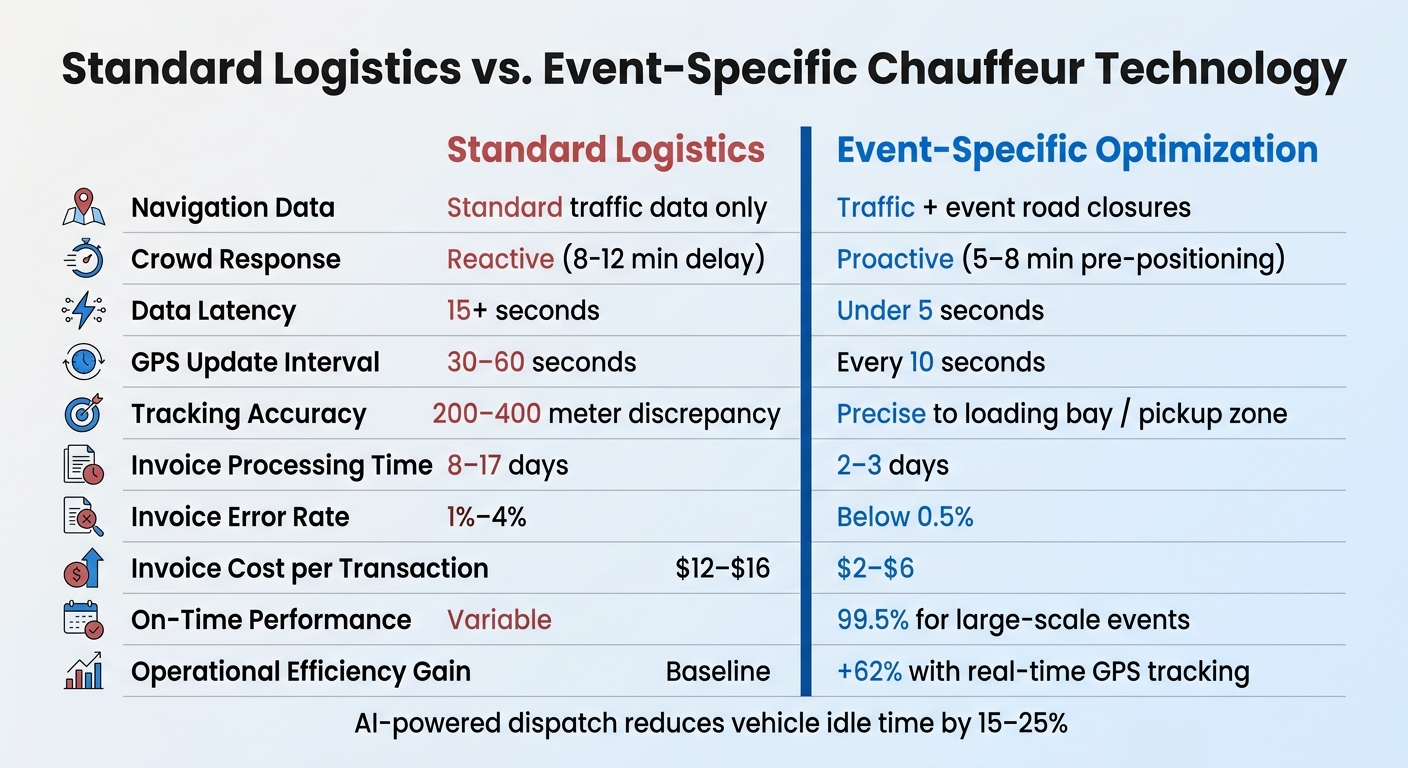
Standard vs. Event-Optimized Chauffeur Tech: Key Performance Metrics
While GPS technology helps locate vehicles, route optimization ensures they arrive on time. Today’s chauffeur platforms leverage AI-powered traffic analysis to anticipate slowdowns before they happen. This means routes are recalculated in real time, and drivers receive updated directions instantly.
Dynamic route optimization takes real-time fleet tracking a step further by adapting to actual conditions on the ground. Imagine a congested venue where a vehicle can cover 1,300 feet in just 30 seconds – if GPS updates lag by 30 to 60 seconds, it can lead to major tracking errors.
"One delay creates a backlog. A backlog creates crowd pressure, which can lead to complaints, security concerns, and a client watching their event unravel." – Mobisoft Infotech
Event-specific driver apps are designed to handle the unique challenges of live events. They incorporate temporary road closures, one-way systems, and restricted venue access, while syncing with live traffic data. This is a game-changer because mainstream mapping apps rarely account for custom traffic plans created for events. Pre-approved secondary routes can also be implemented instantly without waiting for mid-event approvals.
Another smart strategy is syncing route optimization with event schedules. For example, aligning vehicle positioning with session endings or RFID-based exits ensures cars are in place 5–8 minutes before crowds start surging.
| Feature | Standard Logistics | Event-Specific Optimization |
|---|---|---|
| Navigation Data | Standard traffic only | Traffic + event road closures |
| Crowd Response | Reactive (8–12 min delay) | Proactive (5–8 min pre-positioning) |
| Data Latency | 15+ seconds | Under 5 seconds |
3. Centralized Booking Portals and Multi-Guest Scheduling
Centralized booking portals simplify the chaos of managing transportation for large groups of guests. When you’re coordinating rides for dozens – or even hundreds – of attendees from various locations, manual scheduling quickly becomes unmanageable. A centralized booking portal changes the game by offering planners a single platform to handle scheduling, assignments, and real-time ride tracking.
With these systems, planners can upload a guest manifest, assign vehicles, and instantly adapt to changes like late RSVPs, cancellations, or last-minute VIP additions. The entire schedule updates in real time, ensuring nothing falls through the cracks.
"In event transportation, being reactive is not enough, you need to be proactive. Chauffeur dispatch software gives your operations team a single source of truth." – Chauffeur Drive Systems
Another huge advantage is automated guest communication. Once a ride is confirmed, the system sends SMS or email notifications to guests, complete with live tracking links and ETA updates. For VIPs, many platforms also use number masking to protect personal contact information while still allowing smooth communication between drivers and guests.
The scalability of these systems is impressive. For example, drvn‘s FUSE technology successfully managed transportation for 4,000 attendees across 12 hotels during Cvent Connect in Las Vegas – with just 10 days’ notice. The result? A flawless 100% on-time performance and zero guest complaints. Achieving this level of precision requires technology specifically designed for large-scale events. Full-service providers like Essentialyfe integrate these systems into their event management services, ensuring every detail – shuttles, venues, and schedules – stays perfectly aligned.
To streamline the process, share the guest manifest as early as registration opens and finalize it 48–72 hours before the event. As Ridescouts explains, "A simple one-page transportation timeline showing arrival times, number of passengers at each stage, and specific pickup/dropoff locations – this single document eliminates 90 percent of booking miscommunications."
4. Real-Time Communication Tools for Planners, Guests, and Drivers
After bookings are made and vehicles assigned, the next big hurdle is keeping communication smooth and efficient. A single miscommunication can cause delays, irritate VIPs, and throw entire operations off track. That’s where a unified system steps in, extending the benefits of centralized booking into the realm of real-time event coordination.
The key is to shift away from scattered communication methods and move toward a centralized communication platform. This system keeps every instruction, update, and status change logged in one place. Event Falcon captures this idea perfectly with their philosophy: "The radio call you make, not the one you receive.". In other words, reacting to issues after they’ve occurred is already too late.
Modern chauffeur platforms simplify guest-facing communication by automating updates. These tools send out booking confirmations, live vehicle tracking links, and precise ETAs without planners needing to intervene. For VIPs, they strike a balance between maintaining privacy and enabling direct communication when needed. Additionally, these platforms ensure live status updates are acknowledged, keeping everyone on the same page.
What truly sets advanced systems apart are features like AI-powered follow-ups. For example, tools such as Pulse (costing about $1 per hour) automatically nudge drivers or staff if a pickup request isn’t acknowledged within 60 seconds. This virtually eliminates the risk of tasks falling through the cracks. Sarah R., Head of Operations at Grand Events Co., shared her experience:
"We used to lose at least three or four tasks per event. With Charlie [AI] following up automatically, that number is now zero."
Another standout feature is the integrated SOS button. With one press, it alerts a designated dispatcher and provides GPS coordinates, ensuring responses happen within seconds . Isabelle Simmons, Senior Event Content Planner at Goodwood Racing Company, highlighted the peace of mind this kind of visibility brings:
"As event organisers, having complete visibility and knowing our VIP clients were picked up and on route gave us peace of mind."
The bottom line? Assign clear communication roles before the event begins. Designate a lead dispatcher to handle driver communication, a liaison for VIP requests, and a tech operator to monitor platform alerts. Keeping these responsibilities separate ensures that no one is overwhelmed by juggling client calls while managing a fleet of 20 vehicles.
5. Passenger Apps and Digital Ride Experience
Once communication roles are set and dispatch systems are in place, the next step is enhancing the guest-facing side of transportation. A well-designed passenger app takes the guesswork out of the equation, providing guests with essential ride details without the need for phone calls or endless waiting.
These apps shine with features like live driver tracking and automated notifications. Guests can follow their vehicle in real time on an interactive map, complete with the driver’s name and photo. In settings like convention centers or multi-terminal airports, the app can even offer precise instructions – right down to the door number – so guests know exactly where to meet their ride. This kind of direct access not only simplifies the process but also connects efficient dispatching with guest satisfaction.
The Goodwood Racing Company tested this approach when Senior Event Content Planner Isabelle Simmons transitioned her team from manual coordination to a fully digital platform. She shared:
"Our guests loved the convenience of the app, which enabled them to request rides directly – eliminating the need for back–and–forth communication and removing the middleman entirely. It elevated their experience and ours."
For VIP guests, personalization options within the app add an extra layer of convenience. Features like vehicle preferences, comfort settings, and secure communication through number masking allow guests to tailor the experience while keeping personal details private.
To ensure a smooth live tracking experience, GPS updates should refresh every 10 seconds or less. This level of precision enhances the digital ride experience and aligns perfectly with broader technology strategies for event planning.
6. Flight Monitoring and Automated Airport Pickup Adjustments
Airport pickups can quickly become a logistical nightmare, especially during busy travel seasons. With over 20% of domestic flights delayed during peak times, about 1 in 5 airport transfers might need adjustments before the guest even lands. For dispatchers relying on manual methods, this often means constantly refreshing flight boards and making endless phone calls – a time-consuming process prone to errors and unnecessary stress.
Modern technology has stepped in to simplify this chaos. Advanced platforms now tap into FAA and satellite aviation data to track actual landing times, often ahead of what’s shown on public displays. If a flight is delayed or arrives early, the system recalculates the pickup timing – factoring in a 35–45 minute buffer for deplaning and baggage claim – and updates the driver’s app automatically.
These systems don’t stop at timing. Drivers receive real-time updates on gate changes, terminal adjustments, and revised pickup instructions. Meanwhile, guests are kept in the loop with live SMS or app notifications, giving them the driver’s latest status and a new arrival window. If delays create scheduling conflicts, the platform can even reassign the trip to the nearest available vehicle without manual intervention.
The benefits are undeniable. Take Prestige Elite Transport, a Chicago-based fleet with 35 vehicles. By implementing a unified dispatch dashboard with live flight tracking APIs between 2025 and 2026, they saw significant improvements in just 90 days. Client complaints about delays dropped by 40%, deadhead miles fell by 28%, and on-time performance for adjusted trips improved by 22%. This turnaround also helped them recover a lost corporate contract worth $45,000 annually. Real-time adjustments like these transform last-minute changes into manageable processes, ensuring a smoother experience for both guests and staff.
"The moment we started treating last‑minute changes as a process instead of an emergency, our entire team’s stress level dropped and our margins improved." – Ops Director, Prestige Elite Transport
For event planners managing VIP arrivals, the stakes are even higher. Platforms that integrate VIP tagging with full manifest uploads – linking flight numbers directly to guest profiles – take automation to the next level. This ensures logistics run smoothly while allowing your team to focus on delivering exceptional hospitality.
sbb-itb-161ccc1
7. Advanced Dispatch and Load Balancing for Shuttles
Handling shuttle logistics at large events can be a massive challenge, especially when crowds gather quickly. Smart dispatch systems aim to solve this by being proactive rather than reactive – positioning vehicles in advance of crowd surges instead of waiting for lines to form.
These advanced systems rely on GPS updates at intervals of 10 seconds or less, compared to the typical 30–60 seconds. This tighter interval ensures vehicles remain accurately tracked, avoiding discrepancies of 200–400 meters. Pairing this with RFID readers at key locations, like session exits and intersections, creates a window of 5 to 8 minutes to pre-position shuttles where they’re needed most.
For instance, when over 200 attendees converge on a pickup zone in just three minutes, the system automatically triggers a surge alert. It then reassigns the nearest available vehicle, reducing idle time and unnecessary travel. This AI-powered approach not only improves efficiency but also cuts down on wasted miles. These automated processes have proven their worth in high-pressure scenarios.
Take Super Bowl LIX in February 2025 as an example. CharterUP managed shuttles for the event at the Caesars Superdome, deploying 40 motorcoaches to transport 5,500 fans and staff. A team of one program lead and four logistics managers used real-time tracking and oversight to ensure smooth traffic flow and on-time arrivals throughout the event.
Integrating the dispatch platform directly with an event schedule adds another layer of efficiency. When the software knows when high-capacity sessions are ending, it can automatically position vehicles in advance, eliminating the need to wait for queues to form.
Even small delays can snowball into larger crowd management issues, making proactive planning essential. Advanced dispatch systems, combined with dynamic routing and communication tools, ensure seamless operations across multiple zones. For event planners managing complex, multi-venue logistics – like those supported by Essentialyfe’s shuttle and event management services – this level of intelligence can mean the difference between a well-run event and logistical chaos.
8. Digital Manifests, Check-In, and Passenger Identification
Digital manifests have revolutionized how event transportation is managed, offering real-time updates and eliminating the need for outdated paper lists. Unlike traditional methods, where any change in guest or vehicle details could lead to confusion, digital manifests ensure everyone – dispatchers, drivers, and on-site greeters – has access to the same, up-to-date information across all devices.
These platforms don’t just streamline communication; they also save time and reduce errors. By cutting down manual data transfers and slashing booking-related emails by 85%, digital systems can save over 15 hours per event on travel coordination. The efficiency doesn’t stop there – professional manifest systems boast a 99.5% on-schedule performance for large-scale events, a level of reliability that paper-based methods simply can’t match.
Take, for example, a global sales kickoff in Las Vegas. A digital manifest system, synced with Sabre PNR records, managed over 40 vehicle assignments daily for 2,500 attendees from 30 countries. This included coordinating motorcoaches, mini-coaches, and sedans, with precise terminal and door assignments sent directly to passengers.
"Switching from printed spreadsheets and scattered text requests to a fully digital platform was a game–changer for our team. During the event, it streamlined our workflow, consolidated all requests and data in one place, and significantly reduced the pressure on our team." – Isabelle Simmons, Senior Event Content Planner, Goodwood Racing Company
Beyond improving logistics, these platforms prioritize data security. Digital manifests manage sensitive passenger details – like names, flight numbers, and hotel assignments – through encrypted channels, adhering to GDPR standards with data typically purged within 30 days post-event. Physical paper lists, in contrast, offer no such protections. For VIP events, digital systems allow for added precision, such as assigning passengers to vehicles with detailed driver profiles. This level of control is exactly what high-profile guests expect, especially at premium events supported by companies like Essentialyfe.
Paired with real-time fleet tracking and passenger apps, digital manifests ensure every aspect of event transportation operates seamlessly, delivering a smooth and stress-free experience for all involved.
9. Automated Invoicing, Cost Allocation, and Reporting
After ensuring smooth dispatch operations, automated invoicing tools step in to simplify financial tasks once an event concludes. Wrapping up the billing process can be one of the most tedious parts of event planning. Traditional invoicing requires manually reviewing trip logs, reconciling costs, and finalizing payments – all while trying to close out the event promptly. Automated invoicing eliminates these bottlenecks by pulling data directly from dispatch logs and trip records to create invoices without manual input. This not only speeds up the process but also reduces costs and minimizes errors.
Consider the numbers: manual invoice processing costs range from $12 to $16 per invoice, whereas automated systems cut that down to $2 to $6. Error rates drop significantly too, from 1%–4% to below 0.5%. And the time to generate an invoice? It shrinks from 8–17 days to just 2–3 days.
When it comes to cost allocation, these tools shine even brighter. Advanced platforms can handle corporate account billing, automatically assigning charges to the correct department, client, or budget holder. For events involving multiple sponsors or internal teams, the system splits costs accordingly. It also tracks additional charges that are often overlooked – like airport parking, tolls, waiting time overruns, and premium route surcharges. On average, event planners lose $21,000 annually due to missed markups and manual billing errors.
"Vendor pass-through billing was my biggest headache. Now every vendor cost is tracked and my markup is calculated automatically on every client invoice." – Owner, Brooks Events & Design
Post-event reporting takes financial management a step further by offering detailed insights. These reports break down fleet usage, journey completion rates, and revenue per event. Plus, they integrate seamlessly with accounting software like QuickBooks or Xero, keeping records organized and audit-ready while simplifying tax preparation. As Abrez Shaikh, SaaS Development Lead at Yelowsoft, explains:
"Scalability is not adding more vehicles. True scalability means doubling invoice volume without doubling your finance workload."
10. Integration with Event Planning and Property Management Platforms
Automated invoicing is just the beginning. The real game-changer comes when your chauffeur platform connects seamlessly with your event management tools and property systems. Imagine having venue logistics, security protocols, concierge services, and transportation all accessible in one centralized dashboard – no more juggling endless emails or phone calls. This level of integration is made possible by modern API-first technology.
With an API-first architecture, chauffeur software can easily connect to property management systems (PMS), CRMs, and event planning tools. This means when something changes – like a guest’s room assignment or a session running overtime – the transport schedule updates automatically. As Savoya explains:
"Successful executive transportation planning starts with centralization."
For luxury event planners, where transportation is just one piece of a much larger puzzle, this integration is invaluable. Platforms like Essentialyfe simplify the process by combining event venues, shuttle services, security, and concierge offerings into a single system. This eliminates the chaos of coordinating multiple vendors and provides a comprehensive view of all operations.
The benefits are clear, especially for large-scale events. For instance, during the Cvent Connect event in Las Vegas, a coordinated mobility system ensured 100% on-time performance for 4,000 attendees across 12 hotels. By syncing transport schedules with event timelines, vehicles were strategically pre-positioned 5–8 minutes ahead of crowd surges.
Here’s a tip: give on-site venue coordinators and security teams read-only access to the transport dashboard. This reduces repetitive questions like "Where’s the shuttle?" and ensures everyone is working with the same real-time data. By integrating these systems, you create a more transparent and efficient operation for your event.
Wrapping Up
Modern chauffeur services have evolved far beyond basic GPS navigation. Today’s tools – like automated flight syncing, dynamic route optimization, digital manifests, and real-time communication – are designed to tackle specific challenges faced by event planners. And the impact is clear: fleets using real-time GPS tracking report an impressive 62% boost in operational efficiency, while AI-powered dispatch systems can reduce vehicle idle time by 15% to 25%.
As Superior Executive Services aptly puts it:
"Transportation is the invisible thread connecting every part of a corporate event. When it works, nobody notices. When it fails, everyone remembers."
This highlights why the technology backing your chauffeur service is just as important as the vehicles themselves. When choosing a provider, don’t stop at reviewing their fleet. Ask about their API integration options, how they handle unexpected flight delays, whether their dispatch system can manage multi-venue events, and what kind of post-event reporting they offer. These features aren’t extras – they’re essential for high-pressure events.
For planners juggling multiple services, the greatest efficiencies come from integrating transportation with other event logistics. Platforms like Essentialyfe simplify this process by combining event venues, shuttles, security, and concierge services into one cohesive system. This level of coordination ensures that transportation stays aligned with everything else happening on-site, turning potential chaos into seamless execution.
The takeaway? The right chauffeur technology isn’t just about moving people – it’s about safeguarding your event’s success, one ride at a time.
FAQs
What GPS refresh rate is best for event transportation?
For event transportation, relying on a GPS refresh rate of 30–60 seconds can feel like an eternity when quick decisions are needed. Real-time tracking demands faster updates to handle the high-pressure nature of rapid redeployments effectively. Essentialyfe provides event management and shuttle services tailored to keep your transportation plans flexible and responsive, making sure everything runs seamlessly during your event.
How does flight monitoring change airport pickup timing?
Flight monitoring technology integrates with dispatch systems to adjust pickup schedules in real-time based on flight updates. Whether a flight is delayed, arrives early, or switches terminals, this system recalculates the chauffeur’s ETA and updates the driver’s app accordingly. By automating these adjustments, manual tracking becomes unnecessary, ensuring drivers reach the correct location on time. This allows Essentialyfe to maintain dependable service, even when travel plans shift unexpectedly.
What should I ask a chauffeur provider about integrations?
When selecting a chauffeur service for your event, it’s important to inquire about tools that improve organization and streamline operations. Look for features like live flight tracking, which allows for real-time adjustments to pickup schedules, and API connectivity, which simplifies processes like invoicing and CRM integration. Mobile app compatibility is another useful feature, offering instant updates and better communication. Additionally, ensure the platform includes secure payment gateways to protect transactions. Essentialyfe integrates all these systems into its event planning services, ensuring everything runs smoothly for your guests.