Adaptive reuse of older buildings into luxury spaces can save money compared to new construction and offers tax incentives, but it comes with many hidden costs. These include structural upgrades, hazardous material removal, and compliance with historic preservation rules. For example:
- Structural Modifications: Reinforcing foundations, leveling floors, and meeting modern building codes can cost tens of thousands of dollars.
- Historic Preservation: Materials for restoration often cost 30–50% more, and specialized labor adds to expenses.
- Modern Systems: Upgrading HVAC, plumbing, and electrical systems for luxury standards often requires costly retrofitting.
- Compliance Delays: Permits and historic approvals can take months, with fines for non-compliance reaching $10,000 per day.
Developers should budget at least 20% extra for surprises and leverage tax credits (up to 40% of costs) to offset expenses. Early expert involvement and detailed planning are critical to avoid financial pitfalls.
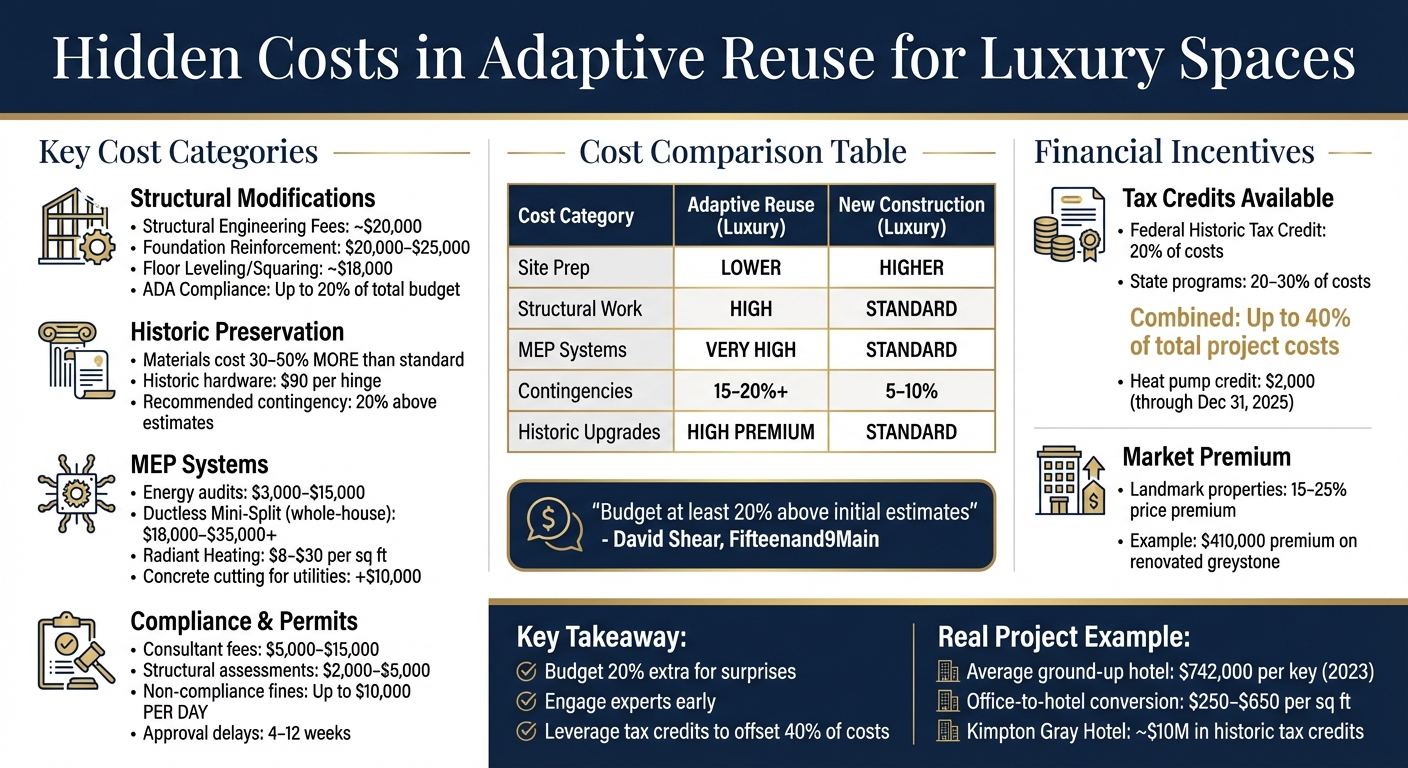
Hidden Costs in Adaptive Reuse: Budget Breakdown vs New Construction
From Old Mills to Stunning Hotels: The Art of Adaptive Reuse in Hospitality Design
sbb-itb-161ccc1
Structural Modifications and Retrofitting Challenges
Transforming older buildings into luxury spaces involves tackling major structural upgrades – often revealing surprises once demolition begins. Reinforcing foundations, leveling uneven floors, and ensuring compliance with modern building codes are some of the most significant hurdles. These challenges often lead to unforeseen costs, as detailed in the sections on meeting current codes and preserving historical elements.
Modifying Structural Features for Luxury Standards
Bringing older buildings up to luxury standards often means addressing structural quirks like uneven floors, unsquare walls, and outdated foundations.
Developer Jonah Richard encountered these challenges during his 501 Main project in June 2022. While converting a one-story foundation to support a three-story apartment building, his team discovered the floor system was several inches out of square. Fixing this required stripping subfloors, shimming joists, and replacing rotted rim joists – a process that took three weeks and cost around $18,000. The foundation also needed $20,000 to $25,000 worth of reinforcements, including custom piers, heavy-duty beams, and metal hold-downs to integrate new and old structures.
"Next time, I may think twice before building on an old foundation. It certainly isn’t the easy path."
- Jonah Richard, Developer, Brick + Mortar
Converting commercial spaces into luxury residential units often involves cutting plumbing stacks through reinforced slabs, each requiring engineering approval. Changing a building’s use – such as from industrial to residential – also mandates a full review of seismic compliance, fire-resistance ratings, and egress width. Upgrading to meet ADA standards can add as much as 20% to the overall budget.
| Structural Challenge | Typical Cost Range |
|---|---|
| Structural Engineering Fees | ~$20,000 |
| Foundation Reinforcement | $20,000–$25,000 |
| Floor Leveling/Squaring | ~$18,000 |
| ADA Compliance Upgrades | Up to 20% of total budget |
These unexpected upgrades highlight the importance of setting aside a contingency budget to handle surprises.
Costs of Preserving Original Architecture
Preserving the historic charm of older buildings introduces another layer of complexity and expense. Materials for historic renovations often cost 30% to 50% more than standard options, and the specialized labor needed can quickly drive up costs.
Between 2024 and April 2026, managing partners David and Carol Shear converted a 250-year-old Danish building in St. Thomas, U.S. Virgin Islands, into five luxury apartments at Fifteenand9Main. The project required two years of daily attention to address unexpected issues like damaged beams and an abandoned elevator shaft that needed urgent removal. Replicating the original roof structure involved importing oversized beams, adding significant expense.
"Anything labeled ‘historic’ comes at a premium."
- David Shear, Managing Partner, Fifteenand9Main
The Shears also found that historic hardware, such as a single hinge, could cost up to $90. When multiplied across an entire building, these costs can escalate quickly. They suggest budgeting at least 20% above initial estimates to account for inevitable surprises in historic renovations.
"If you’re not there every day, things get missed or done wrong."
- David Shear, Managing Partner, Fifteenand9Main
Their experience underscores a critical lesson: daily oversight is essential to catch hidden issues early, whether it’s damaged structural elements, hazardous materials, or architectural details worth preserving. Balancing the authenticity of historic features with modern luxury expectations requires meticulous planning and constant attention to detail.
Upgrading Mechanical, Electrical, and Plumbing Systems
When upgrading older building systems, unexpected costs often emerge. Many historic buildings rely on outdated 100-amp electrical services, which fall short of supporting modern luxury needs like high-capacity HVAC systems, smart home technology, and multiple premium appliances. Adding to the expense, installing luxury HVAC units – some weighing up to 2,000 pounds – frequently requires extensive structural reinforcements to support historic roofs or floors. The lack of space in older buildings for new equipment and ductwork further complicates retrofitting compared to new construction. For instance, during Jonah Richard’s 501 Main project, cutting through existing concrete for new water lines and basement access tacked on an extra $10,000 to the budget – a cost that only became apparent once work began.
"With existing structures accounting for roughly 80% of buildings targeted for decarbonization, repurposing these buildings is becoming a more viable and attractive option."
- Alan Jones, Senior Director of Product Management, Xylem
Repurposing a building – like converting a warehouse into luxury apartments – requires a complete overhaul of HVAC systems due to the drastically different zoning needs and load demands. Older buildings also have high infiltration rates, ranging from 8 to 15 air changes per hour, compared to just 3 to 5 in modern construction. This means HVAC systems must work harder to maintain temperature consistency. Professional energy audits, costing between $3,000 and $15,000 or more for commercial properties, are vital to avoid oversizing systems and wasting money on unnecessary capacity. These challenges often create a domino effect on project budgets, which we’ll explore further in the next sections.
Energy Efficiency and Green Technology Upgrades
Going beyond basic system upgrades, incorporating green technology adds another layer of complexity and cost. For luxury properties aiming to meet decarbonization targets, water-source heat pumps and hydronic systems are increasingly preferred over traditional gas-fired boilers. These systems not only have a Global Warming Potential (GWP) of nearly zero but also offer better thermal storage, making them an excellent choice for properties pursuing LEED or WELL certifications.
A great example is a 4,800-square-foot Victorian mansion in Savannah, Georgia, which underwent a 5-zone mini-split HVAC retrofit in April 2026. The project cost $24,500 and involved routing refrigerant lines through a modified rear addition to preserve the original structure. Indoor units were mounted above the 10-foot picture rail moldings to maintain historic sightlines, and outdoor equipment was screened with period-appropriate latticework. The retrofit saved $3,200 annually in energy costs and earned full approval from the local historic commission.
"The challenge isn’t simply technical – it’s philosophical. How do you honor a structure’s 100-year-old craftsmanship while providing 21st-century comfort?"
- HVAC Laboratory
Adding smart technology to these upgrades is now a must for luxury properties, though it increases costs. Systems like Electronically Commutated Motors (ECM) with variable speed controls and smart parallel pumping improve efficiency in real time. However, assessing compatibility with existing systems is crucial to avoid expensive rework. Federal tax credits of $2,000 for heat pump systems, available through December 31, 2025, can help offset some of these investments.
| System Type | Cost Range | Best Use Case |
|---|---|---|
| Ductless Mini-Split (single-zone) | $3,500–$6,000 | Individual room climate control |
| Ductless Mini-Split (whole-house) | $18,000–$35,000+ | Maximum efficiency with room-by-room zoning |
| High-Velocity Mini-Duct | $12,000–$28,000 | Humid climates needing superior dehumidification |
| Radiant Heating (above-floor) | $15–$30 per sq ft | Preserving architectural integrity |
| Radiant Heating (below-floor) | $8–$18 per sq ft | New floor installations |
Replacing Outdated Infrastructure
After upgrading for energy efficiency, replacing outdated infrastructure becomes essential for ensuring long-term durability and compatibility with modern systems. Transforming a building’s use often requires entirely new distribution networks, and the hidden labor involved – like breaking through walls, running conduits, and repairing finishes – can significantly inflate costs.
Structural engineering fees, averaging around $20,000, are necessary to confirm that buildings can handle modern upgrades. This is especially true for heavy rooftop HVAC units or multiple high-capacity water heaters for luxury bathrooms. Material compatibility also presents challenges. For example, drilling through historic walls requires careful techniques like using rotary drills instead of hammer drills to prevent plaster damage. Repointing with matching lime mortar is essential to avoid expansion-related issues. These nuanced details demand contractors well-versed in working with historic materials.
Creative solutions can help reduce costs. For instance, unused features like chimneys, coal chutes, or dumbwaiter shafts can serve as vertical chases for refrigerant lines and wiring, eliminating the need to cut through historic walls. Outdoor equipment can be discreetly placed on flat roofs, in interior courtyards, or hidden with period-appropriate screening to secure preservation board approvals.
Thorough evaluations of existing systems are critical before deciding to reuse any legacy components. Comprehensive assessments of equipment conditions, load profiles, and critical circuits can prevent costly failures down the line. For buildings taller than three stories, hydronic systems are often the best choice, offering flexibility for future energy sources and ensuring the investment remains relevant as sustainability standards evolve. Fully understanding these system upgrade costs is vital as we delve into budget planning and managing unforeseen expenses.
Historic Preservation and Compliance Requirements
When working with historic properties, legal and compliance hurdles can introduce unexpected costs and delays. Preservation laws create additional layers of complexity, often underestimated by developers. Projects involving historic buildings must navigate a three-tier regulatory system: oversight from the National Park Service at the federal level, reviews by State Historic Preservation Offices (SHPO) at the state level, and local control through Municipal Historic District Commissions. Local commissions typically have the final say on exterior changes, requiring a Certificate of Appropriateness (COA) before standard building permits can be issued. This process can delay construction by 4–12 weeks.
The financial risks are steep. Unauthorized work can lead to fines reaching $10,000 per day and require costly restoration at the owner’s expense. Even experienced developers can face challenges understanding what constitutes a "character-defining feature." According to the National Park Service, these features include "the overall shape of the building, its materials, craftsmanship, decorative details, interior spaces and features". Failing to comply can result in losing tax credits and expensive rework.
Balancing Preservation with Modern Luxury Requirements
Historic preservation guidelines do allow for modern upgrades – if done with care. The Secretary of the Interior’s Standards for Rehabilitation permit "compatible use", meaning luxury additions like high-end appliances, smart systems, and radiant heating are acceptable as long as they are reversible and preserve the building’s original elements. For example, in March 2026, Assembly Squad completed a $485,000 renovation of a 4,200-square-foot mansion in Chicago’s Gold Coast. The project included steam showers, heated floors, and modern appliances while restoring 23 original wood sash windows and the limestone facade. Impressively, commission approval was secured in just seven weeks.
However, preserving material authenticity can significantly increase costs. Regulations often require matching original window profiles and using specific masonry mortars. In 2026, import tariffs of 25% or more on specialty materials made domestic sourcing a budget-friendly alternative. On average, materials for historic renovations cost 30–50% more than standard construction materials, and specialized labor is often necessary to meet the Secretary of the Interior’s Professional Qualification Standards.
"The Commission review process, which many homeowners view as an obstacle, is actually the mechanism that protects the value of your investment."
- Viktor Aharon, Founder & CEO, Assembly Squad Remodeling LLC
Compliance costs go beyond construction. Budget for expenses like consultants ($5,000–$15,000), structural assessments ($2,000–$5,000), and potential ADA upgrades, which can add 20% to the total project cost for public accommodations. That said, correctly renovated landmark properties often command price premiums of 15–25% over comparable non-landmark properties. For instance, a 3,100-square-foot greystone in the Mid-North Landmark District underwent a $312,000 gut renovation, combining a modern open-concept kitchen with restored original pocket doors. It sold 18 months later for a $410,000 premium above pre-renovation comparables.
While modern upgrades are allowed, adhering to the permitting and incentive processes requires strict compliance with preservation standards.
Permits, Approvals, and Tax Incentive Processes
Tax credits can help offset the costs of compliance, but the application process is complex. The Federal Historic Preservation Tax Incentive provides a 20% tax credit for substantial rehabilitation of certified historic structures. Since 1976, this program has leveraged over $144 billion in private investment and created more than 315,000 housing units. By 2019, 45,383 historic projects had been certified. Additionally, 38 states offer their own historic tax credit programs, with rates ranging from 20% to 30% of qualified expenditures. Combining federal and state credits can cover over 40% of a project’s costs.
The National Park Service requires a three-part application: Part 1 (Significance), Part 2 (Description of Work), and Part 3 (Request for Certification of Completed Work). Submitting Part 2 before starting construction is highly recommended to ensure planned expenditures qualify for credits. Both state and federal reviews typically take about two months. To qualify for the 20% federal credit, Qualified Rehabilitation Expenditures (QREs) must exceed the greater of the building’s adjusted basis or $5,000 within a 24-month period (or 60 months for phased projects). QREs cover structural components and permanent flooring but exclude enlargements, acquisition costs, and non-permanent items like carpets. The credit only applies to income-producing properties for at least five years post-renovation; selling or changing the property’s use within that time can trigger an IRS recapture of the claimed credits.
"HTC projects are just big puzzles, and like any puzzle, one of the keys to success is being patient and sometimes thinking of outside-the-box solutions to make things work."
- Albert Rex, Principal in Ryan‘s Historic Tax Credits Division
Early planning is essential. Schedule a pre-application meeting with preservation staff to identify potential issues. Confirm with your SHPO whether a building contributes to a historic district before purchase, as non-contributing buildings don’t qualify for federal credits. Hire qualified architects and contractors for specialized tasks like lime mortar repointing or structural stabilization. To avoid delays, submit PLA and building permits simultaneously. Keep detailed photographic records of the property’s condition and all construction phases to ensure compliance and tax credit eligibility.
These intricate regulatory and incentive processes highlight the importance of detailed budget planning, a topic covered in the next section.
Budget Planning and Contingency Management
Accurate budget planning is essential when tackling the hidden costs that often emerge in adaptive reuse projects, especially for luxury developments. These projects routinely overshoot initial budget estimates due to unexpected structural deficiencies and hazardous materials that only become apparent once construction starts. For instance, older buildings often lack modern reinforcements like footings or rebar in their foundations. Fixing these issues may require costly solutions such as custom piers, thicker concrete, or higher PSI ratings to accommodate luxury upgrades. On top of that, floors in older structures are rarely level or square, leading to weeks of unplanned labor as crews work to shim joists or replace damaged sections. Environmental remediation adds another layer of expense, as lead-based paint, asbestos, mold, or industrial chemicals left by previous occupants must be professionally removed before construction can proceed.
Take Jonah Richard’s 501 Main project in June 2022. He encountered significant challenges with reinforcement and leveling, which caused foundation costs to rival those of new construction. These types of "unforeseen contingencies" are par for the course in adaptive reuse projects, particularly in luxury developments where precision for finishes is non-negotiable.
"Historical adaptive reuse [has] almost always [been] much more costly than ground-up development, mainly because you have to maintain certain standards. So, there’s a lot of unforeseen contingencies and costs that you have to adapt for."
- Andrew Hartley, Director, CBRE Hotels Valuation and Advisory
Beyond structural work, converting older buildings for luxury use often requires expensive upgrades to mechanical, electrical, and plumbing (MEP) systems. Many original structures weren’t designed to handle the demands of luxury appliances or dense bathroom layouts. For example, converting office space into life sciences labs requires power densities of 12–29 watts per square foot, compared to just 12–14 watts for standard office use. Historic compliance further drives up costs, as materials for historic renovations are 30–50% pricier than standard ones, and specialized labor is often required to meet preservation standards. For instance, the Willows at East Greenville project faced a US$500-per-window premium for historically accurate detailing to maintain its National Register of Historic Places status.
Cost Comparison: Adaptive Reuse vs. New Construction
While adaptive reuse can theoretically save 12–15% compared to new construction and shorten project timelines by about 18%, these benefits can be offset by higher contingency costs and the need for luxury-specific upgrades. Here’s a breakdown of typical cost differences:
| Cost Category | Adaptive Reuse (Luxury) | New Construction (Luxury) |
|---|---|---|
| Site Prep & Demolition | Lower (selective demolition only) | Higher (full site clearing and excavation) |
| Structural Work | High (reinforcing and leveling existing systems) | Standard (ground-up framing included) |
| MEP Systems | Very High (retrofitting old cores for modern use) | Standard (designed for efficiency upfront) |
| Contingencies | 15–20%+ (due to unknown conditions) | 5–10% (predictable construction environment) |
| Historic/Luxury Upgrades | High premium (preserving character/details) | Standard luxury material costs |
| Financial Incentives | High (HTCs, zoning variances, ESG grants) | Limited (standard tax breaks) |
For context, the average cost of ground-up development for an urban full-service hotel reached US$742,000 per key in 2023 – a 32% jump from 2019. In contrast, converting a vacant office building into a hotel typically costs between US$250 and US$650 per square foot. However, these figures often fail to account for the additional costs of structural reinforcement, environmental remediation, and historic compliance, which can push adaptive reuse budgets far beyond initial projections. This highlights the importance of thorough contingency planning.
Managing Unexpected Costs
To keep costs under control in adaptive reuse projects, early detection and realistic contingency planning are critical. For any building over 50 years old, allocate funds for professional abatement of hazards like lead and asbestos. Involve structural engineers and historic consultants during the pre-acquisition phase to identify mandatory preservation requirements and structural issues. While a structural assessment for a small three-story project might cost around US$20,000, this upfront investment can save hundreds of thousands in surprise expenses later.
When changing a building’s use – such as converting an office into residential space – prepare for full compliance with the International Existing Building Code (IEBC). This includes seismic verification and fire-resistance upgrades. Additionally, Americans with Disabilities Act (ADA) requirements can add as much as 20% to total project costs when alterations affect primary function areas.
Take full advantage of financial incentives. The Federal Historic Tax Credit (HTC) offers a 20% credit on qualified rehabilitation costs, and when combined with state credits, it can cover over 40% of a project’s capital stack. The Kimpton Gray Hotel in Chicago, for example, secured nearly US$10 million in historic tax credits during its landmark conversion. These incentives can make or break a project’s financial viability.
"HTC projects are just big puzzles, and like any puzzle, one of the keys to success is being patient and sometimes thinking of outside-the-box solutions to make things work."
- Albert Rex, Principal, Ryan’s Historic Tax Credits Division
Leveraging tools like digital modeling and AI can also help identify compliance issues early, reducing the need for costly redesigns. By approaching the project as a "puzzle" rather than a blank slate, developers can turn existing features – like exposed brick and high ceilings – into assets that elevate the luxury appeal, rather than forcing a standard new-build layout.
Conclusion
Transforming historic structures into luxury spaces through adaptive reuse is a delicate balancing act. While these projects preserve architectural charm and character, they come with hidden costs – like structural reinforcements, environmental cleanup, and the use of specialized materials – that can quickly eat into profit margins if not carefully planned. Tackling these challenges requires a proactive approach and strategic investments.
One key to success is engaging experts early in the process. Investing in thorough inspections and structural assessments upfront can save developers from costly surprises down the line. For example, Carol Shear, who completed a 250-year-old building conversion in St. Thomas in April 2026, advises budgeting at least 20% above initial estimates to account for unexpected expenses. David Shear, Managing Partner at Fifteenand9Main, stresses the importance of hands-on oversight:
"If you’re not there every day, things get missed or done wrong".
Financial incentives are another crucial element. Programs like the Federal Historic Tax Credit, which offers a 20% credit on qualified costs, can significantly offset expenses. When paired with state-level programs, these incentives can cover more than 40% of a project’s funding needs. However, developers must strictly follow approved plans to retain these credits, as deviations can jeopardize funding. Additionally, the use of specialized materials – often costing 30–50% more than standard options – underscores the importance of detailed financial and logistical planning.
While adaptive reuse projects are inherently challenging, they offer unique opportunities for developers willing to approach them with diligence and strategy. By prioritizing early expert involvement, leveraging financial incentives, and carefully managing costs, developers can turn historic structures into profitable luxury spaces, all while preserving their architectural legacy. Each project is a complex puzzle, but when executed thoughtfully, the rewards can be both financial and cultural.
FAQs
What inspections should I do before buying a building for adaptive reuse?
Before buying a building intended for reuse, it’s essential to perform thorough inspections to evaluate its condition. Focus on key assessments like utility locating and concrete scanning to detect hidden infrastructure, video pipe inspections to examine plumbing and drainage systems, and reality capture or 3D laser scanning to create precise as-built models. These measures help identify structural, utility, and safety concerns, reducing the risk of surprise expenses and confirming the property’s viability for renovation.
How can I estimate a realistic contingency for hidden conditions?
When planning for hidden conditions in reuse projects, it’s crucial to start with thorough inspections and due diligence. Older structures often come with outdated materials or unexpected structural challenges. To account for these uncertainties, set aside a contingency budget – typically around 10% to 20% of the total project cost. The exact percentage will depend on factors like the building’s age and complexity. Be ready to adjust this budget as you uncover more details throughout the project.
What mistakes can cause me to lose historic tax credits or face fines?
Failing to meet "qualified rehabilitation" standards, submitting certification applications late, or triggering recapture events – like building destruction, sale, or loss of historic designation – can lead to losing historic tax credits or even facing fines. Recapture events are especially costly, as they may result in losing 20% of the credits for each remaining year within the five-year recapture period. Staying compliant is crucial to avoid these expensive mistakes.