Luxury rental properties face unique security challenges, including identity fraud, property damage, and privacy concerns for high-profile guests. In 2026, boutique operators reported average chargebacks of $4,200 and municipal noise fines as high as $7,500 per violation. Fraudulent bookings, often using AI-generated IDs, bypassed traditional verification methods 68% of the time. To combat these risks, technology like AI cameras, smart sensors, and biometric locks has become essential for protecting properties while maintaining guest comfort.
Key Takeaways:
- Access Control: Smart locks with temporary codes and biometric features prevent outdated key issues.
- AI Cameras: Offer 24/7 monitoring, reduce false alarms, and detect unusual activity.
- Smart Sensors: Detect noise, smoke, water leaks, and overcrowding discreetly.
- Integrated Systems: Platforms like Alarm.com combine smart devices for real-time oversight and faster responses.
- Privacy Balance: Security tools are designed to protect guests without over-monitoring private spaces.
Using these tools together creates safer, more efficient luxury rentals, reducing risks while ensuring a premium guest experience.
Bond Securcom Case Study: Over 100 Cameras, 45 Card Readers, 200 Smart Locks in Rental Housing

sbb-itb-161ccc1
Common Security Risks in Luxury Rentals
Luxury rentals, known for their premium amenities and high-profile clientele, face a range of security challenges – from synthetic identity fraud to unauthorized events. Identifying these risks is crucial, and tackling them effectively often requires leveraging modern technology.
Unauthorized Entry and Intrusions
One of the most significant vulnerabilities in luxury rentals is outdated access control systems. Physical keys can be duplicated, and lockbox codes are frequently shared without being updated in a timely manner.
"Physical keys get copied. Lockbox codes get shared. A contractor who worked on a property six months ago still has the code. A former tenant kept a spare key. You have no record of who entered a property, when they arrived, or when they left." – Dehart Alarm Systems
Without a digital system to track access, property managers are left in the dark about who enters or exits the property. This issue is especially concerning for vacant units, which are often targeted by unauthorized visitors or suffer from environmental damage. For instance, in humid areas like Florida, a malfunctioning air conditioning unit can lead to mold growth in as little as 48 hours.
Protecting Guest Privacy
For high-profile guests – such as executives, celebrities, and public figures – privacy is not just a preference but an absolute necessity. Even an offhand remark by staff about a guest’s schedule or unit number can result in a major confidentiality breach.
"Privacy is fragile because modern information spreads quickly, and building staff may not realize how a casual comment can become a breach." – Tenancy.cloud
Such incidents can tarnish the property’s reputation, making it less appealing to future high-end renters. As Tenancy.cloud points out, "Protecting the building’s image is not superficial – it is a direct revenue strategy."
Property Damage and After-Hours Incidents
Unsanctioned gatherings, often arranged through fraudulent bookings, can cause serious financial and reputational damage. These events frequently result in property destruction, noise complaints, and fines. For example, noise violations now carry penalties as high as $7,500 per incident. Additionally, single-night weekend stays are expected to contribute to an 18% increase in damage claims by 2026.
Fraudulent bookings are becoming increasingly sophisticated, with bad actors using AI-generated documents and fake profiles to bypass manual checks. Common warning signs include local addresses, last-minute weekend bookings, and guests who avoid pre-arrival digital procedures. When caught violating house rules, these individuals often file retaliatory chargebacks, costing boutique operators an average of $4,200 per incident by 2026. These challenges highlight the growing need for advanced security technologies to safeguard luxury rental properties effectively.
How AI Monitoring and Smart Sensors Work
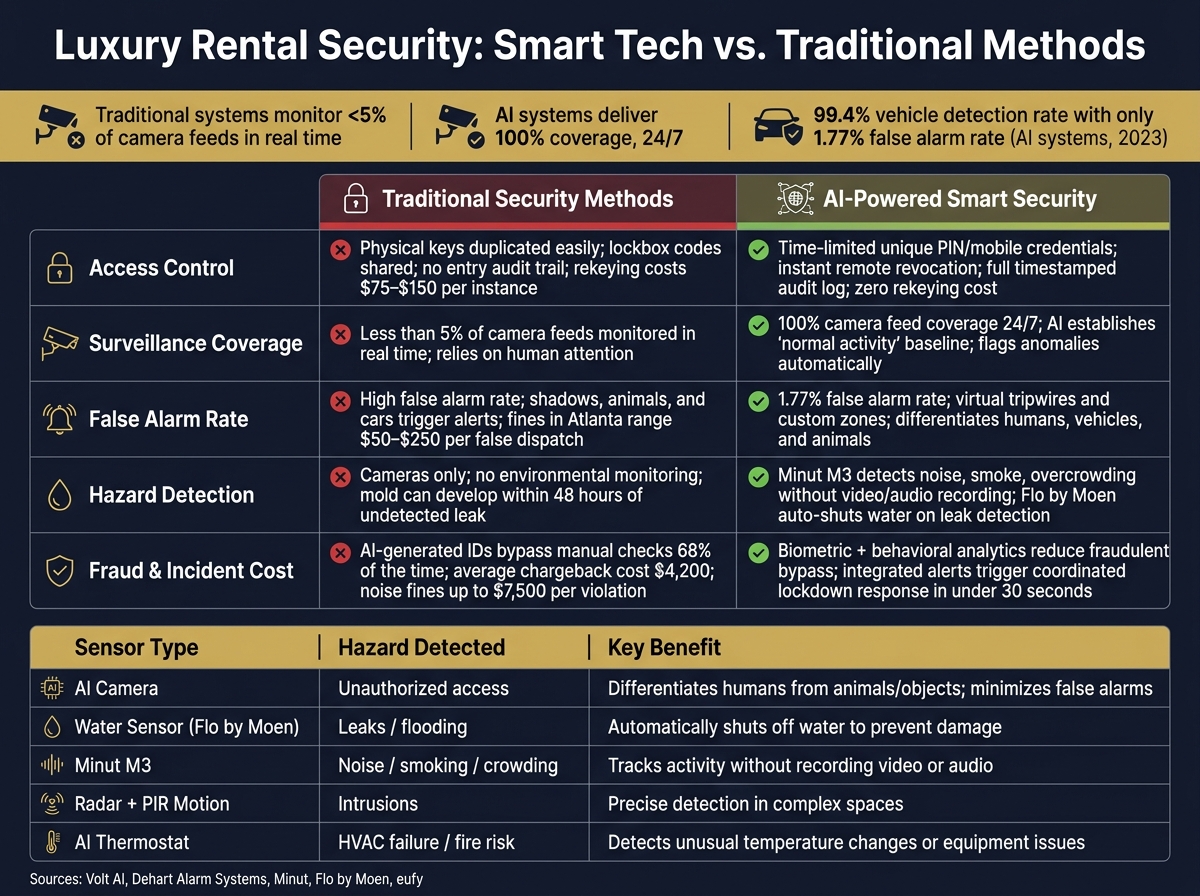
Luxury Rental Security: Smart Tech vs. Traditional Methods
Modern security for luxury rentals combines AI and smart sensors to create a layered defense system. This approach not only enhances property protection but also ensures guest comfort and privacy.
AI Cameras and Motion Analytics
A major limitation of traditional security systems is their reliance on human attention. According to Volt AI, conventional setups typically monitor less than 5% of camera feeds in real time, while AI systems provide 100% coverage, 24/7. This shift redefines how properties are safeguarded.
AI cameras establish a "normal activity" baseline for specific areas and times. When something deviates – like a person entering a restricted area at 2 AM versus a guest in the lobby at 2 PM – the system flags it. These cameras also connect movement patterns across multiple views, offering a comprehensive picture of activity.
False alarms, a common issue with older systems, are significantly reduced with features like virtual tripwires and custom zones. This ensures alerts are triggered only by real threats, not by shadows, moving trees, or passing cars. Research from 2023 demonstrated that AI security systems achieved a 99.4% vehicle detection rate with just a 1.77% false alarm rate. For property managers, this means fewer unnecessary interruptions.
"An AI security camera turns raw footage into useful insight, helping you see what matters and ignore what doesn’t." – eufy team
While cameras handle visual monitoring, sensors tackle hidden dangers.
Sensors for Hazard Detection
Sensors are essential for detecting threats that cameras can’t capture, all while respecting guest privacy. In luxury rentals, where discretion is critical, environmental sensors provide a non-invasive safety layer by avoiding audio or video recording.
For example, the Minut M3 tracks noise levels, cigarette smoke, and overcrowding using decibel levels and air quality data – without recording any visuals.
"Minut gives our remote team an important line of sight into what’s happening inside a unit without requiring on-site interaction or intervention. The data Minut provides enables us to resolve historically high-risk situations."
Water leak sensors are another key tool, especially in humid or coastal areas. Devices like Flo by Moen detect leaks in real time and can automatically shut off water, preventing costly damage. This is particularly valuable in regions like Florida, where mold can develop within 48 hours of a slow leak.
Here’s a quick breakdown of various sensor types and their benefits:
| Sensor Type | Hazard Detected | Key Benefit |
|---|---|---|
| AI Camera | Unauthorized access | Differentiates humans from animals/objects; minimizes false alarms |
| Water Sensor (e.g., Flo by Moen) | Leaks / flooding | Automatically shuts off water to prevent damage |
| Minut M3 | Noise / smoking / crowding | Tracks activity without recording video or audio |
| Radar + PIR Motion | Intrusions | Offers precise detection in complex spaces |
| AI Thermostat | HVAC failure / fire risk | Detects unusual temperature changes or equipment issues |
Access Control with Smart Locks
Sensors and cameras do a great job of monitoring activity inside and around a property, but managing who gets in and out is just as important. Smart locks step in to fill this role by swapping out traditional keys for digital credentials. These credentials can be created, customized, or canceled in seconds, completely eliminating the hassle of manual rekeying or dealing with lost or unreturned keys. Let’s break down how features like temporary codes and remote management make these devices invaluable for luxury properties.
Temporary Access Codes and Mobile Credentials
A standout feature of smart locks is the ability to provide time-limited access codes to anyone who needs entry – whether it’s guests, housekeeping staff, maintenance teams, or vendors. Each user gets a unique PIN or mobile credential that’s only valid during their approved time frame. Once that window closes, the code automatically becomes invalid.
To put this into perspective, traditional rekeying can cost anywhere from $75 to $150 per instance. For luxury rentals with frequent guest turnover, these costs can add up quickly. Smart locks not only eliminate this expense but also remove the worry of unauthorized key duplication.
High-end models like the Lockly Vision Elite ($499.99) go a step further by incorporating advanced features such as biometric fingerprint access, facial recognition, and a 2K HD video intercom. This combination of security and convenience is ideal for properties that demand privacy and control. For rental properties, a more budget-friendly option like the Rently Smart Bolt Elite (~$195.00) offers unlimited temporary codes without the need for a smart hub. It uses a mix of Z-Wave, Bluetooth, cellular, and Wi-Fi connectivity to ensure seamless operation.
Remote Lock Management
Remote management takes convenience to the next level, allowing property managers to grant or revoke access no matter where they are. If a vendor arrives early, access can be extended instantly. If a guest checks out and something seems off, the code can be deactivated on the spot – no locksmith required.
Every entry is logged with a timestamp, creating a detailed audit trail that’s invaluable for resolving disputes. For luxury estates with multiple access points – like guest houses, garages, or pool houses – platforms such as Lockly simplify management by consolidating all locks into a single app interface. With AES-256 encryption (the same standard used by banks), the digital security is as strong as the physical lock itself.
Integrated Alerts and Security Management Systems
Bringing together smart locks, sensors, and other security devices under a single platform makes them far more effective. When these tools operate independently, gaps can appear. Systems like Alarm.com, Control4, and Crestron solve this by consolidating everything into one dashboard, giving property managers real-time oversight of their entire security setup. Using AI cameras and smart sensors as a foundation, these platforms ensure that every alert triggers a swift and coordinated response. For instance, if a perimeter sensor is activated, the system doesn’t just send a notification – it also turns on cameras, locks doors, and activates lights simultaneously. This kind of automation buys critical time, often before anyone even has to take action. The result? A seamless and synchronized response that boosts overall security.
Faster Incident Response
A centralized dashboard is a game-changer for security teams. From one screen, they can monitor live camera feeds, review access logs, and check the status of every property’s security system. Timestamped logs remove any guesswork during investigations.
"Every entry and exit is timestamped and tied to a specific credential. You can see exactly who accessed which property and when, all from your phone or desktop dashboard." – Dehart Alarm Systems
AI-driven filtering plays a key role in cutting down response times. Advanced cameras can differentiate between a person, a vehicle, or an animal, which significantly reduces false alarms. This is particularly important in cities like Atlanta, where false alarm fines range from $50 to $250 per incident after a limited number of free dispatches. By minimizing false alerts, security teams can focus on real threats instead of wasting time on non-issues.
While automated alerts handle detection quickly, monitoring teams use this information to intervene with precision when needed.
Technology as a Support Tool for Security Personnel
Rather than replacing on-site security staff, technology complements their efforts. Professional monitoring centers act as an extension of the team, verifying alarms in the middle of the night and coordinating with local authorities. This ensures human personnel are only dispatched when absolutely necessary. As one industry expert explains:
"A security system without monitoring is a detection system that relies on you to respond." – The Luxury Realtor Group
Role-based permissions keep the system efficient and privacy-focused. For example, maintenance staff receive alerts about equipment issues, security guards access logs and camera feeds, and office staff handle reports. Each role is limited to data relevant to their responsibilities. This structured approach is especially important for high-end rental properties, where guest privacy is a top priority. It’s a standard that full-service operations like Essentialyfe integrate into their security strategies, ensuring both safety and discretion.
Best Practices for Luxury Property Security
Securing a luxury rental property is all about combining the right tools, policies, and personnel into a cohesive system. Here’s how to create a secure and seamless experience for both property managers and guests.
Setting Clear Access Policies
Access control starts with clear, well-defined policies. Each individual – whether a guest, vendor, or staff member – should only have access to what they need, when they need it. For example, a landscaping vendor could be restricted to entering the property on Tuesdays between 9:00 AM and 11:00 AM. This minimizes risks by limiting access during off-hours.
Smart locks make this process easier by offering features like up to 99 unique fingerprints and unlimited temporary codes. These locks allow instant credential revocation once a task is complete, eliminating the need for costly rekeying. Pairing access control with strategically placed surveillance and sensors enhances the overall security of the property.
Camera Placement, Sensor Setup, and System Upkeep
Proper placement of cameras and sensors is essential for comprehensive security coverage. Focus on key areas like front and back doors, driveways, gates, garage exits, and shared entrances. Use wide-angle cameras with at least 2K resolution to avoid blind spots and ensure clear footage. Install cameras high enough to deter tampering but low enough to capture identifiable details.
Sensors also play a crucial role. Place water leak detectors under sinks and near water heaters, and position temperature and humidity monitors near HVAC units. These can help spot slow-developing problems before they escalate into costly repairs.
Regular maintenance is equally important. During the first two weeks after installation, fine-tune alert settings and motion zones to reduce false alarms. Afterward, conduct an annual audit to ensure the system is functioning properly, complies with legal standards, and aligns with guest communication protocols. Don’t forget to update firmware, enable multi-factor authentication, and change default usernames to close any security gaps.
Balancing Guest Privacy with Security Measures
Luxury guests want to feel secure without feeling monitored. To strike this balance, keep security measures discreet and avoid placing cameras in private areas like bedrooms and bathrooms. Instead, focus on securing perimeters and entry points. Privacy masks or blackout zones can also prevent cameras from recording neighboring properties or private interior views.
In areas where cameras aren’t suitable, consider using non-intrusive sensors. These can monitor noise levels, air quality, and temperature to safeguard the property while respecting guest privacy. For identity verification, opt for less invasive methods like behavioral analytics or motion-based detection instead of facial recognition.
"Balancing tenant privacy with tenant security is part of our job as property managers. The right technology helps us achieve this." – Silas Frazier Jr., Silas Frazier Realty, LLC
To maintain a luxurious aesthetic, choose hardware in finishes like Satin Nickel or Matte Black, which blend seamlessly with high-end interiors. These practices show how thoughtful technology can enhance security without compromising elegance or comfort.
Conclusion: Using Technology to Secure Luxury Rentals
A well-rounded security approach – blending AI cameras, smart sensors, and digital smart locks – tackles vulnerabilities that no single tool can address on its own.
Advancements like cellular-supported panels, biometric authentication, and live monitoring in under 30 seconds take things further by minimizing false alarms and accurately identifying people, vehicles, and objects.
The key to long-term effectiveness lies in integration. Merging access control, surveillance, and environmental monitoring into a unified dashboard allows for remote, real-time management. This approach directly combats risks like unauthorized entry and property damage while streamlining oversight.
This integration doesn’t just improve security; it also creates tangible benefits for both guests and property owners. Guests enjoy privacy without feeling over-monitored, while owners gain reduced liability risks, detailed audit trails, and peace of mind knowing their property is secure – even when vacant.
Essentialyfe exemplifies this approach by embedding security into its luxury rental services. Along with concierge amenities, carefully selected homes, and event planning, security becomes a seamless part of the premium experience they offer.
FAQs
What security tech should be installed first?
Installing a smart lock should be your first move. It gives you instant control over who can access your property, boosts security, and can work seamlessly with other systems for a more integrated setup. For luxury rentals, smart locks are a key starting point to ensure proper protection.
How do smart sensors protect guests without recording them?
Smart sensors help keep guests safe by tracking things like noise levels, motion, and changes in surroundings – all without gathering personal information or recording visuals. This allows for proactive property management while maintaining guest privacy.
How can I stop fraudulent bookings before check-in?
AI-powered guest screening tools can help protect your business from fraudulent bookings. These systems use advanced methods like biometric analysis to verify identities, while also analyzing key details such as IP addresses and device fingerprints. Additionally, they often require guests to submit verified IDs, adding an extra layer of security.
If a reservation seems suspicious, the system can flag it for manual review, allowing you to address potential risks without disrupting the booking experience. This approach helps maintain both security and a smooth process for genuine guests.