When you shop directly from artisans, you’re not just buying a product – you’re supporting skilled individuals, preserving craftsmanship, and contributing to local economies. This guide helps you make informed choices before, during, and after your trip to ensure your purchases and experiences benefit artisans fairly and responsibly.
Key Takeaways:
- Research before you go: Verify fair trade certifications like Fairtrade or GOTS and check local labels (e.g., Craftmark in India).
- Support artisan-friendly stays: Choose accommodations that source decor from local makers.
- Engage directly: Visit workshops, participate in hands-on classes, and ask questions about the origin and production process.
- Pay fairly: Avoid underpricing artisans’ work; ensure your spending reflects the time and skill involved.
- Respect cultural heritage: Understand the meaning behind designs and avoid buying items with unclear origins.
- Stay connected: Build relationships with artisans for future collaborations, and share their stories responsibly.
Every decision – whether it’s where you stay, what you buy, or how you interact – can create a lasting impact on artisans and their communities.
How Passion Lilie Uplifts Artisan Communities Through Fair Trade Fashion | Katie Schmidt
sbb-itb-161ccc1
Pre-Trip Planning Checklist
Careful planning ensures your spending genuinely supports local artisans and their communities.
Research Fair Trade and Ethical Standards
Before visiting workshops, markets, or cooperatives, confirm their credentials. Check official databases for certifications like Fairtrade, GOTS (Global Organic Textile Standard), or the Leather Working Group. Be cautious with labels such as "eco-friendly" or "locally inspired" – always verify their claims through trusted sources.
Familiarize yourself with regional certifications like Craftmark in India or the Indigenous Art Code in Australia. When visiting artisan spaces, ask these three key questions: Who made this? Where did the materials come from? How are the profits shared? Sellers who can answer confidently and transparently are usually more trustworthy.
"The difference between genuine ethical sourcing and greenwashing often comes down to a single question: can the brand prove it?" – San Rocco Italia
Additionally, choose accommodations that align with these ethical standards.
Choose Accommodations That Support Local Artisans
Your choice of accommodation can also reflect your commitment to supporting artisans. Inquire about the sourcing of textiles, ceramics, and decor featured in the property. Services like Essentialyfe can guide you to artisan-friendly stays.
| Sourcing Model | Best For | How to Verify |
|---|---|---|
| Single Artisan | Provenance and craft detail | Studio photos, direct communication |
| Cooperative | Fair wages and shared resources | Collective reports, member testimonies |
| Social Enterprise | Community impact and reinvestment | Impact reports, audited finances |
| Certified Supply Chain | Environmental and labor assurance | Certificate numbers, third-party websites |
Plan Visits to Artisan Markets and Workshops
Once you’ve verified credentials, plan direct interactions with artisans. Start with recommendations from tourism boards or local cultural organizations to find authentic markets and workshops. Look for opportunities to see artisans at work – for example, a weaver at their loom or a potter shaping clay. These experiences provide a deeper connection to the craft than any label ever could.
Many travelers now seek hands-on experiences like indigo dyeing in Bali or pottery workshops in Morocco. These activities not only connect you to the creators but also ensure your spending benefits them directly.
"Choose tourism experiences that take you directly to artisans." – Halle Butvin, Fair-trade Expert, Smithsonian Center for Folklife and Cultural Heritage
In larger markets, look for independent recognitions to verify authenticity.
Set a Budget for Fair Pricing
Fair pricing reflects the time, skill, and materials involved in creating a piece. If an intricately hand-embroidered item is priced suspiciously low, it could indicate unfair labor practices or compromised materials. Research typical pricing for the crafts you’re interested in, and factor in extras like shipping or customs fees. For informal markets, keep some local cash on hand to make transactions smoother.
On-Site Checklist: Shopping and Engaging with Artisans
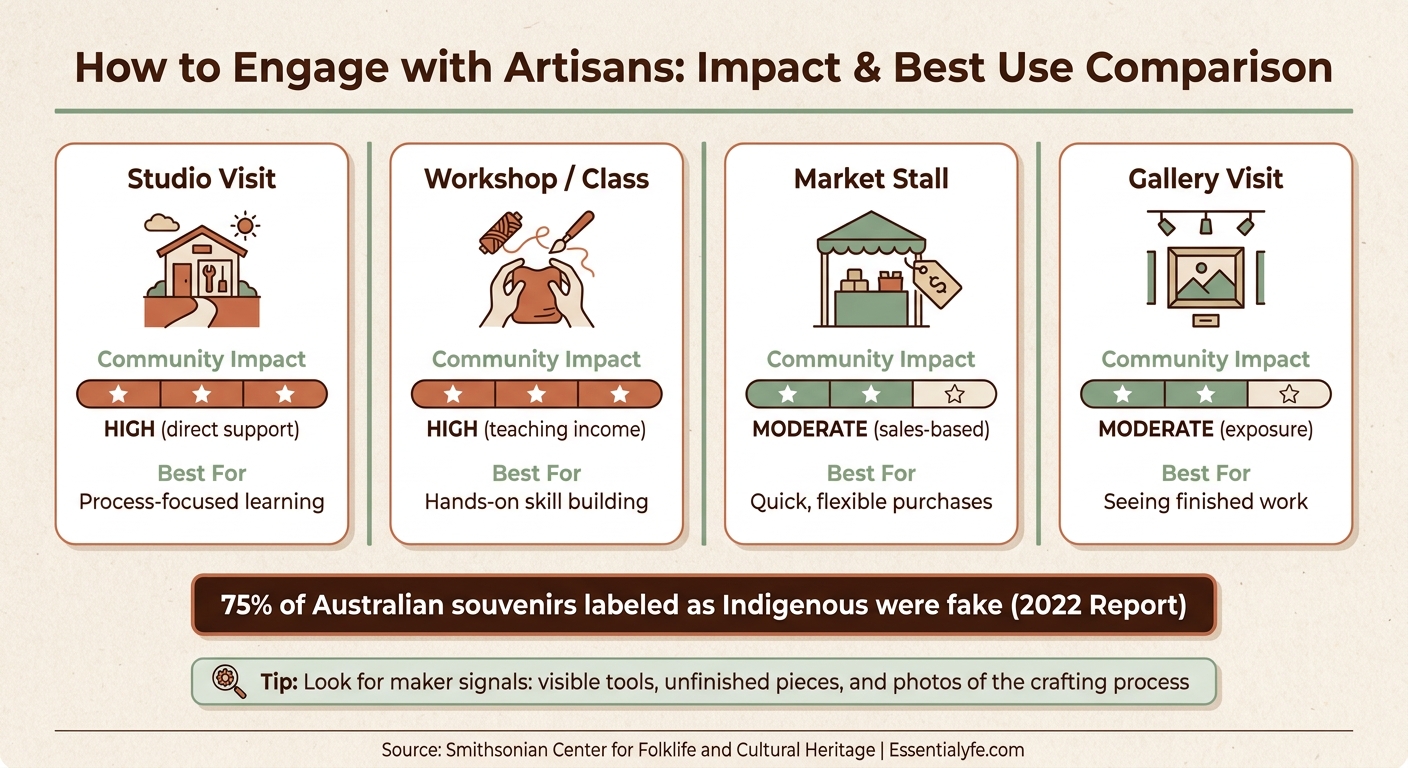
Artisan Engagement Types: Community Impact & Best Use Guide
Once you arrive, keeping your focus on ethical travel means being intentional about how you shop, interact, and pay. Every choice you make directly ties back to the artisans’ stories and the communities you aim to support. These small but thoughtful decisions make your travel experience more meaningful.
Confirm Authenticity and Origin
A 2022 report revealed that up to 75% of Australian souvenirs labeled as "Indigenous" were fake. To avoid falling for imitations, look for what experts call "maker signals." These might include visible tools, unfinished pieces, or photos of the crafting process at the vendor’s stall. Pay attention to tactile details as well – carvings that feel cool and heavy are often more authentic than those that are warm and lightweight. Be cautious if you see stalls displaying rows of "hand-carved" items that look identical, as this is often a sign of mass production.
"Don’t assume that someone in a marketplace is an artisan. Do you see them making the craft? Many vendors just gather products from artisans and mark them up." – Halle Butvin, Fair-trade Expert, Smithsonian Center for Folklife and Cultural Heritage
Always ask for a receipt that includes the artist’s name, the materials used, and the cultural origin of the item. This documentation not only confirms authenticity but also provides a safeguard if questions arise later. And once you’re confident in the item’s origin, double-check that the source supports fair labor practices.
Respect Working Conditions
Buying from vendors tied to exploitative supply chains – even unintentionally – undermines the entire purpose of ethical travel.
"When you buy a mass-produced product, you might be supporting a business that doesn’t pay its workers a fair wage." – Jeremy Fritzhand, Founder, Studio Bagru
Seek out sellers affiliated with cooperatives or guilds, as they often have better transparency around labor standards. If you visit a workshop, take note of the environment. Basic indicators of ethical practices include proper lighting, reasonable working hours, and the absence of child labor.
Practice Fair Payment
Before heading to a market, research the local customs around bargaining. In some places, haggling is expected, while in others, it can be seen as disrespectful. Either way, the goal isn’t to force the price as low as possible – it’s to pay an amount that reflects the true value of the labor and materials.
Whenever possible, pay artisans directly. For high-value purchases, use a credit card to protect yourself in case the item turns out to be counterfeit. Be cautious of large souvenir stalls, as they often work with centralized suppliers, which means the original artisans may see little to no profit from the sale.
Honor Cultural Intellectual Property
When buying or commissioning items that feature cultural symbols, patterns, or motifs, it’s important to understand their meaning. Wearing or displaying sacred designs without context – or casually – can harm the communities that created them.
"Ethical sourcing scales only when artisans stay authors of their patterns and benefit fairly from growth." – Isabella Marquez, Specialist in Ethical Sourcing and Community Partnerships
Be wary of vague labels like "heritage" or "descent" (e.g., "Native American heritage"), as these often indicate the maker is not a certified or enrolled artisan from that tradition. If you’re unsure, ask questions – most artisans are happy to share the cultural significance behind their work. Showing this level of respect reinforces your commitment to meaningful and responsible travel.
Choose Experiences That Support Artisans Directly
One of the best ways to make a positive impact is by participating in workshops or studio visits. These experiences not only provide artisans with direct teaching income but also give you hands-on insight into their craft. If booking through a third party, confirm that the artisans receive a fair share of the fees – not just the tour operator. Every intentional choice you make deepens your connection to the communities you visit.
| Engagement Type | Community Impact | Best For |
|---|---|---|
| Studio Visit | High (direct support) | Process-focused learning |
| Workshop/Class | High (teaching income) | Hands-on skill building |
| Market Stall | Moderate (sales-based) | Quick, flexible purchases |
| Gallery Visit | Moderate (exposure) | Seeing finished work |
Event and Property Styling Checklist
This checklist is designed to help you seamlessly incorporate artisanal elements into events or rental properties, creating an elevated experience that supports local artisans. By blending handcrafted decor and gifts into your setup, you not only enhance the guest experience but also strengthen ties to local communities, aligning with the ethos of meaningful travel.
Source Decor and Gifts from Local Artisans
Start by defining your event’s theme – whether it’s coastal, heritage-inspired, or wellness-focused. This will serve as your guide for choosing artisans, materials, and designs. To simplify the process, create a sourcing checklist. Focus on these key factors: proximity (within 50 miles is a good rule of thumb), material type, durability for high-traffic areas, scale, and budget.
When selecting guest gifts, go for practical items that will see everyday use. Think textiles, ceramics, tableware, or stationery. As Maya Thornton, Senior Travel Content Strategist, explains:
"The most memorable souvenirs are usually the least ‘souvenir-like.’ Look for items that function in everyday life – textiles, tableware, bags, stationery, ceramics, and wearable fiber goods."
If you’re working with Essentialyfe, their concierge team can assist in sourcing decor and gifts from trusted local artisans. They can even integrate handmade elements directly into your setup. For added personalization, consider including QR codes that link to artisan bios and purchasing details.
Set Clear Terms for Custom Orders
When commissioning custom work, a well-drafted contract is essential. It should outline the scope of work, deliverables, timeline, payment schedule, intellectual property ownership, credit/attribution, and a plan for resolving disputes. Don’t assume that paying for a design gives you ownership – most artisans retain copyright and grant usage rights under specific terms like medium, territory, and duration.
Use a staggered payment plan to protect both parties: an initial deposit, a mid-project payment upon proof approval, and the final payment upon delivery. For revisions, set clear limits (e.g., two rounds of minor changes) and agree on an hourly rate for additional adjustments. Maya Hollis, Senior Editor & Creative Business Strategist, advises:
"Treat contracts like creative briefs – be concise, specific, and include measurable milestones. The clearer the brief, the fewer disputes later."
Before approving full production, always request a physical sample to check for issues like color mismatches, loose seams, or uneven finishes. This step can save you from costly mistakes down the line.
Plan Logistics for Artisan Involvement
Effective logistics are crucial for a smooth collaboration with artisans. Before finalizing designs, evaluate the venue’s details: load-in access, weight limits, ceiling height, and power availability. Allow for a lead time of 6–12 months and set aside 10–15% of your budget for unexpected costs.
For fragile handmade items, specify packaging requirements in advance, especially if the pieces will undergo multiple shipments. Coordinate staggered deliveries to align with your setup schedule. If artisans will be on-site, ensure they have ample space, easy access, and sufficient time to set up. Assign a dedicated point person to handle decisions and avoid last-minute delays.
Post-Trip Checklist: Continued Support for Artisans
Your journey doesn’t truly end when you head home. Some of the most impactful ways to support artisans happen after your trip – through follow-up purchases, thoughtful storytelling, and reflecting on how your travel choices made a difference.
Build Long-Term Relationships
Before leaving a studio or market, take a moment to gather the artisan’s contact information, social media handles, or website. Ask if they can handle international shipping and customs for remote orders. This simple step can pave the way for future collaborations without unnecessary hassle.
After returning home, send a short thank-you email within a week. Include a photo of their work (if they allow it) and let them know how much you appreciated their craft. Signing up for their newsletter or mailing list is another easy way to stay connected. As Riley Navarro, Senior Travel & Culture Editor, explains:
"Small ongoing actions – sharing their posts, buying a repeat piece, or arranging a friend’s commission – have outsized impact on a maker’s sustainability."
Remote commissions can range from $10 to over $500, depending on the complexity of the piece. Typically, artisans require a 30–50% deposit upfront. Keep all correspondence and payment details organized to ensure a smooth process for both parties.
Once you’ve built these relationships, sharing their stories can amplify their reach even further.
Share Artisan Stories Responsibly
When showcasing an artisan’s work, always tag their social media and include a direct link to their shop. A simple, well-credited post can drive meaningful sales.
"A single well-credited profile or direct sale link can be worth more than 500 passive likes. Prioritize links and commissions over vanity metrics." – Ava Mercer, Senior Editor & Travel Culture Strategist
Make sure to get explicit permission before sharing photos of artisans, their workshops, or their creative process. Some techniques or materials may hold cultural or ceremonial importance and shouldn’t be shared publicly. If an artisan has a "no photo" policy, respect it in every interaction – no exceptions.
Review Your Fair Trade Impact
Take a moment to reflect on how your spending supported local communities. Set aside 15–20 minutes to review your travel budget. How much of it went directly to artisans, local accommodations, or community markets? Research shows that up to 80% of tourism’s financial benefits can leak out of a destination when travelers rely on multinational businesses instead of local ones.
Identify areas where convenience may have taken precedence – like staying at a chain hotel or buying a mass-produced souvenir – and note them as opportunities for improvement. James Lanka, Senior Editor & Local Travel Expert, sums it up well:
"Your choices as a traveler can support local livelihoods, preserve ecosystems, and protect cultural heritage."
Keeping a simple impact log can help. Track the number of artisan purchases, the markets you visited, and whether you’ve shared or recommended these artisans to others. This record not only informs your future travel decisions but also strengthens your commitment to community-focused travel.
Conclusion: Traveling with Purpose
Every purchase you make while traveling shapes the kind of world you want to see. Choosing direct purchases, fair pricing, and authentic storytelling does more than bring home a keepsake – it helps preserve traditions, sustain families, and safeguard cultural heritage.
As Ava Mercer, Senior Editor & Ethical Sourcing Strategist, explains:
"Handmade goods carry more than form and function – they carry stories, skills and ecological footprints."
This perspective encourages intentional decisions that can enrich your travel experience. You don’t need to strive for perfection. Even small, deliberate actions – like visiting an artisan market or commissioning a handmade piece – can create meaningful and lasting change.
For those who want to immerse themselves in artisan culture throughout their journey, Essentialyfe offers a seamless way to do so. Their curated vacation homes, event venues, and concierge services are designed to connect travelers with locally inspired, elevated experiences, making it easy to support artisans as part of your trip.
FAQs
How can I quickly spot fake “handmade” items?
Look closely for small inconsistencies in shape, color, or stitching – these can be signs of manual craftsmanship. Handmade items often have slight imperfections and natural variations that set them apart. Additionally, genuine pieces usually come with clear details about the maker. If you’re uncertain, don’t hesitate to ask the seller for images or videos of the creation process to verify authenticity.
What’s a fair price if bargaining is expected?
When bargaining is part of the buying process, a reasonable starting offer is usually between 10% and 25% of the vendor’s initial asking price. For instance, if an item is priced at $100, you could begin negotiations at $10–$25, gradually moving upward in a respectful manner.
In artisan markets, where the sellers are often the creators of the goods, it’s best to avoid overly aggressive haggling. Instead, focus on reaching a price that feels fair for both you and the seller.
What should a custom order contract include?
A custom order contract needs to include all the important details to ensure clarity and protect everyone involved. These details typically cover the scope of work, payment terms, ownership rights, and project specifics.
Key components to include are:
- A clear description of the work to be done
- Defined deliverables and expectations
- The timeline and any project milestones
- A detailed payment schedule
Additionally, it’s important to address intellectual property rights, include confidentiality clauses, and outline any material or resource requirements. These elements help set clear boundaries and avoid misunderstandings.