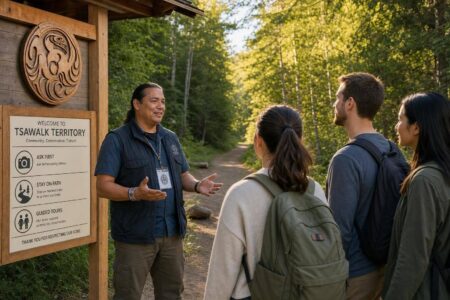
If I want to book this kind of trip well, I need to check one thing first: who controls the land access, the story, and the money. That is the line between a community-led conservation trip and a standard nature tour with Indigenous branding added on. It also matters because Indigenous peoples are about 5% of the world’s population and protect about 80% of remaining biodiversity.
Here’s the short version:
- Ownership comes first. I should look for trips created, owned, or co-managed by Indigenous communities.
- Money flow matters. In many package tours, leakage can be over 70%, so less than $30 out of every $100 stays local.
- Control of access matters. The community decides where I can go, what I can see, and what should stay private.
- Conservation is part of the trip. These experiences can support reef repair, habitat patrols, watershed care, turtle recovery, or forest protection.
- Behavior matters too. I should ask before taking photos, follow site rules, and respect limits without arguing.
- Booking direct is often the better move. It can keep more trip income with the operator and community.
A few examples show what this looks like in practice:
- In Quebec, Nibiischii Park became the first national park in the region managed fully by the Cree Nation in 2026.
- In Brazil, the Kayapó manage more than 22 million acres of Amazon forest.
- In Ecuador, the Sani Warmi women’s group helped hatch 80 baby yellow-spotted river turtles in 2025.
- In Australia, 17 First Nations guides were working on reef trips in 2026, including coral repair days.
Quick comparison
| What I should check | Community-led trip | Standard nature tour with Indigenous add-on |
|---|---|---|
| Ownership | Community or Nation owned/led | Outside company |
| Storytelling | Set by the community | Set by the operator |
| Revenue use | Supports local jobs and land care | Much of the money leaves |
| Access rules | Clear limits on sites, photos, and group size | Rules may be loose or unclear |
| Conservation role | Built into the trip | Often limited to sightseeing |
My takeaway: if I want a trip that supports land care and local decision-making, I should verify ownership, ask where the money goes, check who guides the trip year-round, and follow community rules once I arrive.
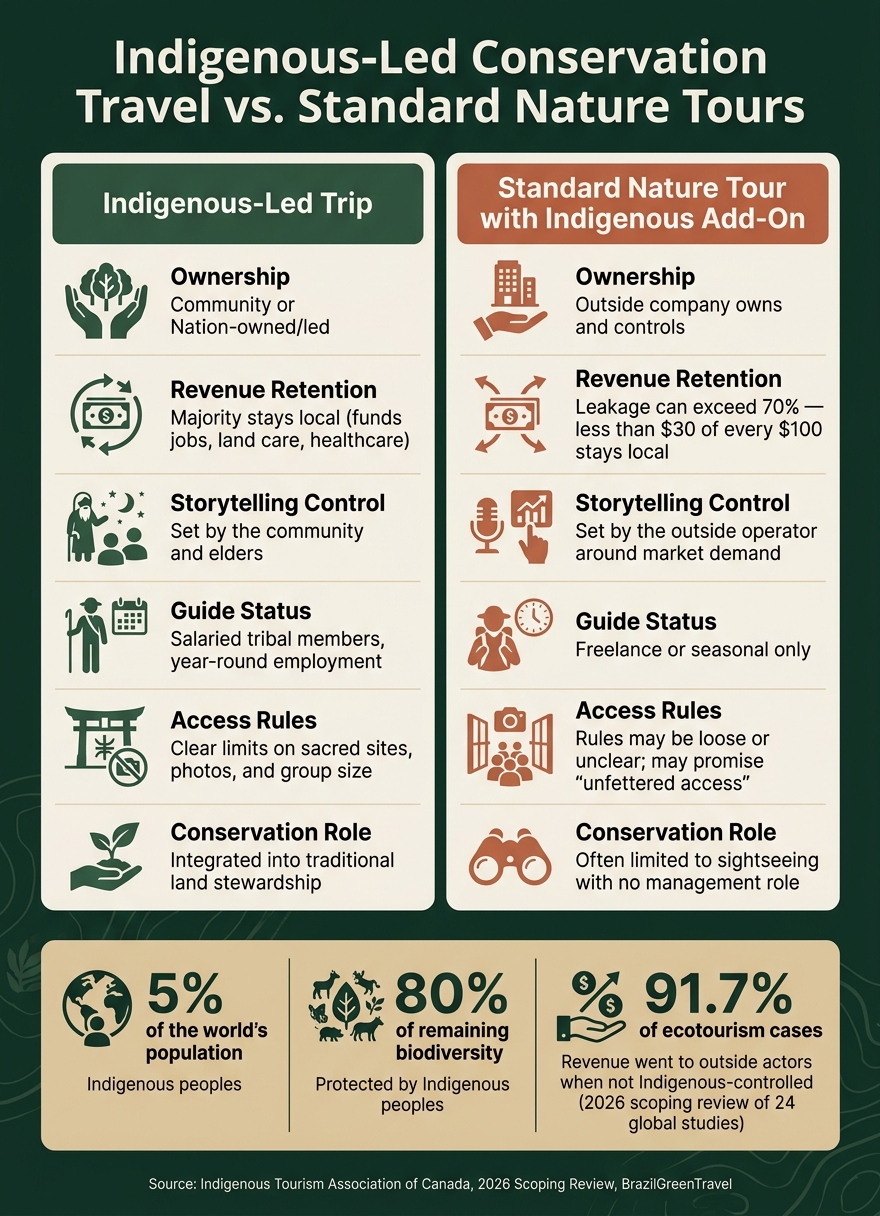
Indigenous-Led vs. Standard Nature Tours: Key Differences at a Glance
Empowering indigenous communities through tourism | Guayana Tourism Authority | Travel Redefined
sbb-itb-161ccc1
Why Indigenous Leadership Matters in Conservation
Indigenous leadership doesn’t just shape the visitor experience. It changes who holds decision-making power, who keeps the income, and how conservation happens on the ground. Put simply: conservation tends to work better when the people who know the land best also control access, revenue, and management.
Land Stewardship, Biodiversity, and Local Governance
Governance decides whether tourism income supports stewardship or slips out of the community. That split shows up fast in land management. A scoping review of 24 global studies found that 91.7% of ecotourism cases led to revenue concentrating with outside actors when projects were not Indigenous-controlled. When communities run the project themselves, that same income can help fund land stewardship, healthcare, and education.
In 2026, Nibiischii Park in Quebec became the first national park in the region managed entirely by the Cree Nation. That marked a shift away from state-led conservation and toward Indigenous sovereignty. For travelers, the change is concrete: the community controls access, interpretation, and how visitor revenue is used.
Place-Based Knowledge and Intergenerational Continuity
Indigenous stewardship depends on Traditional Ecological Knowledge (TEK) – deep, place-specific knowledge of fire, water, wildlife, and medicinal plants. This kind of knowledge stays strong when younger people are taught how to carry it forward.
The Dinjii Zhuh Adventures program in Yukon shows what that looks like in practice. Between 2023 and 2024, it trained five Indigenous youth as whitewater guides, tying tourism jobs to stewardship of the Peel River Watershed. As founder Bobbi Rose Koe puts it:
"You can’t protect what you don’t love."
When young people guide visitors through their ancestral watersheds, they’re doing more than leading trips. They help maintain a continuous Indigenous presence on the land, which can deter illegal logging, mining, poaching, and resource extraction.
Why Local Ownership and Local Hiring Are Non-Negotiable
The clearest line between Indigenous-led travel and a cultural add-on comes down to ownership and control of the story. In standard package tours, leakage can exceed 70%, which means less than $30 out of every $100 spent stays in the host community. Indigenous-owned operations are built to push against that pattern.
Stacey Simmons, Director of Operations at the Kodiak Brown Bear Center, says it plainly:
"Indigenous tourism is exciting to me because we get to control the narrative. We know what we should be sharing, and we know what things we shouldn’t that are sacred to us."
Responsible tours also hire local people year-round and offer steady wages, not just seasonal payments. At Klahoose Wilderness Resort in British Columbia, local hiring and local products are part of the model. If you’re evaluating a tour, check who works there day to day. The best operators hire community members across guiding, lodging, and operations roles, not just for ceremony or peak-season work.
Types of Indigenous-Led Conservation Experiences You Can Book
Indigenous-led conservation travel can take you into rainforests, reefs, rivers, and coastal areas. And each type feels a little different. Knowing the main categories makes it easier to pick a trip that lines up with what you care about most.
Wildlife Viewing, Safaris, and Birding on Indigenous Lands
These trips center on wildlife and birding in places that Indigenous communities help protect day to day. The Kayapó people in Brazil are a strong example. They manage more than 22 million acres of intact Amazon forest, the largest Indigenous-managed tropical forest in the world. Tours into Kayapó territory through BrazilGreenTravel cost about $3,848 per person for a 5-day/4-night itinerary, plus a required private charter flight. Groups are limited to 8 people to reduce impact.
What makes these trips different? You’re not just there to look at animals. The visit sits alongside habitat monitoring, anti-poaching presence, and community-led interpretation.
The same pattern shows up in Kenya. The Nashulai Maasai Conservancy, led by Nelson Ole Reiya, reported 25 baby elephants born within its borders in 2025 after the community reclaimed an ancient birthing ground.
"The animals vote with their feet." – Nelson Ole Reiya, Founder, Nashulai Maasai Conservancy
Marine, River, and Coastal Conservation Tours
On the water, the work changes. The focus often moves from land-based wildlife protection to reef, river, and shoreline recovery. These tours usually depend on tides, seasons, and community approval, which can shape when and how visits happen.
In April 2026, GBR Biology and Dreamtime Dive and Snorkel in Australia employed 17 First Nations cultural guides, including five women such as Reggie Morey, the first Indigenous female Master Reef Guide. They lead "Reef Recovery Days", where guests attach coral fragments to steel structures to help reef growth after climate events.
River trips can work differently but still serve the same goal. Tours run by Dinjii Zhuh Adventures in the Yukon focus on watershed protection, with the journey itself acting as a kind of land monitoring.
Land-Based Stewardship and Guided Landscape Visits
Land-based visits tend to be the most hands-on. Instead of watching from the sidelines, travelers may help plant trees, learn agroforestry in "chacras", join seasonal harvesting, or take part in weaving.
The Sani Warmi women’s collective in Ecuador’s Kichwa Sani Isla community protects about 31,000 hectares of Amazon rainforest through agrotourism and organic chocolate production. In 2025, the collective successfully hatched 80 baby yellow-spotted river turtles from 100 collected eggs. That work was part of a program that increased turtle sightings by 340% over seven years. Activities follow community rhythms, and the community sets the access rules.
| Category | Example Program | Primary Conservation Outcome |
|---|---|---|
| Wildlife/Birding | Kayapó territory, Brazil | Habitat monitoring and anti-poaching support |
| Marine/Coastal | GBR Biology and Dreamtime Dive, Australia | Reef recovery and species repopulation |
| Land Stewardship | Sani Warmi collective, Ecuador | Rainforest protection and food sovereignty |
In practice, these categories often blend together. A wildlife trip may also support habitat patrols. A river journey may double as watershed observation. So once you know the type of trip you want, the next thing to check is who owns the operation, who leads guests on the ground, and where the visitor fees go.
How to Screen and Choose Tours Responsibly
Once you know what kind of trip you want, the next step is simple: make sure the operator is actually Indigenous-led, not just marketed that way.
What to Check Before You Book
Start with ownership. Who owns the business? Who controls the money? Who decides what goes into the itinerary? Those questions matter more than polished branding.
Be careful with false Indigenous branding. That’s when a non-Indigenous business is sold as Indigenous, even though Indigenous people don’t own it or manage it.
A good starting point is to ask three direct questions:
- How much of the revenue stays in the local community?
- Who designed the itinerary?
- Do staff have year-round jobs or only seasonal work?
If the answers sound fuzzy – something like “we support local communities” – that’s a red flag. Stronger signs are specific names, clear roles, and actual percentages.
For vetted listings, check NativeAmerica.travel in the U.S., Destination Indigenous in Canada, or Discover Aboriginal Experiences in Australia. In Canada, The Original Original accreditation mark, managed by the Indigenous Tourism Association of Canada, had certified 278 Indigenous businesses as of 2026. These directories make it easier to find operators where revenue stays local.
Side-by-Side Tour Comparison Table
Use this table as a quick way to compare two or more operators. The point is to see where the money goes, who controls the story, and whether the community has real decision-making power.
| Criteria | Indigenous-Owned/Led | Non-Indigenous "Cultural" Tour |
|---|---|---|
| Ownership | Community or Nation-owned; profits reinvested locally | Outside shareholders; profits largely leave the community |
| Revenue | Funds local wages, healthcare, schools, and land stewardship | Profits largely leave the community |
| Experience Design | Set by elders or community based on their own values | Designed by outside operators around market demand |
| Guide Status | Salaried tribal members, often with year-round employment | Freelance or paid per visitor; seasonal only |
| Protocol | Clear rules on sacred sites and photography, stated upfront | May promise "unfettered access" to sacred areas |
| Conservation Role | Integrated into traditional land stewardship | Often limited to viewing without management |
A 2026 scoping review found that in 91.7% of studied ecotourism cases, revenue went mainly to outside actors instead of the Indigenous community. That makes the ownership question hard to brush off.
How to Behave Respectfully on the Ground
Checking the operator matters. So does how you act once you’re there.
Photography is one of the most common trouble spots. Always ask the person directly, not just the guide. Ask before taking photos of anyone, and don’t post ceremonies or sacred moments on social media unless you’ve been clearly invited to do that.
When you enter a new place, slow down and watch first. Then join in if invited. Follow elders’ cues on dress, noise level, and participation. If a site is closed, or a guide says an area is off-limits, stay out.
Use nation names like Yurok or Hopi instead of broad labels like “tribe” or “native.” And if a community has asked for fewer visitors or limits on access to certain places, respect that without pushing back.
Respect helps protect access, trust, and sacred knowledge.
Once an operator clears these checks, the next step is to line up timing, access, and lodging with the community’s rules.
Planning a Responsible and Comfortable Trip
Timing, Trip Fit, and Access Planning
Once an operator clears the ownership and protocol checks, shift your attention to timing and logistics. Wildlife sightings, community events, and land access all change with the season. The best trips are planned around the community’s calendar, not just yours.
Popular routes fill up early, so book well ahead of time. Before you pay a deposit, confirm which permits apply to the route, group size limits, how often visits are allowed, and whether cancellation terms are flexible if community schedules change.
For remote trips, check air, boat, or overland transfers before you lock anything in. A longer stay usually means less travel churn and a calmer pace. That kind of planning helps protect access and respects the community’s schedule.
Accommodations, Privacy, and Concierge Support
Once the timing is set, build your lodging and transportation around the community calendar. Many Indigenous-led conservation sites are intentionally remote, so spotty Wi-Fi and changing weather come with the territory. It helps to set up a comfortable home base before and after the trip.
You can also use comfort services around the trip without letting them replace the trip itself. If you want curated vacation homes, private chefs, transportation coordination, or concierge-style planning, Essentialyfe offers luxury property rentals and concierge services. The point is to use that support to frame the trip, not swap out community-led experiences.
Book direct with the Indigenous operator whenever possible. That keeps more money in the community. On typical packaged tours, leakage can top 70%.
Conclusion: Key Principles for Booking Well
Verify ownership, confirm that local revenue stays local, follow community protocols, and line up logistics in a way that supports both comfort and accountability. Done right, this is more than a smoother trip. It supports the work of Indigenous peoples, who make up about 5% of the global population and protect 80% of the world’s biodiversity.
"Indigenous tourism is exciting to me because we get to control the narrative. We know what we should be sharing, and we know what things we shouldn’t that are sacred to us." – Stacey Simmons, Director of Operations, Kodiak Brown Bear Center
FAQs
How can I verify a tour is truly Indigenous-led?
Check who owns the business and who gets to shape the story being told. There’s a big difference between a community building the experience and a community being pulled in just to play a part.
Be careful with broad claims about “supporting local communities.” That phrase can sound nice without saying much. Look for operators that clearly name the specific tribe or community involved.
In the U.S., NativeAmerica.travel is the official directory for Indigenous-led travel managed by tribal nations.
What should I ask before booking an Indigenous-led conservation trip?
Ask a few plain questions before you book: Who owns the operator? Who gets the revenue? How much of your trip cost stays in the host community? That gives you a much clearer picture of where your money is going.
It also helps to ask who shaped the experience in the first place. Was it designed by the community itself, or put together by an outside operator for tourists? That difference matters more than most people think.
Take a look at labor practices too. Check how guides are paid, whether they get benefits, and what happens when travel slows down in the off-season. A business can look good on the surface and still treat workers poorly behind the scenes.
If you’re booking through Essentialyfe, make sure the stay or experience lines up with responsible, community-conscious travel.
How do I behave respectfully on the trip?
Be a learner and a good guest, not just someone passing through. Before you visit, look into the specific tribe or community so you understand the terms they use and any site rules you should follow.
Always ask before taking photos, filming video, or flying a drone. Respect restricted areas, sacred ceremonies, tribal laws, and people’s privacy. Go in with humility, and spend more time listening than talking.