A fire plan needs to do one job: get people out fast and keep panic low. In U.S. homes, a fire happens every 96 seconds, and cooking is tied to about 49% of residential fires. If I manage a luxury rental, I need to check exits, alarms, extinguishers, staff roles, guest instructions, and support for anyone who may need help leaving the property.
Here’s the short version:
- I check the property before each stay or event
- I confirm occupancy limits, exits, and outdoor meeting spots
- I test smoke alarms and CO detectors
- I inspect fire extinguishers, lighting, and exit access
- I give guests plain-language evacuation instructions
- I assign staff jobs for 911 calls, room checks, gate access, and headcounts
- I prepare help plans for guests with mobility, hearing, visual, or cognitive needs
- I keep drill notes, inspection logs, and equipment replacement records
Bottom line: a written checklist is not just paperwork. It helps guests, staff, vendors, and crews know where to go, what to do, and who is in charge when seconds matter.
| Area | What I focus on |
|---|---|
| Property check | Kitchens, sleeping rooms, utility spaces, outdoor fire risks |
| Exits | Clear paths, working doors, code-sized egress windows, posted address |
| Detection | Interconnected alarms, CO detectors, sound level across the property |
| Fire control | ABC extinguishers, sprinklers if installed, clean cooking areas |
| Evacuation plan | Maps, room cards, digital instructions, no-elevator rule where needed |
| People | Staff roles, guest headcounts, disability support plans |
| Records | Drills, inspections, incident notes, alarm and detector replacement dates |
If I want a luxury rental to be ready for a fire, this is the framework I use.
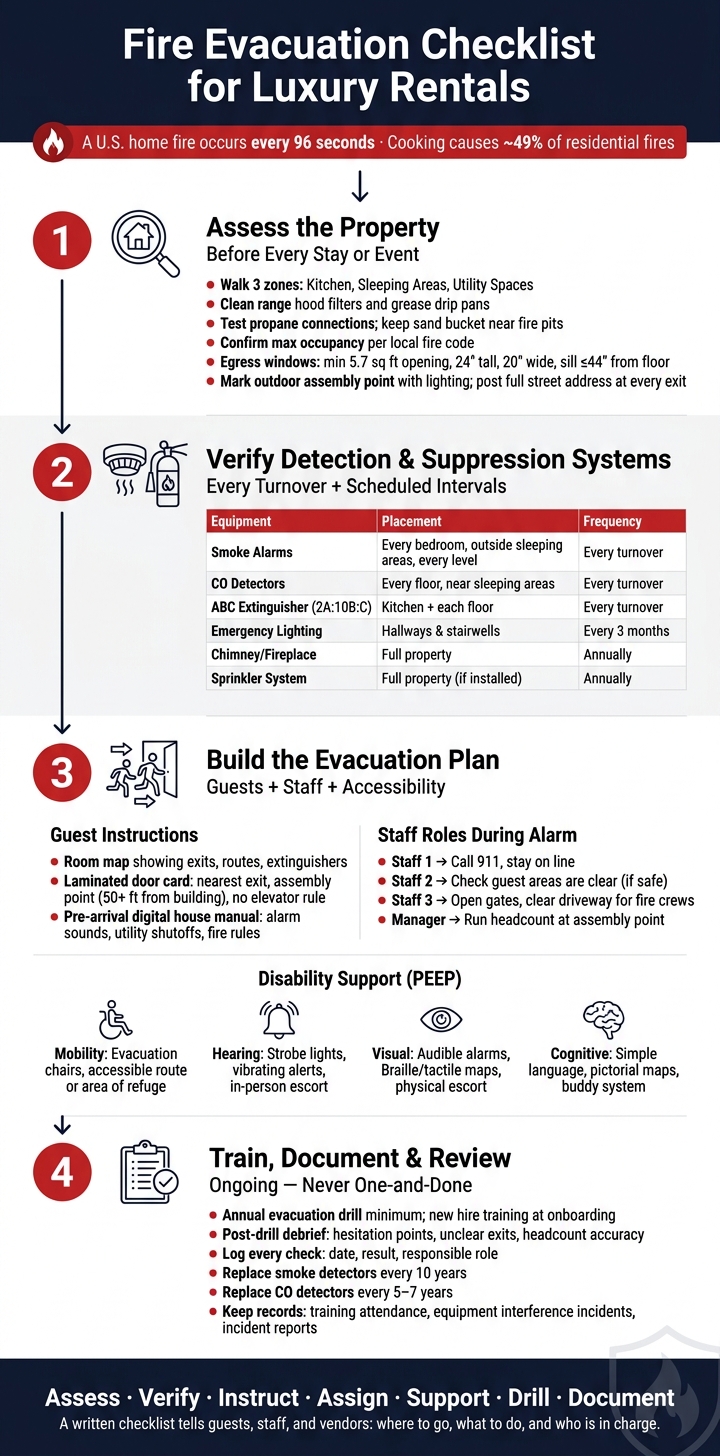
Fire Evacuation Plan for Luxury Rentals: 4-Step Safety Framework
Evacuation Diagrams for the Short Term Rental Industry. Airbnb Fire Evacuation Plan Diagrams
sbb-itb-161ccc1
1. Assess the property and confirm fire safety basics
Start with a fire safety walk-through before anyone arrives. The goal is simple: spot hazards early and make sure people can get out fast if something goes wrong.
Property-specific fire risk assessment
Walk the property in three zones: kitchen and cooking areas, sleeping areas, and utility spaces. Each one comes with its own set of risks.
In the kitchen, clean range hood filters and drip pans. Grease buildup is a major fire risk. If the property has smooth-top electric ranges, post a clear hot-surface warning nearby.
Utility and tech areas often get overlooked, especially in large properties. Generators, backup batteries, and overloaded power strips can all start fires. Outdoor spaces bring their own risks too. Test propane connections with soapy water before use, and keep a sand bucket near fire pits. If there’s a fireplace, check that the damper works and that combustibles stay at least 12 inches from the opening before guests arrive.
Replace any key-operated interior deadbolt with a thumb-turn model.
Occupancy limits, exits, and assembly points
After you’ve checked for hazards, confirm how many people can safely use the property and how they would get out in an emergency.
Maximum occupancy is set by local ordinances, fire codes, and permits. Properties with a lot of guests often face required fire inspections, so verify your permitted capacity before listing event or overnight headcounts.
Every bedroom needs code-compliant egress, which usually means a door and an operable escape window. Under the International Residential Code (IRC), egress windows must have a minimum clear opening of 5.7 square feet, be at least 24 inches tall and 20 inches wide, and have a sill no higher than 44 inches from the floor. Make sure none of these windows are painted shut or blocked by furniture.
Pick an outdoor assembly point that guests can find in the dark, has good lighting, and sits far enough from the building to keep fire lanes open for emergency vehicles. Post the full street address near every exit. In an emergency, guests may not know it, and dispatchers need it right away.
Checklist: minimum life safety items to verify before every stay or event
These items are non-negotiable. Check each one at every turnover.
| Item | What to Verify | Frequency |
|---|---|---|
| Smoke and CO alarms | Push-to-test every unit; check expiration date | Every turnover |
| Fire extinguishers | Gauge in the green zone; safety seal intact; Class ABC | Every turnover |
| Exit paths & doors | No furniture or decor blocking routes; doors open freely without a key | Every turnover |
| Range hood & drip pans | Clean grease accumulation | Every turnover |
| Emergency lighting | Battery backup functional along corridors and stairwells | Every 3 months |
| Chimney/fireplace | Professional inspection for creosote buildup | Annually |
Smoke alarms should be inside every bedroom, outside each sleeping area within 21 feet of bedroom doors, and on every level. Install CO detectors on every floor and near sleeping areas if the property has gas appliances, a fireplace, or an attached garage. Place one 2A:10B:C-rated ABC extinguisher in the kitchen and on each floor.
Post the full street address, emergency contact numbers including 911, and a clear evacuation diagram in easy-to-see spots like the kitchen and the back of each bedroom door.
Once the layout is checked, move on to alarms, extinguishers, lighting, and exit signage.
2. Prepare detection, suppression, and exit systems
With the layout set, check alarms, suppression gear, and exit visibility before each guest arrival or event.
Smoke alarms, carbon monoxide detectors, and alarm audibility
Test every unit before each arrival or event. Use interconnected alarms so one alert can be heard across the whole property. That matters even more in large properties with detached suites or outbuildings. If one alarm goes off, all of them should sound at the same time.
If you need to monitor the property while you’re away, smart detectors with remote alerts can help.
After you confirm alarms can be heard everywhere, move on to the equipment that helps control a fire and keeps exits easy to find.
Fire extinguishers, sprinklers, emergency lighting, and exit signs
Place fire extinguishers near kitchen exits and along exit routes. At every turnover, check the gauge and seal. Have them serviced once a year.
If the property has a sprinkler system, schedule a yearly inspection with a certified contractor.
Emergency lighting and lit exit signs matter most in large homes, multi-level properties, and event spaces. Battery-backed pathway lights in hallways and stairwells help people see where to go during a power outage or when smoke cuts visibility. Test these every three months.
Fire safety equipment by area, inspection frequency, and responsible role
| Equipment Type | Property Area | Required Presence | Inspection Frequency | Responsible Party |
|---|---|---|---|---|
| Sprinklers | Throughout (if installed) | Per local code | Annual professional inspection | Certified Contractor |
| Exit Signage | Primary and secondary exits | Recommended for event spaces and large homes | Monthly visual check; annual battery test | Security / Maintenance |
3. Build a guest and staff evacuation plan
Once alarms, exits, and suppression gear are checked, the next step is simple: turn that setup into clear instructions people can follow under stress. Everyone on site needs to know exactly what to do during an evacuation.
Guest instructions in rooms and digital welcome materials
Each guest room should include a simple property map that points out exits, escape routes, and fire extinguishers. In high-rise units, place a laminated card near the front door that shows the nearest exit, the assembly point at least 50 feet from the building, and a clear note telling guests not to use elevators during a fire.
The room card handles the route out. Digital materials cover what happens next.
Before arrival, send fire safety details in your pre-arrival message or digital house manual. That information should explain alarm sounds, utility shutoff locations, and house rules that help cut fire risk, such as no unattended candles or indoor grilling. If you’re hosting a film or production booking, give the same guidance during crew briefings so temporary personnel know the property’s evacuation protocols.
Staff roles during an alarm
When an alarm goes off, confusion is the last thing you want. Give each person one clear job:
- One staff member calls 911 and stays on the line.
- A second staff member checks that guest areas are empty, if safe.
- A third opens gates and clears the driveway for fire crews.
- An event or property manager runs a headcount at the assembly point for guests, staff, vendors, contractors, and any production crew on site.
Write these assignments into the guest-access plan and review them before each arrival.
Evacuation support for guests with disabilities or limited mobility
Accessibility support needs to be built before guests arrive, not figured out in the middle of an alarm. Prepare a Personal Emergency Evacuation Plan (PEEP) before arrival for guests with mobility, hearing, visual, or cognitive needs.
- Mobility: Use evacuation chairs or descent devices. Security or valet staff help the guest get to ground level using an accessible route or an area of refuge in the stairwell.
- Hearing: Use strobe lights and vibrating alerts. Concierge gives an in-person escort and confirms the guest notices visual alarms.
- Visual: Use audible alarms and verbal guidance, along with Braille signage or tactile floor maps. Concierge or security gives a physical escort along the main evacuation route.
- Cognitive: Use simple language and pictorial maps. The event manager uses a buddy system and gives calm, direct guidance to a quiet area at the assembly point.
These PEEPs belong in the same evacuation checklist, not in a separate policy. In multi-story properties, if a guest can’t use the stairs, staff should move them to a designated area of refuge and tell the fire department their exact location right away.
4. Train, document, and review the checklist regularly
Fire safety takes regular practice and upkeep. It’s not something you set up once and then forget. After you’ve mapped routes, assigned roles, and posted guest instructions, your team needs to practice using that plan when stress kicks in.
Training and drill schedule
Run an evacuation drill at least once a year, and train new hires during onboarding. After each drill, debrief with your team. Ask where people hesitated, whether any exit felt unclear, and whether the headcount at the assembly point went smoothly. Review and update the evacuation plan right after each drill.
Each drill is also a reality check. It shows whether the written checklist still matches what people will face on the property.
Maintenance logs and written records
Every safety check needs a written record. Log each check from this checklist with the date, result, and responsible role. If records are missing, claims and liability reviews after an incident can get messy fast.
Keep records for:
- Staff training attendance
- Any guest interference with safety equipment, with photos and timestamps
- Written incident reports after any fire incident
Smoke detector units should be replaced every 10 years. CO detectors should be replaced every 5–7 years.
After each drill, document what changed so the checklist stays current.
Conclusion: the fire evacuation checklist for luxury rentals
A complete fire evacuation plan for a luxury rental comes down to five steady actions: assess the property, verify every detection and suppression system, post clear instructions for guests, assign specific roles to staff, and support guests who need extra help getting out safely.
That plan only works if the team keeps practicing it. Regular drills, honest post-drill reviews, and written logs are what keep the checklist tied to daily reality. Assess, verify, instruct, assign, support, drill, and document – that’s what keeps a luxury rental safe for everyone who walks through the door.
FAQs
What should be on a fire evacuation checklist?
A fire evacuation checklist should include:
- Smoke and carbon monoxide detectors on every level and in all bedrooms
- ABC-rated fire extinguishers in key areas, serviced annually
- Posted floor plans with primary and secondary escape routes, assembly points, and the full property address
- Clear exits, emergency pathway lighting, and interior thumb-turn deadbolts
It also helps to keep these details in the house manual. On top of that, maintain records of safety inspections and equipment testing before each guest arrival.
How often should fire safety equipment be checked?
Follow a strict maintenance schedule to help protect guests and staff.
- Test smoke and carbon monoxide detectors every month. Replace the batteries every six months.
- Check fire extinguishers once a month for damage and proper pressure.
- Book a professional fire extinguisher inspection once a year.
- Keep a digital or written log of every check.
How do I plan for guests who need evacuation help?
Include clear procedures in your fire evacuation plan for guests who may need help, including people with mobility, sensory, or cognitive impairments.
Document areas of refuge, evacuation devices, assigned staff support, and any individual needs assessments. If the guest agrees, share the relevant details with emergency responders and include all procedures in the building-wide evacuation plan.