Co-branding works when two brands build one event together, not when one brand just buys logo space. If you want better turnout, more guest interaction, and a stronger case for renewal, focus on three things first: audience fit, shared goals, and clear contracts.
Here’s the short version:
- Co-branding is not standard sponsorship. Sponsorship is mostly paid visibility. Co-branding means both sides shape the guest experience.
- Fit matters more than hype. Weak partner match and uneven work split are common reasons these deals fail.
- Set goals before you pitch partners. Use KPIs for attendance, sales, exposure, and guest response.
- Pick the right setup. Common models include equal-host deals, “presented by” deals, embedded activations, and co-branded hospitality.
- Lock terms in writing. Cover payment, exclusivity, logo use, cancellations, liability, deadlines, and data rules.
- Use the venue as part of the brand story. This matters even more for luxury villas and event venues, private estates, and destination events.
- Plan branding across the full guest journey. Registration, arrival, stage moments, lounges, VIP touchpoints, and post-event follow-up should all feel connected.
- Track proof of delivery. Send a post-event report within 14 days with photos, screenshots, and results tied to sponsor goals.
A few numbers stand out: co-marketing efforts can lift engagement by up to 30%, and 71% of consumers say they like co-branded collaborations. But those gains depend on setup, partner quality, and on-site execution.
If I were building a co-branded event, I’d keep it simple: find the right partner, define who owns what, map every guest touchpoint, and measure results in plain numbers.
What Is Co Branding? (5 Powerful Strategy Examples)
sbb-itb-161ccc1
Co-Branding Basics: Alignment, Models, and Risk
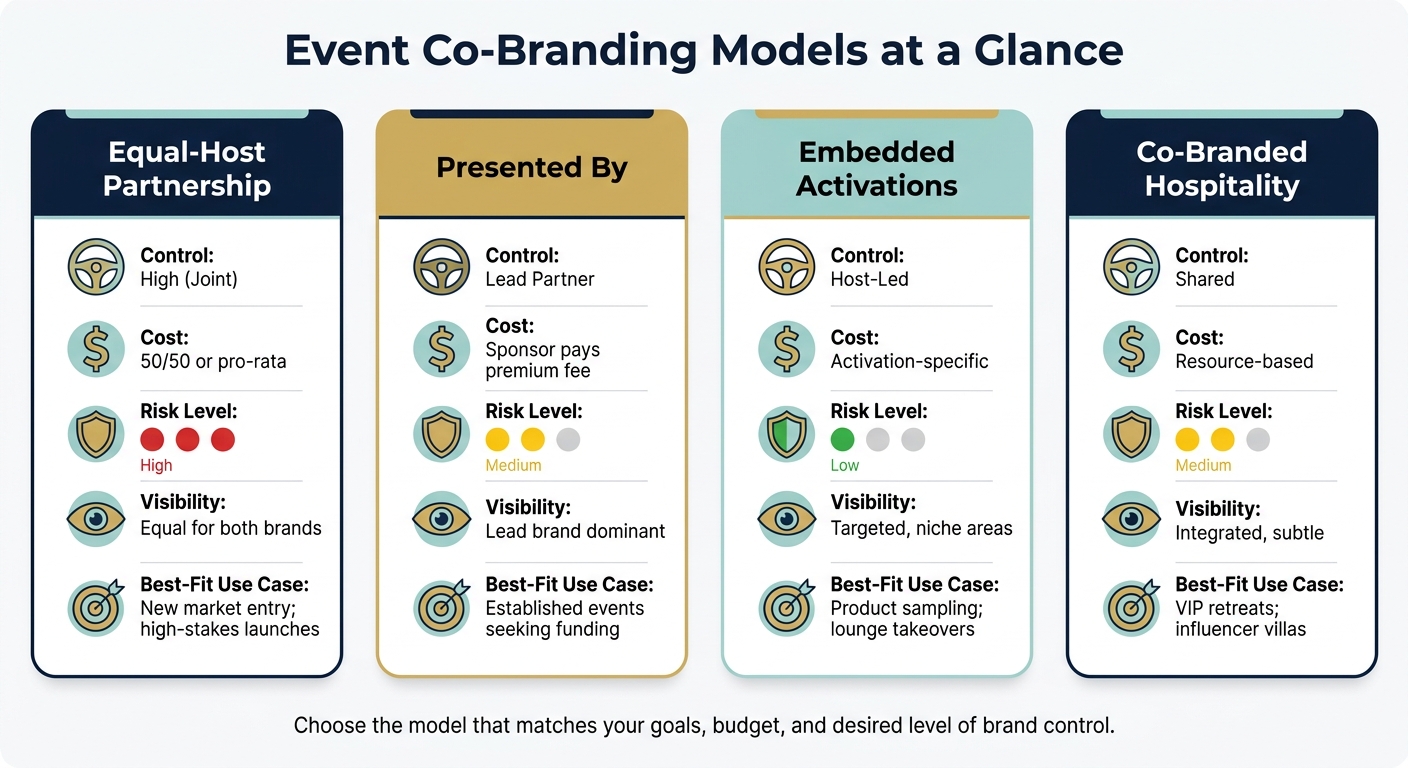
Event Co-Branding Models: Control, Cost, Risk & Visibility Compared
Audience Fit and Brand Alignment
In luxury events, alignment does two jobs at once: it protects audience fit and keeps brand exclusivity intact. Start with an internal brand audit. Define your tone, values, audience, and non-negotiables. That gives you a clear baseline before you contact anyone.
From there, you can spot real fit issues and reputation risk early, not after plans are already in motion.
Most failures come from weak alignment or uneven contributions. And this goes past shared values. You also need to look at what each brand is actually bringing to the table. That might include:
- Venue access
- Guest lists
- Speakers
- Media reach
- Staffing
- Hospitality services
The point is simple: the exchange should feel fair. One brand shouldn’t do all the heavy lifting while the other just shows up.
Once fit is clear, choose a structure that matches the level of control, cost, and risk you can live with.
Common Event Co-Branding Models
With alignment in place, the next step is picking the partnership model. The right setup should match your goals, your partner’s expectations, and the kind of experience you want guests to have.
| Model | Control | Cost | Risk | Visibility | Best-Fit Use Case |
|---|---|---|---|---|---|
| Equal-Host Partnership | High (Joint) | 50/50 or pro-rata | High | Equal for both brands | New market entry; high-stakes launches |
| Presented By | Lead partner | Sponsor pays premium fee | Medium | Lead brand dominant | Established events seeking funding |
| Embedded Activations | Host-led | Activation-specific | Low | Targeted, niche areas | Product sampling; lounge takeovers |
| Co-Branded Hospitality | Shared | Resource-based | Medium | Integrated, subtle | VIP retreats; influencer villas |
Each model shifts the balance a bit. An Equal-Host Partnership gives both sides a strong hand, but it also means more shared risk. A Presented By setup gives the lead brand more control and makes sense when funding is a top goal. Embedded Activations work well when a partner wants a focused presence without shaping the whole event. Co-Branded Hospitality sits somewhere in the middle, with both brands woven into the guest experience in a quieter way.
Legal, Insurance, and Compliance Basics
Once you’ve picked the model, lock the terms before the fun stuff starts. Verbal agreements aren’t enough. Put payment schedules, exclusivity, logo rights, cancellation and force majeure terms, liability allocation, and asset deadlines in writing.
Also, get separate legal review for regulated industries and for any activation that collects attendee data. That step can save a lot of pain later, especially when guest info, privacy rules, or industry-specific limits are in play.
Planning the Partnership: Goals, Partners, and Venue Selection
Set SMART Goals and Event KPIs
Define success with numbers, not opinions. SMART goals give both sides a shared target and make post-event reporting much easier.
A simple way to organize KPIs is to put them into three buckets: Attendance & Sales (ticket sales in USD, RSVP-to-attendance rate), Brand Exposure (press mentions, social impressions, sentiment lift), and Guest Engagement (Net Promoter Score, dwell time in activation zones, and post-event conversion within a 14–30 day window). Put these into a one-page brief before the kickoff call so every stakeholder starts on the same page. Co-marketing campaigns that line up on goals early can boost engagement by up to 30% compared with solo efforts.
Once the targets are clear, it’s much easier to judge potential partners against them.
Screen Partners With a Scorecard, Not Instinct
Instinct isn’t due diligence. A scorecard gives you a cleaner way to compare audience overlap, reputation, budget capacity, and reliability.
| Partner Type | Primary Contribution | Branding Rights | Expected Outcome | Complexity |
|---|---|---|---|---|
| Venue Provider | Physical space, infrastructure, security | On-site signage, "Official Venue" | Premium atmosphere, future bookings | Moderate |
| Consumer Brand | Experiential activations, products | Category exclusivity, co-branded content | Brand affinity, product trials | High |
| Financial Sponsor | Capital, budget support | Logo placement, VIP access | Lead generation, ROI proof | Low |
| Media Partner | Reach, coverage, PR | "Official Media Partner" status | Visibility, ticket sales, content | Moderate |
If you want 10 strong partners, expect to start about 100 real conversations. That ratio may feel steep, but it keeps your pipeline honest. More important, it helps you rule out weak fits before they cost time or damage your name.
After partner fit is nailed down, the next step is picking a venue that works for both the brand and the run of show.
Use the Venue as a Branding Asset
Pick spaces with built-in assets like VIP suites, digital marquees, and flexible layouts for activation zones. Those details give you actual sponsorship inventory to sell instead of forcing you to make things up on-site. For luxury and destination events, Essentialyfe pairs curated venues with planning, security, shuttle, and concierge support.
With goals, partners, and venue lined up, the next piece is brand rules, guest flow, and on-site control.
Running the Co-Branded Event
With the partner model and venue locked in, it’s time to shift from planning to delivery.
Set Brand Rules Before Creative Production Starts
Before anyone opens a design file, agree on the basics: logo hierarchy, color use, typography, sizing, and who approves what. Put required proof sign-off in place so every partner reviews materials before anything goes to production.
On key assets, lead with the event logo. Title sponsors should get prominent placement, while secondary sponsors should sit in a dedicated sponsor block. Define minimum safe space around each logo so nothing feels crowded or overlaps. If a sponsor uses a colorful mark, ask for white or black monochrome versions too. That keeps the logo readable on event backgrounds.
Tie sponsor deliverables to one thing: receiving the right files by a fixed deadline.
Map Co-Branding Across the Guest Journey
Once the rules are approved, map them across each guest touchpoint. This is where alignment stops being internal and starts showing up in the actual experience.
| Journey Phase | Key Touchpoints | Brand Role |
|---|---|---|
| Invitation & Registration | Co-branded landing pages, registration apps, pre-event email campaigns | Event leads; sponsor supports via reach |
| Arrival | Event signage, welcome gifts, lanyards, concierge moments | Event leads on atmosphere; sponsor adds surprise and delight |
| Programming | Stage visuals, keynote intros, sponsored sessions, branded stages | Event leads on content; sponsor leads on specific tracks |
| Social & Dining | Branded lounges, coffee breaks, mixers, golden hour rooftop experiences | Sponsor leads on experience; event stays supportive |
| VIP Moments | Invite-only VIP experiences, influencer brunches, private meet-and-greets | Sponsor leads; integration should feel native, not promotional |
| Post-Event | On-demand video, follow-up emails, ROI reports | Shared leadership; sponsor leads on content authority |
The aim is simple: branding should feel woven into the event, not slapped on at the last minute. A wellness sponsor running a recovery lounge with cold towels and herbal drinks will stick with guests far more than a logo on a step-and-repeat. The same goes for destination events. When transportation and concierge moments shape the day, services like Essentialyfe‘s shuttle, private chef, and concierge offerings can give a sponsor a natural place in the experience without breaking the flow.
Divide Responsibilities for Staffing and On-Site Control
After touchpoints are mapped, assign clear on-site ownership so the event stays under control.
Every deliverable needs one named owner, not a department. Put the host’s production team in charge of the overall run of show. Then create a separate asset-tracking team with one job: document each sponsor deliverable as it happens. That means photographing signage, timestamping mentions, and logging activations. This record becomes your proof-of-performance report, and it also helps when renewal talks come around.
Use a shared run of show and an escalation list so the right person can be reached fast when something changes live. Live changes need a clear chain of command. Give each deliverable one owner, each partner one on-site decision-maker, and each issue one escalation path.
Measure Results and Build a Repeatable Co-Branding Program
Track Brand, Revenue, and Experience Metrics
Once the event ends, proof of delivery is what drives renewal.
Sponsors come back when the results are easy to see. That’s why post-event reporting isn’t a nice extra. It’s a core part of the job. Send the fulfillment report within 14 days while the event is still fresh. Include timestamped photos, digital screenshots, and a checklist showing every promised asset was delivered. Using one report template across events also helps your team move faster and makes side-by-side comparisons much easier.
| KPI Category | Specific Metrics to Track | Data Sources |
|---|---|---|
| Brand Awareness | Impressions, social reach, brand sentiment lift, media mentions, logo recall | Social analytics, PR reports, post-event surveys |
| Lead Generation | Cost per qualified lead, badge scans, demo signups, meetings booked | Lead retrieval apps, CRM integration |
| Guest Experience | Dwell time in activation zones, session attendance, Net Promoter Score (NPS) | Heat mapping, RFID/BLE tracking, surveys |
| Revenue & Sales | Ticket sales via partner links, pipeline value, renewal intent, average order value | Ticketing platforms, sponsor debrief calls |
Before the contract is signed, ask each partner for their top two goals – leads, visibility, content, or sales – and build the measurement plan around those priorities. That way, the post-event report answers the question they care about most.
Start renewal talks as soon as the report goes out.
Apply the Framework to Multi-Day Retreats and Luxury Properties
For multi-day retreats and luxury properties, the same rules apply, but the workflow looks a little different.
With multi-day retreats, keep all deliverables in event management software and settle IP ownership for all photo and video assets before production starts. If you want to protect the guest experience, use smaller cohorts across multiple dates.
Conclusion: Key Takeaways for Event Co-Branding
Strong co-branding starts with audience overlap, shared goals, and clear contracts.
Every touchpoint matters. The registration page, the on-site experience, the post-event follow-up email – each one can strengthen the partnership or weaken it. Build those moments on purpose. Then measure results against the KPIs set at the beginning, not the ones that happen to look good later.
"Event sponsorship works best as a long-term partnership, not a one-off logo deal." – Zainab Asad, Remo.co
The practical takeaway is simple: repeatable co-branded events rely on audience fit, standardized reporting, and well-run cohorts for multi-day formats. When you can show delivery and tie it to results, the renewal conversation gets a lot easier.
FAQs
How is co-branding different from sponsorship?
Sponsorship is usually a straightforward trade. One partner gives funding or other support in return for visibility and access to the event. In most cases, the focus is brand awareness or lead generation through logo placement and a set list of deliverables.
Co-branding goes further. It brings two brand identities together to build a shared story and a smoother attendee experience. The focus shifts from simple exposure to mutual growth and shared resources.
What makes a good co-branding partner?
A good co-branding partner comes down to fit, not just budget.
The strongest partners line up with your core values, whether that’s luxury, sustainability, or innovation. They should also speak to the same target audience, but from a different angle. That’s the sweet spot. You want overlap, not a copy of your brand.
Just as important, the right partner wants more than logo placement or extra exposure. They want to work with you to build an integrated guest experience that feels natural, not forced.
At the end of the day, a strong partner makes the event better for attendees while helping both brands grow and build credibility.
Which event co-branding model fits my goals?
Choose the model based on the result you want, not just the label attached to it. Modern co-branding is more than putting two logos side by side. It’s about building a planned partnership that runs through the event in a clear, useful way.
For broad awareness, put visibility and category exclusivity first. If you want deeper engagement, lean into experiential collaborations or co-created content. If lead generation is the goal, use modular packages with demos, meeting blocks, or data-sharing.
Essentialyfe can help shape these options around your event goals.