Private island wellness retreats offer an exclusive and personalized alternative for group events like corporate retreats, weddings, or family gatherings. These venues provide unmatched privacy, tailored wellness programs, and all-inclusive pricing, making them ideal for groups seeking a secluded, distraction-free environment. However, they come with higher costs and logistical complexities compared to standard venues.
Key Highlights:
- Privacy: Full-island buyouts ensure no external guests or interruptions, offering complete control over the space and schedule.
- Wellness Programs: Activities like beachfront yoga, equine therapy, and personalized meals cater to group goals, far beyond typical venue offerings.
- Logistics: Access often requires multi-step travel (e.g., seaplanes, private boats), demanding careful planning and coordination.
- Cost: While upfront costs are higher, all-inclusive packages often simplify budgeting and deliver better overall value for larger groups.
For those prioritizing exclusivity and a highly tailored experience, private islands are a standout choice, though standard venues may suit tighter budgets or simpler logistics.
Escape to The Aerial, BVI – A Private Island Retreat for Purposeful Travel
sbb-itb-161ccc1
Privacy and Exclusivity
Booking a private island for your group event goes far beyond reserving a few rooms – you’re taking over the entire island. A full-island buyout means you have exclusive access to every villa, beach, spa, and staff member. Unlike shared venues where you might have to work around other guests, a private island operates entirely on your group’s schedule and needs.
As Cousine Island describes it:
"This is not simply a booking. It’s a bespoke, closed‑door world: your villas, your beach, your spa, your yacht days, your conservation team, your chef, your schedule. No compromises. No onlookers."
This exclusivity is further enhanced by the island’s natural boundaries. The secluded setting ensures a distraction-free atmosphere, making it easier to foster meaningful connections and stay focused. This is why private islands are perfect for corporate retreats or milestone celebrations. When participants know the space is entirely theirs, they feel more comfortable, engage more authentically, and remain fully present – all of which are key to successful wellness programs.
For high-profile groups, the added layer of security is a game-changer. The natural isolation of a private island allows for unparalleled discretion, something mainland properties simply can’t offer. Whether you’re hosting top executives or a prominent family gathering, the island’s exclusivity ensures privacy and keeps your event contained. This complete control over the environment creates the ideal backdrop for personalized wellness experiences.
Wellness Programming
Private islands take a completely different approach to wellness compared to standard venues, where wellness often feels like an afterthought – think a spa menu or an early morning yoga class. On a private island, wellness isn’t just an option; it’s integrated into every aspect of the experience.
These islands typically have dedicated wellness directors who design programs tailored to your group’s specific goals. Activities can include everything from guided freediving in open water and equine-assisted therapy with rescued horses to immersive sound baths and beachfront "Tribal Gyms" without mirrors. Even the environment amplifies the experience – imagine sunrise yoga on an ocean-facing platform rather than in a studio overlooking a busy cityscape.
Customization is where private islands truly shine. Before arriving, guests usually complete detailed preference sheets that cover dietary needs (keto, plant-forward, paleo, etc.), sleep habits, and activity preferences. Private chefs then use this information to create meals tailored to each individual, moving far beyond the standard group menu with its generic alternatives. Jason Acosta, Co-Founder & Principal Broker at Vital Charters, sums it up perfectly:
"A private crewed yacht is the only travel product that delivers all five wellness inputs – autonomy of schedule, exclusivity of venue, customized nutrition via the preference sheet, anchored-quiet sleep… and movement variety."
This level of personalization is something standard venues simply cannot compete with. The table below highlights the key differences:
| Dimension | Standard Venue | Private Island Retreat |
|---|---|---|
| Yoga/Meditation Space | Fixed indoor studio or shared room | Open-air platforms and beachside settings |
| Nutrition | Group menus with limited modifications | Private chef crafting fully customized meals |
| Activity Variety | Standard gym and basic spa offerings | Freediving, equine therapy, sound baths, hikes |
| Schedule | Fixed class times | Co-created, self-paced itineraries |
| Acoustic Environment | Ambient hotel noise | Natural sounds of wind, water, and silence |
This highly tailored programming doesn’t just enhance personal well-being – it also strengthens group dynamics. For corporate groups, activities can focus on leadership development and team building. For families or milestone celebrations, the focus can shift to connection and restoration. With specialized staff like nutritionists, personal growth coaches, and certified wellness facilitators, private islands offer a level of flexibility and care that standard venues simply can’t match.
Logistics and Getting There
Reaching a private island isn’t as straightforward as hopping on a plane. Most trips involve a multi-step journey: starting with a commercial flight to a regional hub, followed by a transfer via charter flight, seaplane, helicopter, or private speedboat. The last leg of the journey – from the mainland to the island – can be both the trickiest and the priciest, with transfer costs ranging anywhere from $500 to $10,000.
Timing is everything when it comes to this final stretch. Coordinating guest arrivals to align with the island’s transfer schedule is crucial. Miss the seaplane departure, and guests could find themselves stuck at a regional airport. Jeremy Jarvis from SilkHarbor Travel emphasizes this point:
"The final leg of your journey (seaplane, speedboat) is a critical detail that needs to be perfectly timed with your international flights."
Beyond transfers, there’s a lot more to consider. Permits, customs clearance, and vendor logistics all require careful planning. For example, if you’re hiring a photographer, wellness instructor, or live band, ensure they can transport their equipment and comply with local regulations. Some destinations also require event permits, which must be secured well in advance. To avoid last-minute headaches, start planning 6–12 months ahead. Keep in mind that private islands often have minimum stay requirements of 3–7 nights and tend to book up quickly during peak seasons.
By contrast, traditional venues near major airports offer a much simpler experience. There’s no need to sync with a seaplane schedule, navigate maritime customs, or worry about how vendors will transport their gear. Vendors can often just drive up with everything they need, making these venues far more accessible.
Given the complexities of private island logistics, expert help can make a huge difference. For groups looking for a smooth journey from planning to execution, working with a full-service concierge partner can ease the burden. For example, Essentialyfe specializes in handling these intricate details – coordinating shuttle services, vetting vendors, and managing on-site logistics. As Isabella Rossi explains:
"Working with a reputable concierge service or specialized platform is a game-changer. They can handle all the nitty-gritty details, from booking flights and arranging transfers to stocking the pantry."
Lastly, don’t overlook travel insurance. Policies that cover trip cancellations or weather-related disruptions typically cost 5–8% of the total trip value. It’s a small price to pay for peace of mind.
Cost and Value
When considering a private island buyout, the initial price tag might seem higher, but the bundled pricing often delivers better overall value. Traditional event venues typically charge separately for accommodations, meeting spaces, catering, AV equipment, and transfers – plus service charges and taxes that can add an extra 20–35% to the bill.
Private island retreats, on the other hand, usually offer an all-inclusive fee. This covers accommodations, meals, beverages, staff, and most activities. Take Bliss Island in Hawaii as an example: their 5-night/6-day buyout costs $35,000 and accommodates 8 to 16 guests. This price includes everything – taxes, gourmet meals, an open bar, airport transfers in a Mercedes Sprinter, and three off-property excursions. That breaks down to $2,319 to $3,888 per guest, with no hidden fees.
"Our guarantee is a memorable experience free from unexpected markups such as taxes at check-out, exorbitant dining costs, marked-up excursions, cleaning charges, vehicle rentals, or cash tips at departure." – Bliss Island Resort
Now, let’s compare costs for a 3-day retreat for 20 people:
| Expense Category | All‑Inclusive Island/Resort | Traditional Venue |
|---|---|---|
| Accommodation | $450/person/night | $225/person/night |
| F&B / Activities | Included | $75/person/day |
| Venue Rental | Included | $1,500 |
| Total Estimated Cost | $27,000 | $19,500+ |
While the base cost of a traditional venue might seem lower, additional expenses – like AV rentals and gratuities (usually 15–20%) – can quickly narrow the gap. Other factors, such as staff gratuities (10–15%), premium spa services, or outside entertainment, can further influence the final cost.
For a full island buyout, you’ll generally need to book 75–90% of the property’s villas. For example, a 26-villa resort might require booking around 20 villas, accommodating roughly 40 guests. Peak-season buyouts in destinations like the Maldives often need to be secured 9 to 18 months in advance. However, booking during shoulder seasons – April to May or September to November – can save you 20–40% without compromising the retreat’s programming.
"This structure can make a $1,000/night island resort surprisingly competitive against a $600 city hotel once you factor in à la carte dining, transfers, and activities." – LodgingStay
Ultimately, the return on investment depends on your group’s priorities. Studies show that 67% of employees report feeling more engaged after a structured retreat. A private island buyout offers exclusivity, personalized service, and a fully tailored experience – elements that traditional venues often struggle to match. These benefits create the perfect environment for the kind of immersive programming discussed in upcoming sections.
1. Private Island Wellness Retreats
Private island wellness retreats create an unparalleled experience by offering complete group isolation. Imagine an entire island – every beach, spa, and staff member – dedicated solely to your group. These retreats provide a unique environment that fosters deeper connections and engagement, with exclusivity, tailored wellness programs, streamlined logistics, and bundled pricing making them an attractive choice for group events.
Privacy and Exclusivity
Complete privacy is a game-changer for group events. Exclusive-use properties are becoming increasingly popular, with demand for such venues projected to rise by 22% in 2026. In fact, 78% of luxury travelers now prefer private spaces for their gatherings. The reason? When a group has exclusive access to its surroundings, participants can connect more authentically and stay fully engaged.
"A private sanctuary replaces shared lobbies with exclusive entryways and personal grounds… creating a ‘thinking environment’ where distraction-free solitude leads to better strategic outcomes." – The Kanini Estate
Wellness Programming
Private island retreats excel at weaving physical, mental, and nutritional wellness into a seamless experience. Guests can enjoy activities like beachside yoga, guided nature hikes, and kayaking, all complemented by garden-to-table meals crafted by on-site nutritionist chefs.
These programs are tailored to the group’s goals. For example, corporate teams can use oceanfront boardrooms with high-speed internet (up to 1,000 Mbps) and participate in team-building activities like Beach Olympics. Families, on the other hand, can enjoy kids’ workshops and communal dinners. Some properties go above and beyond – Icon Private Collection in the British Virgin Islands even offers equine therapy with rescued horses and access to a recording studio on its 43-acre property, accommodating up to 32 guests.
Logistics and Getting There
Reaching a private island often involves multiple transfers, but many high-end retreats simplify this process with all-inclusive packages. For instance, Bliss Island Resort includes round-trip airport transfers in its pricing, removing logistical headaches for organizers.
"Our intention is to provide a complete luxury experience, free of worry, so you can focus on what matters most: your guests’ experience and your own! This means removing the complication and hassle of logistically running your own retreat." – Bliss Island Resort
Cost and Value
Costs depend on the destination, group size, and length of stay, but the all-inclusive pricing model ensures great value. For example, Embrace Resort’s 4-day/3-night "Essence" package starts at $1,800 per person, while The Enclave in Belize offers a 6-night island takeover for around $3,979 per person. These packages typically cover transfers, meals, and wellness programming, making them a worthwhile investment for groups focused on connection and results.
Booking well in advance (12–18 months) is recommended for peak-season dates. However, choosing shoulder-season periods like April–May or September–November can lower costs by 20–40% without sacrificing quality.
2. Standard Venues
Standard venues like luxury villas, boutique resorts, and hotel conference centers offer convenience and affordability for many groups. However, they often lack the exclusivity that private island retreats provide. Let’s dive into how these venues measure up in terms of privacy, wellness programs, logistics, and cost.
Privacy and Exclusivity
Standard venues provide what’s often called "layered privacy." Your group may have a dedicated space within the property, but the overall environment is shared with other guests. This means the beach isn’t entirely yours, nearby activity is noticeable, and the ambiance feels less secluded.
"The hotels are exceptional, but the surrounding energy is louder. The restaurants are world class, but reservations are competitive. The beaches are stunning, but never quite empty." – Stefanie P., AAV Explorations
For groups that thrive on interaction or wish to explore local attractions, the shared spaces and proximity to cultural landmarks can actually be a benefit. However, for those seeking true seclusion, this setup falls short.
Wellness Programming
Wellness offerings at standard venues are designed for a broad audience, with fixed schedules for yoga, spa treatments, and fitness sessions. Personalized attention is limited due to lower staff-to-guest ratios. Meals tend to feature healthy resort-style menus but lack the tailored, nutritionist-designed options often found on private islands. This one-size-fits-all approach can be less effective for groups with specific wellness goals.
Logistics and Getting There
One advantage of standard venues is the simplicity of access – no complicated transfers are required. However, shared facilities like dining halls and meeting rooms can create scheduling conflicts with other guests. As Orange Springs Retreat Center explains:
"Exclusive-use means your group is the only one on the property… This setup is the opposite of hotels, conference centers, or public campgrounds where groups often share facilities."
Because these venues aren’t exclusively yours, spontaneous late-night gatherings or last-minute changes often require coordination with management, adding logistical hurdles that exclusive-use properties avoid.
Cost and Value
Standard venues typically operate on an itemized pricing model, which can be more economical for smaller groups. For example, boutique resort packages start at around $1,800 per person for a 4-day/3-night stay, including meals and basic session spaces. While this pricing makes standard venues accessible, you’re paying for shared access rather than exclusive ownership, which can affect the overall experience.
Pros and Cons
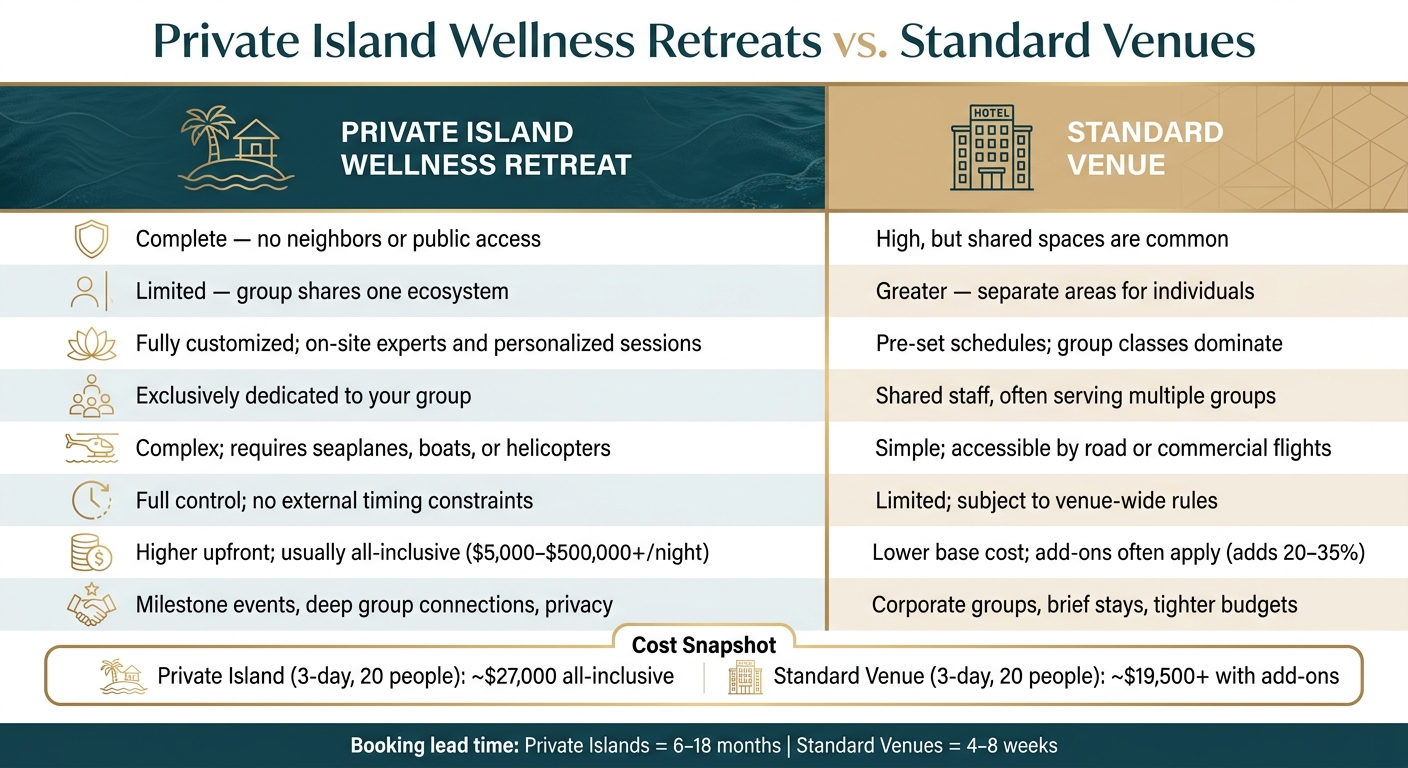
Private Island Wellness Retreats vs. Standard Venues: Key Differences
Choosing the perfect venue for a group event can be tricky. It all comes down to what matters most to your group – whether that’s complete privacy, budget considerations, or convenience. Here’s a breakdown of how private island wellness retreats compare to standard venues across key factors.
| Factor | Private Island Wellness Retreat | Standard Venue |
|---|---|---|
| External Privacy | Complete; no neighbors or public access | High, but shared spaces are common |
| Internal Privacy | Limited; the group shares one ecosystem | Greater privacy; separate areas for individuals |
| Wellness Programming | Fully customized; on-site experts and personalized sessions | Pre-set schedules; group classes dominate |
| Staffing | Exclusively dedicated to your group | Shared staff, often serving multiple groups |
| Logistics | Complex; requires private transport like boats or helicopters | Simple; accessible by road or commercial flights |
| Schedule Flexibility | Full control; no external timing constraints | Limited; subject to venue-wide rules |
| Cost Structure | Higher upfront; usually all-inclusive | Lower base cost; add-ons often apply |
| Best For | Milestone events, privacy, deep group connections | Corporate groups, brief stays, tighter budgets |
This comparison highlights the balance between control and convenience. While private islands offer unmatched exclusivity and tailored service, their high costs reflect the all-inclusive nature of the experience. Nightly rates range from $5,000 to over $500,000, but for groups of 18–32, the per-person cost can rival that of ultra-luxury resorts – often priced at $2,000 per person per night without exclusive access.
"The difference isn’t merely about accommodation – it’s about the fundamental nature of your healing experience and the level of personalization that money can truly buy." – Forbes & Partners Editorial Team
Standard venues, on the other hand, are far easier to book and access. They typically require less lead time – 4 to 8 weeks compared to 6 to 12 months for private islands during peak seasons. For groups looking for structured programming without the logistical hurdles, standard venues are a practical choice. However, shared environments can limit the depth of immersion, which is crucial for wellness-focused events where privacy fosters trust and openness.
"People open up more readily when they know the space is safe and private. Vulnerability increases. Trust builds faster." – Orange Springs Retreat Center
Ultimately, the right choice depends on whether your group values a highly personalized, boutique experience or prefers the simplicity and accessibility of more traditional options.
Conclusion
When deciding between private islands and standard venues, it all boils down to one key question: Does your group need total immersion or prefer individual flexibility?
Private islands shine for milestone events that call for stepping away from the usual – think destination weddings or executive retreats. They’re ideal for settings where deep focus and meaningful connection take center stage, like wellness programs or intimate gatherings. On the other hand, standard venues are better suited for multi-generational trips, extended stays, or groups that prioritize personal routines and space.
The choice ultimately depends on whether your group values a fully immersive, tailored experience over the convenience and adaptability of more traditional options. Keep in mind, private island buyouts often start at around $25,000 per night. This premium price tag makes sense only when the goal is to create a deeply immersive and unforgettable experience, perfect for small, tightly-knit groups looking to go beyond the ordinary.
For those ready to commit to this elevated level of experience, partnering with Essentialyfe ensures seamless access to luxury venues. Their comprehensive planning services cover everything from private chefs and concierge support to security and transportation logistics, turning potential hurdles into a smooth, personalized journey.
"Choose the experience that matches your group’s rhythm, not the one that simply sounds more impressive." – James Nightingall
FAQs
What group size works best for a private island buyout?
Private island buyouts usually cater to groups ranging from 6 to 30 guests, though some locations can accommodate 40 or more. For smaller gatherings of 4 to 8 people, intimate islands often prove to be a more budget-friendly option. Meanwhile, groups of 8 to 20 can enjoy per-person costs comparable to those found at high-end luxury resorts. Corporate retreats typically bring together 8 to 16 attendees, while family reunions often flourish with groups of 10 to 25. Essentialyfe specializes in customizing the ideal venue and handling event logistics to ensure everything runs smoothly.
What’s the biggest travel risk when getting to a private island?
The most significant risk is missing your scheduled transfer, as many seaplane or boat services stop running once the sun sets. Since these transfers often depend on weather conditions and may not operate every day, a mismatch in schedules could result in an unexpected overnight stay in a transit city. To avoid this, always double-check your transfer arrangements ahead of time and have a backup plan in place to deal with potential weather-related delays or disruptions.
What’s usually not included in “all-inclusive” island pricing?
Even with all-inclusive pricing, there are often extra costs to consider. These might include premium alcohol – like wine or champagne – specialized excursions, and motorized water sports. Transportation options such as private seaplane or boat transfers can also add 10–20% to your total expenses. Additionally, government taxes, conservation fees, and service charges may apply. Essentialyfe can help arrange extras like private chefs or enhanced security, but these are usually not part of standard packages.