When a crisis happens, what you do afterward can shape your team’s future. Skipping structured debriefing risks repeating mistakes, hurting morale, and damaging your brand. Done right, debriefs help teams learn, fix systemic issues, and improve performance. Here’s why debriefing matters and how to do it effectively:
- Why Debriefing Matters: It identifies root causes of problems, prevents repeated errors, and reduces staff burnout.
- Risks of Skipping It: Blame culture, unresolved stress, and poor guest experiences.
- How to Run It: Act within 24–48 hours, use a neutral facilitator, and focus on facts, not blame.
- Key Outcomes: Better processes, stronger teams, and improved guest satisfaction.
Structured debriefing isn’t just a discussion – it’s a way to improve and ensure every crisis becomes a learning opportunity.
Workforce Wellness Series: Post-Crisis Debriefing and Processing
What Happens When Debriefing Is Skipped After a Crisis
Skipping a debrief might save time in the moment, but it often leads to bigger problems down the road.
Staff and Operations Suffer Without Debriefing
Without a structured review after a crisis, teams tend to fill in the gaps with assumptions. Instead of focusing on facts, individual stories take over, leading to blame games. This focus on personal accountability often hides larger, systemic problems like unclear protocols, understaffing, or outdated processes. When these root issues aren’t addressed, they keep causing the same disruptions over and over. The result? Operational inefficiencies and a team that struggles to work together effectively.
The psychological impact on employees is another major concern. High-stress incidents without proper follow-up can lead to emotional exhaustion and hypervigilance. Over time, this can wear down morale and push employees toward burnout. And when experienced team members leave, the consequences aren’t just emotional – they’re financial. For mid-to-large events, staffing typically accounts for 25–40% of total production budgets. Losing skilled employees due to burnout creates costly setbacks for operations.
Guest Experience and Brand Reputation Take a Hit
When operational and staffing issues go unresolved, they don’t just stay behind the scenes – they inevitably affect the guest experience. A stressed, overburdened team can lead to slower service, inconsistent communication, and an overall sense of disorganization. Guests notice these things, even if they don’t know the full story.
These breakdowns have a direct impact on guest satisfaction and the brand’s image:
| Consequence | Impact on Staff & Operations | Impact on Guest Experience & Brand |
|---|---|---|
| No root cause analysis | Persistent process or technical failures | Recurring service interruptions and safety concerns |
| Blame culture | Higher turnover and lower morale | Staff appear unprepared or defensive |
| Fragmented narrative | Rumors replace facts internally | Mixed messages and inconsistent public communication |
| Unaddressed stress | Emotional burnout and disengagement | Lower service quality and reduced empathy |
For a luxury brand like Essentialyfe, where every interaction shapes guest perception, these missteps are especially damaging. Guests expect a flawless, high-touch experience across vacation rentals, event spaces, and curated services. If they encounter inconsistent service or notice stressed staff, it undermines the brand’s promise of seamless luxury. Even the most beautiful property won’t bring them back if the service feels off.
"Stakeholders notice patterns; when they see an organization learning and adapting after a disruption, their trust grows." – BrandJet
In luxury hospitality, trust is everything. When mistakes repeat and communication falters, that trust can disappear in an instant. And once it’s gone, it’s hard to win back.
Why Structured Debriefing Belongs in Every Crisis Plan
When a crisis hits, what happens afterward can make or break a team’s future performance. Swift post-crisis analysis is what sets apart teams that improve and adapt from those that repeat past mistakes. Structured debriefing is the tool that makes this improvement possible, acting as a cornerstone of any effective crisis management plan. As William DeMuth points out, structured debriefing can turn a crisis into a chance for growth rather than just a setback. This process not only sharpens operational performance but also helps safeguard a company’s brand reputation – a critical factor highlighted earlier in this discussion. The research backing these benefits underscores why debriefing should be a non-negotiable part of every crisis strategy.
Key Benefits of Running Structured Debriefs
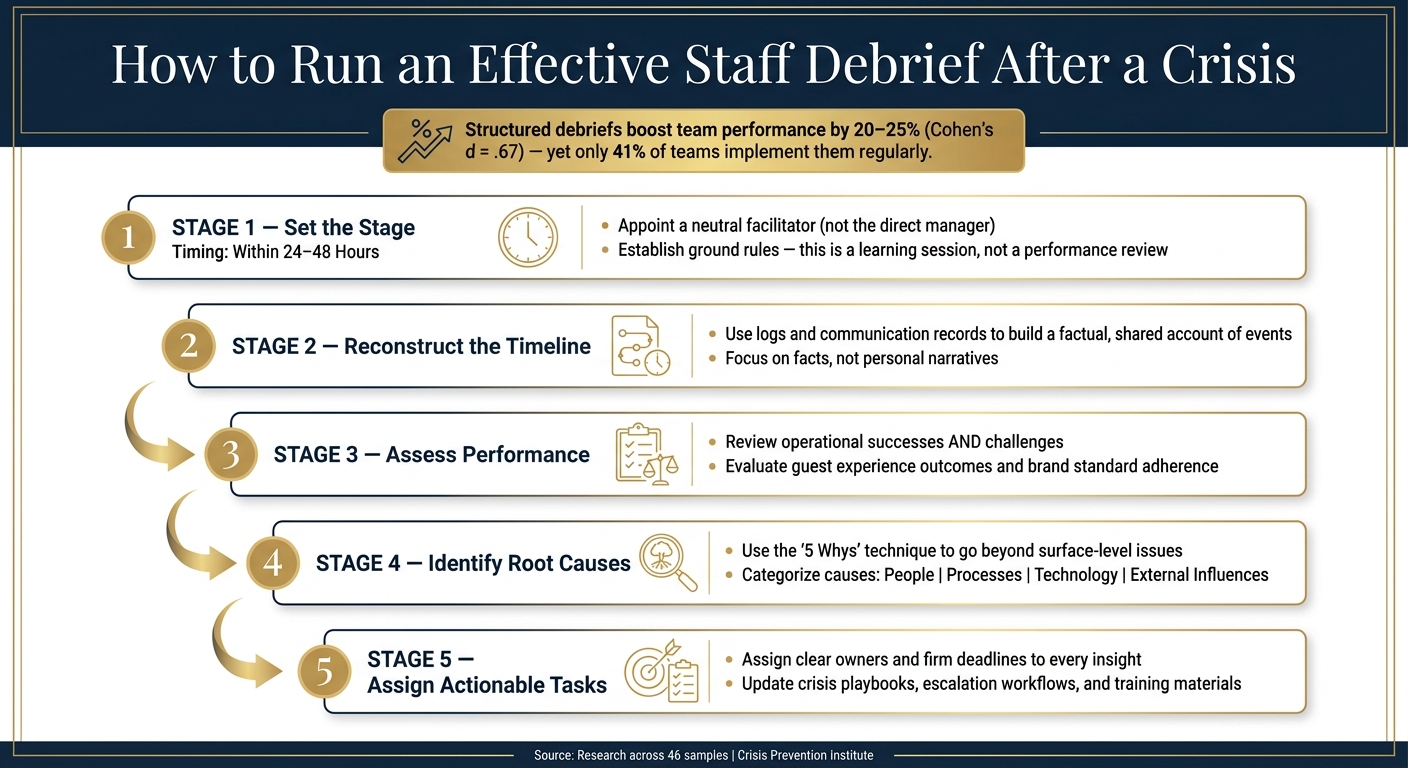
A structured debrief doesn’t just feel productive – it delivers measurable results. Research spanning 46 samples shows that structured debriefs boost team and individual performance by a Cohen’s d of .67, translating to a 20–25% improvement in effectiveness compared to teams that skip this step. That’s not just a small boost – it’s a significant edge in operations.
The practical advantages go beyond the statistics. Structured debriefs focus on identifying systemic issues rather than placing blame on individuals. For instance, they might uncover problems like unclear escalation procedures, insufficient staffing, or tools that didn’t hold up under pressure. Additionally, debriefs provide a space for team members to process the stress of high-pressure situations, which helps maintain morale and reduces long-term burnout risks.
Why Debriefing Fits the Complexity of Luxury Properties and Events
For luxury properties and high-profile events, where operations are inherently complex, structured debriefs are even more critical. These settings often require seamless coordination across multiple departments – security, concierge, event logistics, transportation, and more. In such environments, even minor confusion can spiral into larger issues. The Crisis Prevention Institute emphasizes this point:
"Consistency among staff is a non-negotiable factor in crisis prevention. When everyone follows the same protocols, speaks the same language, and upholds the same values, the potential for confusion diminishes."
Take a brand like Essentialyfe, for example. A single event might involve private chefs, security teams, shuttle services, and on-site concierge staff all working simultaneously. Structured debriefs help align these moving parts by identifying specific communication failures or process gaps exposed during real-world incidents – not just in training scenarios. This level of operational insight ensures the team isn’t just reacting well once but is prepared to respond effectively every time.
sbb-itb-161ccc1
How to Run Effective Staff Debriefing Sessions
How to Run an Effective Staff Debrief After a Crisis
Running a debrief effectively means understanding its purpose and executing it with precision, particularly in luxury properties or high-profile events where every detail counts.
Core Principles for a Successful Debrief
Creating a safe environment for open dialogue is essential. Team members should feel comfortable sharing their thoughts without fear of blame or repercussions. Crisis management expert Edward Segal emphasizes this importance:
"After any crisis or significant challenge, companies should hold a debrief or ‘post-mortem.’ This is a critical time for an organization to look in the mirror and evaluate its performance."
Here’s how to make your debrief sessions impactful:
- Timing is crucial: Hold the debrief within 24 to 48 hours after the incident. This timing ensures details are still fresh, but emotions have settled enough to allow for constructive discussion.
- Use a neutral facilitator: Choose someone impartial, not the participants’ direct manager, to reduce defensiveness and encourage honest feedback.
- Start on a positive note: Begin by highlighting what went well before addressing areas for improvement. This approach builds trust and reinforces that the session’s purpose is learning, not assigning blame.
Focus the discussion on systemic issues rather than individual mistakes. Questions like "Was the escalation process clear?" or "What could have made your work easier?" help uncover structural challenges and opportunities for improvement.
These principles create a foundation for a productive and actionable debrief session.
A Suggested Debriefing Agenda
Luxury events demand a clear and concise debrief agenda. Here’s a suggested structure:
- Set the stage: Establish ground rules, emphasizing that this is a learning session, not a performance review.
- Reconstruct the timeline: Use logs and communication records to create a factual account of events.
- Assess performance: Review operational successes and challenges, as well as guest experience outcomes.
- Identify root causes: Go deeper than surface-level issues with tools like the "5 Whys" technique to uncover underlying problems.
- Assign actionable tasks: Turn insights into specific tasks, assigning clear owners and deadlines.
For luxury events, it’s also important to evaluate whether the team upheld the brand’s high service standards. Pay attention to how guest communication was handled and whether discretion was maintained throughout.
Using Visual Tools to Present Debrief Findings
Plain notes can lack clarity and impact, but visual tools make debrief findings more actionable and easier to understand. Here’s how to map debrief components to useful visual formats:
| Debrief Component | Visual/Output Tool | Purpose |
|---|---|---|
| Timeline Reconstruction | Chronology Map | Establish shared facts and sequence of events |
| Performance Assessment | Strengths vs. Gaps Table | Highlight what worked well and what didn’t |
| Root Cause Analysis | Causal Tree / 5 Whys Diagram | Identify systemic causes beyond surface issues |
| Action Assignment | Owned Improvement Plan | Assign tasks with clear ownership and deadlines |
| Monitoring | KPI Dashboard | Track participation and long-term progress |
For leadership, presenting a comparison between teams that debrief and those that don’t – highlighting differences in blame culture, staff morale, and even legal risks – can demonstrate the value of making debriefing a standard practice. Using visuals ensures that lessons learned lead to meaningful, lasting improvements.
Turning Debrief Findings Into Real Changes
Putting Lessons Learned Into Practice
A well-structured debrief isn’t just about identifying what went wrong – it’s about ensuring those lessons lead to real, lasting changes. As Lori Geary of Lexicon Strategies aptly says:
"A debrief that ends with a conversation and nothing written down is a debrief that will be forgotten."
To make debriefs impactful, every insight needs a clear owner, a firm deadline, and a measurable goal. For instance, instead of vague objectives like "improve communication", aim for something actionable, such as, "roll out mandatory escalation training for all supervisors within 30 days." This level of specificity ensures accountability and progress.
Documenting findings in a centralized knowledge repository is key. This creates a shared institutional memory, allowing the entire team – not just those present at the debrief – to benefit from the insights. Once documented, these lessons should be integrated into crucial operational tools like crisis playbooks, escalation workflows, and communication guidelines. Doing so transforms a single incident into a stepping stone for permanent improvement. These updates also lay the groundwork for targeted staff training, ensuring that past challenges directly inform and strengthen future performance.
Using Debrief Insights to Improve Staff Training and Support
Debrief findings provide some of the most practical material for refining staff training. Instead of relying on generic training sessions, use real incident data to create scenario-based exercises that mirror the challenges your team faced. For example, if staff struggled during a guest communication breakdown, design a simulation that recreates that exact scenario for your next training.
To make training more focused, categorize the root causes of incidents into People, Processes, Technology, and External Influences. This approach ensures that the response matches the problem – a staffing gap requires a different solution than a flawed escalation process. Additionally, debriefs often highlight team members who may need extra support. For example, employees showing signs of emotional fatigue or stress can be connected with resources like an Employee Assistance Program (EAP). By using real-world data, you not only sharpen your training but also enhance your team’s resilience and overall readiness.
Measuring the Impact of Debriefing Over Time
To confirm that your debriefing process is making a difference, link insights to measurable outcomes. Key indicators include: how often similar incidents recur, how quickly new issues are detected and resolved, and shifts in staff feedback scores.
| Metric Category | What to Track | Measurement Method |
|---|---|---|
| Operational Efficiency | Time-to-detection; time-to-response; protocol adherence | Incident logs and timestamps |
| Staff Impact | Turnover rates; workers’ comp claims; feedback scores | HR data and post-debrief surveys |
| Prevention | Frequency of repeated incidents; near-miss reports | Trend analysis in centralized repository |
| Reputation & Trust | Guest satisfaction scores; adverse media volume | External surveys and social listening tools |
A digital KPI dashboard can help track these metrics over time, making it easier to identify patterns and assess progress. The goal isn’t to achieve perfection after one debrief but to see a steady improvement. Fewer recurring incidents, faster response times, and increased staff confidence are clear signs that your debriefing process is working as intended.
Conclusion: Making Debriefing a Standard Part of Essentialyfe‘s Quality Assurance

Handling a crisis without a structured debrief means losing a chance to improve. When this happens repeatedly, it creates a pattern – one that quietly chips away at service quality, staff morale, and guest trust. For a company like Essentialyfe, where every detail of a luxury rental, private event, or film production must run seamlessly, such gaps can undermine the high standards clients expect.
William DeMuth, Director of Training at the Center for Violence Prevention and Self Defense, emphasizes this point:
"Debriefing is not a courtesy conversation. It is a structured risk management function. When done correctly, it converts an incident from a liability into institutional learning. When ignored, it guarantees repetition."
Debriefing isn’t just a one-time discussion – it’s a system. A successful debrief involves a regular schedule, open and blame-free conversations, and actionable insights that lead to updated protocols and training. The numbers speak for themselves: while 85% of emergency response teams recognize debriefing as a valuable tool for improvement, only 41% follow through with implementation. That gap is where avoidable mistakes take root, highlighting the importance of adopting debriefing as a core practice.
For Essentialyfe, which manages concierge services, event planning, security, and on-site staff across luxury properties, consistency is the real product. Guests aren’t just paying for a stunning venue or a gourmet meal – they’re paying for an experience that feels effortless and professional from start to finish. As discussed earlier, building institutional memory not only refines crisis response but also strengthens the brand’s promise. Structured debriefing ensures that even when things go wrong, lessons are learned and applied, making every subsequent event stronger.
Incorporating debriefing into Essentialyfe’s quality assurance framework isn’t about focusing on failures. It’s about creating a culture of learning that leads to quicker, smarter solutions and elevates the guest experience. By making debriefing a standard practice, Essentialyfe turns challenges into opportunities to deliver continuous excellence.
FAQs
Who should attend a crisis debrief?
A crisis debrief works best when everyone directly involved in the event is part of the discussion. This approach helps ensure that insights are shared and future responses are improved. Key participants often include:
- Crisis Lead: The person responsible for overseeing the entire response effort.
- Frontline Responders: Those who were actively managing the situation on the ground.
- Communications or Brand Representatives: Team members handling public messaging and brand reputation during the crisis.
- Operations or Technical Leads: Experts who managed the systems or processes impacted by the event.
A neutral facilitator plays a vital role in guiding the conversation and keeping it productive. Additionally, assigning someone to document key findings and action items is essential to ensure follow-up and implementation.
How do you keep debriefs blame-free?
To keep debriefs free of blame, shift the focus to systemic factors, processes, and outcomes rather than singling out individual actions. Set clear ground rules that create a safe environment for open learning and discussion. Rely on a structured format to objectively review timelines and pinpoint gaps in areas like training, resources, or communication. Leaders play a key role in steering the conversation toward understanding what happened and why systemic issues arose, encouraging teamwork and steering clear of fear-driven narratives.
What KPIs show debriefing is working?
Debriefing works best when it uncovers early-warning failures, highlights performance gaps and delays, and assigns clear corrective actions with measurable deadlines. Studies suggest it can lead to a 20–25% improvement in crisis response effectiveness, while also fostering stronger teamwork and ensuring that findings are consistently documented. Following up on these action items and regularly reviewing outcomes helps maintain steady progress over time.