Event crisis management is about preparing for and responding to unexpected situations that could disrupt your event. Whether it’s a natural disaster, technical failure, or security issue, the goal is to protect attendees, maintain operations, and safeguard your reputation. Here’s what you need to know:
- Plan Ahead: Build a crisis management team with clear roles. Include experts in logistics, security, communications, and medical response.
- Assess Risks: Identify potential problems through venue walkthroughs and stakeholder analysis. Use tools like risk matrices to prioritize issues.
- Have a Plan: Create step-by-step procedures for emergencies, define decision-making authority, and prepare backup resources like generators or medical kits.
- Communicate Clearly: Use multiple channels (social media, email, PA systems) for updates. Designate a spokesperson to avoid mixed messages.
- Practice Regularly: Conduct drills and simulations to ensure your team is ready to handle high-pressure situations.
- Review and Improve: After the event, analyze what worked and update your plan to address gaps.
#EventInsights webinar – Emergency & Crisis Management, Are You Prepared?
sbb-itb-161ccc1
Building Your Crisis Management Team
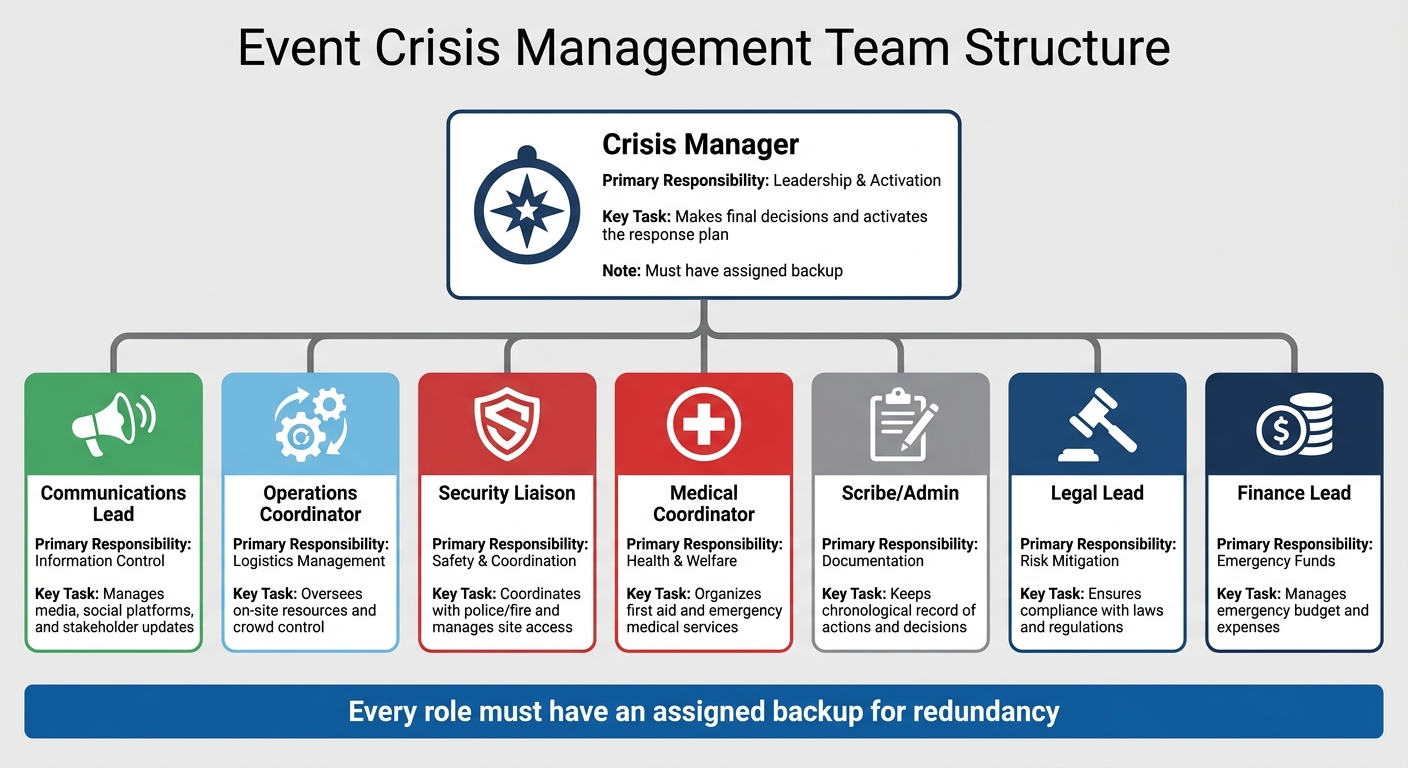
Event Crisis Management Team Roles and Responsibilities
Your crisis management team forms the backbone of any emergency response. Choosing the right individuals for each role is critical to maintaining control during a crisis. Michael Herrera, CEO of MHA Consulting, emphasizes:
"A strong crisis management team does not depend on a perfect org chart. It depends on clear authority, functional coverage, backups, communication ownership, and a structure people can actually use under pressure."
When selecting team members, prioritize individuals who can stay calm under pressure and make swift decisions. A cross-functional approach is essential – include representatives from areas like event management, security, communications, medical services, and logistics. This combination of expertise ensures that all critical aspects are covered, creating a solid foundation for your crisis response.
Assigning alternates and cross-training team members is equally important. This redundancy ensures your response remains effective even if key personnel are unavailable.
Take the example of P&O Ferries, which, in March 2022, dismissed 800 staff without proper legal consultation. This misstep led to immediate governmental backlash and long-term reputational harm. The takeaway? Clear roles and proper oversight are not just helpful – they’re non-negotiable.
Team Roles and Responsibilities
| Role | Primary Responsibility | Key Task |
|---|---|---|
| Crisis Manager | Leadership & Activation | Makes final decisions and activates the response plan. |
| Communications Lead | Information Control | Manages media, social platforms, and stakeholder updates. |
| Operations Coordinator | Logistics Management | Oversees on-site resources and crowd control. |
| Security Liaison | Safety & Coordination | Coordinates with police/fire and manages site access. |
| Medical Coordinator | Health & Welfare | Organizes first aid and emergency medical services. |
| Scribe / Admin | Documentation | Keeps a chronological record of actions and decisions. |
| Legal Lead | Risk Mitigation | Ensures compliance with laws and regulations. |
Every role listed above must have an assigned backup. The Crisis Manager takes charge of activating the plan and acts as the primary link to executive leadership. A unified communication strategy, led by the Communications Lead, helps prevent conflicting messages and confusion. The Operations Coordinator handles on-the-ground logistics and resource allocation, while the Security Liaison works closely with emergency services to ensure safety.
The Medical Coordinator is responsible for arranging medical support, including first aid stations and hospital contacts. Meanwhile, the Scribe plays a crucial role by documenting all decisions and actions for future analysis and legal accountability. The Legal Lead ensures adherence to laws and regulations, while the Finance Lead manages emergency funds. HR should focus on employee welfare, offering counseling and coordinating family notifications. Additionally, an IT Lead may be necessary to restore systems and secure data when technology is impacted.
To keep the team effective under pressure, establish clear decision-making authority and separate tactical responsibilities from strategic oversight. Define who has the power to decide, recommend, or approve actions. This clarity ensures the team can act decisively when time is of the essence.
For events hosted through Essentialyfe (https://essentialyfe.com), having a well-structured crisis management team is essential to ensuring safety and operational continuity.
Conducting Risk Assessment
Risk assessment turns uncertainty into clear, actionable steps. Before safeguarding your event, you need to pinpoint what could go wrong. This starts with establishing context – gathering details about the event environment, stakeholders, and logistics to identify potential risks.
Start with a physical walkthrough of event venues. Look for hazards like narrow hallways, risks from electrical setups, parking congestion, or blocked emergency exits. A tragic example of why this matters is the 2010 Love Parade in Germany, where 21 people died and over 650 were injured due to a single overcrowded ramp serving as both entrance and exit. Identifying these issues early can prevent such disasters.
Next, evaluate each scheduled activity to uncover logistical challenges and potential weak points. Combine this with stakeholder analysis to understand attendee demographics and expectations. For instance, a music festival might face risks related to crowd behavior and weather, while a corporate tech conference might deal with cybersecurity threats or equipment failures. Tailoring your approach to the type of event ensures you’re addressing the right risks.
Collaboration across teams is key. Bring together security personnel, technical staff, vendors, caterers, and venue managers to identify risks from multiple perspectives. Use a Risk Breakdown Structure (RBS) to group risks into categories such as External (like weather or regulations), Internal (like funding or staff injuries), Technical (such as power or Wi-Fi issues), and Management (like communication failures or vendor problems). Assign team members to oversee specific categories to ensure nothing is overlooked.
After identifying risks, assess their probability (likelihood of occurrence) and impact (severity of consequences). Assign numerical values to each and multiply them to calculate a risk score. This removes guesswork and helps prioritize resource allocation.
Creating a Risk Matrix
A Risk Matrix is a visual tool for prioritizing risks based on their likelihood and impact. A 3×3 matrix can help categorize risks as Low, Medium, or High for both factors. Here’s how it looks:
| Low Impact | Medium Impact | High Impact | |
|---|---|---|---|
| High Likelihood | Monitor | Mitigate | Priority Action |
| Medium Likelihood | Monitor | Mitigate | Mitigate |
| Low Likelihood | Accept | Monitor | Mitigate |
Risks in the high-likelihood, high-impact quadrant require immediate attention – these are your "Priority Action" items. Assign specific individuals to handle these risks and ensure they’re prepared to act if the threat arises. Schedule regular reviews – three months out, one month out, one week out, and the day of the event – to adapt to changing conditions like weather or updated attendance numbers. Use tools like weather apps and crowd monitoring systems to stay on top of new threats during the event.
For critical single points of failure, use Fault Tree Analysis. Start with a major potential issue (like a complete power outage) and work backward to identify all possible causes. Then, implement backups and redundancies, such as backup generators, alternative communication systems, or secondary vendors, to minimize the risk of failure.
Developing Your Crisis Management Plan
Once you’ve identified potential risks, the next step is to turn preparation into actionable strategies. A crisis management plan acts as your guide to handling emergencies efficiently and safeguarding your event’s reputation. Without a clear plan, valuable time is wasted, and roles may become unclear when quick decisions are critical.
Start by outlining potential scenarios your event could face – such as severe weather, tech outages, medical emergencies, or security issues. Use your risk assessment to prioritize these scenarios based on their likelihood and potential impact. Then, create preset modules – essentially, ready-made action plans that can be quickly adapted to address various situations. For instance, a power outage module might include steps for switching to backup generators, while a medical emergency module could detail first aid protocols and hospital contact information. This modular approach is far more flexible than rigid scripts.
"Leaders should be able to pull combinations of pre-set response modules off the shelf." – Michael Watkins, Professor, Harvard Business School
Activation protocols are crucial. Define clear triggers for action, such as a fire alarm lasting 30 seconds or multiple reports of food poisoning. Use tools like a RACI Chart to establish a chain of command, ensuring everyone knows their responsibilities when time is of the essence.
Your plan should also include designated command posts: a primary on-site location for your crisis team and an off-site backup in case evacuation is necessary. Stock these posts with essential supplies like backup power, medical kits, food, and water. Equally important are communication channels. Avoid relying on a single system – have backups like two-way radios or satellite phones ready in case the internet or mobile networks fail. Pre-written message templates for scenarios like technical failures or security incidents can save precious time and ensure clear, consistent communication. Follow the 15-30-60-90 rule: acknowledge a crisis within 15 minutes, confirm details within 30, share information within 60, and issue a formal statement within 90 minutes.
With these modules and protocols in place, the following elements form the backbone of your crisis management plan.
Core Plan Components
A crisis management plan is a dynamic document that should be accessible to your entire team. Here are the key elements to include:
Emergency Contacts: Keep an up-to-date 24/7 contact list with mobile numbers, emails, and social handles for all key stakeholders – team members, local law enforcement, fire departments, medical services, utility providers, and vendors. Update this list regularly. For high-profile events, establish relationships with local law enforcement and venue security in advance. Introducing yourself during a crisis is a rookie mistake.
Response Procedures: Document step-by-step actions for each potential crisis scenario, assigning responsibilities using your RACI chart. For upscale events, consider "participant ease" protocols, such as wellness checkpoints, quiet spaces, and hydration stations, to minimize stress and prevent overstimulation.
"Disastrous doesn’t always mean dramatic. It could be not enough water, not enough downtime, not enough accessibility. You have to think about how people feel. Decision fatigue, overstimulation – it’s all part of taking care of them." – Princess Castleberry, Global Speaker and Enterprise Risk-Management Expert
Communication Strategy: Appoint a primary spokesperson and a backup, both trained to deliver consistent messaging. Segment your audiences – attendees, on-site suppliers, and partners – and assign dedicated contacts for each group to avoid confusion. Plan for both online (social media, email, push notifications) and offline (group calls, messaging apps) communication channels, ensuring you can still reach people if mobile networks fail. Use clear, transparent language in your messages, prioritizing public safety and avoiding jargon or evasive phrasing that could lead to speculation.
Financial Contingency: Set aside funds for unexpected expenses. Nicole Osibodu, co-founder of Club Ichi, shared a cautionary tale from December 2025, when her team fell victim to an invoice scam just 48 hours before a New York event. A fraudulent routing number change meant the venue never received payment, forcing the team to rely on credit cards and personal loans to keep the event on track. This underscores the importance of having emergency funds, especially for high-value events.
Post-Crisis Review Process: After the event, conduct a formal After-Action Review to document lessons learned and update your plan. This ensures your strategies evolve based on real-world experiences.
"The best plans are worthless if they exist only on paper. There needs to be regular, at least biannual, exercises." – Michael Watkins, Professor, Harvard Business School
Test your crisis plan at least twice a year through tabletop exercises or full-scale simulations. This ensures the plan is practical and that your team is confident in their roles. A plan that gathers dust in a binder won’t help when a crisis hits.
Activating Immediate Response Protocols
When a crisis strikes, quick action is critical. The first step? Acknowledge the situation right away. Delays can worsen the impact. As soon as you identify an issue – whether it’s a fire alarm, medical emergency, or security threat – activate your alert system to bring your Crisis Committee together at the designated command center.
"The first step to correctly react is acceptance." – InEvent
Start by assessing the situation. Ask yourself: What happened? Who is impacted? What resources do we need? Determine whether the problem is confined to one area or spreading. Call 911 immediately, and assign a team member to guide emergency responders to the main entrance. Use pre-set code words, like “unwanted guest,” to discreetly alert staff without alarming attendees. This reinforces communication protocols you’ve already established.
Next, secure the affected area and clear emergency routes. Have your transportation coordinator manage traffic flow to keep the situation under control. The crisis manager should focus on making big-picture decisions while delegating tasks to specialized team members. Assign one person to document every action, decision, and communication, complete with timestamps. This record can be crucial for legal purposes and for evaluating your response later.
"As the event manager, your response to a crisis sets the tone for your team." – iVvy
Communication is key. Activate your protocols by having your trained spokesperson handle media inquiries and monitor social media to address any spreading misinformation. When speaking to attendees, keep your language simple and clear – this is not the time for technical jargon. Stick to the 5Cs of crisis communication: Comprehension, Clarity, Consistency, Credibility, and Contingency.
Focus first on issues that pose the greatest danger or risk of significant damage. Take a moment to collect your thoughts before moving forward, then let your team carry out their roles. Your preparation has set the stage – now it’s time to act with precision. These immediate response protocols are the backbone of effective crisis management and pave the way for recovery efforts.
Crisis Communication Methods
Once swift action is taken, a solid communication strategy becomes the backbone of managing information during a crisis. The goal is to maintain control and ensure the right messages reach the right people. To achieve this, rely on multiple communication channels rather than just one. Use tools like SMS, push notifications, social media, email, website alerts, and on-site PA systems to make sure your message gets delivered effectively.
"Crisis communication is a vital piece of corporate strategy that determines its resilience and drives regulatory compliance." – Wire
Secure Internal Communication
For internal coordination, skip consumer-grade apps like WhatsApp. These tools lack the security features and role-based access controls needed for emergency management. Instead, opt for secure, enterprise-approved messaging platforms and establish fallback channels that can operate independently of your main network. This ensures messages are clear, secure, and timely, aligning with your crisis management plan.
Your crisis team should include leadership, legal, PR, IT, and HR, with one designated spokesperson delivering official statements. This avoids conflicting messages, which can confuse audiences and damage trust.
When information is still unfolding, issue a brief acknowledgment to control the narrative and address potential rumors. Timing matters – 72% of consumers expect a response within 24 hours of a crisis, while 65% remain loyal to brands that provide transparent updates. The first 72 hours are crucial for managing the situation and minimizing damage.
Internal and External Communication
Internal Communication
Start with your crisis management team and extend the chain to event staff, suppliers, and vendors. Use direct phone calls and text messages for coordination, as these channels often work even during network disruptions. Before the event, establish contacts with first responders, ensuring clear points of contact between your team and emergency services. Suppliers should also be briefed on contingency plans ahead of time to ensure everyone is aligned during disruptions.
External Communication
For attendees, your primary audience, focus on clear, actionable safety instructions like "proceed to exits" or "shelter in place." Avoid vague reassurances that can confuse or mislead. Tailor your messages to the platform:
- Use concise 280-character updates for X (formerly Twitter).
- Provide detailed instructions for Facebook and email.
- Prepare clear scripts for on-site PA announcements.
Stakeholders, clients, and media need consistent messaging to counter misinformation. Always maintain a calm, professional tone – steer clear of humor or downplaying the situation, as these can harm your reputation and escalate panic. Regular crisis simulations are essential to identify weak spots and ensure your team is confident using all communication tools.
"Festival and venue teams should speak with one voice in a crisis. Inconsistent messaging undermines credibility." – Ticket Fairy Promoter Blog
Post-Crisis Recovery and Evaluation
Once the crisis has passed, it’s time to shift focus to recovery. Officially declare the end of the crisis to mark the return to normal operations. This step helps reallocate resources used during the response and provides an opportunity to reflect on lessons learned for future improvements. It’s also essential to fulfill all promises made regarding updates and corrective actions to maintain public trust.
"The crisis managers must deliver on those informational promises or risk losing the trust of the public wanting the information." – Moh Heng Goh, President, BCM Institute
Just as swift action is vital during a crisis, timely recovery efforts are equally important for protecting your reputation. Show gratitude to attendees, sponsors, and partners for their support during the incident. This gesture reinforces the communication standards you upheld throughout the crisis. Keep stakeholders informed about the recovery process, including updates on corrective actions and any financial impacts. Transparency matters – be upfront about what went wrong, what you’re doing to fix it, and how you’ll prevent similar issues in the future.
To ensure a comprehensive evaluation, document the full timeline of events, from the initial warning signs to the resolution. Conduct a root cause analysis to identify underlying problems. This process naturally transitions into a detailed after-action review, which is vital for refining your crisis management strategies.
After-Action Review Process
The after-action review builds on your earlier risk assessments and emergency responses to provide valuable insights for improvement. Schedule debriefing sessions within days of the incident while memories are still fresh. Bring in an independent evaluation team – one that wasn’t involved in the crisis response – to provide an unbiased perspective. These sessions should focus on comparing your planned actions with the actual responses.
"Importantly, an after-action report is a learning tool, not a mechanism for disciplinary action." – National Policing Institute
Gather feedback from everyone involved, including on-site staff, emergency responders, attendees, and suppliers. Use questions like “What worked?” and “What could be improved?” to guide the discussion. For example, after-action reviews conducted by the Cleveland and Philadelphia Police Departments for large-scale events helped them develop more effective response strategies for national conventions, avoiding the chaos seen in earlier situations.
Compile your findings into a formal After-Action Report and create an Improvement Plan with clear, actionable steps. Update your Crisis Management Plan immediately and share it with all relevant parties. This ensures that lessons from the experience are not just noted but implemented, strengthening your readiness for future challenges.
At Essentialyfe, we believe that evaluating and improving after a crisis is key to hosting successful events, even when faced with unexpected hurdles.
Training and Practice Drills
Having a written crisis plan is a great start, but it’s not enough. Regular practice is what truly prepares a team to handle high-pressure situations. Drills reinforce every part of your crisis management plan, from immediate response steps to recovery strategies. In fact, a 2023 Deloitte study found that 84% of organizations conducting regular crisis simulations reported better outcomes during actual incidents. When the pressure is on, the difference between a team that trains and one that doesn’t becomes crystal clear.
"The time to prepare for a crisis isn’t when it arrives." – Ronn Torossian, Founder & Chairman, 5WPR
Practice drills are key to building instinctive responses and sharpening decision-making skills under stress. They also help reveal any weaknesses in your plan, like resource gaps or areas needing extra support. For event managers, training ensures they can remain calm, delegate tasks effectively, and set the right tone during a real crisis.
Modern crisis simulations aim to replicate real-world stressors – think breaking news, social media spikes, conflicting information, and tight deadlines. These exercises go beyond basic protocols and communication strategies, offering a more complete preparation. After each drill, hold a quick "hot-wash" debrief to capture immediate feedback, followed by a more detailed review to refine your approach.
Training Exercise Options
A step-by-step training approach works best, starting with simpler exercises and building up to more complex scenarios. Here’s how you can structure it:
- Tabletop exercises: These are great for low-pressure practice, focusing on specific skills and walking through procedures.
- Department-level simulations: These drills target functions like security or communications, helping teams refine their roles.
- Full-scale exercises: These enterprise-wide scenarios bring together the entire organization and external partners to test readiness on a larger scale.
For an effective schedule, consider running tabletop exercises monthly, department-level drills quarterly, and full-scale simulations annually. During these sessions, track key metrics like response time, consistency in messaging, and decision-making quality.
"Effective crisis management isn’t about perfect execution – it’s about confident teams making sound decisions under pressure." – Ronn Torossian, Founder & Chairman, 5WPR
Conclusion
Event crisis management isn’t about dodging every possible issue – it’s about creating a solid plan that safeguards attendees, upholds your reputation, and ensures smooth operations even when challenges arise. The key difference between a quick recovery and complete chaos boils down to three essentials: preparation, clear communication, and learning from every situation.
"The difference between chaos and control lies in preparation." – Katie Lynch, Ideal Charter Bus
Before your event even begins, make sure your risk assessment and team activation strategies are crystal clear. Quick implementation of protocols and thorough documentation are critical. Use consistent, reliable communication practices to avoid misinformation, and designate a single spokesperson to deliver updates. This focused approach not only tackles the immediate crisis but also sets the stage for ongoing improvement.
Once the crisis has passed, conduct an After-Action Review within a few days to gather insights while the experience is fresh. This review helps identify gaps in your plan and areas for improvement. While 86% of organizations have emergency plans, many fail to keep them updated or adaptable to new risks. Regular drills, cross-training your team, and having pre-written message templates ready can turn your staff into a cohesive, responsive unit. By refining your plan through continuous practice and updates, you ensure your team is always ready to act when every second counts.
FAQs
What’s the first thing I should do when a crisis starts at my event?
To handle a crisis effectively, the first move is to act fast and evaluate the situation. Start by determining how severe the issue is and identifying its nature. Pinpoint any risks involved and decide if they can be reduced or if immediate action is required. Collect all relevant information to understand the full scope of the problem and put your crisis management plan into motion to address it appropriately.
How do I decide which risks deserve the most attention and budget?
Evaluating risks involves looking at two key factors: how severe the impact could be and how likely it is to happen. When prioritizing, focus on risks that combine high severity and high probability – think safety incidents, legal problems, or significant financial setbacks.
Start with a thorough risk assessment to pinpoint potential threats. Once identified, allocate resources where they’re needed most. For example, high-priority risks, such as medical emergencies or security breaches, demand detailed planning and a larger share of your budget.
It’s also smart to set aside contingency funds for unexpected challenges, like technical malfunctions or fraudulent activities. Being prepared for the unexpected can make all the difference.
What should my after-action review include to improve the next event?
An after-action review works best when it dives into what succeeded, what fell short, and where there’s room to grow. Take a close look at potential challenges, backup plans, crisis handling, communication tactics, and how well the team worked together. Make sure to document key takeaways, adjust risk assessments, and fine-tune plans to address any weaknesses. This approach helps ensure steady progress and stronger readiness for whatever comes next.