Planning a jungle adventure requires preparation, especially for destinations like the Amazon. Here’s what you need to know upfront:
- Book Early: Secure lodges or guides 6–12 months in advance, especially for peak travel times.
- Choose the Right Season: Dry season (June–November) is ideal for trekking and wildlife spotting. Wet season (December–May) offers unique activities like canoeing through flooded forests.
- Budget Wisely: Costs range from $1,500 for budget trips to over $7,000 for luxury options, including accommodations, meals, and guided tours.
- Plan Activities: Early mornings (6:00–9:30 AM) are best for wildlife sightings. Include rest periods to handle the heat.
- Pack Smart: Bring quick-dry clothing, waterproof gear, insect repellent, and a headlamp. Avoid cotton due to high humidity.
- Health and Safety: Get vaccinations (e.g., Yellow Fever) and travel insurance with medical evacuation.
Start with a clear vision for your trip – relaxed or adventurous – and match it to a destination like Brazil, Peru, or Ecuador. From there, plan your route, accommodations, and daily schedule while preparing for the jungle’s unique demands.
How to Spend 4 Days Exploring the AMAZON RAINFOREST in ECUADOR
sbb-itb-161ccc1
Step 1: Define Your Jungle Adventure Vision
Planning your jungle adventure starts with defining your vision – this will shape every decision you make moving forward.
Decide on Your Trip Style and Priorities
First, think about how adventurous you want your trip to be. Jungle adventures generally fall into two categories. If you’re looking for a more relaxed experience, consider soft adventures like guided walks, motorized boat rides, or birdwatching. These options allow you to enjoy the jungle without too much physical effort. On the other hand, if you’re seeking a challenge, high-adrenaline activities such as multi-day treks, rappelling, rafting, or even survival training might be more your speed.
Your trip theme is just as important. If wildlife is your main focus, head to biodiversity hotspots like Tambopata in Peru, famous for its macaw clay licks, or Alta Floresta in Brazil, known for jaguar sightings. Photography enthusiasts will want to plan for longer stays and aim for the dry season, when natural light and visibility are at their best. If you’re interested in cultural exchange, look for lodges that partner with indigenous communities to offer a more immersive experience.
Travel logistics are another factor to consider. For example, Ecuador offers quick access to primary rainforest – just an hour’s flight from Quito – while reaching similar areas in Brazil often takes longer.
Once you’ve decided on your trip style, it’s time to choose a destination and season that align with your goals.
Pick the Right Destination and Travel Season
For U.S. travelers, three Amazon rainforest regions are particularly popular: the Brazilian Amazon, Peru’s Amazon, and Ecuador’s Oriente. Each offers something different:
| Destination | Best For | Access Hub | Unique Draw |
|---|---|---|---|
| Brazil | Vast scale & diverse accommodations | Manaus | "Meeting of the Waters" |
| Peru | Wildlife & luxury cruises | Iquitos / Puerto Maldonado | Macaw clay licks |
| Ecuador | Short, impactful trips (4–6 days) | Quito | Quick access to primary rainforest |
As Southern Explorations puts it:
"Ecuador delivers more rainforest per day of travel than almost anywhere else in the Amazon basin."
Timing your trip is equally important. The dry season (June–November) is ideal for hiking and spotting land mammals, while the wet season (December–May) is better for canoeing through flooded forests and exploring remote waterways.
Once you’ve matched your goals with the right destination and season, the next step is to determine a budget that fits your vision.
Set a Realistic Budget
Most jungle travel packages include accommodations, meals, guided activities, and transfers, simplifying the planning process. However, costs can vary depending on your comfort level and preferences.
Here’s a rough breakdown of costs for a 7-day trip per person:
| Trip Category | Cost Range (USD) | What’s Included |
|---|---|---|
| Budget | $1,500–$2,200 | Economy flights, basic jungle camps, local meals |
| Mid-Range | $2,500–$4,000 | Comfortable lodges, private rooms, guided tours |
| Luxury | $4,000–$7,000+ | High-end lodges with A/C, gourmet meals, premium flights |
Don’t forget to account for additional expenses like yellow fever vaccination (required at least 10 days before travel), malaria prevention, comprehensive travel insurance with medical evacuation, and a buffer night in a gateway city to handle any unexpected delays. If you’re looking to save, consider traveling during shoulder months like April or November, when lodge prices can drop by 20% to 30% compared to peak dry-season rates.
With your vision, destination, season, and budget set, you’re ready to dive into planning routes and logistics in the next step.
Step 2: Plan Your Route, Accommodations, and Logistics
Now that you’ve nailed down your destination, season, and budget, it’s time to focus on the nitty-gritty – mapping out your journey, picking the right place to stay, and figuring out how to get there.
Map Out Your Jungle Route
Start your adventure at a gateway city. For instance, Manaus is a hub for about 70% of Brazilian Amazon tourism, thanks to its international flights and well-developed infrastructure. In Peru, Puerto Maldonado is a great starting point for exploring the Tambopata region, while Iquitos provides direct access to the Amazon River and is only accessible by air or river.
Plan for a "Day 0" in your gateway city. This extra day gives you time to recover from travel, grab any last-minute essentials, and double-check your transfer details.
When organizing your stay, remember to include time buffers for arrival and departure. A 4-night lodge stay typically requires 6 to 7 days when you account for these. Lodges closer to the gateway city (within 20–40 miles) are easier to reach but might not offer as many wildlife encounters. If you’re up for a longer journey, remote lodges over 90 miles away often provide access to untouched ecosystems, though getting there can take 5 to 6 hours by boat.
"Flexibility beats rigid hour-by-hour scheduling – weather, wildlife unpredictability, and jungle pace demand an adaptive approach." – Brazilian Amazon Tours
Choose Accommodations That Fit Your Needs
Jungle stays can range from simple, open-air huts ($80–$150 per night) to luxurious eco-lodges with all the bells and whistles ($250–$500+ per night). Your choice depends on whether you value comfort or a closer connection to nature.
Look for key amenities like high-quality mosquito nets, reliable fans (air conditioning is rare in remote lodges), and a steady power supply (often solar-powered with limited hours). English-speaking naturalist guides can enhance your experience, so confirm their availability. If staying connected is a priority, some upscale lodges now offer Starlink satellite Wi-Fi – even in remote areas. A standout example is the Tambopata Research Center in Peru.
To fully immerse yourself, book at least a 3-night stay. For a more luxurious and customized experience, services like Essentialyfe offer tailored concierge options to elevate the pre- or post-jungle parts of your trip.
Arrange Transportation and Transfers
Once you’ve booked your lodge, align your flights with the lodge’s transfer schedule, typically between 7:00 AM and 9:00 AM. For your return, aim for flights no earlier than 3:00 PM, as tropical weather can delay boat transfers by 2 to 4 hours.
| Transfer Mode | Duration | Best For |
|---|---|---|
| Speedboat | 1–4 hours | Mid-range to upscale lodges |
| Floatplane | Under 1 hour | Ultra-remote or luxury properties |
| 4×4 Vehicle | Varies | Land-based retreats |
| Slow Boat | Overnight | Budget travelers; deep-jungle camps |
Before finalizing your plans, confirm your pickup location, get the operator’s contact details, and check whether they provide life jackets for water transfers.
With your route, lodging, and transportation sorted, you’re ready to focus on planning a balanced itinerary for your jungle adventure.
Step 3: Build Your Daily Activities Plan
With your route and lodging sorted, it’s time to focus on planning your daily activities. A well-thought-out jungle itinerary isn’t about packing in as much as possible – it’s about selecting the experiences that matter most and giving yourself the time to fully savor them.
Choose Your Jungle Activities
Plan your most adventurous activities for the early morning hours since 60–70% of mammal sightings happen during this time. Options like guided rainforest hikes or silent canoe paddles through narrow waterways are perfect for these cooler, active hours. Another unforgettable experience is visiting a clay lick (collpa) at dawn, where hundreds of macaws gather for a colorful display of wildlife.
For a different perspective, consider a night walk to spot creatures like tarantulas, snakes, frogs, and caimans as they come alive after dark. If your group has varying fitness levels, canopy tours are an excellent choice. These tours offer a bird’s-eye view of the jungle from platforms as high as 115 feet above the forest floor.
"Manu is much more pristine and less commercialized… offers superior biodiversity and a true ‘deep-jungle’ immersion experience for serious nature enthusiasts." – Manu Jungle Expeditions
While planning these experiences, don’t overlook the importance of recovery time. The intense jungle heat makes rest just as important as adventure.
Balance Activity with Rest
The jungle’s midday heat, often reaching 90°F–95°F (32°C–35°C), calls for a smart schedule. A three-hour midday rest isn’t just a luxury – it’s a necessity for staying safe and energized. Use this time to cool off, rehydrate, or simply relax in a hammock while reflecting on the day’s adventures.
Here’s an example of how to structure your day:
| Time Block | Activity | Intensity |
|---|---|---|
| 5:30 AM – 9:30 AM | Dawn trek or wildlife spotting | High |
| 10:00 AM – 12:30 PM | Breakfast and free time | Low |
| 1:00 PM – 4:00 PM | Midday rest/siesta | Minimal |
| 4:00 PM – 6:30 PM | Canoe trip or cultural visit | Moderate |
| 8:00 PM – 9:30 PM | Night spotting | Low |
As Lunita Jungle Retreat Center puts it:
"Spaciousness is not wasted time. It is often where insight settles and where the heart catches up with the experience." – Lunita Jungle Retreat Center
Also, consider including at least one buffer day in your itinerary. This allows flexibility for unexpected weather or unplanned wildlife encounters, so your schedule stays on track without feeling rushed.
Add Luxury Services to the Experience
To round out your jungle adventure, adding a touch of luxury can make a big difference. For the start or end of your trip – perhaps in a gateway city or private villa – Essentialyfe offers vacation properties with extras like private chefs, in-home massages, and shuttle services. These tailored amenities provide the perfect balance to the physical demands of jungle trekking, ensuring your journey feels both adventurous and rejuvenating.
"Luxury in nature is less about spectacle and more about intention." – Sensoria
Step 4: Prepare for Your Jungle Adventure
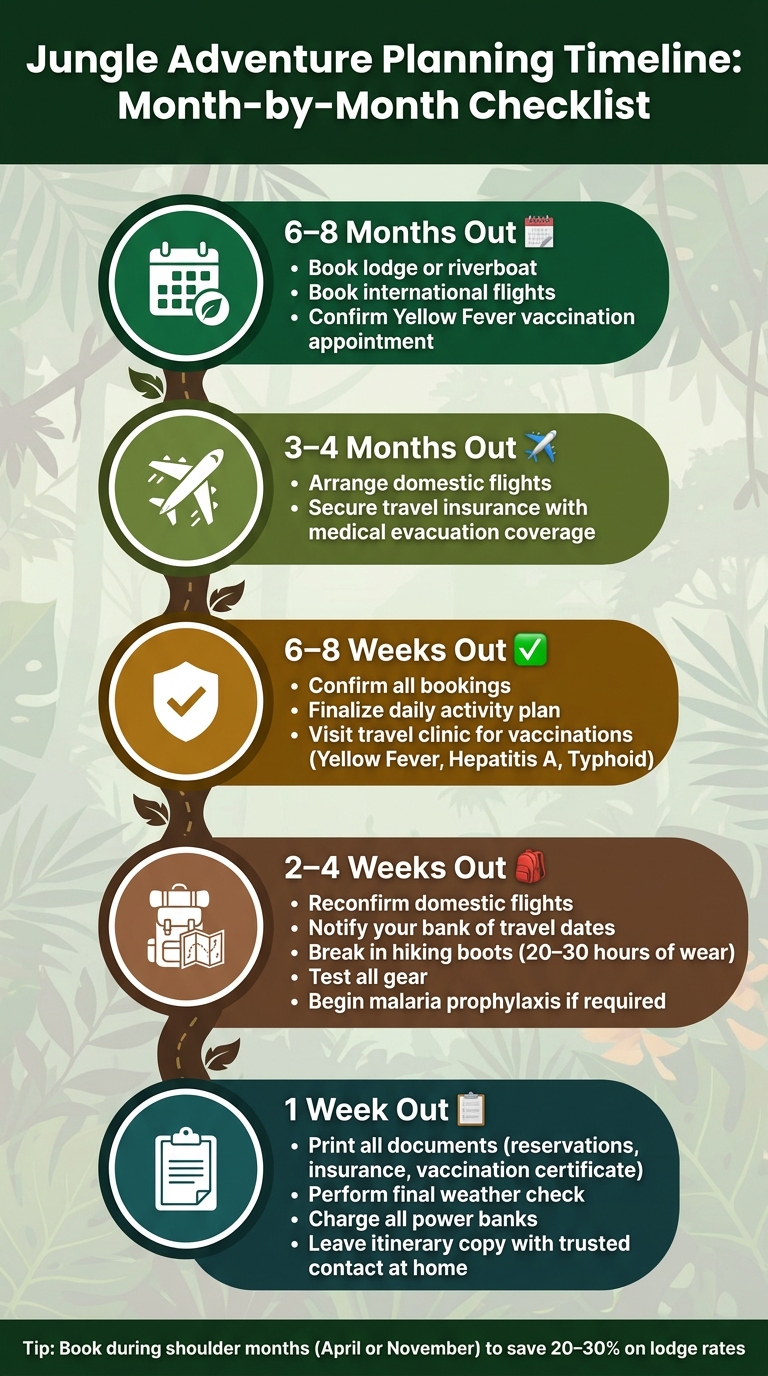
Jungle Adventure Planning Timeline: Month-by-Month Checklist
With your daily itinerary in place, it’s time to focus on preparation. Being well-prepared can make the difference between an unforgettable jungle adventure and a stressful experience. From packing the right gear to handling health and safety essentials, here’s how you can set yourself up for success.
Pack Smart for the Jungle
The jungle environment requires specific gear to keep you comfortable and safe. First, steer clear of cotton – it takes forever to dry in the jungle’s 80–90% humidity, which can lead to chafing and even skin infections. Instead, pack lightweight, quick-drying fabrics like polyester or nylon. Long-sleeved shirts and zip-off pants are great choices – they protect you from the sun and insects while staying breathable.
For footwear, follow a three-pair approach:
- Waterproof hiking boots: Essential for trails. Break them in for at least 20–30 hours before your trip to avoid blisters.
- Water shoes: Perfect for river crossings.
- Flip-flops: Handy for relaxing at your lodge.
Stick to neutral colors like olive, beige, or gray to blend in with the environment and avoid catching the attention of wildlife.
Don’t forget these jungle essentials:
- Headlamp with red-light mode ($30–$60): Ideal for night walks without disturbing animals.
- Dry bags (10L and 20L, $15–$30): Protect electronics and important documents from the relentless humidity.
- Silica gel packets: Keep them in your camera bag to prevent lens fogging.
- Insect repellent: Opt for 30–50% DEET or Picaridin for effective protection. Natural repellents may not last long in jungle conditions.
- Permethrin-treated clothing: Pre-treat your clothes before leaving; the protection lasts through multiple washes.
Keep luggage limits in mind, especially if your trip involves small regional flights or boat transfers, which often cap baggage at 15–20 kg (33–44 lbs). Use a soft duffel pack to stay within these restrictions.
Handle Health, Safety, and Documentation
"The difference between a life-changing adventure and a miserable ordeal often comes down to decisions made weeks or months before setting foot on the trail." – Adrian Mitchell, Cultural Anthropologist
Health and safety prep is non-negotiable. Schedule a visit to a travel clinic 4–6 weeks before your trip to get vaccinations like Yellow Fever, Hepatitis A, and Typhoid, and to secure malaria prophylaxis if needed. Remember, your Yellow Fever certificate must be dated at least 10 days before entry and is valid for life once issued. Keep both digital and printed copies of your vaccination certificate, along with your passport, travel insurance policy, and blood type details.
Travel insurance is a must. Medical evacuations from remote jungle areas can cost tens of thousands of dollars, so make sure your policy includes emergency medical evacuation and transportation. For areas without cell service, think about carrying a satellite messenger or personal locator beacon (PLB). Be sure to save contact details for the nearest U.S. embassy, local hospitals, and your lodge’s emergency number.
"Medical evacuation coverage is essential. Think of it as your emergency helicopter ride out of the jungle." – Palotoa Amazon
Finalize Your Itinerary
Pulling all your plans into a single, clear document is an essential step. Confirm all bookings 6–8 weeks before you leave and reconfirm domestic flights 2–4 weeks out, as schedules in remote areas like Brazil’s Amazon can change frequently. Print hard copies of your reservations, transfers, and insurance details since Wi-Fi in jungle lodges can be unreliable.
Notify your bank about your travel dates and bring $200–$300 in cash for tips and emergencies. Plan to tip guides and lodge staff around $10–$15 per person, per day. About a week before departure, check the weather forecast one last time and leave a copy of your itinerary – with return dates and emergency contacts – with someone you trust back home.
| Timeline | Key Action |
|---|---|
| 6–8 months out | Book your lodge/riverboat, international flights, and confirm your Yellow Fever vaccination. |
| 3–4 months out | Arrange domestic flights and secure travel insurance with medical evacuation. |
| 6–8 weeks out | Confirm all bookings and finalize your daily activity plan. |
| 2–4 weeks out | Reconfirm domestic flights, notify your bank, break in your boots, and test your gear. |
| 1 week out | Print all documents, perform a final weather check, and charge all power banks. |
Being prepared ensures that your jungle adventure is as smooth and enjoyable as possible. From packing the right gear to having your health and safety measures in place, every step counts toward creating an unforgettable experience.
Conclusion: Start Planning Your Jungle Escape
Careful planning is the key to a smooth jungle adventure. Organizing your trip boils down to four main steps: defining your goals, charting your route and accommodations, creating a daily activity plan, and prepping thoroughly before departure. Each step is vital, and skipping even one could lead to unexpected hurdles once you’re deep in the rainforest, far from conveniences.
If it’s your first jungle trip, consider staying at least 5–7 days. This gives you time to adjust to the climate – especially the heat and humidity – and enjoy early mornings when wildlife is most active. The timing of your trip matters too. The dry season (June–November) is perfect for trekking, while the wet season (December–May) opens up opportunities like canoeing through flooded forests. Don’t forget to handle all health and safety preparations beforehand.
For those who prefer a stress-free experience, Essentialyfe provides luxury property rentals with personalized concierge services. From private chefs to shuttle logistics, they take care of the details, which can be a game-changer for jungle trips where remote locations and long transfers can turn minor issues into major headaches.
A jungle adventure rewards those who prepare and plan with purpose. Know what you want from the experience, align your plans accordingly, and let the journey unfold. With thoughtful preparation and a bold spirit, the jungle’s wonders await.
FAQs
How many days do I need for a first jungle trip?
For your first jungle adventure, aim for at least 4 days and 3 nights to go beyond just scratching the surface. While it’s possible to squeeze a trip into 3 days, it often feels too hurried. For a more relaxed and fulfilling experience, many recommend spending 5 to 7 days. This gives you time to adapt to the tropical climate, deal with any unforeseen hiccups, and fully enjoy the wildlife and local activities.
What’s the best season for my top activities?
The best time to visit depends on what you’re looking for and the region’s wet and dry seasons. If hiking and wildlife spotting are your priorities, the dry season is a great choice. Trails are easier to navigate, and animals tend to gather around water sources, making them easier to spot. On the other hand, the wet season transforms the landscape into a lush, green paradise, with flooded forests and fewer crowds – not to mention lower travel costs.
For a mix of good weather and smaller crowds, consider shoulder months like March, May, or November. These times often strike a balance between favorable conditions and less congestion. Need help planning? Essentialyfe offers planning and concierge services to fine-tune your itinerary.
Do I need malaria meds and evacuation insurance?
Before heading out on your trip, it’s a good idea to consult a healthcare provider or visit a travel clinic about 4–8 weeks in advance. This allows enough time to assess any health risks. For destinations where malaria is a concern, medication might be necessary. The need for it depends on factors like your travel destination, planned activities, and medical history. If prescribed, it’s best to get the medication in the U.S. to ensure it meets safety standards.
If you’re planning remote adventure travel, evacuation insurance is strongly advised. This type of coverage can be a lifesaver in emergencies. Be sure to discuss all aspects of your trip with your doctor to figure out the specific health precautions you should take.