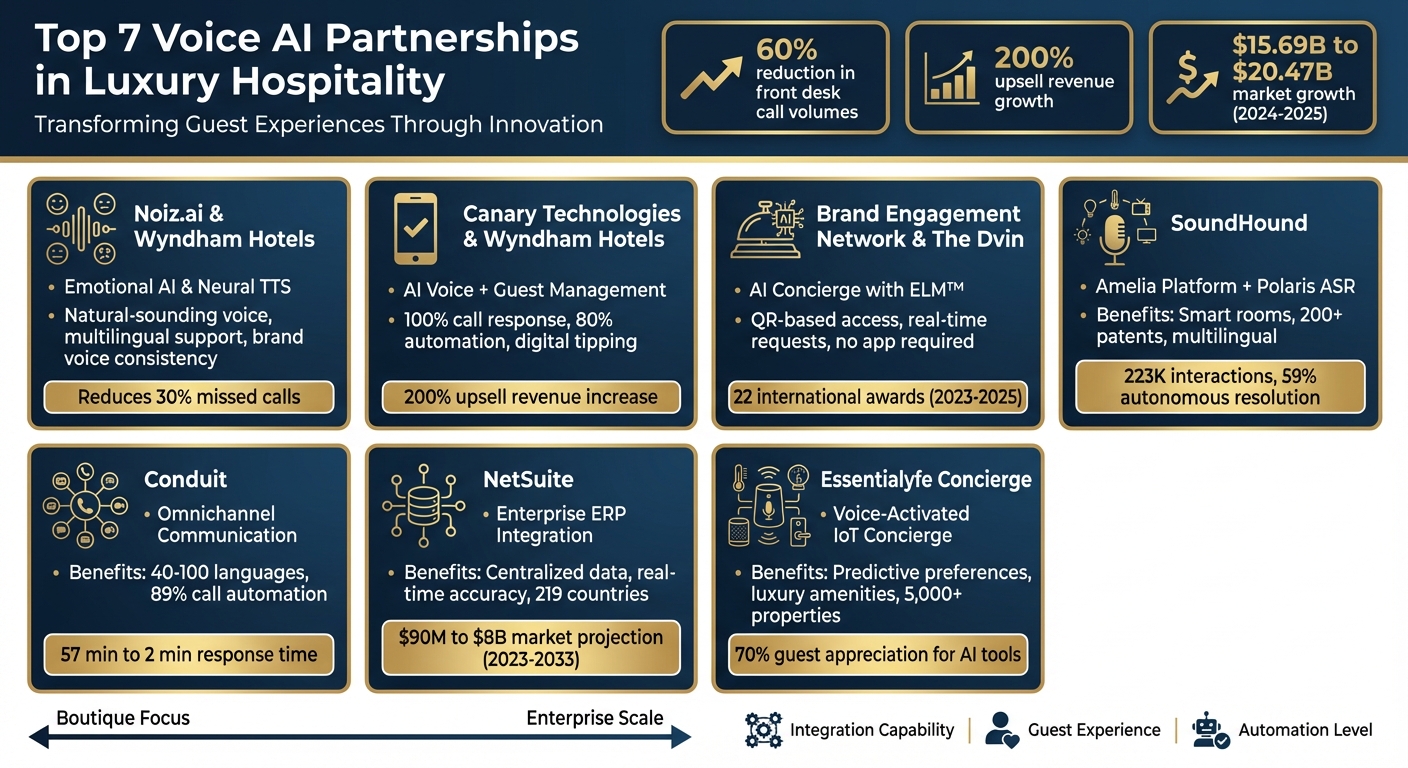
Voice AI is transforming luxury hospitality by enhancing guest services, tackling staffing shortages, and improving efficiency. From enabling multilingual support to automating routine tasks, these partnerships are reshaping how hotels operate and deliver premium experiences. Here’s a quick look at the standout collaborations:
- Noiz.ai & Wyndham Hotels: Emotional AI improves guest interactions with natural-sounding TTS and multilingual support, reducing missed calls and enhancing service consistency.
- Canary Technologies & Wyndham Hotels: AI Voice ensures 100% call response, automates 80% of inquiries, and boosts revenue through upsells and digital tipping.
- Brand Engagement Network & The Dvin: AI Concierge handles real-time service requests securely without apps, streamlining luxury service delivery.
- SoundHound: Advanced speech recognition powers smart rooms and automates guest services, reducing staff workload.
- Conduit: Combines all guest communications into one platform, cutting costs and improving efficiency for boutique hotels.
- NetSuite: Integrates backend systems for large hotel groups, enabling seamless voice AI operations and data accuracy.
- Essentialyfe Concierge Services: Voice-activated concierge connects with IoT devices for personalized luxury services like car rentals and spa bookings.
Key Stats:
- Voice AI reduces front desk call volumes by 60%.
- Hotels using AI report 200% upsell revenue growth.
- The hospitality AI market is projected to grow from $15.69 billion in 2024 to $20.47 billion in 2025.
These partnerships highlight how cutting-edge technology is reshaping luxury hospitality while maintaining high service standards.
Top 7 Voice AI Partnerships in Luxury Hospitality Comparison
How AI Is Revolutionizing the Hotel Front Desk | with Anthony Melchiorri & Ryan Daniel
sbb-itb-161ccc1
1. Noiz.ai and Wyndham Hotels & Resorts
Wyndham Hotels & Resorts, a franchise powerhouse with over 8,300 hotels and 130 million guests annually, has embraced Noiz.ai’s emotional AI technology to improve guest interactions. By incorporating natural pauses, breathing sounds, and varied tones, Noiz.ai’s system mimics human speech, making automated interactions feel more personal.
Noiz.ai’s Neural Emotional TTS (Text-to-Speech) allows Wyndham to customize automated messages for tasks like check-in instructions, morning greetings, or providing reassurance. Audio engineer Guru shared their enthusiasm:
"Finally, a TTS that doesn’t sound flat! The emotional range and breath sounds add so much life to the narration."
A standout feature of Noiz.ai is its instant multilingual support, which simplifies contactless check-ins by delivering clear instructions in a guest’s native language. This is a game-changer in an industry where hotels reportedly miss up to 30% of inbound calls, with about one-third of those missed calls representing potential bookings. By leveraging these multilingual capabilities, Wyndham not only enhances guest convenience but also strengthens its brand image through advanced voice cloning technology.
The voice cloning feature ensures a consistent brand voice across various touchpoints, from phone greetings to in-room assistants. This tool enables staff to update daily specials, event announcements, or welcome messages instantly via a simple text interface, ensuring guest communications are always up-to-date. Podcast producer AimsHigh praised this innovation:
"The natural pauses and intonation make it sound like a real host."
2. Canary Technologies and Wyndham Hotels & Resorts
In December 2025, Wyndham Hotels & Resorts began a global rollout of Canary Technologies’ AI Voice across its network of about 8,300 hotels. This decision followed a 2024 pilot program involving over 700 properties, where the technology proved its value by ensuring 100% of guest calls were answered while eliminating the need for paper-based workflows. This move not only streamlines guest communication but also transforms missed calls into revenue-generating opportunities.
On average, hotels miss between 30% and 40% of inbound calls, with roughly 33% of those missed calls representing potential bookings. By integrating AI Voice with Canary’s Guest Management System, Wyndham properties can now respond to every inquiry immediately, turning lost chances into confirmed bookings and additional revenue through upsells.
Scott Strickland, Wyndham’s Chief Commercial Officer, highlighted the financial and operational benefits of adopting AI at scale:
"By leaning into AI early and at scale – including solutions like Canary’s AI Voice – we’re helping hotels capture more revenue, deliver faster service, and meet guests where they are."
The platform has automated 80% of routine inquiries, allowing front desk staff to dedicate their time to more meaningful guest interactions. Digital tipping now averages over $10 per transaction, and dynamic upsell features have significantly increased revenue. Hotels using Canary’s solutions have seen upsell revenue grow by 200%, driven by offerings like room upgrades, early checkouts, and additional amenities.
Additionally, the system has replaced manual registration forms, paper credit card authorizations, and physical ID exchanges, creating a seamless, paperless guest experience from booking to checkout. This shift has reduced fraud and chargebacks across more than 6,000 hotels in the U.S. and Canada. Recognizing their AI-driven advancements, Wyndham and Canary Technologies were honored with the 2024 Hotel Visionary Award in the Partnership category by Hospitality Technology.
3. Brand Engagement Network and The Dvin at Seven Visions Resort
In March 2026, Brand Engagement Network (BEN) introduced its AI Concierge pilot at Seven Visions Resort & Places, The Dvin, located in Yerevan, Armenia. This launch, spearheaded by BEN CEO Tyler Luck and resort chairman Artak Tovmasyan, followed a two-phase pilot program that began in May 2025. The AI Concierge was seamlessly integrated into the resort’s operations, handling real-time requests such as room service, housekeeping, spa appointments, and restaurant bookings.
What sets BEN’s AI Concierge apart from typical chatbots is its secure, closed-loop system powered by the proprietary Engagement Language Model (ELM™). This advanced setup ensures guest requests are immediately routed to the appropriate hotel departments, triggering real-world service actions without delays. Guests can access the concierge through QR-based activation on their smartphones, eliminating the hassle of downloading apps or using specialized devices. The result? A personalized, round-the-clock service experience.
The Dvin served as the perfect testing ground for this cutting-edge technology. Known for its exceptional standards, the resort earned 22 international awards between 2023 and 2025. It boasts 153 luxurious rooms and suites, 12 state-of-the-art meeting venues, and standout features like the world’s only ceiling-stage theater. With its operational complexity and a position in the $170 billion luxury market of 2025, The Dvin provided the ideal environment to validate the performance of BEN’s enterprise-grade AI.
Artak Tovmasyan highlighted the importance of this collaboration, stating:
"Introducing AI at this level isn’t just about adopting new technology – it’s about redefining luxury. We chose BEN for their secure, guest-first platform – designed with trust, speed, and world-class execution in mind."
This initiative showcases how voice AI is reshaping the guest experience in top-tier luxury properties.
4. SoundHound and Luxury Hospitality Brands
SoundHound is redefining what luxury hospitality can achieve by blending cutting-edge technology with seamless guest experiences. Its Amelia platform is a standout example, capable of processing natural speech in real time, understanding context, and automatically triggering the right workflows and integrations.
Take Resorts World Las Vegas, for example. In 2024, SoundHound’s AI agent managed an impressive 223,000 interactions, resolving 59% of them without needing human assistance. This freed up staff to focus on more complex, high-touch tasks.
"There’s a concern in luxury hospitality that AI could undermine the guest experience, but clearing the path for those luxury moments is exactly what RED enables. It’s been a true differentiator for us." – Shannon McCallum, VP of Hotel Operations, Resorts World Las Vegas
SoundHound’s Polaris ASR system takes things further. With over 200 patents backing it, this system can interpret guest intent with incredible accuracy – even in challenging conditions like heavy accents, pauses in speech, or background noise. Plus, it supports multiple languages, automatically switching to a guest’s native tongue for a more personalized interaction.
On top of its speech capabilities, SoundHound has expanded its hardware integrations. Through a partnership with HARMAN Professional Solutions, its voice AI now works with JBL Professional speaker systems to create "smart rooms." Guests can use natural voice commands to adjust lighting, temperature, and entertainment, bringing the ease of home automation to their hotel stay. This collaboration, which kicked off with pilot programs in 2019, continues to elevate the luxury travel experience.
5. Conduit and Premium Hotel Groups
Conduit is changing the game for luxury hospitality by simplifying guest communication. It merges all interactions – whether by phone, text, or chat – into a single, seamless conversation. Thanks to its use of natural language processing, guests can communicate naturally, saying things like, "Got any rooms free this weekend?" instead of dealing with outdated "press 1 for reservations" systems.
One of Conduit’s standout features is its real-time connection to property management systems. It directly integrates with platforms like Mews, Cloudbeds, and Opera Cloud to provide instant pricing and availability updates. Beyond just answering queries, it can book rooms, update guest profiles, and modify reservations – all within milliseconds. This level of integration has led to noticeable improvements in efficiency and operations.
The impact is clear at Lauderdale Boutique Hotel, where Conduit replaced the call center. The results? Response times dropped from 57 minutes to just 2 minutes. Support costs plummeted from $4,000 to $600 per month, and net operating income rose by $3,400 monthly – boosting the hotel’s asset value by over $500,000.
"The more hands-off the property, the higher the valuation. We choose Conduit for that." – Noel Poler, Founder, The Lauderdale Boutique Hotel
Conduit’s success extends beyond operational efficiency. Its multilingual capabilities recognize and manage 40 to 100+ languages, leading to a 50–65% increase in international bookings. It autonomously answers 89% of calls, resolves 70–90% of them without human intervention, and still achieves a 97% human-like interaction score. This advanced AI has already been adopted by top-tier brands like Caesars Palace and Nobu Hotels as of early 2026.
6. NetSuite and Enterprise Hospitality Providers
NetSuite plays a critical role in supporting the backend infrastructure that allows voice AI systems to function effectively at scale. For luxury hotel groups managing hundreds of properties, NetSuite provides a centralized data ecosystem. It integrates finance, operations, inventory, and guest services into a single system, ensuring real-time data accuracy across the board [43,45].
What sets NetSuite apart is its ability to seamlessly connect with property management systems like Oracle Hospitality OPERA Cloud and point-of-sale platforms such as MICROS Simphony. This integration enables voice AI assistants to access live information on room availability, dynamic pricing, and guest preferences instantly. For global portfolios, NetSuite OneWorld simplifies operations by handling multiple currencies and legal entities, making it easier for hotel groups to manage their international operations [44,45].
A great example of this in action comes from Hotel Equities, a management firm responsible for nearly 300 hotels and resorts across the U.S. and Canada. In April 2024, the company, led by CFO Eric McCarthy-Zink, chose Oracle NetSuite to implement an ERP system. This project integrated all property management and POS systems into NetSuite, providing unified visibility across their entire portfolio. The firm is also exploring NetSuite’s AI capabilities for data warehousing and financial reviews to support growth and pave the way for advanced voice AI deployments [45,46]. This integration not only streamlines operations but also enhances the guest experiences powered by voice AI.
"NetSuite will help remove this complexity by creating a single source of truth that allows us to improve the accuracy and efficiency of our business processes as we grow." – Eric McCarthy‑Zink, CFO, Hotel Equities
The hospitality AI market is rapidly expanding. Valued at approximately $90 million in 2023, it is projected to surpass $8 billion by 2033, with an annual growth rate of 60%. With over 37,000 customers across 219 countries, NetSuite positions enterprise hotel groups to take advantage of this booming trend. Its AI-driven Planning and Budgeting tools provide predictive analytics to maximize occupancy and revenue, while features like NetSuite Text Enhance automate critical communications [43,45].
7. Essentialyfe Concierge Services with Voice AI
Essentialyfe is taking luxury hospitality to the next level by introducing voice-activated technology across more than 5,000 high-end properties, event venues, and film locations in Southern California. Acting as a digital concierge, this system allows guests to manage premium services effortlessly using voice commands – no need for phone calls or navigating apps. It also integrates seamlessly with in-room smart devices to enhance the guest experience.
The technology connects directly to IoT devices in the room, enabling guests to adjust lighting, climate, and entertainment settings with ease. Beyond that, it offers concierge services, such as arranging exotic car rentals, booking private chefs, or scheduling in-home massages – all through natural voice interaction.
What sets this system apart is its ability to learn from historical preferences. It can anticipate and adjust settings like room temperature and lighting based on past guest behavior. By handling these routine tasks, the technology frees up staff to focus on delivering more personalized and memorable service.
Martin Green, Editor at Glion Institute of Higher Education, captures this shift perfectly:
"AI doesn’t replace human service. It elevates it".
By automating simple requests, voice AI ensures that staff can dedicate their attention to creating exceptional guest experiences.
This innovation reflects a broader trend in the hospitality industry. The AI hospitality sector is expected to grow from $15.69 billion in 2024 to $20.47 billion in 2025, marking a 30.5% annual increase. Additionally, about 70% of guests now appreciate AI-powered tools for handling routine tasks.
Partnership Comparison
The examples above illustrate how the Top 7 voice AI partnerships in luxury hospitality stand out by offering unique features and benefits. Here’s a closer look at the key differences that set these partnerships apart.
Each voice AI solution brings its own strengths to the table, ranging from smooth conversational abilities to effortless integration with existing systems. These distinctions are crucial when selecting technology that enhances guest experiences while maintaining the personalized service that defines luxury.
Integration capabilities are a major factor distinguishing enterprise-scale solutions from smaller, boutique options. For instance, Canary Technologies connects voice, text, and webchat, ensuring guest inquiries are addressed without delay across Wyndham Hotels & Resorts’ extensive network. On the other hand, Essentialyfe focuses on privacy and tailored service, offering a voice-activated concierge that integrates directly with IoT devices and luxury amenity bookings – all through a unified platform.
Multilingual support is another essential feature, especially for properties catering to international clientele. Both Canary and Essentialyfe excel in this area, providing services in multiple languages to improve guest satisfaction and streamline operations across diverse regions.
Comparison Table
| Partnership | Core Strength | Guest Benefit | Scalability |
|---|---|---|---|
| Canary Technologies & Wyndham Hotels & Resorts | Omnichannel AI integration | 100% call answer rate across voice, text, and webchat | High – deployed across 8,300 hotels globally |
| Essentialyfe Concierge Services with Voice AI | Integrated, predictive concierge solutions | Automated luxury amenity bookings and streamlined services | High – serving a curated portfolio in Southern California |
This comparison highlights how partnerships like Canary and Essentialyfe are reshaping guest experiences in the luxury hospitality sector by blending advanced technology with impeccable service.
Conclusion
Voice AI collaborations are transforming how luxury hospitality brands enhance guest experiences. From effortless room controls – allowing guests to adjust lighting and temperature with voice commands – to 24/7 digital concierges managing tasks like towel delivery or late checkouts, these technologies are meeting rising guest expectations while tackling operational hurdles.
With 67% of properties reporting staffing shortages, automating repetitive tasks has become more than just a convenience – it’s a necessity.
Industry leaders are taking note of this shift:
"Our hotel customers need to move at the speed of the guest. Guest expectations… are soaring due in part to the expansive adoption of connected home technologies."
– Shovan Sengupta, Global Vice President, Hotel Segment, Schneider Electric
Platforms like Essentialyfe bring this vision to life. By offering multilingual support and automating complex service coordination, they ensure prompt and personalized assistance in luxury environments.
These partnerships demonstrate how voice AI complements human service, delivering faster, more tailored, and efficient guest experiences.
FAQs
What should a luxury hotel automate with voice AI first?
Luxury hotels can elevate the guest experience by automating in-room smart controls like lighting, thermostats, curtains, and do-not-disturb indicators. With voice commands, guests can effortlessly tailor their environment to their preferences, adding a touch of modern convenience to their stay.
On top of that, incorporating voice AI for guest service requests – like ordering extra amenities, setting up wake-up calls, or arranging housekeeping – takes convenience to the next level. These features not only enhance the overall guest experience but also streamline operations, making them a win-win for both guests and staff.
How does voice AI connect to a hotel’s PMS and POS systems?
Voice AI connects directly to a hotel’s PMS (Property Management System) and POS (Point of Sale) systems through certified integrations. This setup ensures real-time access to crucial data like reservations, room availability, and operational updates. With this connection, the AI can efficiently respond to guest inquiries, manage bookings, and automate various tasks by interacting directly with these systems.
How do hotels keep guest data private when using voice AI?
Hotels safeguard guest data through several key practices. They use secure system integrations, ensuring that sensitive information is protected during data exchanges. Additionally, voice recordings are deleted within a predetermined timeframe, preventing unnecessary storage of potentially sensitive data. Finally, hotels adhere to strict privacy standards, ensuring that recordings are not tied to personally identifiable information. These steps collectively help maintain guest confidentiality and trust.