The demand for event venues in 2026 is shaped by shifting priorities, with a focus on creating engaging, high-value experiences rather than simply hosting more events. Here are the key takeaways:
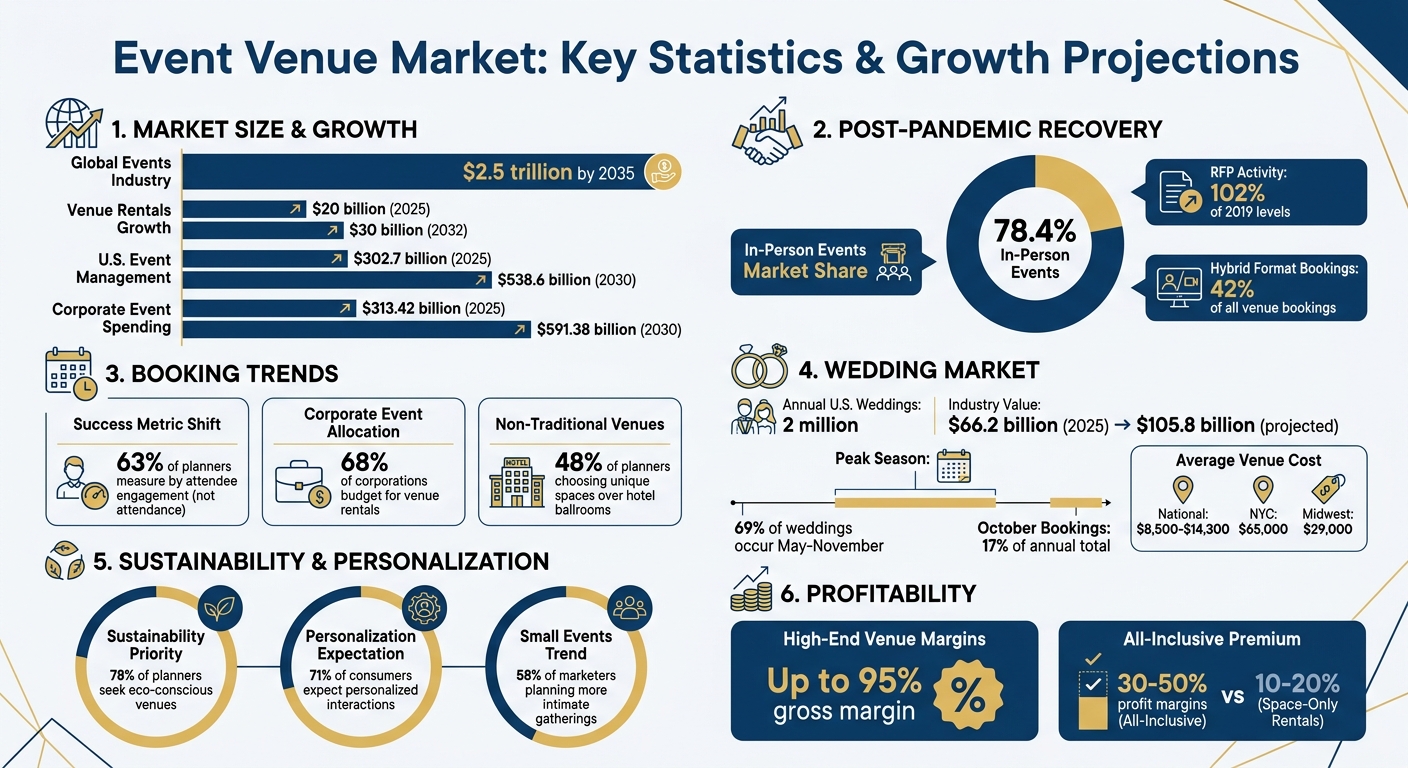
- Market Growth: The global events industry is projected to reach $2.5 trillion by 2035. Venue rentals alone are expected to grow from $20 billion in 2025 to $30 billion by 2032.
- Corporate Spending: Corporate event budgets are climbing, with spending predicted to nearly double from $313.42 billion in 2025 to $591.38 billion by 2030.
- Booking Trends: Early reservations are critical as bookings extend into 2028. 63% of planners now measure success by attendee engagement, not just attendance numbers.
- Post-Pandemic Recovery: In-person events dominate again, with 78.4% of the market in 2025, surpassing pre-pandemic levels.
- Regional and Seasonal Demand: Wedding venues see peak demand from May to November, with October being the busiest month. Urban venues command higher prices, with New York City averaging $65,000 per wedding.
- Emerging Trends: Planners are prioritizing immersive, themed events and opting for non-traditional spaces like art galleries and lofts. Sustainability and personalization are major considerations, with 78% of planners seeking eco-conscious venues.
- Investment Opportunities: High-end, all-inclusive luxury venues offering bundled services like event planning and concierge options are highly profitable, with gross margins reaching 95%.
The event venue market is evolving rapidly, presenting lucrative opportunities for those who can cater to these growing demands for engagement, sustainability, and personalization.
Event Venue Market Growth Statistics and Trends 2025-2035
Current Market Landscape
Market Size and Growth Rates
The event venue market in the U.S. has seen impressive growth over recent years. In 2025, the event management sector – which includes venue rentals and coordination – hit $302.7 billion, a significant leap from $94.8 billion in 2020. This represents nearly threefold growth in just five years.
Looking ahead, projections vary but remain optimistic. Estimates suggest the market could reach $538.6 billion by 2030, growing at a 13.0% CAGR. Alternatively, another forecast predicts $471.44 billion by 2033, with a steadier 5.7% CAGR. North America dominates the global venue rental market, with corporate events making up about 60% of all bookings, showing strong confidence in the industry.
The MICE sector (Meetings, Incentives, Conferences, and Exhibitions) is a key driver of this growth, contributing 30.08% of U.S. industry revenue in 2024. Within this segment, the U.S. MICE market expanded from $126 billion to $146.1 billion in 2025, with future estimates pointing to $205.6 billion. Meanwhile, wedding venues are thriving too, as the U.S. wedding industry grew from $51.2 billion to $66.2 billion in 2025, with projections suggesting it could hit $105.8 billion.
These numbers highlight the dynamic shifts in the event venue industry, particularly as it adapts to new trends and demands in a post-pandemic world.
Post-Pandemic Recovery Effects
The post-pandemic recovery has not only restored the event venue market but pushed it beyond pre-crisis levels. By the second quarter of 2025, global RFP (Request for Proposal) activity had climbed to 102% of 2019 benchmarks, signaling a full recovery and even exceeding previous booking levels. In-person events have regained dominance, holding a 78.4% market share in 2025, demonstrating a clear preference for physical gatherings over virtual-only options.
This rebound has been accompanied by what experts are calling "funflation." Demand for live events remains strong despite higher costs. For example, hotel room rates in RFP responses reached 131% of 2019 levels by mid-2025. Consumer spending on live sports surged by 25% compared to 2019, and the average U.S. concert ticket price jumped 45%, reaching $144 in 2025. Live Nation Entertainment also reported record-breaking revenue of $25.2 billion in 2025 – a 9% increase from the previous year – with 159 million fans attending 55,000 concerts globally, up by 8 million attendees from 2024.
The emotional pull of in-person events has played a significant role in this recovery. Surveys show that 65% of U.S. participants felt happy after attending events, while 55% said they felt energized. Destination events have also seen a surge, with venues in resort areas experiencing 15% higher occupancy rates compared to pre-pandemic levels. Additionally, hybrid formats have become a staple, now accounting for roughly 42% of all venue bookings, blending the benefits of physical and digital engagement.
sbb-itb-161ccc1
What Drives Event Venue Demand
Corporate Events and Conferences
Corporate events and conferences play a major role in driving demand for event venues. Global corporate event spending is projected to rise significantly, jumping from $313.42 billion in 2025 to $591.38 billion by 2030. This reflects how businesses increasingly value in-person gatherings for networking, product launches, and team-building activities.
With 68% of corporations allocating budgets for venue rentals and 70% of corporate events in North America planned as in-person gatherings, the demand for spaces continues to grow. The MICE sector (Meetings, Incentives, Conferences, and Exhibitions) alone is worth $146.1 billion in the U.S.. Furthermore, 78% of event organizers rank in-person conferences as their most effective marketing channel for 2026.
"Hotels are already booking into 2028. And 2026? It’s tough out there." – Madison Shepherd, Marketing Manager, GoGather
Interestingly, nearly half (48%) of corporate planners are moving away from traditional hotel ballrooms, opting for more unique venues like restaurants and art galleries to create memorable experiences.
Social Events and Weddings
Social events, particularly weddings, continue to be a major driver of venue demand. Each year, around 2 million weddings take place in the U.S.. The wedding industry, valued at $66.2 billion in 2025, is expected to grow to $105.8 billion soon. Venue rentals often account for a significant portion of the wedding budget, ranging from 24% to 40%.
Costs vary widely depending on location. While the average wedding venue rental ranges from $8,500 to $14,300, prices in cities like New York can soar to $65,000, compared to $29,000 in the Midwest. Seasonality also plays a big role, with 69% of weddings occurring between May and November, and October alone accounting for 17% of bookings. Popular venues are often reserved 12 to 18 months in advance, or up to 24 months for peak-season Saturdays.
Gen Z couples, who now make up 41% of the wedding market, are reshaping trends by seeking out more authentic and non-traditional settings. As The Knot Worldwide‘s 2026 Real Weddings Study notes:
"Ballrooms and barns are out; unconventional venues are in." – The Knot Worldwide 2026 Real Weddings Study
Urban lofts, historic buildings, and botanical gardens are replacing traditional banquet halls. Guest counts have also shifted, with the average dropping to 117 in 2025, while micro-weddings (fewer than 50 guests) now make up 18% of the market. In the high-end micro-wedding segment, spending per guest has skyrocketed to over $2,900, compared to $1,000 in traditional luxury weddings and $300 in the standard market.
Experiential and Themed Events
Immersive and themed events are reshaping how venues are chosen, as planners focus on creating visually striking and memorable experiences. Locations like art galleries, industrial lofts, rooftops, stadiums, and warehouses are becoming increasingly popular for their unique atmospheres and Instagram-worthy aesthetics.
"Attendee engagement is now the leading success metric, with 63% of planners citing it as their primary KPI." – Mike Fletcher, Cvent
Consumer preferences for live experiences are evident in spending trends. For example, spending on live sports jumped 25% compared to 2019, and the average U.S. concert ticket price climbed 45% to $144 in 2025. This willingness to pay more for unforgettable experiences underscores the demand for innovative venues.
Brand activations and experiential marketing are also driving the need for flexible spaces. The number of AI-focused events in the U.S. saw a nearly fourfold increase in 2023, requiring venues equipped for interactive demos and hands-on experiences. Planners increasingly prefer "blank canvas" venues that allow for customizable layouts and thematic programming. This shift moves away from traditional, presentation-heavy formats toward more interactive setups like roundtables and experiential activations.
Part 1: The hottest trends shaping events in 2025
Seasonal and Regional Demand Patterns
Grasping seasonal and regional demand patterns is a game-changer for optimizing event venue investments. These trends reveal when and where demand spikes, helping venues plan effectively and maximize their returns.
Peak Booking Seasons
Event venues experience noticeable seasonal swings. Weddings dominate the warmer months, with 69% of bookings occurring between May and November. October takes the crown as the busiest month, accounting for 17% of all annual wedding bookings. This seasonal boom creates fierce competition for venues during these peak months.
On the flip side, winter (December through February) is the quietest season, with only 9% of annual wedding bookings. Corporate events, however, march to a different beat. Spring and fall are prime seasons for conferences, while experiential marketing events often align with major industry gatherings or product launches. Live events are thriving, with 80% of B2B marketers considering them critical to their success.
To make the most of slower periods, venues can target budget-conscious clients. For example, Friday or Sunday weddings save couples about $5,000 compared to Saturday celebrations. Additionally, focusing on smaller gatherings or micro-events can help fill gaps between larger bookings.
These seasonal trends don’t exist in isolation – they’re deeply intertwined with regional differences across the U.S.
Regional Differences in Venue Demand
Where a venue is located plays a huge role in its demand and pricing. Texas leads the pack with 3,932 venues, followed by California (3,654) and Florida (2,426). Together, these states account for 28% of U.S. wedding venues.
Urban venues tend to come with a hefty price tag, often costing $10,000 more than suburban or rural options. Regional pricing also varies widely. For instance, the Mid-Atlantic region averages $48,400 per wedding, while New England comes in slightly lower at $46,600. The Midwest, however, remains more affordable, averaging $29,000. City-specific costs can skyrocket, with New York City averaging $65,000, Washington D.C. at $52,000, and San Francisco topping $85,000 for 150 guests.
Regional events can also create spikes in demand. Take Coachella, for example. In April 2026, Desert Sol Real Estate, which manages over 130 properties in Palm Desert, California, earned an extra $8,000–$12,000 by offering gap-night deals between festival weekends and charging for early check-ins and late checkouts. Properties near major events often see nightly rate increases of 2x to 5x.
Las Vegas stands out for its wedding demand, hosting 80,000 to 120,000 weddings annually. Meanwhile, Austin showcases a dual demand pattern during SXSW, with corporate travelers seeking practical amenities like Wi-Fi and convention center access during the week, and festival-goers prioritizing entertainment and noise-friendly policies on weekends.
These patterns paint a clear picture: understanding both the timing and geography of demand is key to staying competitive in the event venue industry.
Trends Shaping the Industry
The event venue market is undergoing rapid transformation, driven by advancements in technology, growing sustainability expectations, and changing preferences in how people want to experience events. For anyone investing in or managing event spaces in 2026 and beyond, understanding these trends is essential.
Technology Integration
Technology has become a cornerstone for how venues are discovered and managed. Today, 75% of event planners use AI for venue searches. Sophie Linin, Deputy Head of Events at Royal Museum Greenwich, highlights this shift:
"We’re shifting our focus from SEO to AI optimisation, recognising that clients are using these tools and we need to be visible".
AI is streamlining time-consuming tasks like summarizing client briefs, drafting email responses, and creating quote variations. Additionally, 70% of large-scale events now rely on digital automation tools for scheduling and invoicing, improving efficiency by at least 30%. Venues are also using AI for personalized attendee engagement, with 63% of organizers reporting increased satisfaction thanks to tools like smart badges, AI matchmaking, and adaptive digital signage. Wellness features, such as personalized reminders for movement breaks or quiet spaces, are being integrated into event apps to help reduce attendee burnout.
Carlos Lumiere, Founder and Creative Director at Lumiere London, explains:
"Digital behaviour is reshaping how planners search, evaluate and book venues, and in 2026 the first impression happens long before a site visit. It happens through data, content and clarity".
However, the human touch remains critical. Anna Fenten, Marketing Director at Searcys, emphasizes:
"Never underestimate the importance of real human interaction – most importantly – delivering fast, human, and non-robotic responses".
These technological innovations are not just about efficiency – they also enhance client satisfaction, making venues more appealing. But technology is only part of the story. Venues are also being pushed to meet higher environmental standards, creating opportunities for sustainable practices.
Eco-Friendly and Green Venues
Sustainability has moved from being a "nice-to-have" to an essential feature. 78% of event planners now consider sustainability a key factor when choosing a venue, and many are willing to pay more for spaces that demonstrate real environmental commitment.
Certifications like LEED, ISO 14001, and Zero Waste have become benchmarks for credibility. As Mindy Harrison of The Harrison Ballroom puts it:
"A sustainable event space is no longer a bonus – it is becoming an expectation".
Venues are stepping up by adopting energy-efficient systems, renewable energy sources, and robust recycling and composting programs. Many are also tracking resource usage to provide transparent data to clients. Sustainable materials like bamboo flooring and reclaimed wood are becoming popular choices, and accessibility to public transit and electric vehicle charging stations is increasingly prioritized.
74% of planners are now emphasizing accessibility alongside sustainability, reflecting a broader shift toward creating inclusive and responsible event experiences. For Millennials and Gen Z, these values align with corporate ESG goals, making sustainable venues highly attractive. By adopting eco-friendly practices, venues not only meet expectations but also stand out in a competitive market. At the same time, they’re reimagining spaces to offer more intimate and tailored experiences.
Personalized and Boutique Experiences
Event planners are moving away from large-scale gatherings and focusing on creating meaningful, engaging experiences. 58% of marketers are planning to host more small events, and 48% of organizers are turning to unique venues like restaurants, art galleries, and cultural spaces.
Data underscores this shift: 71% of consumers expect personalized interactions from the events they attend, and 63% of planners now prioritize attendee engagement over cost as a key metric for success. Modern audiences want flexibility, with venues offering spaces that cater to networking, quiet reflection, or structured sessions.
Boutique venues – such as converted warehouses, wineries, and galleries – are gaining popularity for their character and adaptability. Key reasons for choosing these spaces include flexibility (41%), attendee experience (35%), and cost (34%). Rebecca Kelly, CEO of VenueScanner, captures this sentiment:
"The era of one-size-fits-all events is over".
Venues that can demonstrate how a single space can support diverse activities – and offer smaller, curated experiences like "chef’s tables" or "private salons" – are setting the standard. These personalized touches align perfectly with the evolving preferences of today’s event planners and attendees, making them a critical part of the industry’s future.
Investment Opportunities with Essentialyfe
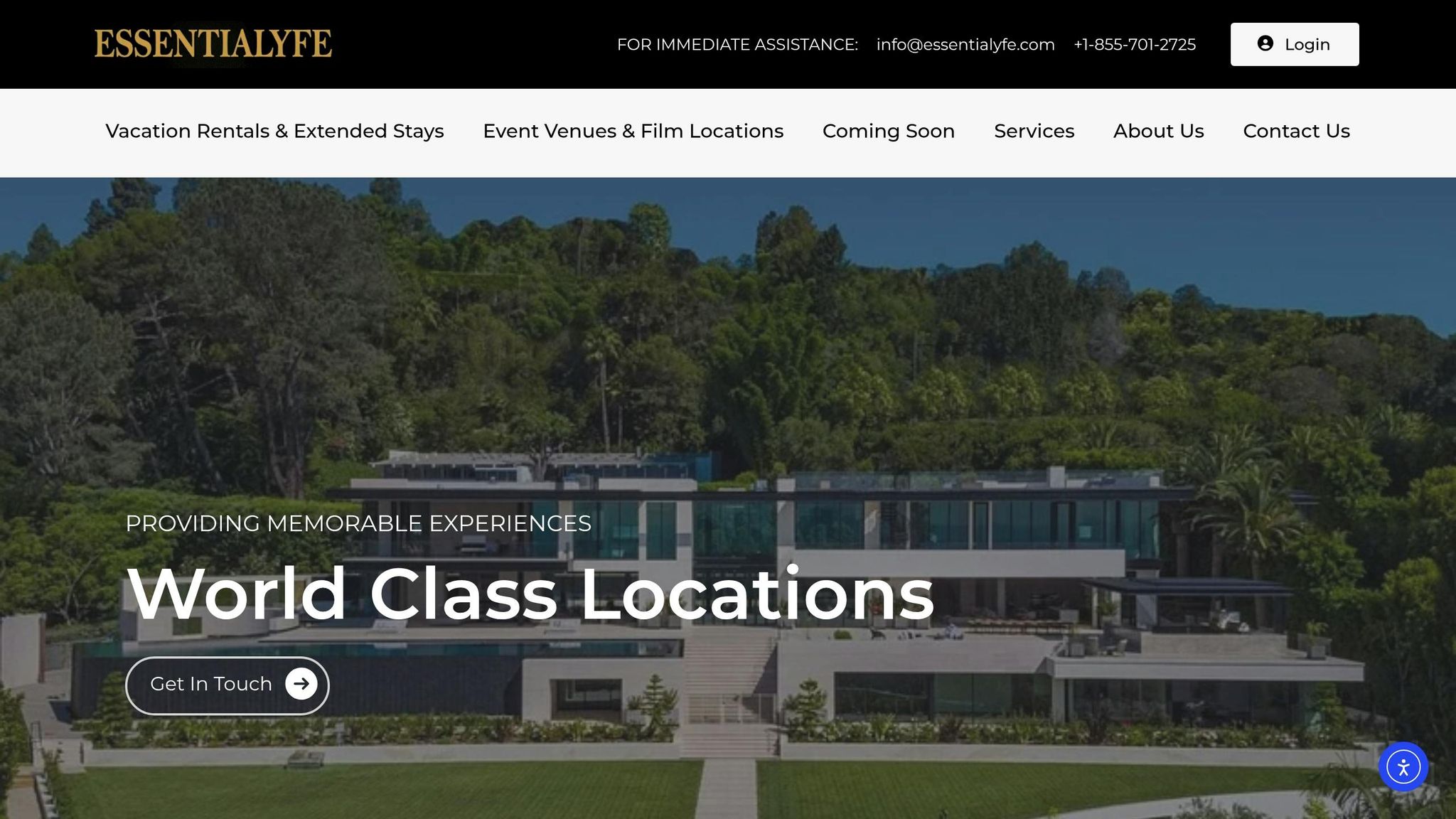
As market trends shift, there’s growing potential in investing in personalized, high-end venues that cater to niche audiences.
Luxury Properties and Exclusive Venues
Essentialyfe has curated a portfolio of high-end properties in Los Angeles, designed to fill a gap in the market for intimate, upscale event spaces. These venues, accommodating 20–50 guests and priced between $500 and $1,500, address a demand that larger venues often overlook. Beyond their role as luxury vacation rentals, these properties double as exclusive event spaces, appealing to high-net-worth individuals who value privacy and controlled environments over traditional hotel offerings.
Bundled Services for Complete Experiences
What sets Essentialyfe apart is its all-inclusive service model. Clients benefit from a seamless experience with integrated offerings such as event planning, security, shuttle services, valet, and concierge options like private chefs or exotic car rentals. This eliminates the stress of juggling multiple vendors. Willis Aybar, a former venue owner, highlighted the importance of this approach:
"The venues crushing it offer all-inclusive packages because overwhelmed brides don’t want to coordinate five vendors."
This strategy not only simplifies the client experience but also boosts revenue. Ancillary services contribute roughly 28% of total venue income, underscoring the financial advantage of this bundled approach.
Custom Pricing and ROI Potential
Essentialyfe employs a tailored pricing structure based on factors like property type, event duration, and service level. Corporate events, for instance, generate 40% higher revenue than social events. Luxury venues in this category can achieve gross margins of 95% or more, as the core rental services involve minimal variable costs. By 2026, the average revenue per event for premium wedding venues is expected to reach $28,375. Additionally, operational break-even is projected within just two months, with full capital recovery achieved in 26 months.
Key metrics like maintaining labor costs below 30% of revenue and keeping customer acquisition costs under $2,500 per booking further highlight the model’s profitability. This combination of exclusive venues and streamlined services not only delivers exceptional value but also aligns with the rising demand for tailored, high-end event experiences.
Conclusion
The event venue market is evolving in ways that prioritize quality and meaningful experiences over sheer volume. With 63% of planners now viewing attendee engagement as their top success metric, the industry is clearly moving toward creating events that encourage interaction and leave lasting impressions. This shift presents exciting opportunities for investors who can anticipate where demand is heading.
The numbers tell a compelling story. The global event venue rental market is expected to grow from $123.85 billion in 2026 to $168.14 billion by 2034. Meanwhile, corporate event spending is projected to nearly double, jumping from $313.42 billion in 2025 to $591.38 billion by 2030. The most lucrative opportunities lie in the upper-middle and luxury tiers, where all-inclusive venues can achieve profit margins of 30–50%, compared to just 10–20% for space-only rentals.
Essentialyfe is positioned to capitalize on these trends. By offering curated luxury properties with bundled services – such as event planning, private chefs, security, and even exotic car rentals – the platform eliminates the logistical stress for clients. This approach resonates with the 48% of planners now actively seeking non-hotel venues for their unique atmospheres and flexibility. It also aligns with broader industry trends emphasizing sustainability and engagement-focused setups.
For investors, the message is clear: venues that deliver more than just space will lead the market. Hybrid formats now account for 42% of all bookings, and 78% of planners are prioritizing sustainability. Additionally, the fragmented nature of the industry – where 71.8% of U.S. wedding venues are run by single owners – presents a prime opportunity for consolidation and professionalized, service-rich models. These factors underscore the growing importance of value-driven event experiences.
As Mike Fletcher from Cvent aptly stated:
"Planners are shifting their focus from event volume to event value, prioritizing engagement, experience, and efficiency".
The future belongs to venues that can deliver exceptional experiences, not just capacity.
FAQs
How far ahead should I book a venue for a 2026–2028 event?
Booking your venue 12 to 18 months ahead is ideal for events scheduled between 2026 and 2028. This approach not only increases the chances of securing your preferred location but also helps you lock in competitive rates, particularly for high-demand or upscale venues.
What venue features matter most for boosting attendee engagement?
When planning an event, certain venue features can make all the difference in keeping attendees engaged and satisfied. Here are some essential elements to focus on:
- Operational excellence: A smooth registration process, professional staff, and reliable technical support create a stress-free experience for attendees from start to finish.
- Brand alignment: Choosing a venue that reflects the event’s image or theme helps reinforce the overall message and leaves a lasting impression.
- Accessibility: Convenient locations near hotels, public transportation, and parking make it easier for attendees to participate without hassle.
Venues with flexible layouts and modern designs also stand out. These spaces allow for interactive and personalized experiences, something attendees increasingly appreciate. By prioritizing these factors, you can create an event that feels seamless and engaging for everyone involved.
How can a venue prove it’s truly sustainable (not greenwashed)?
Venues can showcase their commitment to eco-conscious practices by offering clear, measurable proof, such as certifications like LEED or Green Globes. These certifications often highlight key achievements like cutting carbon emissions, improving energy efficiency, and increasing waste diversion rates.
Real dedication goes beyond surface-level efforts. It involves weaving sustainable practices into everyday operations – things like adopting renewable energy sources or prioritizing local suppliers. To maintain trust and ensure they meet established standards, venues should also conduct regular audits and seek third-party verification.