Executive protection certification is essential for professionals safeguarding high-profile individuals. It validates expertise in threat prevention, risk assessment, and security operations. Here’s a quick breakdown:
- Earning Potential: Certified specialists earn $90,000–$200,000+, with top earners exceeding $300,000 annually.
- Eligibility: Requirements include being 18+ (21 for armed roles), a high school diploma/GED, clean background, and physical fitness.
- Training Costs: Programs range from $150 (online basics) to $24,000 (advanced residencies).
- Key Skills: Threat assessment, tactical medicine, defensive driving, and surveillance detection.
- Licensing: Varies by state; Virginia and Texas have specific credentials like PPS and Level IV.
This certification opens doors to careers in corporate, VIP, and high-risk security sectors. With industry growth projected at 15% by 2030, it’s a lucrative field for those committed to continuous learning and professional development.
Executive Protection Training Bodyguard & Close Protection Certificate Course
sbb-itb-161ccc1
Prerequisites and Eligibility Requirements
To pursue advanced training in executive protection, you’ll need to meet several key eligibility requirements that lay the groundwork for a successful career in this field.
Minimum Qualifications
For unarmed roles, most states require candidates to be at least 18 years old, while armed positions typically have a minimum age requirement of 21. A high school diploma or GED is mandatory, though top-tier firms often prefer candidates with college degrees. Additionally, passing a criminal background check is essential, as felony convictions generally disqualify applicants.
You must also be a U.S. citizen or legal resident and hold a valid driver’s license. This is crucial since secure transportation and defensive driving are integral parts of the job. Physical fitness is another important factor – cardiovascular endurance, strength, and agility are necessary for the demands of the role. While there are no fixed height or weight standards, you must be capable of quick movements and sustaining physical activity under pressure.
Required Certifications
Before enrolling in executive protection training programs, you’ll need certifications in CPR, First Aid, and AED. These are standard prerequisites and can significantly enhance your employability. Many professionals also pursue additional certifications, such as Tactical Combat Casualty Care (TCCC) or Emergency Medical Technician (EMT) credentials, to stand out in the field.
While not mandatory, a background in the military or law enforcement is highly regarded. It can even result in a salary boost of 25–50% for many candidates. However, most training programs are open to applicants regardless of prior experience.
State Licensing Requirements
Executive protection licensing is regulated at the state level, with requirements varying widely depending on your location. Some states, like Virginia and Texas, have specific credentials for executive protection professionals beyond standard security licenses. For instance, Virginia was one of the first states to establish mandatory training standards for its "Personal Protection Specialist" (PPS) designation in 1994.
Here’s a quick look at licensing requirements in a few states:
| State | License Required | Training Hours | Min. Age | Specific EP Credential |
|---|---|---|---|---|
| Virginia | Yes | 18–32 hours | 18 | Personal Protection Specialist (PPS) |
| Texas | Yes | 4–40+ hours | 18 | Level IV (Bodyguard) |
| California | Yes | 40 hours | 18 | BSIS Guard Card |
| Florida | Yes | 42 hours | 18 | Class D License |
| New York | Yes | 8 + 16 OJT | 18 | DOS Guard Registration |
Before enrolling in any program, check with your state’s regulatory authority, such as Virginia’s Department of Criminal Justice Services or California’s Bureau of Security and Investigative Services, to ensure you meet all requirements. Keep in mind, holding a state security license or executive protection credential does not automatically grant you the right to carry a concealed weapon. A separate Concealed Handgun Permit is required, and you’ll need explicit permission from your employer to carry a weapon while on duty.
Once you’ve met these prerequisites, you’ll be ready to explore training programs that will equip you with the skills needed for a successful career in executive protection.
Training Programs and Certification Options
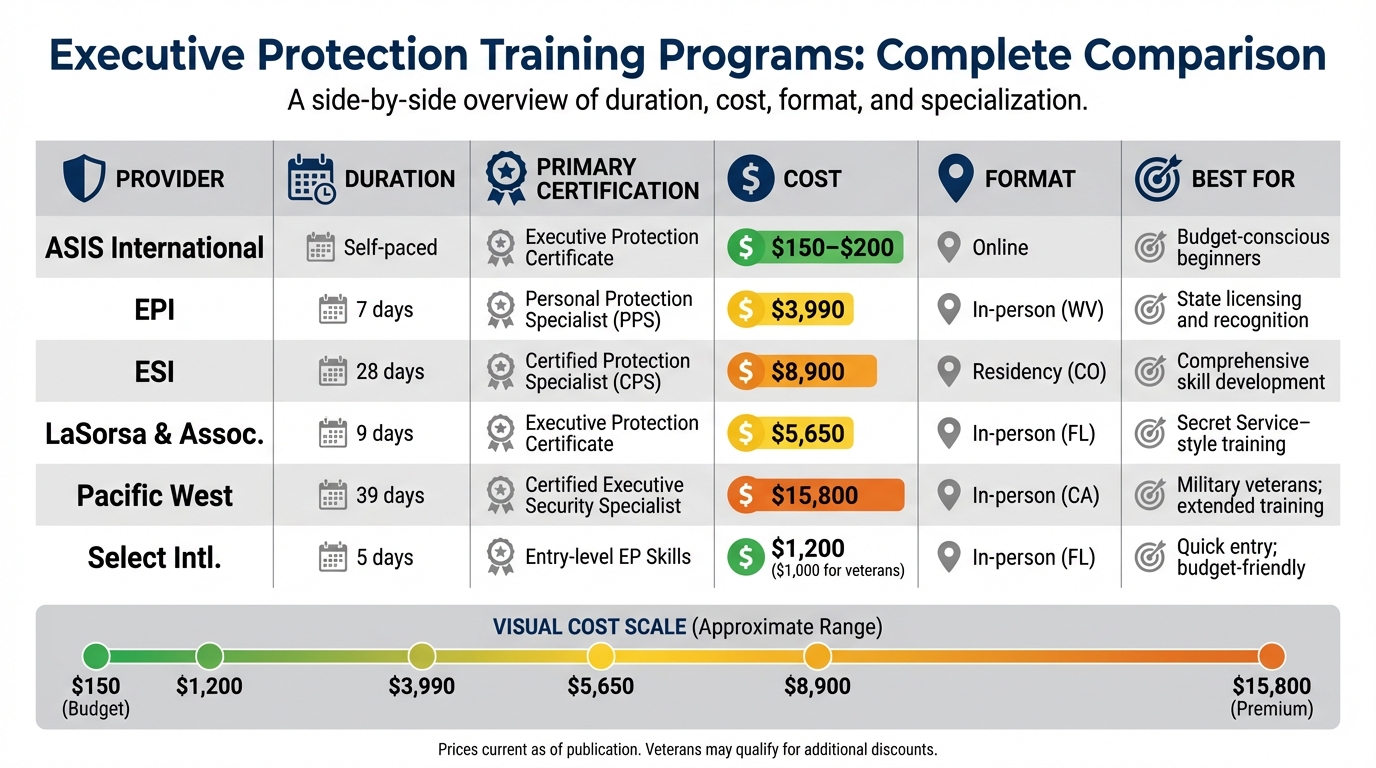
Executive Protection Training Programs Comparison: Cost, Duration, and Certifications
Once you’ve met the initial requirements, it’s time to pick a training program that aligns with your career goals and budget. In the executive protection field, options range from affordable online certificates to intensive, multi-week residencies that can cost tens of thousands of dollars.
Leading Training Providers
ASIS International is a great starting point with its Executive Protection Certificate. This self-paced online course focuses on strategy, intelligence, and risk assessment. At $150 for members and $200 for non-members, it’s a cost-effective way to cover the basics. However, keep in mind that online courses lack hands-on training in areas like defense tactics and firearms handling.
For those aiming for a well-recognized credential, the Executive Protection Institute (EPI) offers the Personal Protection Specialist (PPS) certification. Their 7-day program, priced at $3,990, is considered a cornerstone in the industry and forms the basis for Virginia’s licensing standards.
– Executive Protection Blog
Executive Security International (ESI) provides a deeper dive with its 28-day Certified Protection Specialist (CPS) residency program, priced at $8,900. They also offer a 10-week Ultimate Training Track for $24,000, which aligns with the annual VA education funding cap for veterans [15,16].
LaSorsa & Associates stands out with training led by former Secret Service agents. Their 9-day intensive course, which costs $5,650 (including accommodations), emphasizes intelligence operations and defensive tactics tailored to real-world scenarios.
For military veterans transitioning to executive protection, Pacific West Academy offers a 39-day Certified Executive Security Specialist program for $15,800. This program covers advanced skills like surveillance, reaction drills, TASER training, and conflict management.
MVP Protective Services combines online and in-person training, offering 6 days of virtual learning followed by 4 days of hands-on instruction. Their courses, taught by former Secret Service agents in collaboration with the Society for International Executive Protection (SIX), focus on creating field-ready agents. According to MVP Protective Services:
"MVP isn’t built to ‘teach the basics.’ It’s built to produce deployable agents".
Specialized tracks are also available for those looking to refine skills for specific roles.
Specialized Training Paths
Specialized training can make you more competitive in the job market. For instance, celebrity protection requires expertise in managing public appearances and media interactions. ESI offers a 3-day online course specifically for this niche.
Another sought-after area is security driving. The International Security Driver Association (ISDA) provides the Certified Security Driver (CSD) credential, which combines skills for both everyday driving and high-risk evasive maneuvers.
Tactical medicine has become increasingly important, with many employers requiring certifications like Tactical Emergency Casualty Care (TECC) or Law Enforcement First Responder (LEFR). These qualifications equip agents with essential life-saving skills.
For those aiming to lead teams, Convoy Group offers a 5-day Executive Protection Detail Leader Course, focusing on operational planning and team management. Additionally, training in cybersecurity and digital protection is crucial for addressing threats like cyber-attacks and data breaches that can compromise an executive’s safety and reputation.
Program Comparison
Once you’ve explored specialized paths, compare training providers to find the best fit for your needs. Factors like cost, duration, and certification type should guide your decision.
| Provider | Duration | Primary Certification | Cost | Format | Best For |
|---|---|---|---|---|---|
| ASIS International | Self-paced | Executive Protection Certificate | $150–$200 | Online | Budget-conscious beginners |
| EPI | 7 days | Personal Protection Specialist (PPS) | $3,990 | In-person (WV) | State licensing and recognition |
| ESI | 28 days | Certified Protection Specialist (CPS) | $8,900 | Residency (CO) | Comprehensive skill development |
| LaSorsa & Assoc. | 9 days | Executive Protection Certificate | $5,650 | In-person (FL) | Secret Service–style training |
| Pacific West | 39 days | Certified Executive Security Specialist | $15,800 | In-person (CA) | Military veterans; extended training |
| Select Intl. | 5 days | Entry-level EP Skills | $1,200 ($1,000 for veterans) | In-person (FL) | Quick entry; budget-friendly |
When selecting a program, ensure it meets Department of Education licensing standards. This guarantees the curriculum and instructors are up to date. As ESS Global Corporation puts it:
"There are two things you never cheap out on, gear and training. These are the two things that may save your client’s life, and yours!"
If you plan to work in a specific state, confirm that the program complies with local licensing requirements. For example, Virginia only recognizes certain VA DCJS-approved programs for its PPS designation [16,17]. Veterans should also prioritize schools eligible for GI Bill benefits, such as ESI, Pacific West Academy, and Covered 6 [15,16,21].
Core Skills and Training Topics
Executive protection training is a mix of intelligence gathering, tactical expertise, emergency response, and logistics. It prepares agents to handle unpredictable threats while balancing practical abilities – like defensive driving – with interpersonal skills, such as discretion and corporate etiquette. These foundational skills are not only crucial for certification but also pave the way for advanced training and career growth in the field.
Threat Assessment and Risk Management
Modern executive protection is all about staying ahead of threats. Agents are trained to conduct Risk, Threat, and Vulnerability Assessments (RTVAs) to identify potential dangers early. This involves using tools like Open-Source Intelligence (OSINT) and Human Intelligence (HUMINT) to evaluate a client’s exposure to risks.
Advance Work is another critical element. This involves scouting locations ahead of time to inspect venues, identify potential choke points, plan secure routes, and coordinate with local security teams. Security expert Gavin de Becker sums it up perfectly:
"The best protection is avoiding danger entirely rather than responding to it".
Agents also use Pattern of Life Analysis to vary travel routes and schedules, helping to detect if a client is being monitored. They are trained to observe environmental cues, such as unusual crowd behavior or suspicious individuals, and adapt their tactics on the spot. Whether rerouting a motorcade or repositioning personnel, this intelligence-driven approach sets modern executive protection agents apart from traditional bodyguards.
In addition to intelligence work, tactical skills and cutting-edge equipment enhance an agent’s ability to respond effectively to threats.
Security Techniques and Equipment
Tactical skills are the backbone of executive protection. Defensive driving is a key focus, covering high-speed maneuvers, obstacle navigation, and vehicle security. These skills are vital for mobile operations, where agents may need to quickly evacuate clients from dangerous situations. Defensive driving courses typically last 2–5 days and cost between $1,000 and $3,000.
Close-quarter combat and non-lethal defense methods are also emphasized. According to Convoy Group, most incidents involve non-lethal confrontations rather than firearms. As a result, training programs prioritize unarmed combat, restraint techniques, and de-escalation strategies, while still including tactical shooting and advanced marksmanship.
Surveillance detection is another focal point. Agents learn to spot hostile surveillance using both traditional observation methods and modern tools like drones and facial recognition software. Counter-surveillance training helps them identify and avoid planned attacks. Additionally, agents are trained in the use of essential equipment, including bullet-resistant vests, armored vehicles, encrypted communication devices, GPS trackers, and trauma kits equipped with tourniquets.
Emergency Response and Communication
Tactical medicine is a high priority in executive protection training. Agents are taught Tactical Combat Casualty Care (TCCC) and Tactical Emergency Casualty Care (TECC) to handle injuries such as gunshot wounds, fractures, and shock.
Building strong relationships with external agencies is another critical skill. Agents learn to coordinate with local law enforcement, emergency services, and private security teams to ensure seamless integration of protective measures during high-profile events or international assignments. Understanding "Use of Force" laws and state-specific licensing requirements is also part of the curriculum.
Communication protocols focus on professionalism and discretion. Agents are trained to use encrypted radios and secure mobile apps to protect sensitive information. They also develop client communication skills, such as knowing when to speak, blending into corporate environments, and maintaining a low profile. These elements ensure that protective measures are effective without drawing unnecessary attention, complementing the advanced operational strategies outlined in career development programs.
Career Paths and Professional Development
Earning a certification opens doors to a variety of career opportunities in corporate, residential, and high-risk security sectors. With the global security services market projected to hit $350 billion by 2025, there’s a growing demand for specialized protective services.
Private Security Employment
Starting out, roles like security guard, event security staff, or patrol officer are common, offering annual salaries between $30,000 and $45,000. After gaining 2–5 years of experience, many professionals transition into armed bodyguard or personal protection roles, where earnings typically range from $50,000 to $80,000 per year. Those with 5–10 years of experience can advance to executive protection specialist positions, with salaries climbing to $90,000–$150,000 annually.
Corporate executive protection focuses on safeguarding CEOs and other high-level executives from threats tied to their roles, wealth, or access to sensitive information. Residential security, on the other hand, involves protecting affluent families and their properties using surveillance systems and access control measures. Contract work offers flexibility, with daily rates ranging from $500 to $1,500 or more, while full-time roles provide steady income and benefits.
Advanced Specializations
High-level security careers often come with impressive paychecks. Celebrity and VIP protection agents, tasked with managing security for entertainers, athletes, and public figures, can earn between $150,000 and $300,000+ annually. Some clients allocate as much as $5–$10 million yearly for comprehensive security teams. For those interested in politics, dignitary and diplomatic protection focuses on securing government officials and foreign dignitaries.
Technical roles are also gaining traction. Certified Security Drivers (CSD), credentialed by the International Security Driver Association (ISDA), specialize in secure transportation. Professionals working in high-risk or hostile environments, such as military contractors, often protect diplomats or government officials. The rise of cybersecurity has created opportunities for agents who can address both physical and digital security needs. Additionally, backgrounds in Military Special Forces or federal law enforcement can significantly boost salaries – by 30–50% and 25–40%, respectively. Fluency in foreign languages may also increase pay by 10–20%.
Female bodyguards are increasingly sought after for their ability to blend in as companions or assistants and their access to female-only spaces. In Canada, executive protection agents can earn upwards of $120,000 annually.
These advanced roles highlight the importance of staying connected and continually upgrading skills.
Professional Networks and Continued Training
In this field, networking is just as critical as technical expertise. ASIS International offers an Executive Protection Community and the Certified Protection Professional (CPP) designation. Their Executive Protection Certificate costs $150 for members and $200 for non-members. Similarly, the Executive Protection Institute (EPI) provides the widely recognized Personal Protection Specialist (PPS) credential, valued by corporations and government agencies alike.
The League of Executive Protection Specialists provides resources like monthly video conferences, mentorship, and networking opportunities. Byron Rodgers, Founder and CEO of Bravo Research Group, emphasizes the importance of collaboration:
"My mission for the League of EP Professionals is to create the World’s largest and most synergetic network of Private Security professionals".
Other organizations, such as the International Security Driver Association (ISDA), which focuses on defensive driving certifications, and the Overseas Security Advisory Council (OSAC), which supports agents operating in high-risk areas, play a key role in career growth. Since many top-tier roles are filled through personal connections rather than public postings, active participation in these networks is essential.
Boosting your credentials through additional certifications can also enhance your career prospects. Beyond basic licensing, credentials like Certified Security Driver (CSD), Emergency Medical Technician (EMT), or cybersecurity certifications can make you stand out. Soft skills such as discretion, corporate etiquette, and foreign language proficiency are equally important, especially for high-paying corporate or international assignments. The industry values continuous learning, requiring professionals to regularly update their skills to stay ahead of evolving tactics.
Conclusion
Executive protection goes far beyond physical strength; it’s about proactive planning, medical preparedness, and maintaining absolute discretion. The focus is on identifying and neutralizing risks before they escalate – a skill set that distinguishes professional agents from traditional bodyguards. This guide has covered the key steps to entering the field: meeting basic qualifications, securing state-specific licensing, choosing accredited training programs, and mastering the essential skills required for modern executive protection.
Certification, however, is just the first step in your career. With the industry expected to grow by 15% by 2030 and salaries ranging from $35,000–$50,000 for entry-level roles to over $300,000 for high-level VIP protection, the potential for growth is immense. As the Executive Protection Blog wisely points out:
"Certification is just the starting point… Building a robust professional network, gaining real-world experience, and staying hungry for knowledge are equally important".
Before committing to training, make sure you’re aware of your state’s licensing requirements. Opt for programs approved by the Department of Education and taught by instructors with proven backgrounds in the Secret Service, military special operations, or corporate security. Medical training is equally crucial – skills like CPR, First Aid, and EMT certification are often the most utilized in the field.
Once certified, shift your focus to networking. Joining organizations like ASIS International or the League of EP Professionals early in your career can give you access to exclusive job opportunities that rarely appear in public listings. ESS Global Corporation offers this important reminder:
"There are two things you never cheap out on, gear and training. These are the two things that may save your client’s life, and yours!".
Ultimately, your success in this demanding yet rewarding field will hinge on your dedication to continuous learning, professional growth, and an unwavering commitment to excellence.
FAQs
Which executive protection certification should I choose first?
The Personal Protection Specialist (PPS) certification, introduced by EPI in 1994 and officially recognized in Virginia, is a key credential for those entering the executive protection field. It has long been regarded as a benchmark for setting industry standards. Another option for newcomers is the Essentials of Executive Protection Certificate Course offered by ASIS. This program provides a self-paced online format, making it a flexible choice for beginners. While both certifications are strong starting points, the PPS certification is often viewed as the go-to entry-level credential.
Do I need a state license or certification to work in executive protection?
You don’t need a state-specific license to work in executive protection. However, obtaining well-known certifications can highlight your skills and commitment to the profession. Certifications backed by respected organizations can also add an extra layer of credibility to your qualifications.
How can I get hired for executive protection with no military or law enforcement background?
If you’re aiming for a career in executive protection but don’t have a military or law enforcement background, don’t worry – it’s still possible. The key is to focus on specialized training, gaining hands-on experience, and showcasing your abilities. Start by enrolling in well-regarded training programs that cover areas like defensive tactics, firearms handling, and threat assessment. These programs can give you the foundational skills needed for the field.
Next, build your credibility by working in entry-level security roles. These roles not only help you gain experience but also allow you to network with professionals in the industry. Networking is crucial, as connections can open doors to new opportunities. Additionally, make it a priority to stay current with certifications and industry standards to keep your skills sharp and relevant.
By demonstrating a strong commitment to learning and mastering practical skills, you can stand out in this competitive field – even without prior military or law enforcement experience.