Event lighting isn’t just about making spaces visible – it’s about shaping how people feel, what they notice, and creating a memorable atmosphere. By combining ambient, accent, and functional lighting, you can transform any venue into a visually engaging space. Here’s what you need to know:
- Ambient Lighting: Sets the overall mood with even coverage. Warm tones (2700K–3200K) create intimacy, while cooler tones (3500K–5000K) suit professional settings.
- Accent Lighting: Highlights key features like speakers or décor using spotlights and backlighting for depth and focus.
- Functional Lighting: Ensures safety and clarity in areas like walkways and food stations, with practical brightness levels.
Key techniques include layering light, using gobos for patterns, and incorporating dynamic effects like moving heads. Always consider venue constraints like ceiling height, power availability, and surface materials for optimal results. Safety and planning – like testing with cameras and managing power loads – are essential for a polished outcome.
Event lighting is a tool to tell your story, guide attention, and leave a lasting impression. By carefully planning and executing your lighting design, you can elevate your event to the next level.
Lighting at Events: Ideas and Techniques
sbb-itb-161ccc1
Core Components of Event Lighting Design
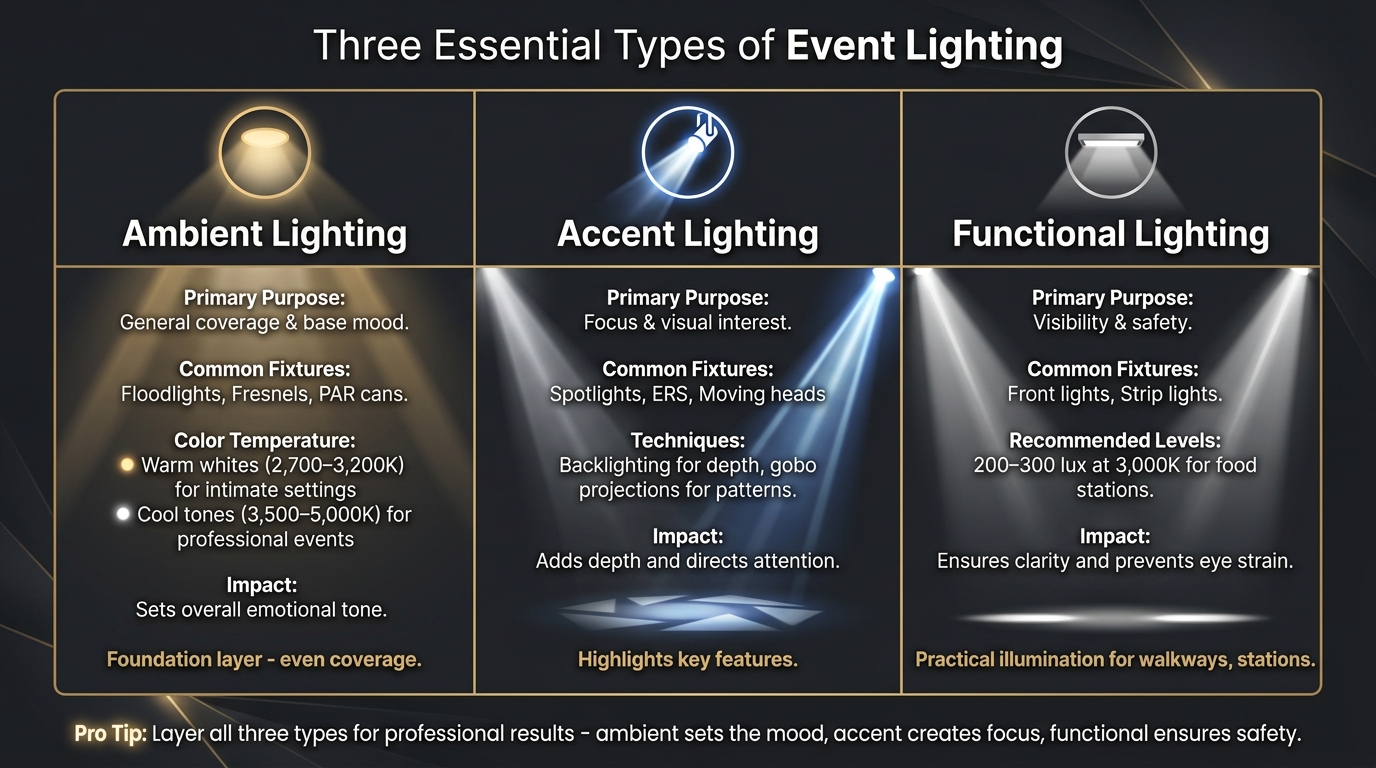
Event Lighting Types: Ambient, Accent, and Functional Lighting Comparison
Event lighting design revolves around three key elements: ambient, accent, and functional lighting. Together, these elements create an atmosphere that guests will remember long after the event ends.
Ambient Lighting
Think of ambient lighting as the foundation – it provides a broad layer of light that covers the entire event space. Often called a "wash" or "fill", it sets the overall brightness and emotional tone before guests even notice the finer details. Tools like floodlights, Fresnels, and PAR cans are commonly used to achieve this soft, even coverage.
The color temperature of the lighting plays a big role in setting the mood. For example:
- Warm whites (2,700–3,200K) create a cozy, intimate feel, perfect for galas or weddings.
- Cooler tones (3,500–5,000K) are better suited for professional settings like corporate events or presentations.
"Stage lighting design is more than just visibility – it shapes the atmosphere, guides audience focus, and enhances storytelling." – LeeJeffrey, Betopper
Be cautious not to over-light the space. Too much brightness can overwhelm guests, cause visual fatigue, and make it harder to direct their attention. A balanced base level of light allows accent lighting to shine – literally – by creating contrast and depth.
Once the ambient layer is set, accent lighting takes center stage to highlight key elements.
Accent and Decorative Lighting
Accent lighting is all about drawing attention to specific features – whether it’s a keynote speaker, a floral arrangement, or a product display. Fixtures like spotlights, ellipsoidals, and moving heads are great for delivering narrow, high-intensity beams that make focal points stand out against the ambient lighting.
One technique that works wonders is backlighting. Placing lights behind a subject helps separate it from the background, adding dimension. Meanwhile, decorative lighting can reinforce the event’s theme. LED strips, string lights, or gobo projections (which use stencils to cast patterns like cityscapes or foliage) can transform plain walls into stunning visual backdrops, adding texture and interest in a budget-friendly way.
Here’s a quick breakdown of the different types of lighting and their roles:
| Lighting Type | Primary Purpose | Common Fixtures | Impact on Ambiance |
|---|---|---|---|
| Ambient | General coverage & base mood | Floodlights, Fresnels, PAR cans | Sets the overall emotional tone (warm/cool) |
| Accent | Focus & visual interest | Spotlights, ERS, Moving heads | Adds depth and directs attention |
| Functional | Visibility & safety | Front lights, Strip lights | Ensures clarity and prevents eye strain |
This layered approach is a hallmark of Essentialyfe’s luxury event designs, where every lighting choice adds to the venue’s elegance.
But creating the right mood isn’t the only priority – functional lighting ensures that guests can safely navigate the space.
Functional Lighting
Functional lighting is all about practicality. It ensures that guests can move around safely and carry out tasks without straining their eyes. Areas like registration desks, buffet stations, bars, and walkways need focused lighting for clarity. For example, food stations typically require 200–300 lux at a warm 3,000K to make dishes look both appetizing and inviting.
Safety is another critical aspect of functional lighting. Here are some tips to keep in mind:
- Use cable ramps to protect temporary wiring.
- Install GFCI protection on non-permanent circuits.
- Keep electrical loads below 80% of the circuit’s capacity.
"The goal of stage lighting isn’t limited to one objective. Stage lighting can help you capture the audience’s attention and enhance a stage production in a number of ways." – Illuminated Integration
Lighting Techniques and Equipment
Layered Lighting Approaches
Professional event lighting is all about creating layers. Start with an ambient wash to set the mood, then add accent and functional lighting to highlight key areas and bring depth to the space.
For a uniform look, position uplights about 8–12 feet apart along walls or drapes. When lighting presenters on stage, a 45-degree key light angle is ideal for avoiding harsh shadows on their faces. Layering like this adds dimension and avoids the flat look of single-source lighting.
"Treat lighting as a narrative tool: your wash sets the scene, accents direct attention, and projection transports guests into the world your event is building." – Loopyah Content Team
The color temperature of your lighting can also set the tone. Use warm whites (2,700–3,200K) to create a cozy atmosphere, while neutral to cool tones (3,500–5,000K) work better for professional or modern settings. For brightness, aim for 100–200 lux in lounge areas, 200–300 lux for general seating, and 800–1,200 lux of key light for presenters on broadcast-quality stages.
These foundational techniques pave the way for incorporating dynamic effects, which can elevate the overall experience.
Special Effects and Dynamic Lighting
With your base lighting in place, special effects can inject energy and visual intrigue. Gobo projection is a popular choice for customizing event spaces, using stencils to project patterns like leaves, cityscapes, or logos onto walls or floors. Breakup gobos, paired with haze, can create textured effects and highlight mid-air light beams for a more immersive vibe.
Moving-head fixtures are another game-changer. These versatile lights can pan, tilt, and change colors, making them perfect for tracking speakers or creating seamless transitions during the event. Beam lights, on the other hand, produce razor-sharp light columns that cut through haze, adding drama to the atmosphere. These effects don’t just look great – they also help reinforce the event’s overarching theme or story.
One practical note: check the venue’s haze policies early in the planning process. While haze is crucial for showcasing light beams, it can sometimes trigger fire alarms. And don’t forget to rehearse with cameras – what looks amazing to the naked eye might not translate well on video.
Basic Lighting Equipment
To bring your vision to life, it’s essential to understand the tools of the trade. PAR cans are reliable, multi-purpose fixtures often used for color washes and backlighting. For softer, adjustable beams, Fresnel lights are ideal, offering beam angles between 10° and 55° that blend naturally for stage washes. If precision is what you need, ellipsoidal reflector spotlights (ERS) provide sharp, focused beams that are perfect for gobos or spotlighting speakers.
Modern lighting setups heavily rely on LED stage lights, which are energy-efficient, generate minimal heat, and offer millions of color options. While traditional tungsten lamps are still used for specific high-CRI needs, they consume more power and are less common today. To control everything seamlessly, DMX controllers are essential for managing brightness, movement, and timing across all fixtures.
Safety should always be a top priority. Use safety cables with clamps when mounting lights on trusses, and ensure that electrical loads don’t exceed 80% of the circuit’s capacity (e.g., 16A on a 20A circuit). Finally, if your rental costs for certain fixtures exceed 50–60% of their purchase price over two years, it’s usually more economical to buy the equipment outright. Every piece of gear plays a role in crafting a polished and cohesive event atmosphere.
Planning and Evaluating Your Event Space
Venue Factors to Evaluate
Before diving into fixture placement, take a close look at the venue’s limitations. For starters, ceiling height plays a big role in determining how and where you can mount your lights. Low ceilings restrict your ability to create dramatic overhead effects, while high ceilings demand more powerful fixtures to ensure enough brightness reaches the floor. Don’t forget to check for rigging points and weight capacities to ensure fixtures can be mounted safely.
Power availability is another critical consideration. Walk through the venue and pinpoint all the circuits and power distribution tie-ins. Stick to the 80% rule to avoid overloading circuits (e.g., a 20A circuit should carry no more than a 16A load). Plan where your power distribution unit (distro) will go and figure out cable routes that won’t interfere with walkways or emergency exit paths.
The venue’s surface materials can also influence your lighting effects. Surfaces like brick, drapes, and foliage work beautifully for uplighting and gobo projections. On the other hand, reflective glass or light-sensitive artwork can cause problems. Windows are another challenge – natural daylight shifts in color temperature and intensity, which can wash out projections. If your event spans from day to night, make sure your lighting strategy accounts for those changes.
"Treat lighting as experience design. Define the atmosphere you want, translate it into measurable specs… then validate everything with onsite and on-camera tests." – Loopyah Content Team
Another important step is checking the venue’s rules for haze and lasers. Some spaces restrict these effects because they can trigger fire alarms. For older buildings or venues where running cables is tricky, determine if wireless DMX is necessary or if a wired setup is possible.
Once you’ve worked through these constraints, you’ll be ready to build a detailed lighting plan.
Developing a Lighting Plan
Turn your vision into a practical, technical plan. Start by dividing the venue into zones. For stages, this might mean breaking the area into 10 ft x 10 ft sections. For receptions, you might focus on functional zones like lounges, seating areas, and food stations. This zoning approach simplifies fixture placement and helps your crew stay organized during setup.
Next, define the illuminance and color temperature for each zone. For example:
- Lounges often feel best with 100–200 lux and warm white tones (2,700–3,200K).
- General seating areas typically need 200–300 lux with neutral whites (3,500–4,000K).
- Broadcast-quality stages for presenters require 800–1,200 lux of key light at 3,200–4,300K to avoid harsh shadows and ensure they look great on camera.
Create a rig plot that maps out fixture positions, lens types, and focus areas. Pair this with a power one-line diagram to ensure circuit loads stay within safe limits. If your event involves video or photography, schedule a camera rehearsal to test the final lighting setup. What looks great to the naked eye might not translate well on camera – testing ensures proper white balance and flattering skin tones.
Finally, prioritize safety. Secure all cables, keep exit paths clear, and document your safety procedures to streamline load-in and troubleshooting.
Lighting Design for High-End Events and Venues
When it comes to luxury venues, lighting design plays a crucial role in complementing architectural beauty while setting the tone for an unforgettable experience.
Lighting for Essentialyfe‘s Event Venues
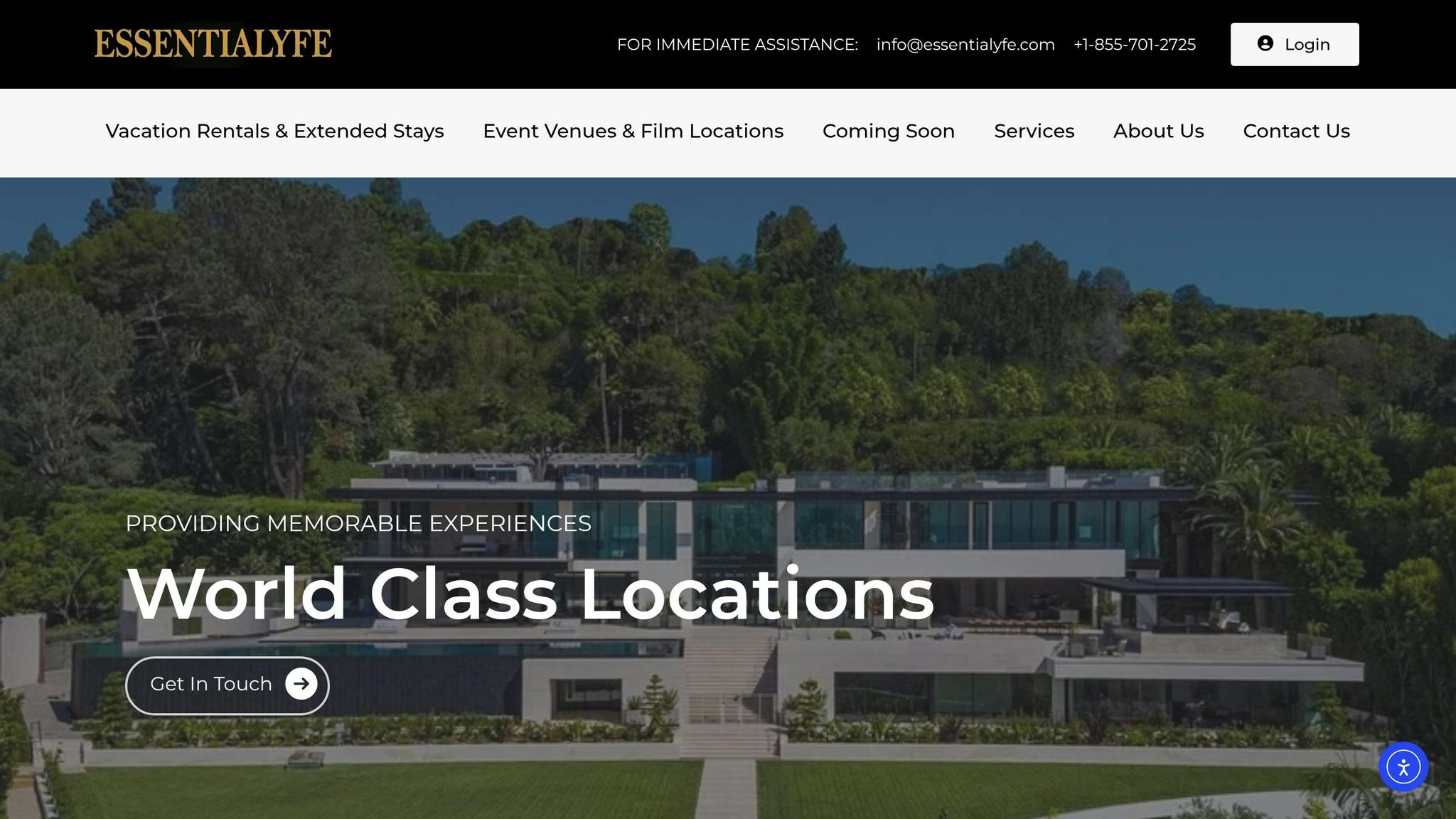
In upscale properties, lighting should enhance the venue’s architectural features rather than overshadow them. A great example is uplighting, which can transform walls, columns, and drapes, adding depth and drama. This technique works especially well in spaces with heritage elements like exposed brick or stone. For the best effect, position uplights about 8–12 feet apart for consistent color coverage, or place them closer together to highlight unique textures.
Essentialyfe’s event venues benefit from wireless, battery-powered uplights, which eliminate messy cables and maintain a polished look. These fixtures are practical too, with a set of 24 typically drawing just 5A of power. This approach seamlessly blends modern functionality with the elegance of the venue. Another creative option is gobo projection, which uses custom stencils to project brand logos or patterns onto blank surfaces, creating dynamic visuals without permanent alterations.
For venues with high ceilings, pinspotting is a fantastic way to emphasize centerpieces and floral arrangements while still keeping the atmosphere cozy. Pair this with chandeliers or decorative lamps to introduce a warm, inviting glow – perfect for photography. Profile fixtures, such as ellipsoidals, can be used to precisely highlight architectural details like moldings, staircases, or water features without spilling light where it’s not needed.
Luxury Event Lighting Design
Lighting for luxury events needs to feel both effortless and purposeful. A layered approach works best: start with neutral base washes, add saturated accents to guide focus, and incorporate scenic projections to create moments of intrigue. For gala dinners, warm white lighting (between 2,700K and 3,200K) enhances skin tones beautifully, while lounge areas benefit from a softer illuminance of 100–200 lux for a more intimate vibe.
Color accuracy is critical at high-end events. Look for fixtures with a TM-30 Rf score of 85–90+ to ensure that brand colors and skin tones look natural both in person and on camera. To elevate the experience further, consider programming lighting transitions that shift from neutral tones during guest arrivals to richer, more dynamic hues as the night unfolds. For events involving photography or live streaming, a 45-degree key light angle on speakers and featured guests helps reduce harsh shadows and ensures flattering visuals.
Conclusion
Event lighting design goes far beyond simply brightening a space – it’s about crafting an atmosphere, drawing attention to key elements, and creating an unforgettable experience. The strategies discussed – such as layered lighting, thoughtful color selection, and smooth transitions – offer a strong starting point to transform any event. Whether you’re using warm hues to foster a sense of closeness or highlighting architectural details with uplighting, every detail plays a role. These fine touches are what set the mood and meet the expectations of upscale gatherings.
Careful planning, thorough testing, and efficient power management are essential to avoid last-minute issues and bring your vision to life without a hitch. At its core, lighting design is a form of storytelling – every decision should contribute to the narrative you’re crafting for your audience.
FAQs
How do I choose the right color temperature for my event?
Choosing the right color temperature can completely transform the mood of your space or event. Warm tones (2000K-3000K) are perfect for creating a cozy and inviting atmosphere, making them ideal for intimate gatherings or relaxed settings. On the other hand, cool tones (4600K-6500K) bring a clean, energetic feel, often suited for modern or high-energy environments. If you’re aiming for something in between, neutral tones (3100K-4500K) provide a more natural and versatile appearance. Think about the mood you want to set – warm for romance, cool for vibrancy, and neutral for a balanced look – and choose your Kelvin range accordingly.
What lighting should I prioritize if my venue has limited power?
If your venue has limited power, consider using energy-efficient lighting options like LED fixtures. These consume less power while still delivering excellent illumination. To make the most of your setup, focus on lighting essential areas with fewer fixtures. Strategic placement and dimming controls can help you maximize coverage without overloading circuits. Steer clear of high-power fixtures to keep your event well-lit while staying within the venue’s power limits.
How can I make lighting look great on camera and in person?
To make lighting look great both on camera and in person, try using a balanced setup like the 3-point lighting technique. This method includes a key light, a fill light, and a backlight, which work together to create depth and provide even illumination.
For live events, consider enhancing the venue’s lighting by incorporating spotlights and softened overhead lights. These can help highlight key areas while maintaining a pleasant atmosphere. When filming, fine-tune your camera settings to match the environment. You can also use tools like bounce flash or diffusers to soften harsh shadows, resulting in a more flattering and professional look.