Skipping proper security licensing for your event could cost you millions. Here’s why it matters and how to avoid common pitfalls:
- Why it’s important: Licensed security ensures legal compliance, insurance coverage, and safety. Unlicensed security can lead to lawsuits, as seen in Atlanta (2023: $4.2M settlement) and Houston (2023: $2.8M settlement).
- How it’s regulated: U.S. security licensing varies by state, with 36 states requiring licenses. Requirements include training, background checks, and insurance.
- Temporary permits: These allow short-term security for events. Examples include Tennessee’s $1,000 Special Event Permit (10-day limit) and Oregon’s Temporary Work Permit.
- Key compliance steps: Hire licensed providers, verify permits, and maintain records like guard cards and insurance certificates.
Understanding and following these rules ensures your event runs smoothly and avoids costly legal issues.
Temporary Security Licensing: The Basics
What Is Temporary Security Licensing?
Temporary security licensing refers to short-term permits allowing security services for specific events. The two primary types of permits are Special Event Permits and Temporary Work Permits.
A Special Event Permit is issued to a licensed security company, enabling them to deploy temporary staff for a specific event and location. For example, in Tennessee, a licensed security company must apply for such a permit to use temporary officers at an event. The permit is tied to the event’s identity and location, and the state charges a $1,000 non-refundable fee per event.
On the other hand, a Temporary Work Permit is granted to individuals, allowing them to work security while waiting for their full certification to be processed. In Oregon, this process involves completing Form PS-20.
Unlike standard licenses, which often have multi-year renewal cycles, temporary permits are strictly time-bound and event-specific. For instance, Tennessee limits these permits to a maximum of 10 days per calendar year.
Next, let’s look at when these permits are necessary.
When Security Licensing Is Required at Events
There are certain situations where licensed security personnel are a must. Licensing typically applies when staff are responsible for controlling access, enforcing rules, or removing individuals – especially for venues hosting minors.
If armed guards are required, additional permits and higher-tier licensing come into play. Events held at federally regulated locations, such as airports, federal buildings, or nuclear facilities, also involve compliance with federal regulations in addition to state rules.
It’s worth noting that some states exempt staff performing "crowd management" or "guest services" roles from private security licensing. This exemption usually applies if the staff are unarmed, non-confrontational, and not tasked with enforcement duties. Understanding these distinctions ahead of time can help save both time and money.
Who Oversees Security Licensing
Security licensing enforcement happens across multiple levels of government. At the state level, dedicated agencies manage most of the regulatory responsibilities. Some examples include:
- California Bureau of Security and Investigative Services (BSIS)
- Texas DPS Private Security Bureau
- Florida Division of Licensing
In Oklahoma, for instance, the Council on Law Enforcement Education and Training (CLEET) oversees the Private Security Division.
"The Private Security division licenses and regulates Private Security Guards and Private Investigators… by implementing standards and procedures designed to protect the interests of the public without placing undue burdens on the private security industry." – Oklahoma Private Security Division (CLEET)
In some states, law enforcement or public safety departments handle licensing. For example, Connecticut’s Special Licensing and Firearms Unit (SLFU) operates under the Commissioner of Emergency Services and Public Protection. Delaware processes applications through the State Police Professional Licensing Section, with fingerprinting handled by the State Bureau of Identification.
For states without state-level licensing – like Colorado, Idaho, and Kansas – local governments set the rules. If your event is in one of these states, your first point of contact should be the city or county clerk’s office.
sbb-itb-161ccc1
Compliance Requirements for Event Planners
State-Level Licensing for Security Providers
When hiring a security company, ensuring they have a valid state-issued agency license is non-negotiable. The type of license depends on the state. For example, California uses the Private Patrol Operator (PPO) designation, Florida requires a Class B Security Agency license, and Texas registers firms as a Private Security Company. Beyond the agency license, individual guards must also carry their own registration card (commonly called a guard card). This is a requirement in 33 states.
Training requirements for guards differ by state. In California, guards may need up to 40 hours of training, while New York and Tennessee only require 8 hours before guards can begin assignments. Armed guards face additional requirements, including 19 hours of firearms certification. Insurance coverage also varies: Arizona mandates US$100,000 per occurrence and US$300,000 aggregate in general liability insurance, while Connecticut requires US$300,000 in coverage plus a US$10,000 performance surety bond. Verifying these licensing and insurance standards upfront is critical to ensure your event meets all legal obligations.
Most states also require security agencies to employ a "qualifying agent" – someone with 3–5 years of law enforcement or security experience. In Maryland, obtaining a security agency license can take up to 90 days, so it’s smart to start the process early.
Security Conditions in Event Permits
Event permits often include specific security requirements that build on state licensing rules. For instance, in Tennessee, a licensed security company must submit a special event permit application at least five days before the event. This application must include the names, Social Security Numbers, and birth dates of any temporary officers. These permits are event-specific and limit temporary officers to 10 days of work per calendar year.
Uniform policies are another common condition. Tennessee mandates that temporary guards must be clearly identifiable as employees of the licensed security company. Delaware takes it a step further, requiring armed guards to wear uniforms with a Class B or C agency patch and to carry their firearm visibly. If your event involves out-of-state security providers, you’ll need to check reciprocity rules. For example, Oklahoma offers a 30-day temporary out-of-state license, but it doesn’t cover firearms. Meeting both licensing and permit conditions is essential to avoid legal complications and ensure a smooth event.
Documents and Records to Keep for Compliance
Keeping thorough documentation is just as important as securing proper licenses and permits. Event planners should collect and retain the following key documents:
| Document Category | Required Documents |
|---|---|
| Business Entity | Agency license, Articles of Organization, EIN |
| Personnel | Guard cards, fingerprint receipts, training transcripts |
| Financial/Legal | Certificate of Insurance (COI), surety bond proof |
| Event-Specific | Special event permit, temporary guard roster (name, DOB, SSN) |
| Compliance | FCRA background check authorizations, Use of Force policy, incident reports |
The Certificate of Insurance (COI) is particularly important. For unarmed events, general liability insurance typically costs between US$3,000 and US$12,000 annually. For armed security, premiums can range from US$10,000 to over US$35,000 per year. Workers’ compensation coverage usually costs US$4 to US$12 per US$100 of payroll for security services.
Tennessee requires security companies to retain records of all temporary officers for at least one year after the event concludes. For events held at airports or federal buildings, additional documentation like TSA Criminal History Records Checks (CHRC) or Security Identification Display Area (SIDA) credentials may be necessary. If your event involves armed guards, always request a copy of the provider’s written Use of Force policy and confirm that each armed guard has signed it.
Step-by-Step Guide to Temporary Security Licensing
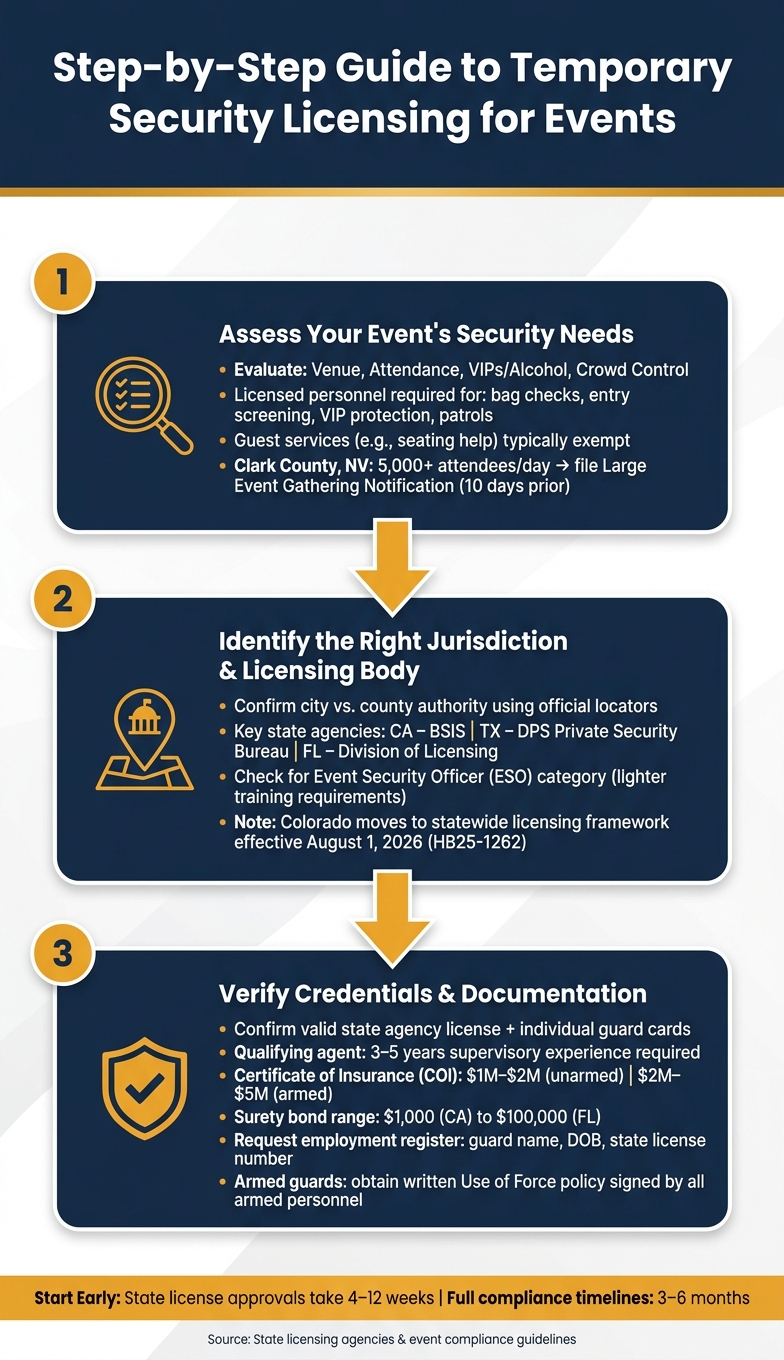
Step-by-Step Guide to Temporary Security Licensing for Events
Conducting a Risk Assessment
Before reaching out to security providers, take the time to evaluate the specific security needs of your event. A thorough risk assessment will help you determine the type and level of security required – and whether licensed security personnel are legally necessary.
Focus on four key factors: venue, attendance, presence of VIPs or alcohol, and crowd control needs. For example, if your staff will be conducting bag checks, screening entries, patrolling the venue, or safeguarding VIPs, most states require these roles to be filled by licensed personnel. On the other hand, general guest services, like helping attendees find their seats, usually don’t require a license.
Pay attention to attendance numbers, as they can trigger additional requirements. In Clark County, Nevada, for instance, events expecting 5,000 or more attendees per day must file a "Large Event Gathering Notification" in addition to standard permits. This application is due at least 10 days before the event. Knowing your expected headcount early will help you stay on track with compliance deadlines. Once you’ve outlined your event’s risk profile, move on to identifying the specific licensing requirements in your jurisdiction.
Researching Local Licensing Requirements
Using your risk assessment as a guide, identify the jurisdiction overseeing your event and its licensing regulations. Each area has its own process, fees, and timelines, so pinpointing the correct governing body is crucial.
"Being specific about your temporary event location is incredibly important… The region most people consider ‘Las Vegas’ is made up of six different jurisdictions." – Clark County Business License Department
To avoid filing errors, use official jurisdiction locators to confirm whether your event falls under city or county authority. Next, research the relevant state licensing body, such as the California Bureau of Security and Investigative Services (BSIS), the Texas DPS Private Security Bureau, or the Florida Division of Licensing (DACS). Some states even offer an Event Security Officer (ESO) category, which typically has less stringent training requirements than a standard commercial license.
Keep an eye on regulatory updates. For example, Colorado is shifting from a city-based system to a statewide licensing framework effective August 1, 2026, which will standardize ESO requirements across the state. If your event is near a regulatory transition date, double-check which rules will apply.
Working with Licensed Security Providers
Once you’ve assessed risks and reviewed licensing rules, it’s time to vet your security provider. Start by confirming that the agency holds a valid state license and that each guard assigned to your event has an individual state-issued registration card. Additionally, ensure the provider’s qualifying agent meets the required 3–5 years of supervisory experience in security or law enforcement.
Ask for a Certificate of Insurance (COI) showing coverage of at least $1M–$2M for unarmed operations or $2M–$5M for armed services. If your event involves armed guards, request a copy of the provider’s Use of Force policy, which should be reviewed by legal counsel and signed by all armed personnel.
For financial compliance, verify that the provider meets your state’s surety bond requirements, which range from $1,000 in California to $100,000 in Florida. Finally, request an employment register listing each guard’s full name, date of birth, and state license number. This ensures you have a clear audit trail and guarantees that only licensed personnel are deployed at your event.
Security Licensing at Luxury Properties
Meeting Security Compliance at Luxury Rentals
Luxury rentals come with elevated security demands, shaped by property-specific rules, zoning laws, and community expectations. Beyond standard state licensing, these venues often require additional considerations. For instance, zoning permits must allow for assembly or your specific event type. Many upscale residential areas enforce strict noise curfews – sometimes as early as 11 PM – and continuing past these hours without a noise variance permit can lead to fines or even event shutdowns. Events involving alcohol service also typically require a Temporary or Special Event Permit, which may include requirements for ID checks and designated service cutoff times.
Insurance expectations are also higher for luxury properties. While some states, like California, set minimum surety bond requirements as low as $1,000, high-end venues often demand general liability coverage ranging from $1 million to $5 million per occurrence. To avoid complications, make sure your Certificate of Insurance (COI) meets these elevated standards. Crafting a security plan tailored to these unique requirements ensures compliance while maintaining the refined atmosphere guests expect.
"Staying compliant isn’t just about following rules – it’s about protecting your business’s ability to operate and thrive." – Ticket Fairy Promoter Blog
For luxury events, consider adopting the "Safety Host" model. This approach emphasizes discreet, hospitality-focused security. Instead of a noticeable enforcement presence, guards use "Quiet Command" techniques, managing uninvited guests and crowd flow without disrupting the event’s ambiance. This method is especially effective for VIP or high-profile attendees who value both safety and subtlety.
"The best security is the kind that enhances the guest experience." – Safety Host Unit
How Essentialyfe Supports Security Licensing
Navigating these stringent requirements is easier with an integrated security solution. Essentialyfe simplifies luxury event planning by combining compliance and security management into one streamlined process. Their services include licensed personnel and compliance documentation, coordinated alongside venue booking, so you’re not scrambling at the last minute.
Essentialyfe helps planners identify the correct license types for temporary events, distinguishing between Event Security Officers (ESOs) for short-term gatherings and Commercial Security Officers (CSOs) for ongoing residential security at luxury rentals. This distinction is crucial, particularly in states like Colorado, where starting August 1, 2026, all private security personnel must hold a state-issued license under HB25-1262.
In addition to staffing, Essentialyfe assists with the administrative side of compliance. They help organize permits, insurance documents, and approvals required by high-end venues, such as Temporary Event Permits, Public Assembly Permits, and Fire Department sign-offs. For planners who prefer not to handle these details alone, partnering with a venue-savvy service offers a clear operational advantage.
Conclusion: Planning Ahead for Security Compliance
Security licensing isn’t something you can leave to the last minute. Depending on your location, approval processes can take anywhere from 3 to 6 months. For state license approvals specific to security companies, you’re typically looking at 4 to 12 weeks. Starting late not only adds stress but could also put your event at risk.
The smartest strategy is to make compliance a part of your overall planning timeline, not an afterthought. As one industry expert noted:
"Professional planners treat compliance as risk control, not administration. When done well, compliance becomes invisible. When ignored, it becomes the headline." – Shreyas Corporate Club
This highlights why it’s crucial to begin audits and vendor checks long before regulatory deadlines. For example, start your workforce and vendor audit at least 4 months before any new state regulations go into effect. This is especially important with Colorado’s HB25-1262, which takes effect on August 1, 2026. Begin vetting security providers no later than 6 weeks ahead of your event, confirm every guard’s credentials in writing, and leave enough time for permit reviews and documentation. Early preparation safeguards not just your legal compliance but also your reputation with artists, sponsors, and venues.
The financial risks are significant. After August 1, 2026, using unlicensed guards in Colorado could cost you daily fines ranging from $500 to $5,000. Beyond fines, a public compliance failure can severely damage your reputation and make recovery an uphill battle.
"The cost of security is a fraction of what one unmanaged incident might cost in legal fees alone." – American Secure Company
For those managing luxury events, partnering with an integrated service like Essentialyfe can simplify compliance. With services that handle in-house security staffing, compliance documentation, and venue coordination, you can focus on creating an unforgettable experience – knowing that all licensing requirements are expertly managed.
FAQs
Do my event staff need security licenses or can they be “guest services”?
Whether event staff need security licenses depends largely on state regulations and the tasks they’re assigned. In many states, anyone handling security-related responsibilities – regardless of whether they’re officially called "guest services" or "event staff" – must have proper licensing. Because these rules differ from one location to another, it’s important to review local laws carefully. Working with professional services like Essentialyfe can simplify the process by handling staffing needs and ensuring compliance with the often-complicated regulations surrounding event security.
How far in advance should I start security licensing and permit paperwork?
Timing can make or break an event, especially when it comes to securing permits. To avoid rejections or cancellations, it’s essential to start the process early. Most special event permits require 30 to 90 days’ notice, with larger-scale events often needing 60 to 90 days. If your event involves alcohol, temporary alcohol permits usually need at least 30 days to process. Since requirements can differ by location, it’s a smart move to connect with local authorities as soon as possible to stay on track and meet all regulations.
What documents should I collect from a security vendor to prove compliance?
To ensure everything is in order, ask your security vendor for these crucial documents: a valid certificate of insurance, a current company license, and proof of business formation (such as articles of organization or an EIN). Depending on your event’s specifics and location, additional documentation might be required, like a surety bond, workers’ compensation proof, tax compliance certifications, or background check records. If managing these details feels overwhelming, Essentialyfe can assist in coordinating these requirements to help your event run smoothly.