Managing security for events like the Super Bowl or local festivals requires vastly different approaches. Large-scale events involve months of preparation, multi-agency coordination, and advanced tools, while smaller gatherings rely on local resources and quicker planning. Key takeaways:
- High-profile events: Require federal and local partnerships, advanced tech (AI, drones), and extensive planning (12–18 months).
- Small events: Depend on local teams, cost-effective measures, and shorter timelines (weeks to months).
- Communication: Centralized command centers for large events; simpler tools like shared radios for smaller ones.
- Stakeholders: Both types benefit from collaborative committees to ensure safety.
For high-profile events, planning starts early, leveraging resources like DHS rankings and AI-driven systems. Smaller events focus on practical solutions, like using public works for traffic control. Effective security hinges on coordination, resource management, and tailored strategies for each event type.
1. High-Profile Event Security Collaboration
Venue Management
Venue managers play a critical role in high-profile event security, far beyond simply running the facility. Federal and local agencies require access to detailed facility blueprints and infrastructure plans well ahead of time. This ensures law enforcement has a full understanding of every entry point, exit, and potential vulnerability. For instance, GEHA Field at Arrowhead Stadium started working with federal and local security teams years before hosting the 2026 World Cup. They even used the DHS SAFETY Act to certify their security measures. Joe Levy from IAVM‘s Security Committee highlights the importance of early collaboration:
You don’t want your very first phone call to the federal government to be ‘hey I think we’ve got a problem.’
Once venue logistics are finalized, the focus shifts to coordinating with local law enforcement for strategic deployment.
Local Law Enforcement Coordination
Local authorities take the lead in crafting and implementing tailored security strategies for high-profile events. Police departments handle on-the-ground operations, wielding legal authority that private security teams lack. With ample planning time, they create a layered security response. This includes uniformed patrols for visibility, plainclothes units for undercover threat detection, and specialized teams like K-9 units, aviation squads, and maritime security for higher-risk situations.
The Department of Homeland Security (DHS) uses the Special Event Assessment Rating (SEAR) system to rank events by risk level, from Level 1 (highest risk) to Level 5 (local focus), and allocate resources accordingly. For example, during Super Bowl LVI in February 2022, DHS deployed over 500 personnel, including TSA canine teams and CBP officers, to support local agencies. Similarly, when a last-minute presidential visit was confirmed for a September 2025 memorial event at State Farm Stadium in Glendale, Arizona, the security perimeter expanded dramatically – from the standard 100 feet to 1,000 feet. This required 200 Uniformed Secret Service officers and 70 federal magnetometers to secure the area.
Communication Protocols
Effective communication is the backbone of any high-profile event’s security plan. Centralized command centers, often called fusion centers, are essential for real-time intelligence sharing and response coordination among local, state, and federal agencies. These centers rely on advanced tools like digital radios, secure messaging apps, and satellite backup systems to maintain connectivity during emergencies. Mass-notification platforms such as Everbridge are used to quickly send critical updates to key personnel, while real-time reporting systems like Tracktik allow field operatives to provide live updates, ensuring flexibility and responsiveness.
During Super Bowl LVI, FEMA Mobile Emergency Response Support units provided backup telecommunications and power, ensuring operations could continue even if local infrastructure failed. Jim Holcomb, a retired senior special agent, compared the coordination effort to a high-stakes, precision maneuver. These robust communication systems set the stage for effective stakeholder collaboration.
Stakeholder Committees
Stakeholder committees bring together diverse perspectives to ensure a unified security approach. These multidisciplinary groups – comprising police, EMS, public works, venue managers, and private security teams – meet regularly, often weekly during peak planning periods. Their sessions focus on reviewing updates, identifying vulnerabilities, and testing communication protocols through tabletop exercises.
Chief Cory Morgan of the Santa Clara Police Department, who oversaw security for Super Bowl LX in February 2026, emphasized the importance of public cooperation:
I’m confident in our planning and in the professionals executing that plan. You’ll see a strong public safety presence and we ask the public to help us – if you see something, say something.
The extensive 18-month planning effort for Super Bowl LX earned it a SEAR 1 designation, which activated federal air and maritime resources. The operation also led to 45 arrests related to human trafficking in the lead-up to the event.
sbb-itb-161ccc1
2. Small Event Security Collaboration
Venue Management
Small events operate on a completely different scale than major, high-profile gatherings. While large-scale events often require years of preparation and involve extensive coordination among multiple agencies, small community events – like youth parades, block parties, or local festivals – are typically planned with shorter timelines. These smaller gatherings, classified as SEAR Level 5, are managed primarily at the local level, focusing on streamlined operations and quick decision-making.
One key shift in recent years has been the adoption of online permit portals. These systems centralize event applications and maintain historical records, which are invaluable for planning recurring events. This localized approach allows for more customized coordination with law enforcement and other key stakeholders.
Local Law Enforcement Coordination
For small events, local police take center stage in handling security. Their responsibilities range from managing traffic flow to addressing potential criminal incidents. Unlike larger events that might involve federal agencies like the FBI or Secret Service, these smaller gatherings rely entirely on local resources, including police, fire departments, and emergency management teams.
Cost-effective strategies are a top priority. Lieutenant Jon Zimmer and Captain John Mocello from the Anne Arundel County Police Department highlight creative solutions that help conserve police resources for higher-priority tasks:
A public works truck and barricade may be used instead of a police officer to manage an intersection, saving money and personnel time.
This approach is part of a broader trend toward risk-based decision-making. Agencies use risk assessment tools to evaluate factors like crowd size, alcohol availability, and medical requirements. This helps determine the right level of security, rather than simply agreeing to the budget proposed by event organizers. By optimizing resource allocation, local teams can focus on maintaining safety while staying efficient.
Communication Protocols
When it comes to communication, small events rely on simple, direct methods rather than the sophisticated command centers seen at larger gatherings. Stakeholder committees meet regularly – weekly during peak seasons or monthly during quieter times – to discuss permit applications, identify potential risks, and plan staffing needs. Virtual meetings have become the standard, making coordination more accessible and efficient.
On the ground, teams use shared radios, group texts, and apps like Tracktik for real-time updates. According to Lieutenant Zimmer, the key is to prioritize "increased safety through a proactive approach that emphasizes communication and collaboration before an event". This straightforward communication framework ensures that all parties stay aligned during the event.
Stakeholder Committees
Multi-disciplinary stakeholder committees are the backbone of small event security planning. These groups bring together local police, fire departments, emergency management personnel, and permit offices to create a unified strategy. This proactive approach has become especially important in the wake of incidents like the 2024/2025 New Year’s Eve terror attack in New Orleans, which claimed 14 lives and forced jurisdictions across the country to reevaluate their security protocols.
After-action reports are a critical part of the process. Following each event, committee members review what worked and what didn’t, creating a feedback loop that helps improve future planning. Even for smaller gatherings, this continuous refinement ensures that security measures remain effective and adaptable to new challenges.
Advantages and Disadvantages
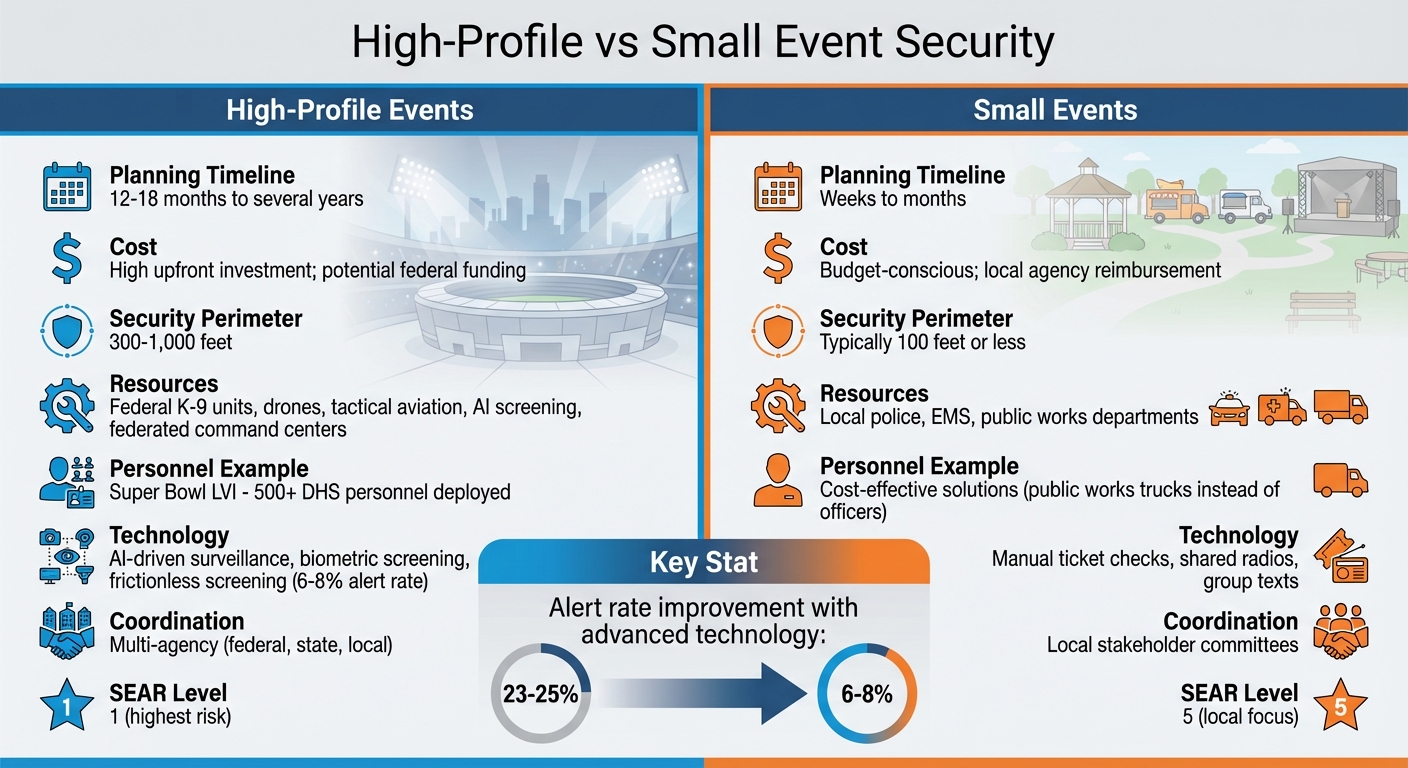
High-Profile vs Small Event Security: Key Differences in Planning and Resources
When comparing high-profile and small events, the trade-offs in security, resource allocation, and cost management become clear.
High-profile events leverage advanced technology and federal support to enhance security. For instance, frictionless screening technologies have significantly lowered alert rates from 23–25% to just 6–8%. Federal backing also plays a key role, as highlighted by Anthony Guglielmi:
Every government tool can be used to mitigate threats.
However, this level of security demands extensive planning – often 12 to 18 months – and substantial personnel commitments. For example, the 2014 G20 Summit in Brisbane required a massive deployment: 6,000 police officers, 1,500 private security professionals, and 600 volunteers.
Small events, on the other hand, focus on cost-effectiveness by utilizing shared resources. Lieutenant Jon Zimmer and Captain John Mocello explain how:
A public works truck and barricade may be used instead of a police officer to manage an intersection.
This approach helps conserve resources and allows for shorter planning cycles, typically ranging from weeks to a few months. Local stakeholder committees, familiar with their communities, often play a vital role in organizing these events. However, small events face limitations in accessing specialized tools like counter-drone technology or AI-driven surveillance systems.
| Feature | High-Profile Events | Small Events |
|---|---|---|
| Cost | High upfront investment; potential federal funding | Budget-conscious; relies on local agency reimbursement |
| Resource Access | Federal K-9 units, drones, tactical aviation | Local police, EMS, and public works departments |
| Efficiency | AI screening, federated command centers | Streamlined permit portals, stakeholder meetings |
| Planning Timeline | 12–18 months to several years | Weeks to months |
| Security Perimeter | 300–1,000 feet for major events | Typically 100 feet or less |
The table highlights how resource availability and allocation shape the security strategies for both types of events.
As mentioned earlier, resource management remains a critical challenge across all event scales. Andrew LaMadrid, Vice President of Sales at Unified Command Solutions, emphasizes this point:
There’s a limited amount of assets, so you’ve got to use them wisely.
High-profile events benefit from sophisticated federal resources but often grapple with complex multi-agency coordination. In contrast, small events operate with limited resources and simpler command structures, focusing on practical safety measures like traffic control and alcohol management.
How Essentialyfe Handles High-Profile Event Security
Essentialyfe takes a trust-first approach to high-profile event security, a model created by founder Avi Shabtai. The company meticulously vets properties and thoroughly screens clients, ensuring peace of mind for both guests and homeowners. As they put it:
We built a platform rooted in trust – carefully vetting our properties so guests always know exactly what they’re getting, and thoroughly screening our clients so homeowners can open their doors with confidence.
Their security measures go far beyond standard background checks. Essentialyfe conducts detailed risk assessments, evaluating venue access points, identifying vulnerabilities, and analyzing audience profiles to pinpoint potential high-risk targets. They employ a structured "Deter, Detect, Delay, and Respond" strategy, creating layered security measures similar to those used at major global events.
What sets Essentialyfe apart is their seamless integration of security and luxury services. From the moment a client inquires to the final checkout, the company provides a comprehensive experience – offering private chefs, exotic car rentals, and shuttle services alongside their security protocols. This approach ensures all parties, including security teams, event managers, and vendors, work in harmony under unified communication protocols. Additionally, their curated venue selection allows for the implementation of key security elements, such as access control systems, surveillance, and emergency preparedness, all without compromising the event’s luxurious ambiance.
A standout feature of Essentialyfe’s service is their commitment to "invisible" security – providing protection that doesn’t disrupt the event’s atmosphere. Mitesh Shah of Empire Protection explains:
The right balance between presence and discretion separates bodyguards from trained close protection professionals [[21]](https://www.empireprotection.ca/security planning for high-profile events).
With the global crowd management market expected to exceed $9.7 billion, Essentialyfe’s blend of luxury service and advanced security positions them to cater to the needs of elite clients hosting high-profile events. Their ability to merge sophisticated security strategies with high-end hospitality reflects the modern demands of such exclusive gatherings.
Conclusion
Organizing high-profile events demands extensive planning and coordination across multiple agencies, a stark contrast to smaller gatherings. Events like the Super Bowl or the United Nations General Assembly require input from federal agencies such as the Secret Service, FBI, and DHS. On the other hand, smaller community events have traditionally depended on local law enforcement, though modern threats now call for more structured security measures. These differences in scale also shape the choice of technology and deployment strategies.
The scale of an event directly impacts its security perimeter. High-profile gatherings often incorporate cutting-edge tools like AI-driven surveillance, biometric screening, and autonomous patrolling robots. Meanwhile, smaller events still rely on traditional methods, such as manual ticket checks. As Lieutenant Jon Zimmer and Captain John Mocello aptly stated:
The days of simply cordoning off a street and letting the crowds gather are long gone. A unified approach to both planning and managing public events is now a necessity for all events, large and small.
Customizing security strategies is crucial because each event presents unique challenges. For example, what works for a local festival would fall short at a stadium hosting 183,000 attendees over four days. Security teams must adjust their tactics, whether deploying 500 federal personnel for Super Bowl LVI or coordinating 200 Secret Service officers for a last-minute presidential appearance.
Collaboration among agencies and support staff is key to effective security. Integrated efforts help avoid redundancies and close potential gaps in coverage. When support teams like housekeeping and maintenance work alongside security professionals, they can act as additional eyes and ears, ensuring quicker identification of potential threats. Partnerships also allow access to advanced technologies that local teams might not have on their own.
FAQs
How is an event’s SEAR level determined?
The Department of Homeland Security’s Office of Operations Coordination assigns an event’s SEAR level through a detailed risk assessment. This process examines three key factors: threat, vulnerability, and potential consequences. Using a risk-based approach, events submitted by officials are rated on a scale from Level 1 (indicating the highest risk) to Level 5 (indicating the lowest risk).
What’s the minimum security plan a small festival should have?
A security plan for a small festival should prioritize a visible security presence, establish clear zone coverage with defined patrol routes, and implement basic emergency procedures suited to the event’s scale and potential risks. These measures are essential for maintaining safety and addressing the unique challenges of smaller events.
How can security stay “invisible” without reducing safety?
Security can prioritize safety without drawing attention by employing detailed risk assessments, careful planning, and unobtrusive protective measures. These methods are particularly effective during high-profile events, where staying inconspicuous while ensuring safety is key.