Length-of-Stay (LOS) pricing is a method that adjusts nightly rates based on how long guests stay. Short stays come at a higher nightly rate, while longer stays are discounted. This strategy increases revenue, reduces operational costs, and encourages longer bookings. For instance, a hotel offering "Stay 3 nights, get 10% off" saw average stays grow from 1.8 to 2.4 nights, with a 15% revenue increase.
Key benefits of LOS pricing include:
- Higher Revenue: Longer stays reduce turnover costs and increase spend on extras like dining.
- Lower Costs: Fewer turnovers mean less cleaning and wear on the property.
- Better Occupancy Management: Discounts for extended stays fill slow periods, while premiums for short stays maximize peak demand.
To implement LOS pricing:
- Analyze Data: Review past booking patterns to identify trends.
- Set Minimum Stay Rules: Adjust based on demand and booking windows.
- Create Tiered Pricing: Offer discounts for weekly or monthly stays.
- Leverage Technology: Use automated tools for real-time adjustments.
This approach helps property managers balance revenue growth with operational efficiency.
Stays.net | Pricing per Night – Length of Stay Discount Model
sbb-itb-161ccc1
What is Length-of-Stay Pricing?
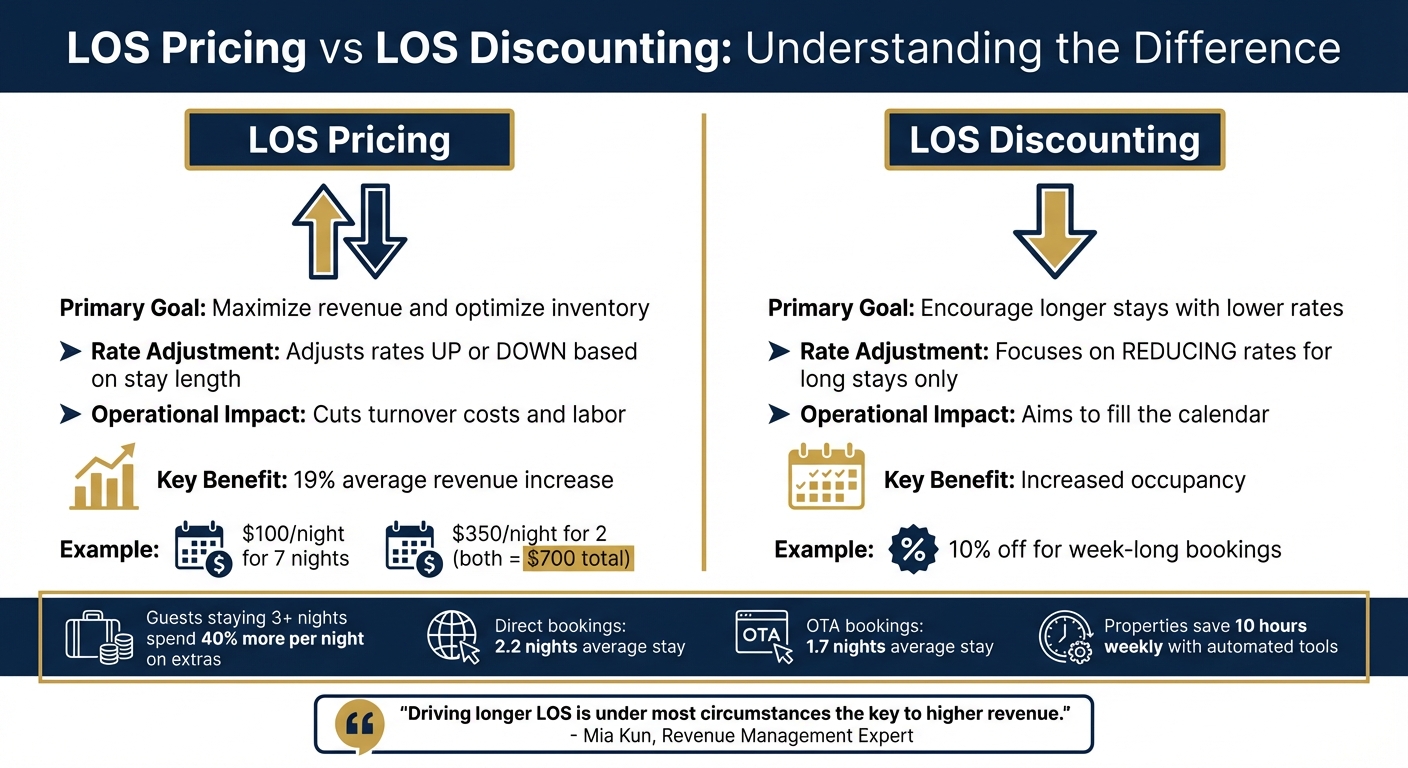
LOS Pricing vs LOS Discounting: Key Differences and Benefits
Definition and Core Mechanics
Length-of-Stay (LOS) pricing is a dynamic revenue strategy that adjusts nightly rates based on two factors: the guest’s arrival date and how long they plan to stay. Unlike fixed nightly rates, LOS pricing tailors prices according to the booking duration, creating opportunities to optimize revenue.
Here’s an example: you could charge $100 per night for a 7-night stay (totaling $700), but for a 2-night booking, you might set the rate at $350 per night, which also totals $700. The higher rate for shorter stays offsets the operational costs tied to frequent turnovers, such as cleaning and administrative work.
What sets LOS pricing apart from simple discounting is its flexibility. While discounting typically reduces rates for longer stays – like offering 10% off for a week-long booking – LOS pricing can both increase rates for short stays and decrease them for extended stays. The goal is to balance revenue by adjusting rates in either direction.
| Strategy Component | LOS Pricing | LOS Discounting |
|---|---|---|
| Primary Goal | Maximize revenue and optimize inventory | Encourage longer stays with lower rates |
| Rate Adjustment | Adjusts rates up or down based on stay length | Focuses on reducing rates for long stays |
| Operational Impact | Cuts turnover costs and labor | Aims to fill the calendar |
This approach not only helps maintain revenue targets but also reduces operational strain, making it a win-win for property managers.
Why LOS Pricing Matters for Revenue Growth
The flexibility of LOS pricing translates into measurable financial gains. Properties using this strategy have reported an average revenue increase of 19%. Longer stays reduce the frequency of turnovers, cutting costs for housekeeping, check-ins, and general wear and tear – key savings, especially for high-end properties.
There’s also the added benefit of ancillary revenue. Guests who stay three or more nights spend 40% more per night on extras like food and beverages compared to one-night guests. Longer stays open up opportunities for additional income from premium services like private dining or spa treatments.
"Driving longer LOS is under most circumstances the key to higher revenue." – Mia Kun, Revenue Management Expert, HotelMinder
Direct bookings amplify these advantages even further. Properties that enforce stricter minimum stay policies on OTAs but offer more flexible options on their own websites see longer average stays – 2.2 nights for direct bookings compared to 1.7 nights for OTA bookings. This approach not only boosts revenue but also strengthens the property’s direct relationship with guests.
Main Benefits of Length-of-Stay Pricing
Increasing Revenue Per Booking
Length-of-stay (LOS) pricing is all about maximizing the value of each reservation. For example, a three-night booking at $225 per night brings in $675, demonstrating how longer stays can generate more revenue compared to shorter, higher-rate bookings.
This strategy also helps avoid lost revenue opportunities. A single-night reservation might block a room that could have been filled with a more profitable multi-night stay. By setting minimum stay requirements during busy periods like festivals or weekends, you ensure that your inventory is used more effectively.
A great example of this: A luxury boutique hotel in Charleston implemented stricter LOS rules on online travel agency (OTA) channels while keeping direct bookings more flexible during peak season. The result? A 22% increase in direct bookings.
Lowering Operational Costs
In addition to boosting revenue, LOS pricing can simplify your operations and cut costs. Fewer turnovers mean lower labor expenses. Think about it: a four-night guest requires just one check-in, one check-out, and one deep clean. Compare that to four separate one-night stays, which multiply those tasks fourfold. This reduces the workload for housekeeping, front desk staff, and administrative teams.
"A guest staying four nights only requires one set of cleaning and administrative tasks, lowering the per-night operational cost." – RoomPriceGenie
Longer stays also reduce wear and tear on your property. Frequent luggage movement, daily deep cleans, and constant guest turnover can take a toll on furniture, fixtures, and amenities. Stable occupancy helps minimize this physical strain. Plus, property managers using automated revenue management tools for LOS pricing save around 10 hours of manual work weekly, allowing staff to focus on enhancing guest experiences instead of juggling rate adjustments.
These operational savings go hand-in-hand with the revenue benefits of LOS pricing.
Managing Occupancy and Demand
Fewer turnovers don’t just save money – they also open up opportunities to better manage occupancy. LOS pricing helps fill gaps in your calendar and smooth out demand fluctuations. For instance, offering discounts to guests who extend their weekend stay into slower weekdays (also known as "bridge stay" incentives) can reduce occupancy spikes and valleys without adding turnover costs.
You can also use premium pricing for short stays to fill "orphan nights" – those one-night gaps between longer bookings that might otherwise go unbooked.
During high-demand periods, LOS pricing can protect your most valuable nights. For example, requiring a three-night minimum that spans Tuesday through Thursday ensures that slower midweek nights are booked, while preserving your high-demand weekend for longer stays.
"LOS restrictions are the easiest way to maximize revenue by improving the demand on your shoulder nights or slowing down demand on peak nights without using any hard restrictions." – Mia Kun, Revenue Management Expert, HotelMinder
How to Set Up Length-of-Stay Pricing
Review Historical Data for Patterns
Start by analyzing at least 12 months of occupancy data. This gives you a clear picture of peak seasons, slower periods, and everything in between. To calculate your Average Length of Stay (ALOS), divide the total number of occupied room nights by the total number of bookings. This serves as your starting point.
Pay attention to demand spikes caused by local events, holidays, or festivals. Note how far in advance guests book different stay lengths. Also, check your property management system (PMS) for outdated rules, like rigid Saturday-to-Saturday stays, that could be limiting your visibility in search results.
If you’re using platforms like Airbnb, take advantage of their built-in analytics. Navigate to Insights > Occupancy & Rates > Length of Stay to identify trends and compare them with the next six months. Watch out for “orphan nights” – those awkward one- or two-night gaps between bookings that often go unfilled when minimum stay rules are too strict. Adjusting your stay requirements regularly can make a big difference; hosts who do this every few months typically see a 17% annual boost in performance.
Use these insights to set smarter minimum stay rules.
Establish Minimum Stay Requirements
Use your historical data to create flexible minimum stay requirements, especially during high-demand periods. For bookings made far in advance (six months or more), consider setting a longer minimum, like seven nights, to reserve those dates for higher-value guests. As the check-in date gets closer, reduce the minimum stay requirement to fill remaining availability. For instance, if a date is less than a week away, drop the minimum to one or two nights.
Avoid rigid, static rules. Instead, implement cascading restrictions that automatically adjust as dates draw near. For example, a boutique hotel in Charleston tightened its LOS rules on OTA channels during peak season but offered more flexibility for direct bookings. This strategy led to a 22% increase in direct bookings.
Be mindful of how strict rules impact visibility. A seven-night minimum, for instance, can exclude your property from more than 50% of search traffic in many markets.
Build Tiered Pricing Models
Create a pricing structure that encourages longer stays while covering the costs of shorter ones. Here’s a simple framework:
- Charge the full nightly rate for stays of one to two nights.
- Offer a small discount for stays of three to five nights.
- Provide 10% to 20% off for weekly stays (six to seven nights).
- Discount 20% to 30% for stays of 28 nights or more.
| Stay Length | Pricing Strategy | Typical Discount |
|---|---|---|
| 1–2 Nights | Full nightly rate | Premium pricing |
| 3–5 Nights | Tier 1 discount | Small percentage off |
| 6–7 Nights | Weekly tier | 10%–20% off |
| 28+ Nights | Monthly tier | 20%–30% off |
Encourage Longer Bookings with Incentives
Discounts aren’t the only way to attract longer stays. Offer value-added promotions like “Stay 4, Pay for 3” or “Stay 7, Get the 8th Night Free” to enhance the perceived value. These offers are especially effective during slower periods when you need to fill gaps without cutting your nightly rates.
You can also target existing guests with “bridge stay” incentives. For example, offer a discount to extend their weekend stay into the weekdays, which is often more profitable than trying to attract brand-new short stays. If you’re using platforms like Airbnb, keep in mind that discounts of at least 10% are more likely to be highlighted in search results.
Apply these tactics consistently to maximize their impact.
Apply Pricing Across All Booking Channels
Once your LOS pricing strategy is set, make sure it’s applied across all booking channels. Keep your pricing and stay requirements consistent between your direct booking site and third-party platforms. Inconsistencies can confuse guests and hurt your visibility. For instance, platforms like Vrbo base pricing for “dateless searches” on an average of all possible stay lengths over the next four months, which accounts for 45% of their traffic.
Consider offering more flexible options on your direct booking site compared to OTAs. This can encourage guests to book directly when they see better availability or terms on your website. Highlight minimum stay rules and discounts clearly on your booking engine to set expectations and attract the right audience.
Advanced LOS Pricing Techniques for Luxury Properties
Combining LOS with Other Pricing Methods
Luxury property managers can increase revenue by pairing LOS (Length of Stay) pricing with other dynamic strategies. Instead of relying on broad regional data, focus on a true competitor set – properties offering similar luxury amenities, bedroom counts, and location quality. This approach ensures your pricing reflects the premium value of your property and avoids underpricing.
To capture local demand, track over 75 micro-seasons, which align with events and other local factors. This strategy has been shown to boost RevPAR (Revenue Per Available Room) by up to 10.7%.
Integrating LOS pricing with strategic booking window management also pays off. Focus on three distinct booking patterns: early planners who book three or more months ahead, spikes tied to event ticket sales, and last-minute travelers. For early bookings, consider longer minimum stays (four nights or more) to attract high-value guests. Closer to arrival dates, relax these requirements to fill remaining availability.
You can also capitalize on existing guests with adjacency logic. Fabio Castiblanco, Head of Revenue and Analytics at Sosuite, highlights the value of this approach:
"If you can get the guest who is already booked to extend their stay by one night, that is always going to be an easier and more profitable booking than trying to attract a brand new one-night stay from the market".
Automated tools can help identify these opportunities, sending personalized offers to guests and reducing turnover costs in the process.
Charging Higher Rates for Short Stays
Short stays often come with higher servicing costs, so pricing should reflect this. Charging a 10% to 20% premium for one- and two-night stays can help offset expenses like cleaning, turnover, and administrative tasks. This ensures even short stays contribute to your bottom line.
Another tactic is orphan day pricing, which targets single-night gaps between longer bookings. By allowing one-night stays only when they fill these gaps, you can maintain occupancy while increasing revenue.
Don’t overlook the importance of adjusting weekend rates. Friday and Saturday nights typically see higher demand, so increasing rates by 10% to 20% on these nights is a smart move. In peak vacation seasons, some markets even see ADR (Average Daily Rate) spikes of up to 178%.
Adjusting Rates in Real-Time
Dynamic, real-time pricing is essential for staying competitive in the luxury market. Static pricing can lead to missed opportunities, while real-time adjustments allow you to respond instantly to market changes like booking trends, inventory levels, and competitor pricing. Properties using AI-driven dynamic pricing have reported annual revenue increases of 10%–40%.
To maintain your luxury brand’s integrity, set minimum and maximum pricing limits. These guardrails prevent automated systems from underpricing during slower periods or overpricing during demand surges.
A cascading minimum stay strategy is another effective tool. For example, require seven-night stays for bookings made six months in advance, then reduce the requirement to four nights at 60 days out, three nights at 30 days, and two nights within the final two weeks. This approach secures longer stays early while filling last-minute gaps with shorter bookings.
Market compression – when limited comparable properties are available – presents another opportunity. In these situations, your system should increase rates aggressively (but within your maximum cap) to capture the highest possible value.
Natalia Alzate, Finance Specialist at Blue Gems MGMT, underscores the importance of flexibility:
"It is so important to always be flexible with your goals, and be flexible with your strategy to adapt to market changes. You have to be willing to look at the data and say, ‘My goal this month isn’t just a high ADR; it’s maximizing my length of stay to prepare for the long run’".
Automated revenue management tools can save up to 10 hours of manual work each week while boosting revenue by an average of 19%. By blending automation with strategic oversight, you can ensure your pricing remains aligned with your property’s premium positioning and long-term objectives.
How to Measure LOS Pricing Performance
Evaluating the success of your Length of Stay (LOS) pricing strategy is essential to ensure it contributes to both revenue growth and operational efficiency.
Calculate Average Length of Stay (ALOS)
ALOS is a key metric for understanding guest behavior and streamlining operations. To calculate it, divide the total number of occupied room nights by the total number of reservations within a specific period. For example, if your property had 300 room nights and 100 reservations, the ALOS would be 3.0 nights. A higher ALOS often leads to reduced labor costs and less stress from frequent turnovers. To keep data accurate, pull these figures directly from your Property Management System.
Track Occupancy Rates and Revenue Metrics
Occupancy rate is a straightforward measure of how well you’re filling your available rooms. For a more precise view, calculate the Adjusted Occupancy Rate, which excludes blocked nights (e.g., for maintenance or owner use) from the total available nights.
RevPAR (Revenue per Available Room) offers a snapshot of pricing and inventory efficiency. You can calculate it by multiplying the Average Daily Rate (ADR) by the occupancy rate or by dividing total revenue by total available nights. Monitoring RevPAR alongside ALOS can reveal if your LOS pricing is driving real improvements. Additionally, keeping an eye on shoulder nights – days adjacent to peak demand periods – can show whether your strategy is filling gaps in the booking calendar.
Lastly, tracking cost savings gives a clearer picture of your LOS strategy’s impact on operational expenses.
Quantify Cost Savings
Cost savings highlight the operational benefits of your LOS strategy by turning reduced turnovers into measurable financial gains. To calculate this, determine the cost per turnover – including labor, cleaning supplies, and laundry – and multiply it by the number of turnovers avoided. For instance, a single 7-night stay requires just one turnover, compared to seven turnovers for seven 1-night stays. This not only saves money but also boosts ancillary revenue, as guests staying three or more nights typically spend 40% more on food and beverages per night compared to single-night guests.
"Driving longer LOS is under most circumstances the key to higher revenue… it’s cost-effective to have a lower turnover of the room".
- Mia Kun, Revenue Management Expert at HotelMinder
Conclusion
Length-of-stay pricing goes beyond being just a revenue tool – it’s a smart way to manage inventory that can improve your property’s financial health. By using strategies like tiered discounts, minimum stay rules, and dynamic pricing adjustments, you can increase total revenue per booking while cutting down on operational costs. The examples shared in this guide highlight how these methods can lead to noticeable gains in both revenue and bookings.
This approach doesn’t just boost revenue; it also reduces operational strain. Longer stays mean fewer turnovers, which helps preserve high-end furnishings and lowers housekeeping costs. Plus, guests who stay more than three nights tend to spend more on extras, creating additional earning opportunities.
To make the most of these benefits, start by analyzing your past booking data. Introduce tiered pricing, enforce smart minimum stay policies, and use automation tools to adjust rates in real time. The goal is to take control of demand instead of simply responding to it.
Whether you’re managing luxury vacation rentals, boutique properties, or event spaces, length-of-stay pricing offers a reliable way to optimize revenue and streamline operations. The strategies outlined here are practical and ready to be put into action. By implementing them, you’ll not only see financial improvements but also align with Essentialyfe’s mission to deliver refined luxury experiences.
FAQs
What LOS discounts should I start with?
Starting with moderate Length of Stay (LOS) discounts is a smart way to encourage longer stays and boost revenue. A tiered approach often works best. For example, offering 10-15% off for stays of 3-7 nights can make your property more appealing to guests seeking extended stays. This strategy not only helps attract these bookings but also keeps your pricing competitive, which can lead to noticeable revenue growth.
How do I avoid losing bookings with minimum stays?
Flexible minimum stay restrictions can make a big difference in avoiding lost bookings. If your rules are too rigid, especially during slow periods, potential guests might look elsewhere. Instead, keep an eye on market trends and adjust your minimum stay policies to strike the right balance between filling rooms and maintaining revenue. By managing these restrictions dynamically, you can attract more guests and maximize income without sticking to inflexible rules.
Which metrics prove LOS pricing is working?
Metrics that demonstrate the success of length-of-stay (LOS) pricing include improvements in average length of stay (ALOS) and revenue performance. When ALOS increases, it means guests are staying longer, which can streamline occupancy management and reduce the need for frequent room turnovers. On the revenue side, growth in indicators like total revenue or revenue per available room (RevPAR) signals that the pricing strategy is driving financial gains. These metrics together underline how LOS pricing can enhance profitability while fine-tuning room rate strategies.