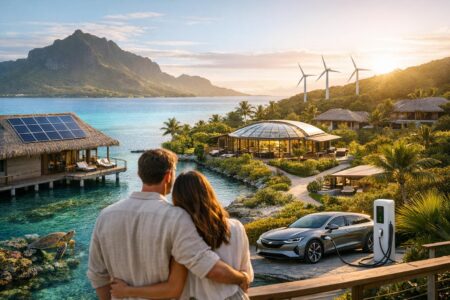
Private islands are proving that luxury and eco-consciousness can coexist. By harnessing renewable energy, reducing waste, and adopting sustainable practices, they’re transforming tourism while protecting fragile ecosystems. Here’s how they do it:
- Renewable Energy: Solar panels, wind turbines, and energy storage systems reduce reliance on costly, polluting diesel fuel. Examples include hybrid systems in Sint Eustatius and Samsø Island, which generate more energy than they consume.
- Waste Management: Zero-waste programs turn food scraps into compost, recycle materials, and use innovative systems like worm-based septic tanks for clean water and soil.
- Water Conservation: Rainwater harvesting and on-site wastewater treatment ensure fresh water for drinking and irrigation, even in drought-prone regions.
- Green Architecture: Local materials, natural cooling designs, and storm-resistant structures lower carbon footprints while blending into the environment.
- Local Farming & Food: Organic farms and community partnerships supply fresh, local ingredients, boosting biodiversity and supporting nearby economies.
- Guest Engagement: Activities like coral restoration, sustainable diving, and eco-education make conservation part of the luxury experience.
Why it matters: With private islands leading the way, luxury tourism is shifting toward sustainability, offering travelers indulgence without harming the planet.
Marlon Brando’s Tetiaroa: A Luxurious and Eco-Friendly Private Island Paradise
Renewable Energy Systems
Private islands are increasingly turning to renewable energy to break free from the financial burden of fossil fuel imports. For some nations, these imports can consume as much as 20% of their GDP. Let’s dive into how hybrid solar and wind systems are helping islands maintain reliable energy supplies.
Solar and Wind Power Setup
Blending solar panels with wind turbines in hybrid systems is proving to be a reliable way to generate energy, even under changing weather conditions. A great example is Sint Eustatius, where a hybrid power plant expanded its solar capacity from 1.89 MW to 4.15 MW, supported by a 5.9 MWh battery storage system. This setup is robust enough to meet peak energy demands.
Another success story comes from Denmark’s Samsø Island. By 2017, the island had adopted nearly every renewable energy technology available. This included biogas plants, wood and straw heating systems, a large solar heat plant spanning 27,000 square feet, and a mix of onshore and offshore wind turbines with a total capacity of 34 MW. The result? The island now generates more energy than it consumes.
The financial advantages of renewable energy are just as compelling. In the Maldives, imported diesel costs range from 30 to 40 cents per kilowatt-hour, significantly higher than the 5 to 7 cents per kilowatt-hour seen in nearby South Asian nations. However, a solar project supported by the World Bank has brought the cost of electricity in the Maldives down to just 9.82 cents per kilowatt-hour, making it one of the most cost-effective rates among small island nations.
"Solar has cut my business expenses by 35 percent, allowing me to expand operations. The primary motivation to go solar was cost savings, but I am pleased to know that I am doing my part to alleviate climate change considering its impact on islands such as Jamaica."
– Shelly-Ann Dinnall, third-generation chicken farmer
Energy Storage Systems
Energy storage systems, particularly batteries, are essential for managing the fluctuations in power generation from renewable sources. They stabilize energy frequency, provide backup during peak demand, and reduce reliance on diesel generators. Modern battery storage solutions are highly responsive and offer ample capacity.
Proper planning is key to maximizing these systems. Resorts and other operators should perform energy audits to assess peak and average consumption, evaluate solar energy potential based on local conditions, and determine how long operations need to function without sunlight. This data is crucial for sizing battery systems effectively. Lithium-ion batteries are a popular choice due to their efficiency, high energy density, and long lifespan. These batteries can be charged through solar panels, diesel generators, or the grid, creating opportunities for cost savings through energy arbitrage.
In addition to storage advancements, incorporating energy-saving measures enhances the overall efficiency of these systems.
Energy Efficiency Methods
Efficiency isn’t just about generating and storing energy – it’s also about using it wisely. Combining energy efficiency with renewable energy reduces the size and cost of installations. A case in point: Fiji managed to save approximately 9.3 GWh of electricity in a single year by implementing appliance labeling and Minimum Energy Performance Standards.
Smart automation systems are particularly useful in resort settings. These systems adjust lighting, heating, cooling, and refrigeration based on occupancy, eliminating the need to run at full capacity when it’s not necessary. Building design also plays a role – strategic placement of solar panels, natural ventilation, and energy-efficient lighting can significantly lower energy consumption.
The benefits aren’t just environmental. Wind energy, for example, offers a staggering 1,164% return on its initial energy investment while offsetting CO₂ emissions equivalent to those produced by nearly 42 million cars in 2019. Forward-thinking projects like VPP4ISLANDS are taking it a step further by using virtual energy storage, digital twin technology, and distributed ledgers to create intelligent energy networks that optimize power distribution across islands.
Waste Management Systems
Private islands face distinct challenges in handling waste. Without municipal waste collection or centralized treatment facilities, these remote locations must adopt tailored strategies to minimize their environmental footprint while maintaining efficient operations. One effective approach is to create closed-loop systems that transform waste into usable resources, promoting self-reliance. These systems exemplify how luxury living can coexist with environmentally-conscious practices. Let’s dive into how zero-waste initiatives are reshaping waste management on private islands.
Zero-Waste Programs
Zero-waste programs on private islands aim to reduce landfill use by prioritizing composting, recycling, and advanced biological treatment methods. Composting is often the cornerstone of these efforts. Organic waste – whether from kitchens, landscaping, or guest areas – is converted into nutrient-rich soil amendments, cutting the need for imported fertilizers.
Recycling efforts go beyond simply separating materials. Crushed glass, for example, can be used in construction, metals are sent off-site for reprocessing, and shredded paper or cardboard can serve as garden mulch. Proper sorting and thorough staff training are key to maximizing recycling efficiency.
Some islands take innovation a step further with worm-based septic systems. These systems use earthworms to break down organic waste and sewage, producing clean water and compost as byproducts. A resort highlighted by GRIFFCOMM exemplifies this approach, with a system that recycles nearly everything and even uses treated sewage to grow vegetables. The resort also funds research through a registered charity to advance these sustainable practices.
Beyond waste management, islands also look to rainwater harvesting to address water scarcity.
Rainwater Collection and Filtration
Given their limited access to freshwater, rainwater harvesting is a vital sustainability measure for private islands. These systems collect, store, and purify rainwater for drinking, irrigation, and other operational needs. For instance, just one inch of rainfall on a 2,500-square-foot surface can yield about 1,500 gallons of water, showcasing how even small structures can gather significant amounts during a storm.
To ensure water quality, rooftops, gutters, and downspouts must remain clean, while first flush diverters capture debris and contaminants from initial runoff. Storage tanks should be made from food-grade, UV-resistant materials to prevent chemical leaching and algae growth. Sealed tanks also help avoid mosquito breeding while maintaining proper ventilation. Experts recommend a minimum storage capacity of 5,000 gallons for domestic use. In practice, residents in the U.S. Virgin Islands using rainwater cisterns manage with an average of just 24 gallons per person per day.
Filtration and disinfection are equally important. Multi-stage filters remove sediments and pathogens, while UV light systems kill microbes without leaving chemical residues. Chlorination can provide additional protection, and regular water testing ensures the water remains safe.
Barbados offers a compelling example of rainwater harvesting in action. Rooftop collection systems there supply water for irrigation, household use, and groundwater replenishment. This approach is especially valuable during droughts in the Caribbean, where roughly 10 million residents face water scarcity.
On-Site Wastewater Treatment
For islands without access to municipal sewage systems, on-site wastewater treatment is essential. These systems not only protect groundwater from contamination but also allow treated water to be reused for landscaping and maintenance, reducing the demand for precious freshwater.
The choice of wastewater treatment system depends on the property’s size and local regulations. Smaller properties often use septic tanks, which cost between $3,000 and $7,000. Larger properties may opt for aerated wastewater treatment systems, priced at $8,000 to $15,000, or custom multi-stage solutions, which can range from $20,000 to $120,000.
Reusing treated wastewater for irrigation – whether for landscaping, golf courses, or agricultural areas – significantly reduces freshwater consumption. For example, the Seven Seas Water Group’s installation at Sandals Emerald Bay in the Bahamas processes all resort sewage, providing enough treated water for on-site needs and even surplus capacity for the local community.
To keep these systems running smoothly, regular inspections, pump-outs, and timely replacements are necessary. Using biodegradable cleaning products helps maintain the delicate bacterial balance within the system. Service packages that include routine maintenance can prevent costly emergency repairs down the line.
Green Architecture and Design
Building sustainably on islands requires careful planning to reduce transport emissions and ensure structures can handle tough marine environments. The isolation of these locations means every construction choice matters – materials must be shipped across water, and buildings need to endure the elements. Smart design not only lowers a property’s carbon footprint but also creates spaces that blend seamlessly with their natural surroundings. Let’s dive into how sourcing materials, utilizing natural ventilation, and building resilient structures come together to shape eco-friendly island architecture.
Local and Renewable Building Materials
Choosing materials from the island itself or nearby areas helps reduce emissions and supports local communities. For example, The Residences at Secret Bay in Dominica use locally sourced stone, wood, and bamboo, promoting sustainable practices in the region. Similarly, Laucala Island in Fiji incorporates traditional materials like thatched roofs made from sago palms, doga timber, and magi magi – a coconut husk weave. Bamboo, a standout option, is highly renewable since it can be harvested without harming the plant. Other traditional materials like thatch, clay, and coconut husk have proven their durability over centuries.
Some islands take sustainability even further. Nikoi Private Island repurposes driftwood collected from beaches and employs local teams for construction. On Isla Palenque in Panama, materials like thatched roofs and wood furniture are crafted from fallen trees in an on-island workshop.
"A big part of the sustainable design is seen in the use of local materials like the thatched roofs and the wood furniture, sourced from fallen wood and crafted at our workshop on the island."
- Hans Pfister, Cayuga Collection
For islands lacking abundant local resources, sustainable sourcing becomes crucial. Kudadoo Maldives Private Island, for instance, imports wood from Canada, New Zealand, and Indonesia, ensuring all materials come from responsibly managed forests.
Natural Cooling and Ventilation
Energy-efficient designs go beyond materials – natural cooling strategies are key to reducing energy demands. Island climates, with their steady ocean breezes and warm temperatures, offer perfect conditions for natural ventilation. By tapping into these natural elements, architects can minimize reliance on energy-intensive air conditioning. Nikoi Island, for instance, uses a double-layered roof design that encourages airflow, along with overhead fans and beach houses positioned close to the shoreline.
"Ocean breezes and the unique cooling effect of the landmass provide an example of ‘nature’s air-con’, providing ‘simple barefoot luxury’ in a sublime setting."
- Nikoi Island
At Kudadoo Maldives, carefully placed windows enhance cross ventilation, cutting down on cooling needs. Isla Palenque combines several strategies, including cross ventilation, solar-powered showers, and optimal use of natural light, to lower energy consumption. Thoughtful building orientation and shading techniques further reduce energy use by maximizing natural light during cooler times and minimizing heat during hotter periods. Outdoor decks with overhangs, umbrellas, and canopies provide shaded spaces for much of the day, adding comfort while reducing heat exposure.
Green spaces and water features also play a big role in cooling. Studies show that features like reflective roofs, water bodies, and greenery can cool urban areas by 0.5°C and lower indoor temperatures by 3–5°C, while delivering substantial long-term benefits.
Elevated and Weather-Resistant Structures
Private islands face unique risks from extreme weather, making resilient construction a necessity to protect both people and ecosystems. Storms and flooding are major threats, and elevated structures can safeguard buildings while minimizing harm to fragile habitats. The financial benefits of weather-resistant designs are clear: every dollar spent on resilience saves four dollars in repair costs, and climate adaptation over the next decade could generate $7.1 trillion in net benefits by 2030.
The importance of resilient construction became evident in Saint Lucia in 2010, when Hurricane Tomas caused catastrophic damage, wiping out 43% of the country’s GDP overnight and destroying infrastructure like power lines and roads. To mitigate such risks, hurricane-resistant features – such as reinforced concrete, impact-resistant windows, and elevated foundations – are essential. These designs not only protect against disasters but also maintain aesthetic appeal.
"You need to prepare to be surprised."
- Associate director at ARUP
Traditional materials, when properly treated, can also enhance resilience. Local timber, reinforced bamboo, and well-constructed thatched roofs have withstood tropical storms for generations. Combining traditional building knowledge with modern engineering creates structures that are tough, sustainable, and ready for whatever nature throws their way.
sbb-itb-161ccc1
Food and Resource Practices
Private islands are creating self-sufficient food systems that not only serve their guests but also support local communities. By focusing on on-site organic farming, forming partnerships with nearby communities, and offering educational programs, these destinations are reshaping the way luxury properties approach food and sustainability. Let’s dive into how these efforts are making a difference.
On-Site Organic Farming
Many private islands are establishing organic farms to grow fresh produce while promoting biodiversity. These farms are designed to operate sustainably, relying on practices that reduce the need for external inputs and prioritize soil health. For example, soil testing is a key step, with farms aiming for 3% organic matter – a challenging goal on sandy island soils.
Crop rotation plays a big role in maintaining soil quality. By waiting up to eight years before replanting the same vegetable family, farms improve soil structure and biodiversity. Additionally, cover crops and complex rotations are used to minimize soil disturbance, while certified organic seeds and seedlings are sourced whenever possible.
Organic fertilizers are another critical element. These fertilizers, made from animal, plant, or mineral sources, are carefully vetted with organic certifiers to ensure they align with sustainable farming standards. To manage pests naturally, farms adopt Integrated Pest Management (IPM) strategies, which reduce reliance on conventional chemical inputs.
As noted by Sustainable Agriculture at UGA:
"Organic production is not simply the avoidance of conventional chemical inputs, but rather is a way of production that focuses on preventative practices that limit the need for external and off‐farm inputs, often called cultural practices."
Buffer zones are also established around farm areas to prevent contamination from surrounding land, ensuring the purity of organic production systems.
Local Community Partnerships
Collaborations with local communities are another cornerstone of sustainable practices. These partnerships provide fresh ingredients for the islands while boosting the local economy. By aligning with community needs, these initiatives ensure that tourism benefits local residents rather than displacing them.
For example, islands establish agreements with local fishermen, farmers, and food producers to supply fresh ingredients. This not only reduces the reliance on imported goods but also supports steady incomes for local workers. The result? Healthier food options for both guests and the community.
Education is another key component of these partnerships. Islands work with local tourism professionals and community members to teach them about sustainability practices, empowering them to take an active role in preserving their environment. Through ongoing consultations, communities also participate in conservation efforts that balance ecological and social goals.
One notable example is the Pacific Organic and Ethical Trade Community (POETCom), which has been promoting sustainable agriculture across island communities since its founding in 2012. Their Strategic Plan for 2013–2017 emphasized production, environmental stewardship, value chains, and sustainability, supported by bi-annual technical exchanges and shared resources.
Guest Education Programs
Private islands are also turning guest visits into opportunities to learn about sustainability and biodiversity. Banwa Private Island, for instance, partnered with the Aquos Foundation to create the "Biodiversity in Full Color" exhibition. This initiative combined art and education, featuring works by artist Samantha Kaspar, whose paintings of local wildlife aimed to inspire guests to appreciate and protect the environment.
"Our approach to conservation is holistic. By combining art, education, and community engagement, we aim to inspire positive change. We believe that by working collaboratively with local communities, we can achieve sustainable solutions that benefit both people and the planet. Our partnership with Samantha exemplifies this approach, as her art serves as a powerful tool for raising awareness and cultivating a sense of stewardship." – Janet Oquendo, Island Manager, Banwa Private Island
These educational efforts go beyond the guest experience. The Aquos Foundation also introduced "Mga Hero ng Planetang Blue", a book designed to inspire environmental responsibility among local students. By reaching younger generations, these programs create a ripple effect that extends far beyond the duration of a guest’s stay.
Combining Luxury with Green Practices
Private islands are proving that luxury and environmental responsibility can go hand in hand. The idea of luxury has evolved – it’s no longer about indulgence at the expense of the planet. Instead, today’s high-end destinations are redefining the concept by combining top-tier amenities with environmentally conscious practices. These islands are creating experiences that cater to the desires of sophisticated travelers while respecting and preserving the natural world. By weaving sustainability into their operations, they’re turning guest services into eco-friendly adventures.
Green Amenities and Activities
With advancements in renewable energy and waste management, private islands are now focusing on enhancing guest experiences through eco-conscious offerings. These sustainable efforts don’t just reduce environmental impact – they elevate the overall experience by fostering a deeper connection with nature.
Take Kudadoo Maldives Private Island, for example. This resort operates entirely on solar power, delivering uninterrupted luxury while maintaining a zero-carbon footprint. In partnership with Healing Earth, it provides biodegradable lifestyle amenities and offers unique activities like sustainable diving and snorkeling, guided by a resident marine biologist who educates guests about manta rays. As Kudadoo puts it:
"At every touchpoint at Kudadoo we aim to minimise our impact on the environment."
Meanwhile, Velaa Private Island Maldives has taken its commitment to sustainability a step further with its Coral Adoption Program. Since 2016, the resort has established three coral nurseries and transplanted 2,000 corals. Guests can actively participate by attaching coral fragments to ropes, naming them, and later observing marine biologists transplant these corals. The island has also achieved a plastic-free environment, further enhancing its pristine, eco-friendly appeal.
Over in Fiji, Six Senses Fiji boasts one of the largest off-grid solar installations in the Southern Hemisphere, powered by Tesla batteries. This makes it Fiji’s first 100% solar-powered resort. Beyond energy independence, the resort runs a breeding program for Fijian-crested iguanas and maintains an organic garden that grows over 40 varieties of herbs, fruits, and vegetables for its restaurants.
Guests are also drawn to activities that combine fun with conservation. Options like kayaking, paddleboarding, and guided eco-tours allow visitors to explore untouched environments while learning about the importance of preserving them.
Green Practices as Guest Appeal
Sustainability has become a key factor for luxury travelers who want their vacations to align with their values. For many, the eco-friendly initiatives of these islands are not just a bonus – they’re a highlight of the experience.
Vomo Island Fiji showcases how effective waste management can make a lasting impression. The resort uses a Power Knot LFC-300 biodigester to process nearly 9,700 pounds of food waste each month, preventing the release of 18.4 tons of CO₂ equivalent annually. That’s like cutting out the emissions from driving 47,000 miles or planting over 300 trees. Michael Fosbender, Vomo Island Resort’s Director of Operations, praises the system:
"I would highly recommend the LFC biodigester to anyone else. It’s a game changer and I was pushing for this for a long time. It does exactly what we need it to do: reduce costs and eliminate food waste."
At Kokomo Private Island Resort, conservation becomes an interactive experience for guests. The resort’s manta ray conservation project tags these animals to monitor their populations, while its coral garden grows more than 3,000 corals per season, thanks to two new nurseries. Guests can also visit the resort’s 2.2-hectare organic farm, which supplies fresh ingredients to its kitchens and offers hands-on farming activities.
Beyond the activities, travelers appreciate the peace of mind that comes with responsible tourism. Destinations like Fiji, home to coral reefs that harbor 42% of the world’s coral species across 10,000 square kilometers, allow guests to feel they’re contributing to meaningful conservation efforts.
This seamless integration of luxury and sustainability is reshaping the travel industry. Properties that prioritize environmental responsibility often attract discerning guests who are willing to pay a premium for authentic, eco-conscious experiences. By blending indulgence with purpose, these private islands are setting new standards for what sustainable luxury can look like. Guests leave not only with cherished memories but also with the satisfaction of knowing their visit helped protect the planet.
The Future of Green Luxury Islands
The luxury travel industry is seeing a transformation, with private islands leading the way toward a new era of eco-conscious luxury. The numbers speak volumes: in 2021, the global eco-luxury market was valued at $185.87 billion, and it’s projected to hit $300 billion by 2030, growing at an impressive annual rate of 15.2%. This shift highlights a significant change in traveler priorities. Today’s guests want experiences that align with their environmental values – without sacrificing the indulgence they expect.
Private islands are uniquely positioned to redefine what sustainable luxury looks like. Unlike traditional resorts that are often limited by existing infrastructure, these islands can incorporate cutting-edge green technologies right from the start. For example, resorts in French Polynesia are already integrating renewable energy systems and innovations like deep seawater air-conditioning to reduce their environmental footprint.
Technology is also playing a massive role in reshaping these destinations. AI-powered digital concierges are enhancing guest experiences while helping to cut down on resource usage. Meanwhile, solar-powered developments are pushing the boundaries of carbon-neutral living. These advancements aren’t just about luxury – they’re about creating a model for sustainable operations that other sectors can learn from.
New investment models are making sustainable luxury more accessible. Fractional ownership, which has grown by over 50% in the past two years, allows investors to share the costs of eco-friendly developments while enjoying exclusive access without the full responsibility of ownership. This approach is helping private islands fund expensive green infrastructure by spreading the financial burden across multiple stakeholders.
The idea of regenerative tourism is also gaining momentum. This concept goes beyond sustainability by actively contributing to the environment and local communities. Land-based examples already show its potential: Kenya’s Ol Pejeta Conservancy uses tourism revenue to fund anti-poaching programs and community initiatives, while Scotland’s Alladale Wilderness Reserve has planted nearly a million native trees thanks to visitor contributions. These models are now inspiring similar efforts in island destinations.
Looking ahead, regulatory shifts are encouraging even more innovation. For instance, the Cayman Islands’ National Energy Policy for 2024–2025 aims to achieve 70% renewable energy by 2037 and 100% by 2045, while offering financial support for sustainable energy projects. Forward-thinking island owners are staying ahead of these regulations, ensuring they remain leaders in eco-luxury.
Travelers today are looking for more than just beautiful views – they want immersive experiences that connect them with nature while leaving a positive impact. For companies like Essentialyfe, this trend is an opportunity to curate destinations that meet these evolving expectations while championing conservation efforts.
Private islands embracing this blend of sustainability and luxury aren’t just protecting their environments – they’re setting themselves apart in a competitive market. Whether through renewable energy, innovative waste management, or thoughtful design, these islands are crafting a new vision for what luxury travel can and should be. As environmental awareness becomes a cornerstone of the industry, these destinations are charting the path forward for the next generation of luxury travelers.
FAQs
How do private islands use renewable energy while maintaining a luxurious experience?
Private islands are redefining luxury by blending it with environmental responsibility. They integrate renewable energy systems like solar panels, wind turbines, and biofuel generators to cut down on fossil fuel reliance while maintaining a steady energy supply for their premium facilities.
On top of that, many islands adopt advanced energy storage systems and explore creative solutions like marine-based solar power. Paired with eco-friendly architecture and efficient waste management, these efforts create a high-end experience that doesn’t compromise on environmental care.
How do private islands manage waste sustainably?
Private islands are stepping up their game with smarter waste management strategies to reduce their environmental footprint. Many are turning to on-site waste processing systems that handle sorting, recycling, and even repurposing materials right on the island. This approach cuts down on the need for transporting waste off the island and ensures better waste management during busy tourist seasons.
Some islands are also composting organic waste, transforming it into nutrient-rich soil to support local plants. Others are actively cutting back on single-use plastics by promoting reusable options. These efforts not only help preserve the island’s natural charm but also support a cleaner, greener future.
How do private islands combine luxury with sustainability and community support?
Private islands manage to combine indulgence with eco-consciousness by embracing green initiatives. They often rely on renewable energy sources like solar and wind power, install water-saving systems, and construct buildings using sustainable materials. These measures help minimize environmental harm without compromising on comfort or sophistication.
Beyond their environmental efforts, many private islands actively contribute to marine conservation and invest in local communities. This can include creating jobs, offering education programs, and preserving local traditions. By weaving these values into their operations, private islands deliver luxurious experiences that also uphold environmental care and social responsibility.