By 2026, drones have become a key tool for showcasing high-end properties and hosting exclusive events. They provide stunning aerial visuals, detailed 3D mapping, and interactive virtual tours, while also being used in modern light shows for luxury events. Key highlights:
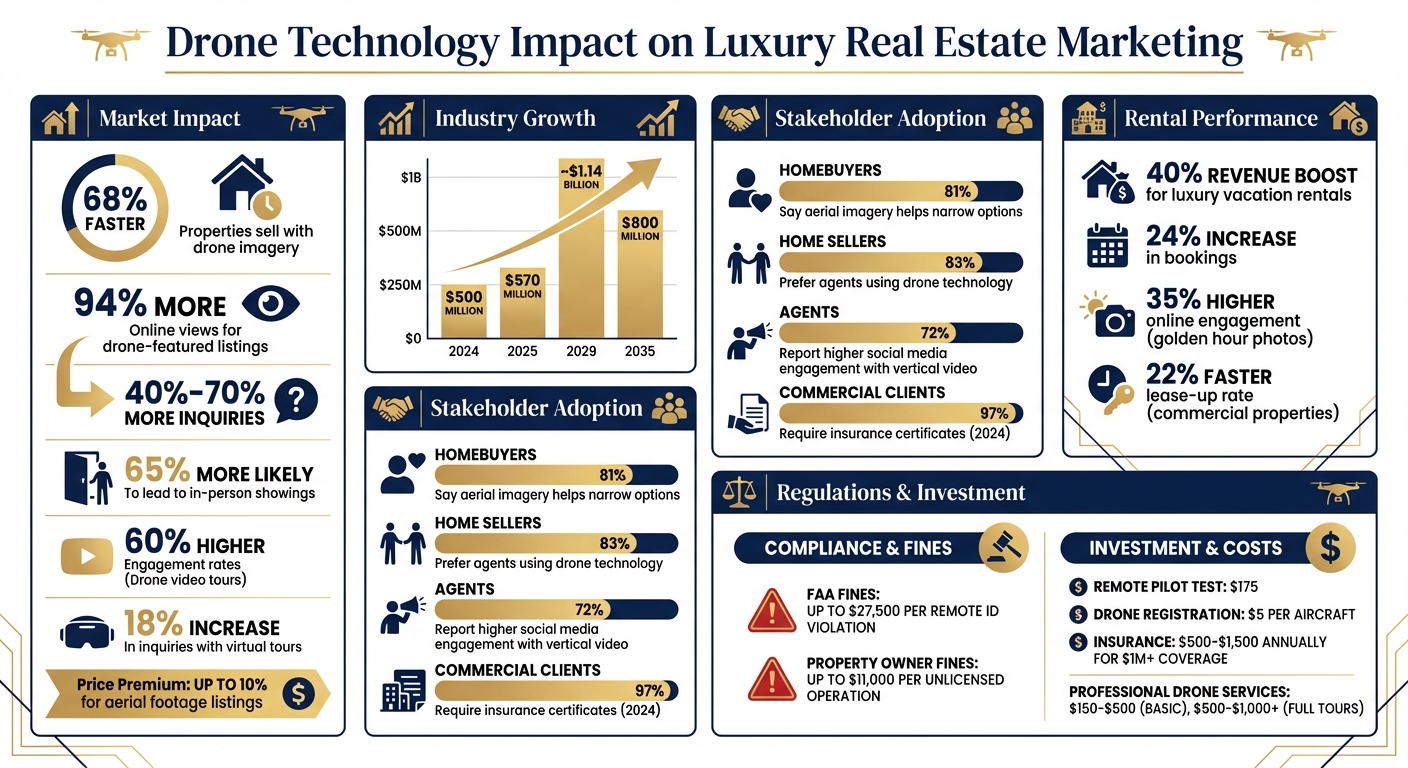
- Real Estate Impact: Listings with drone imagery sell 68% faster, attract 94% more views, and generate 40%-70% more inquiries. Drone videos boost engagement by 60%.
- Advanced Features: Modern drones offer 4K–8K cameras, AI-driven flight modes, and LiDAR for precise mapping, creating cinematic property tours and detailed inspections.
- Event Use: Drones replace fireworks with synchronized light shows – quiet, smoke-free, and customizable – ideal for eco-conscious event venues and film locations.
- Regulations: Operators must comply with FAA‘s Part 107 rules, including Remote Pilot Certification and Remote ID requirements, to avoid fines up to $27,500.
- Insurance: Liability coverage is critical, with policies ranging from $500–$1,500 annually for $1M+ coverage.
Drones are no longer optional in luxury marketing – they’re essential for creating captivating visuals and meeting client expectations.
Drone Technology Impact on Luxury Real Estate: Key Statistics and ROI
I Film Luxury Properties Solo. Here’s My Exact Template.
sbb-itb-161ccc1
Drone Technology Trends in Luxury Property Marketing
The tools used in luxury property marketing have come a long way. Today’s drones, equipped with 4K–8K cameras and advanced sensors, provide visuals that once required expensive helicopter rentals. These sensors excel at capturing high-dynamic-range images, making twilight poolside shots and golden hour estate tours look straight out of a magazine. Take the DJI Mavic 3 Pro, for example – it features a triple-camera Hasselblad system that delivers wide-angle, telephoto, and detailed shots all in a single flight.
High-Resolution Aerial Photography and Video
Aerial imagery plays a big role in property marketing. In fact, 81% of homebuyers say it helps them narrow down their options. Listings featuring drone photography are 65% more likely to lead to in-person showings. Features like the "True Vertical Shooting" mode on the DJI Mini 4 Pro make it easier than ever for agents to create vertical content specifically designed for platforms like Instagram Reels and TikTok. This matters because 72% of agents report higher social media engagement when using vertical video.
The impact of drone imagery is clear. In Chandler, Arizona, golden hour drone photos increased online engagement by 35% in 2025 compared to traditional listings. Similarly, a 2024 drone campaign for an office park in Tempe, Arizona, sped up the lease-up rate by 22%, effectively showcasing the property’s scale and access to major highways. These tools can make all the difference between a property sitting on the market and one that sells quickly. But drones aren’t just for still images – they’re creating fully immersive experiences, too.
3D Mapping and Virtual Tours
Drones have taken property tours to the next level with interactive 3D experiences. These models let potential buyers or vacation rental guests explore estates from virtually any angle, zooming in on key features that traditional ground-level photos can’t capture. Equipped with LiDAR technology, 2026 drones now achieve sub-10 cm accuracy, with some high-end models reaching precision levels as fine as 2–3 cm. This makes it possible to map property boundaries, measure pool dimensions, and detail landscaping with survey-grade accuracy.
FPV (First-Person View) drones are also gaining popularity for luxury properties. These agile drones can seamlessly transition from exterior shots to interior spaces, creating cinematic, one-take tours that showcase a property’s flow and layout intuitively. Properties with drone-captured virtual tours see an average 18% increase in inquiries, and 83% of home sellers now prefer agents who use this technology.
AI-Powered Drones for Property Showcasing
AI is making it easier than ever to showcase properties. Intelligent flight modes like "Orbit", "Reveal", and "Point of Interest" allow even novice pilots to execute complex cinematic shots with just a tap. For example, a drone can circle a luxury pool at sunset, rise to reveal ocean views, and glide toward the main entrance – all without requiring advanced piloting skills.
AI is also speeding up post-production. Automated tools now handle tasks like lighting adjustments, color corrections, and even removing distractions like power lines or parked cars, cutting editing time from days to just hours. Some AI services can even digitally furnish empty spaces in drone footage, helping potential buyers visualize the property’s scale and potential lifestyle without the expense of physical staging. As a result, drone video tours generate 60% higher engagement rates compared to standard photography. The market for drone technology in real estate is expected to grow from $500 million in 2024 to $800 million by 2035.
Drone Regulations in 2026
Using drones for luxury property marketing comes with strict FAA rules. Even if real estate photography is unpaid, the FAA considers any flight promoting a business a commercial operation. This means operators must have a Remote Pilot Certificate under Part 107. Property owners who hire unlicensed operators risk fines of up to $11,000 per violation.
FAA Guidelines for Commercial Drone Operations
Part 107 is the backbone of commercial drone regulations. To comply, pilots must:
- Pass a 60-question aeronautical knowledge test, which costs about $175.
- Register each drone for $5 per aircraft.
- Maintain visual contact with the drone at all times.
- Keep flights below 400 feet above ground level.
As of 2026, Remote ID is fully enforced. This system acts like a digital license plate, broadcasting the drone’s identification, location, and altitude in real time. Non-compliance can lead to civil penalties of up to $27,500 per incident. Older drones must be retrofitted with a broadcast module, which costs between $70 and $150.
Night flights are allowed if the drone has anti-collision lighting visible from at least three statute miles. For flying over crowds, only Category 1 drones (weighing under 0.55 pounds) are permitted; heavier drones face stricter restrictions.
Enforcement efforts have ramped up. In 2025, the FAA increased enforcement actions by 22%. Notable fines include $20,370 for a drone crash at the Sunfest Music Festival in West Palm Beach in May 2024 and $20,371 for a flight in restricted airspace near Mar-a-Lago in January 2025. FAA Chief Counsel Liam McKenna emphasized:
"The FAA will take decisive action against drone operators who ignore safety rules or operate without authorization."
In addition to FAA regulations, state laws impose further controls on aerial imaging and privacy.
Privacy and Safety Concerns
While the FAA oversees airspace, states manage privacy laws. Many states prohibit capturing images of individuals on private property where privacy is expected. This applies to features often seen in luxury properties, like backyards and pool areas. For instance:
- Texas law makes flying below 400 feet over critical infrastructure or photographing private property without consent a Class B misdemeanor under Chapter 423.
- Virginia bans drone flights within 50 feet of a home without permission.
To avoid legal trouble, always get written consent from property owners before filming. This helps prevent "aerial trespass" claims and potential criminal charges. Starting January 1, 2026, California also requires clear disclosure if aerial photographs have been materially altered.
Liability insurance is another key consideration. Standard policies for commercial drone operations typically cost $500 to $1,500 annually for $1 million in coverage – a level of protection many luxury property owners now expect.
These measures not only protect privacy but also uphold safety standards, aligning with the premium expectations of luxury property marketing.
How Drones Are Used for Luxury Rentals and Event Venues
Drones are transforming how high-end properties and exclusive events are marketed. The results speak for themselves: professional drone footage can boost revenue for luxury vacation rentals by 40% and increase bookings by 24%. As the trend gains momentum, drones are becoming a staple in luxury marketing, offering an unmatched ability to tell visually compelling stories. Whether it’s showcasing opulent properties or capturing grand events, drones are reshaping how luxury is presented.
Property Showcasing and Aerial Tours
Aerial footage offers a perspective that ground-level photography simply can’t match. It reveals the true scale of sprawling estates, the seamless connection between infinity pools and ocean views, or how rooftop terraces provide breathtaking cityscape panoramas. With drones, potential renters can visualize property boundaries, nearby natural features like beaches or mountains, and the harmony between indoor and outdoor spaces.
Listings enhanced with professional aerial footage often stand out, commanding price premiums of up to 10% and experiencing an 18% increase in inquiries. Timing is key – capturing footage during the "golden hour" (shortly after sunrise or before sunset) adds a touch of magic, with warm, soft lighting that highlights architectural details and water features beautifully. Costs for professional drone services range from $150 to $500 for basic sessions, while full video tours can start at $500 and go beyond $1,000 for more elaborate productions. But drones aren’t just elevating property listings – they’re also revolutionizing luxury event coverage.
Event Coverage and Cinematic Documentation
For high-end events, drones offer unique perspectives that ground-level cameras can’t achieve. Techniques like "The Orbit" (a 360° circling shot of the venue) and "The Reveal" (a dramatic entrance shot from behind architectural elements) create dynamic, cinematic footage that captures the essence of the event. At upscale weddings and brand launches, drones are even replacing traditional fireworks with dazzling light shows. These synchronized displays feature fleets of LED-lit drones forming custom shapes like initials, logos, or floral designs, offering a quiet and smoke-free alternative.
"Drone shows signal a shift in the way luxury experiences are designed. They’re quiet, clean, and customizable, and above all, unforgettable." – Mark Derho, Tech and Gear Specialist
This innovation is especially valuable for eco-conscious venues where fireworks might be restricted due to environmental concerns or fire hazards. Drone shows provide a stunning visual experience without the noise or pollution, making them ideal for beachfront resorts, heritage venues, and exclusive retreats.
Platforms like Essentialyfe are taking full advantage of these advancements, leveraging cutting-edge drone technology to craft immersive marketing that highlights the elegance and uniqueness of luxury rentals and event venues.
Risks and Insurance Requirements for Drone Operations
Drones have become a powerful tool in luxury property marketing, offering stunning aerial visuals that captivate potential buyers. However, their use comes with serious risks. For instance, flyaways – when drones lose connection with their controllers – can lead to equipment loss or crashes. Such incidents might damage luxury properties, valuable assets, or even historic landmarks. Worse, drones falling near areas with people, like open houses or resort pools, can cause severe injuries to bystanders.
Another major concern is privacy. Filming neighbors or guests without their consent can lead to lawsuits, especially in states with strict privacy laws like Florida, which enforces the Freedom from Unwarranted Surveillance Act. Failing to comply with regulations not only increases risks but could also void insurance coverage. These challenges make strict operational protocols non-negotiable.
Common Risks in Drone Operations
Operating drones in luxury real estate settings comes with unique challenges. Technical failures, such as glitches or battery issues, can occur unexpectedly. Flying near hazards like power lines, birds, or overhangs further increases the likelihood of collisions. Alarmingly, one in seven commercial drone incidents results in third-party claims.
To minimize risks, conduct thorough site surveys to identify potential hazards. Notify neighbors in advance to avoid privacy disputes. Tools like the FAA’s B4UFLY app are invaluable for checking restricted airspace and temporary flight restrictions. As Michael J. Alvarez, a Property & Casualty risk executive at NUsure, aptly states:
Drone photography insurance isn’t just another expense – it’s your financial parachute when things go sideways in the sky.
Considering these risks, having the right insurance coverage is not just advisable – it’s essential.
Insurance Policies for Drone Use in Real Estate
Comprehensive drone insurance is a must for mitigating the risks associated with luxury property marketing. Standard business or homeowners’ insurance policies typically exclude aviation-related incidents, which makes specialized drone insurance critical.
The most important coverage is third-party liability insurance, which protects against bodily injuries and property damage. Most commercial operators carry policies ranging from $1 million to $5 million in coverage. Hull insurance, on the other hand, covers physical damage to the drone itself and usually costs 8% to 12% of the drone’s value annually.
For operators using high-end equipment, payload insurance is vital. It protects expensive cameras, gimbals, and sensors. Additionally, personal injury and privacy coverage shields operators from claims related to privacy violations – issues that could harm a luxury brand’s reputation.
Costs for standard commercial and hull insurance typically range from $500 to $1,500 annually, with higher premiums for larger events. For occasional use, on-demand hourly insurance is available, costing between $5 and $15 per hour. By 2024, 97% of commercial clients required insurance certificates before allowing drone operations, and luxury venues increasingly mandate being listed as "additional insured" on policies.
With the drone insurance market projected to reach $2.6 billion by 2026, it’s clear that proper coverage has become a cornerstone of responsible and professional drone operations in luxury real estate marketing.
Future Developments in Drone Technology
Drone technology is advancing at an incredible pace, and staying ahead of these changes is essential for luxury marketers. In fact, the real estate drone services market, valued at around $570 million in 2025, is expected to nearly double by 2029. This growth is fueled by innovations that extend far beyond simple aerial photography.
Autonomous Drones and Smart Property Integration
Autonomous drones are revolutionizing property showcasing by making decisions independently, without constant human control. As Notting Hill Surveyors explains:
The term ‘autonomous’ represents a fundamental shift from manually piloted drones to intelligent systems capable of independent decision-making.
Unlike traditional drones, these AI-powered systems analyze property data before taking flight, ensuring optimized coverage and efficient battery usage. For sprawling estates, swarm coordination enables multiple drones to work together, dividing tasks and speeding up data collection by as much as 90%. For example, a 750-acre agricultural estate in England used an autonomous drone swarm equipped with LiDAR and multispectral sensors to complete a detailed survey in just two days – a process that would traditionally take 3-4 weeks on the ground.
Modern drones are also integrating multiple advanced sensors into single flights. These include LiDAR for 3D mapping, thermal imaging to assess insulation and heat loss, and high-resolution 61MP RGB cameras. When paired with RTK GPS, these systems achieve pinpoint accuracy down to 1cm. Such precision provides property managers with unparalleled insights, setting a new standard for smart, autonomous operations.
Cloud-based platforms now allow real-time data processing and live streaming, giving property managers the ability to monitor and make decisions on the fly. Looking ahead, augmented reality (AR) tools could overlay drone data onto real-world views, enabling potential buyers to visualize renovations or new designs directly on a property. Additionally, machine learning is becoming more adept at automatically identifying property features like building footprints, roof types, and vegetation health. These developments are opening doors to even more advanced and efficient ways to market luxury properties.
Eco-Friendly Drone Solutions
As sustainability gains importance in luxury property marketing, drone technology is evolving to meet these demands. Eco-friendly drones powered by solar energy or low-emission batteries are on the rise, aligning with global sustainability goals. These advancements are particularly appealing to eco-conscious luxury buyers and travelers.
One standout application is replacing traditional fireworks with synchronized LED drone shows. As Mark Derho from Resident Magazine highlights:
Fireworks may evoke nostalgia, but they also bring noise, pollution, and environmental hazards, all of which clash with the growing sustainability ethos in luxury circles.
Drone light shows offer a sustainable, elegant alternative. They are quiet, reusable, smoke-free, and leave no debris or fire risk behind. This aligns seamlessly with the "quiet luxury" trend, making them a perfect choice for events like destination weddings at beachfront resorts or heritage properties. By combining cutting-edge technology with sustainability, drones help maintain the premium image associated with luxury experiences.
Beyond entertainment, eco-friendly drones equipped with thermal and infrared sensors are transforming property inspections. These drones can detect damage or maintenance needs without invasive methods. For luxury property managers, this means providing prospective buyers or renters with detailed reports on energy efficiency and structural integrity, showcasing a commitment to sustainability. This shift not only enhances the appeal of luxury properties but also sets them apart in an increasingly competitive market.
Conclusion
Drone technology has moved from being a novelty to becoming a game-changer in luxury property marketing. Properties featuring aerial imagery sell up to 68% faster, attract 94% more online views, and generate up to 70% more inquiries – numbers that speak for themselves. For clients seeking premium rental properties or exclusive event venues, this technology aligns perfectly with their high expectations.
But it’s not just about eye-catching visuals. Drones bring practical benefits, like enabling detailed property inspections and highlighting unique amenities that justify premium pricing. They’ve even made their mark in luxury events, with drone light shows offering a less disruptive, eco-conscious alternative to traditional entertainment. Today, drones are no longer optional – they’re an industry standard.
From operational efficiency to sustainable innovation, drones are reshaping the way luxury properties are marketed. With advancements in AI, autonomous features, and environmentally friendly solutions, the future of this technology is soaring higher than ever. Whether it’s showcasing a stunning beachfront estate, emphasizing cutting-edge smart home features, or capturing cinematic event moments, drones deliver the level of storytelling that luxury clients demand. For property owners, embracing this technology means attracting better leads, closing deals faster, and commanding the top-tier rates their properties deserve.
FAQs
Do I need a Part 107 license for luxury rental drone footage?
Yes, if you’re planning to operate drones for commercial purposes – like capturing footage for luxury rental properties – you’ll need a Part 107 license. This certification is required by the Federal Aviation Administration (FAA) to ensure that commercial drone operators follow the proper regulations in the United States.
How do I avoid privacy issues when filming a property with drones?
To steer clear of privacy concerns, it’s essential to stick to legal and ethical practices. Start by securing written consent from property owners and nearby residents. Carefully plan your flight paths to steer clear of private areas, and consider using tools like geofencing to ensure compliance with regulations. Additionally, edit your footage to remove any unintended captures of private spaces.
Taking these precautions not only helps you comply with privacy laws at the federal, state, and local levels but also safeguards your reputation and strengthens your clients’ trust.
What drone insurance coverage should a luxury venue require?
A luxury venue must ensure its drone insurance policy addresses key areas of risk. This includes liability coverage for crashes, privacy violations, and FAA compliance issues. Additionally, the policy should protect high-value drone equipment and cover legal risks associated with commercial drone operations. This approach helps shield the venue from potential damages and regulatory challenges.