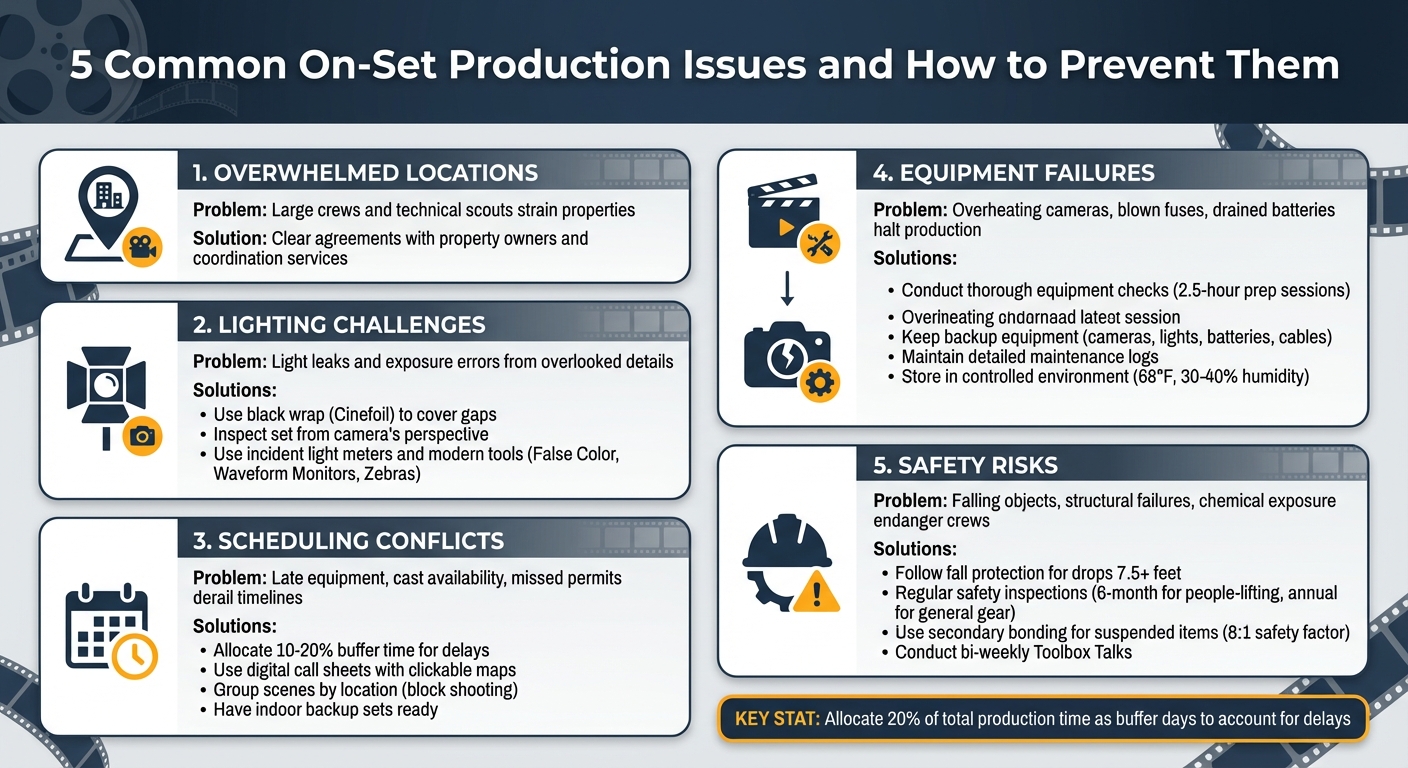
Productions face challenges like delays, equipment failures, and safety risks. These issues can disrupt schedules and increase costs if not managed well. Key problems include:
- Overwhelmed Locations: Large crews and technical scouts can strain properties.
- Lighting Challenges: Light leaks and exposure errors often stem from overlooked details.
- Scheduling Conflicts: Late equipment, cast availability, and missed permits can derail timelines.
- Equipment Failures: Malfunctions like overheating cameras or blown fuses can halt production.
- Safety Risks: Hazards like falling objects, structural failures, and chemical exposure endanger crews and properties.
Solutions:
- Allocate 10–20% buffer time for delays.
- Use tools like digital call sheets for smooth logistics.
- Conduct thorough equipment checks and keep backups.
- Follow strict safety protocols, including regular inspections and proper training.
- Plan proactive schedules, group scenes by location, and have indoor backup sets.
Preparation and clear agreements with property owners help prevent these issues, ensuring smoother operations and cost control.
5 Common On-Set Production Issues and Prevention Strategies
12 Filmmaking Problems And How To Solve Them – Sean Reid
sbb-itb-161ccc1
Lighting Problems on Set
Lighting issues can throw a wrench into even the best-laid plans for a shoot. Problems like uncontrolled light leaks and exposure errors often arise from equipment quirks or overlooked surroundings. Tackling these challenges is crucial to keeping things on schedule and ensuring production quality. Let’s take a closer look at light leaks and how to keep them in check.
Light Leaks: Causes and Prevention
Light leaks happen when stray light from unintended sources makes its way to the camera sensor or film. This can occur due to gaps between lamps and barn doors, especially when wire scrims are in use. For instance, barn door coatings can reflect light, unintentionally brightening parts of the set. Similarly, wire scrims in front of high-intensity lamps, like Source 4 lights, can act as secondary light sources. As Art Adams, Director of Photography, explains:
"The scrim becomes a light source… the scrim glows and becomes a 5″ light source that illuminates anything in front of the lamp."
To combat light leaks, here are some practical fixes:
- Use black wrap (Cinefoil) to cover gaps on lamps where barn doors face the set.
- Adjust the barn door’s angle or use a flag with black duvetine to block unwanted spill.
- For Source 4 lights, replace metal scrims with ND gel or use a dimmer to manage intensity.
Always inspect the set from the camera’s perspective to spot any glowing areas or stray beams before rolling. A quick scan can save hours of frustration later.
Exposure Issues: Underexposure and Overexposure
Achieving proper exposure is more complex than it might seem. While the human eye can detect a dynamic range of about 30 f-stops, camera sensors fall short of that. Accurately measuring light is key, and incident light meters – tools that measure the light falling on a subject – are often more reliable than spot meters, which depend on surface reflectance. In situations with harsh backlighting, you can block direct sunlight from the incident meter’s dome with your hand to focus solely on ambient fill light.
Modern tools like False Color, Waveform Monitors, and Zebras provide real-time feedback, making exposure adjustments more precise. A great example comes from December 2025, when cinematographer Shane Hurlbut, ASC, used Kodak Vision3 50D film with an ND 0.6 filter and circle bounce to create a cinematic T2.5 aperture. By underexposing the subject’s face by 1.5 stops while allowing the backlight to remain 1.5 stops overexposed, Hurlbut preserved highlights and achieved a glowing rim effect.
These techniques highlight the level of precision required to overcome exposure challenges on set. Attention to detail is what separates a good shot from an unforgettable one.
Scheduling and Logistics Problems
On-set delays and logistical hiccups can throw even the best-laid production plans into chaos, making solid scheduling strategies a must. When cast members are juggling multiple projects or equipment arrives late, costs can quickly spiral. Missed location permits or scheduling conflicts can lead to overtime pay and extended rental agreements, which often come at premium rates. For instance, high-end cameras and other specialized gear are typically reserved months in advance, and even a minor schedule change can mean losing access to essential equipment.
To account for these uncertainties, production managers usually allocate about 20% of the total production time as buffer days. Without this safety net, delays in one department – like the art team falling behind on set construction – can grind the entire operation to a halt, affecting lighting and camera crews. Union rules add another layer of complexity. For example, failing to provide the required 12-hour turnaround between shoot days can lead to penalties, and crew members may earn double-time pay if they work beyond 14–16 hours .
Moving between locations, known as company moves, presents its own set of challenges. Striking a set, transporting anywhere from 2,000 to 10,000 pounds of gear, and setting up at a new site takes at least two hours. Underestimating this time can derail even the most carefully crafted schedule. A great example of proactive scheduling is Ridley Scott’s production of Napoleon in 2023, where the team completed principal photography in just 62 days by addressing potential issues like weather delays, equipment failures, and cast availability ahead of time.
These logistical hurdles highlight the importance of forward-thinking scheduling and practical strategies to keep production on track.
Preventing Schedule Conflicts
One effective approach is block shooting – grouping scenes by location and time of day rather than following the script’s chronological order. This reduces the need for company moves and helps cut down on rental costs. Tools like Day Out of Days (DOOD) reports are also invaluable for tracking actor availability, avoiding contract overlaps, and managing payroll efficiently .
Smart scheduling can also make a big difference. Start the day with complex scenes when everyone’s energy is at its peak, and save quicker, simpler shots for later . Always have backup plans, such as cover sets – indoor locations ready to go if weather disrupts outdoor shoots . For productions that demand flexible and well-coordinated locations, services like Essentialyfe can simplify logistics and help avoid common scheduling headaches.
Digital call sheets with clickable map links are another game-changer, ensuring crew members can easily find their way. Real-time confirmation tracking also helps verify who has seen their call times. Finally, budgeting an extra 10–15% of time and adopting a "third day off" rule can provide breathing room for unexpected setbacks .
Equipment Failures and Breakdowns
Once scheduling and logistics are set, managing equipment failures becomes a top priority to keep production on track.
Technical malfunctions can bring production to a standstill. Common problems include overheating cameras, drained batteries, blown fuses, and disconnected cables. Add to that physical mishaps, environmental wear and tear, or small but costly mistakes like missing dovetail plates or mismatched components. Compatibility issues – like attaching the wrong lens mount or using incorrect cables – can eat up precious time as crews scramble for fixes. Even outdated firmware on cameras or recorders can lead to major setbacks, making preemptive checks and quick troubleshooting plans essential. As a camera assistant at DFI Rentals aptly said:
"I don’t want any surprises on set".
The financial implications are no small matter either. Professional gear rentals typically cost 3–5% of the gear’s purchase price per day. A single bulb for an 800-watt HMI light could set you back $500. When equipment fails, the costs pile up – not just for replacements but also for crew downtime and potential overtime penalties. Proactive maintenance is key to keeping production moving and avoiding these costly disruptions.
Regular Maintenance and Backup Plans
The best way to avoid equipment breakdowns is through consistent, proactive maintenance. A prep session at the rental house – usually lasting about 2.5 hours – lets you assemble the camera in its shooting configuration and confirm all accessories are compatible. Test the setup under real-world conditions, using focus and distortion charts to check lens sharpness and sensor performance. Before and after every shoot, conduct thorough visual inspections and functional tests to catch loose connections or worn parts early [33, 36].
Smart rental strategies can also help. Many rental houses offer cost-effective options like weekend or extended rentals. For example, weekly rentals (6–7 days) are often billed as the cost of four shoot days, and monthly rentals (22–31 days) typically count as 12 shoot days. These flexible options give you extra time for prep and create a buffer for unexpected issues.
Redundancy is another must. Keep spare cameras, lights, microphones, batteries, and cables on hand, organized in clearly labeled cases for quick access. Labeling essential items ensures you can find what you need in moments. To protect your equipment, store it in a controlled environment – 68°F or cooler with 30–40% humidity – to prevent damage.
Detailed maintenance logs are invaluable. Track service history, noting dates and tasks performed, to spot potential problems before they escalate. And if you’re renting gear, save broken or blown bulbs to show the rental house as proof, avoiding charges for "missing" items. For shoots that require quick shifts or backup locations, Essentialyfe offers well-coordinated spaces to minimize downtime and keep your production moving smoothly.
Safety Risks on Set
Once equipment is secured, the next priority is safeguarding both the crew and the property from potential on-set hazards.
Set construction and rigging come with risks that can disrupt production or harm team members. One significant concern is structural failure – temporary sets that aren’t properly secured can collapse. Fall risks are also common, whether it’s crew members working on ladders, scaffolds, or studio grids, or objects like props, lights, or cameras falling from above. These incidents often occur when load limits are exceeded or when hardware becomes worn out.
Filming in high-end properties adds another layer of complexity. In these spaces, protecting both the crew and the property is essential. Chemical hazards from paints, adhesives, or other treatments can accumulate in confined areas, while disturbing older materials might release harmful substances like asbestos. Electrical and fire risks also increase on sets constructed with materials like wood and fabric, especially if built-in cables are damaged during transport.
Strict regulations govern safety on set. For example, fall protection systems are mandatory for any hazard involving a drop of 7.5 feet or more. Temporary stages or platforms must support a load strength of at least 5 kN/sq.m. Safety inspections are required for pressure systems exceeding 0.5 bar (around 7 psi). Additionally, materials stored near ceilings must be kept at least 18 inches below sprinkler heads – or 24 inches below the ceiling if sprinklers aren’t installed.
Reducing Risks in Set Design
Addressing safety risks begins with thoughtful planning during pre-production.
A solid safety plan should include detailed entry and exit routes, risk assessments, and clear documentation of methods before filming starts. Regular safety meetings are essential for aligning designers, riggers, and the art department. Producers should hire skilled designers and construction managers who can oversee the set build and communicate risks during both setup and dismantling.
Rigging and equipment protocols are key to maintaining safety. A Rigging Supervisor should be appointed to manage all lifting operations, review rigging plans, calculate load requirements, and inspect equipment. All hardware must be load-rated, and a minimum safety factor of 8:1 should be applied for overhead lifting. Using secondary bonding methods, like safety cables on suspended items, adds an extra layer of protection. The BBC Safety Guidelines emphasize:
"Secondary bonding should be used where risk of collapse presents a significant hazard to those below, with special attention paid to items flown above audiences".
Lifting equipment must follow strict maintenance schedules. Equipment used for lifting people needs inspections every six months, while general lifting gear should be checked annually. Items over 20 kg should be clearly labeled with their weight and center of gravity. Electrically driven chain hoists should feature "dead man’s hand" switches to prevent accidental movement.
Protecting the property is just as important as ensuring crew safety. When filming in luxury locations, use "Permits to Work" for activities like welding or rigging, and ensure that any metal scenery with mains-powered equipment is properly grounded. Lifting points should undergo annual inspections, and there should always be at least 36 inches of clearance around electrical service areas and fire exits.
Thoughtful design choices can prevent hazards before they arise. Use lightweight or modular materials to reduce manual handling risks, and clearly mark all elements with their weight and lifting points. Replacing real glass with safer alternatives like Perspex, toughened or laminated glass, or sugar glass can minimize the danger of splinters. For chemical applications, opt for water-based paints and ensure proper ventilation with fans or air conditioning.
Proper training is non-negotiable for operating heavy machinery. Crew members using equipment like Mobile Elevating Work Platforms or forklifts must hold valid licenses, such as IPAF or IATTF certifications. The Safety on the Set guidelines stress:
"Tell your crew members that they MAY NOT perform any work for which they have not been specifically trained and authorized!".
Additionally, Lockout/Tagout (LOTO) procedures should be enforced to de-energize electrical, hydraulic, or pneumatic systems before maintenance. Operators must have a clear line of sight when moving equipment, with spotters in place when necessary.
For productions in luxury properties, balancing crew safety with asset protection is vital. Companies like Essentialyfe specialize in providing security personnel and property coordination services, ensuring that both safety protocols and property preservation needs are met during filming.
Lastly, don’t rush the "strike" phase. A hurried de-rigging process can lead to accidents or property damage. Use formal handover certificates to establish accountability, and conduct bi-weekly Toolbox Talks to review safety measures and address new concerns.
Conclusion
Careful planning and informed decision-making are crucial for handling on-set challenges effectively. As filmmaker Trent Peek aptly notes:
"Location scouting isn’t just about finding pretty backgrounds. It’s about understanding what a space costs – in time, money, logistics, and sanity".
Adding time buffers is a must. Producers should allocate extra time to address unexpected delays. For outdoor shoots, having an indoor backup location ensures the production doesn’t come to a standstill due to bad weather. These precautions help maintain the flow and reliability of the production.
Selecting the right location can significantly improve efficiency. Professional film locations often provide dependable power sources and backup generators, which help avoid equipment-related disruptions [48, 5]. Additionally, being close to rental houses minimizes delays caused by gear malfunctions, as replacements can be obtained quickly.
Legal preparation is just as important as logistical planning. Quality locations usually come with established permit procedures and clear agreements, which protect productions from unexpected shutdowns by authorities or uneasy property owners [47, 5]. In major filming hubs like Los Angeles, FilmLA typically processes permits within a few days, while areas like Pico Rivera may require a lead time of two weeks or more.
FAQs
How do I estimate the right buffer time for my shoot?
When planning buffer time, think about factors like scene complexity, location logistics, and crew size. For location changes, allocate extra time – about 30 minutes for smaller teams and up to an hour for larger crews. Be prepared for potential setbacks, such as weather conditions, equipment malfunctions, or actor-related delays. A well-detailed schedule with built-in contingency time is key to keeping the production on track and minimizing disruptions.
What’s the fastest way to catch light leaks before rolling?
To check for light leaks in your camera, grab a small, portable light source – something like a keychain flashlight works perfectly. Place the light inside the camera or film compartment, then carefully look for any spots where light might be sneaking through. If you find any leaks, you can patch them up with black electrical tape or use materials like moleskin for a more durable fix. Taking a few minutes for this simple test can protect your film and save you headaches later when you’re ready to shoot.
What backups should you bring to prevent gear downtime?
Bringing at least two hard drives to back up your footage is a must to avoid unnecessary downtime with your gear. This becomes even more critical if you don’t have a dedicated DIT (Digital Imaging Technician) on set. Having multiple backups ensures your footage is securely stored and reduces the chances of losing valuable data.