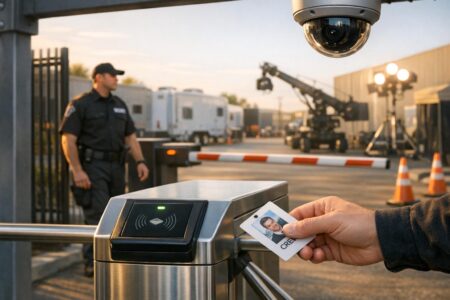
Film sets are high-stakes environments with expensive equipment, sensitive content, and high-profile talent. Security breaches can disrupt production, lead to financial losses, and compromise creative assets. To mitigate risks, here are four key strategies:
- Physical Barriers: Fences and barricades define boundaries and deter intrusions.
- Surveillance Systems: CCTV with night vision and AI analytics monitors activity and detects threats in real-time.
- Credential Systems: RFID badges and wristbands control access and track personnel movements.
- Security Patrols: Trained personnel provide on-the-ground intervention and enforce confidentiality.
Each method has strengths and limitations, but combining them creates a layered security approach that protects assets, ensures safety, and minimizes disruptions. Whether you’re managing a small indie set or a large-scale production, tailoring these strategies to your specific needs is crucial for smooth operations.
1. Physical Barriers (Fencing and Barricades)
Effectiveness in Deterrence
Fencing and barricades act as clear physical boundaries, keeping unauthorized individuals away from the set. They are especially useful for deterring paparazzi, overly enthusiastic fans, and curious onlookers. Beyond just keeping people out, these barriers also help protect equipment storage areas and trailers from opportunistic theft.
To maximize their effectiveness, barriers should be strategically placed to safeguard the set without compromising its visual appearance. Blue Star Security highlights this dual purpose:
Use barricades, fencing, and signage to establish clear boundaries around the set. This not only deters unauthorized individuals but also protects the safety of the crew and public.
That said, barriers should be viewed as one layer in a broader security plan. Relying solely on them is rarely sufficient.
Setup and Maintenance Costs
The cost of physical barriers depends on the size and scope of the production, but they are a crucial investment. Well-placed barriers can help reduce liability and even lower insurance premiums by minimizing risks. As Hub Security and Investigative Group emphasizes:
Professional security isn’t just about protection – it’s about enabling creativity to thrive in a secure, controlled, and efficient space.
This approach allows productions to scale their security measures effectively, whether for a small indie set or a sprawling blockbuster production.
Scalability for Large Sets
Physical barriers can adapt to sets of any size, from a single room to a massive outdoor location. On larger sets, barriers can divide the space into smaller, more manageable zones, making supervision easier. The most effective setups combine perimeter fencing with advanced measures like access-controlled doors and internal monitoring systems. For particularly large perimeters, additional tools like surveillance towers, motion sensors, and radio tags are often used to enhance security.
Response Times to Security Breaches
While barriers are passive by nature, they serve an important role in directing all access through designated, monitored entry points. This controlled flow makes it easier for security teams to identify and handle breaches quickly. Michael Witt, Director of Sales & Marketing at Kontek Industries, explains:
By establishing these physical barriers, a facility ensures that intruders face significant resistance from the very outset, making it more difficult for them to achieve their goals.
sbb-itb-161ccc1
2. Surveillance Systems (CCTV with Night Vision)
Effectiveness in Deterrence
Modern CCTV systems do more than just record – they actively deter and detect incidents. Equipped with 4K resolution and AI-powered analytics, these cameras are designed to prevent theft, vandalism, and unauthorized access, whether from fans or paparazzi. They operate in real time, identifying suspicious behavior and unauthorized movements while instantly alerting security teams. With their ability to monitor perimeters continuously, even in low-light conditions, these systems are a cornerstone of security for major production hubs like Netflix and Amazon Studios, safeguarding both sound stages and outdoor locations.
Setup and Maintenance Costs
CCTV systems are adaptable, making them a viable security solution for productions of all sizes. Smaller, independent productions can implement effective surveillance without the hefty expenses associated with major studios. The cost depends on features like 4K resolution, AI analytics, and remote monitoring capabilities, allowing for tailored investments that align with specific needs. While the upfront expense may vary, it pales in comparison to the potential financial losses from security breaches. As one expert aptly puts it:
There’s no point triple-locking all your doors if you leave the window open.
Considering that the average cost of a data breach for U.S. companies is $9.44 million, investing in robust surveillance systems becomes a practical choice. These scalable solutions not only reduce overhead but also meet the stringent security standards required by studios, making them a cost-effective option for productions of any scale.
Scalability for Large Sets
For expansive sets, Pan-Tilt-Zoom (PTZ) cameras offer a flexible and effective solution. These cameras excel at covering large outdoor areas, backlots, and delivery zones where fixed cameras might not suffice. From small editing rooms to sprawling sound stages that span city blocks, PTZ cameras reduce the need for constant human supervision. Remote access capabilities allow production managers to oversee entire campuses 24/7, whether from centralized control rooms or off-site locations. For maximum security, large-scale setups often combine CCTV with additional measures like motion sensors and badge-controlled entry points, creating layered defenses that protect every corner of the production environment.
Response Times to Security Breaches
Surveillance systems play a critical role in shortening response times to security threats. AI-powered cameras analyze behavior patterns and send instant alerts the moment unauthorized activity is detected, eliminating delays associated with manual monitoring. Rapid response is further enabled by integrating CCTV feeds with security personnel, allowing teams to act immediately based on live footage. Strategically placing cameras near sensitive areas like editing bays and storage facilities helps prevent leaks by identifying unauthorized access before any damage occurs. When paired with other security measures – such as physical barriers and credential systems – these surveillance tools create a robust, multi-layered defense that enhances the overall security of the production set. This seamless integration ensures that breaches are addressed swiftly and effectively.
3. Credential Systems (RFID Badges and Wristbands)
RFID badges and wristbands bring an essential layer of electronic security to film sets, complementing physical barriers and surveillance systems.
Effectiveness in Deterrence
RFID badges go beyond traditional paper credentials by offering automated verification at access points, minimizing human error and creating a digital record of every entry and exit. Unlike visual-only badges that rely on guards to identify fakes, RFID systems make it nearly impossible for unauthorized individuals to slip through unnoticed. The technology acts as a deterrent, as counterfeit credentials are easily detected. Additionally, features like holographic overlays and tamper-evident "VOID" marks add an extra layer of protection against counterfeiting. Security teams can also monitor restricted or high-value areas in real time, further enhancing the system’s effectiveness.
Setup and Maintenance Costs
RFID systems are surprisingly budget-friendly, even for productions with limited resources. A great example is the thriller Geechee, filmed at Pinewood Studios in the Dominican Republic during November 2020. The production used RFID cards for a 500-member crew to manage access control and enforce social distancing, achieving zero reported COVID-19 cases during filming. Jeronimo Bertrán, the COVID-19 supervisor, led the effort and noted:
"The overwhelming feat of adapting and incorporating new technology to face these challenges head-on will be undertaken by filmmakers who are committed to continuing to make movie magic".
While the initial investment might seem high, it quickly pays off by automating check-ins, reducing the need for manual logs and additional staff. This automation makes it easier to trace any security breaches and maintain accountability.
Scalability for Large Sets
RFID technology shines in large-scale productions with multiple zones and high crew turnover. For instance, digital check-in systems can handle hundreds of daily visitors, including cast, crew, vendors, and extras, with instant, automated processing replacing error-prone manual logs. Productions can also issue role-based credentials, restricting access to specific areas based on personnel roles. Beyond managing people, RFID systems can track high-value equipment like cameras and lighting rigs, reducing potential losses. The success of Geechee, which efficiently managed 500 personnel using RFID cards, highlights the technology’s ability to handle complex operations without overwhelming security teams.
Response Times to Security Breaches
RFID systems excel at identifying and responding to unauthorized access. Digital logs provide immediate insights into who was in a specific area at any given time, while attempted breaches trigger instant alerts for security teams. This quick response capability ensures that potential issues are addressed before they escalate, creating clear accountability and minimizing risks.
4. Security Personnel Patrols
Human patrols are the glue that binds a security strategy together, offering real-time intervention and awareness that cameras and fences simply can’t match. A uniformed guard not only discourages potential intruders but also reacts to unexpected situations on the spot. Alongside constant CCTV monitoring, security personnel can detect suspicious activities, enforce confidentiality rules, and respond rapidly to threats. This human element fills in the gaps that technology alone might miss, creating a well-rounded approach to on-set security.
Effectiveness in Deterrence
The presence of visible security is a powerful deterrent against theft, vandalism, and unauthorized access. Security teams routinely patrol storage areas, equipment trucks, and staging zones, especially after hours, to safeguard valuable gear and sensitive materials like scripts [4, 9]. They also enforce "no-phone zones" in restricted areas and stay alert for hidden recording devices, ensuring confidential information stays protected.
Setup and Maintenance Costs
Hiring professional security teams requires an investment that scales with the size of the production. Smaller shoots may rely on in-house teams, while larger or more complex productions often turn to specialized firms experienced in handling medical emergencies, crowd control, and other challenges. Additionally, having documented security plans and incident reports can help lower insurance premiums and reduce liability risks. These measures can be tailored to fit the unique needs of any production.
Scalability for Large Sets
Security personnel can adapt to productions of any size. On larger sets, coverage can be expanded for high-risk scenes, such as those involving stunts or pyrotechnics, ensuring safe distancing and regulatory compliance. In urban environments like Times Square or Central Park, patrols work with local authorities to manage street closures and crowd control. For sprawling sets that span multiple city blocks, GPS-equipped security vehicles enable real-time tracking and quicker responses to breaches. This adaptability strengthens the overall security plan when combined with physical and electronic measures.
Response Times to Security Breaches
When surveillance systems trigger alerts, security personnel step in as first responders, handling everything from medical emergencies to fire hazards and security breaches until emergency services arrive [4, 9]. Equipped with tools like two-way radios and smartphones, they ensure rapid communication and coordination across large sets. Daily briefings covering shoot locations, VIP movements, and potential crowd issues prepare teams to act swiftly and effectively. As Jake Gibbs, Tech Writer at Rev, puts it:
A film set can be a chaotic place… Every member should have clear and specific duties, so that if there’s a breach, you’ll have traceability and accountability.
Strengths and Weaknesses
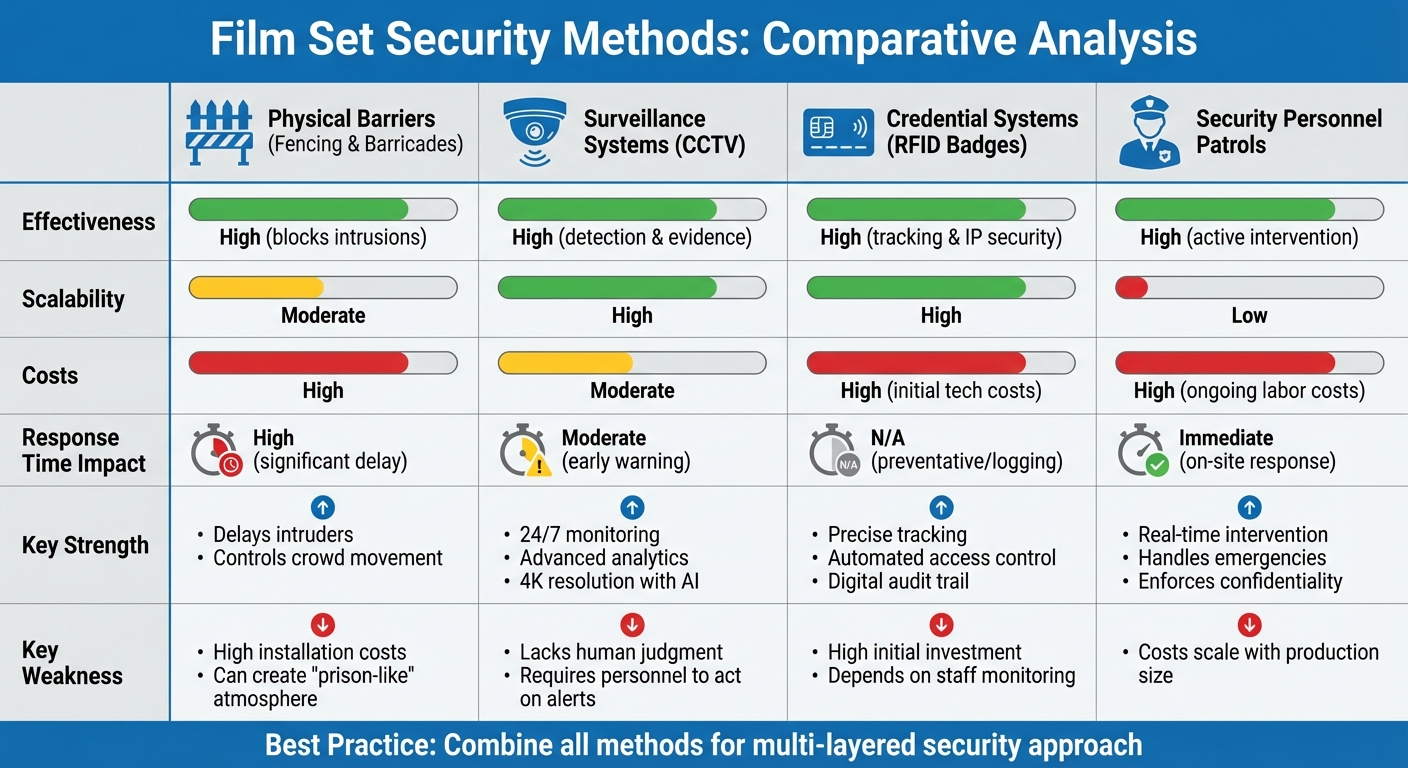
Film Set Security Methods Comparison: Effectiveness, Costs, and Response Times
This section breaks down the strengths and weaknesses of each security method, building on the earlier analysis.
Physical barriers like fences and barricades are effective at delaying intruders and controlling crowd movement. However, they come with high installation costs and can create a "prison-like" atmosphere, which might negatively impact crew morale. Without additional measures like surveillance or patrols, determined intruders may still find ways to bypass these barriers.
Surveillance systems offer round-the-clock monitoring and advanced analytics. While they excel at detection, cameras lack human judgment and the ability to intervene directly in complex situations. This makes them dependent on personnel to act on any alerts generated.
Credential systems, such as RFID badges, provide precise tracking and automated access control, making them especially useful for managing large teams at various film locations and safeguarding sensitive intellectual property. However, these systems require a significant initial investment in technology and still depend on security staff to monitor entry points effectively.
Security personnel patrols are invaluable for handling emergencies, enforcing confidentiality, and managing crowds. Their ability to actively intervene is a major advantage, but the cost of maintaining a security team grows with the size of the production.
Here’s a quick comparison of how these methods perform across key factors:
| Security Method | Effectiveness | Scalability | Costs | Response Time Impact |
|---|---|---|---|---|
| Physical Barriers | High (blocks intrusions) | Moderate | High | High (significant delay) |
| Surveillance (CCTV) | High (detection & evidence) | High | Moderate | Moderate (early warning) |
| Credential Systems | High (tracking & IP security) | High | High (initial tech costs) | N/A (preventative/logging) |
| Security Personnel | High (active intervention) | Low | High (ongoing labor costs) | Immediate (on-site response) |
As outlined earlier, combining these methods – using barriers to delay, surveillance to detect, credentials to control access, and personnel to respond – creates a multi-layered security approach that enhances overall protection.
High-End Security Solutions for Film Productions
When it comes to high-end film productions, standard on-set security measures often need an upgrade. Shooting at luxury estates or remote locations presents unique challenges, requiring tailored solutions that go beyond conventional practices. Essentialyfe steps in with custom security services, offering advanced perimeter protection, cutting-edge access control, and round-the-clock on-site monitoring.
Custom Perimeter Security: For premium locations, security measures must be both effective and discreet. Essentialyfe employs customized barricades, fencing, and signage that blend seamlessly with the property’s aesthetic. A multi-layered approach combines physical barriers, CCTV surveillance, and keycard access, ensuring that even if one layer falters, others maintain the integrity of the system.
RFID Access Control: RFID badges and wristbands enforce strict access zones, restricting entry to sensitive areas. These systems also create a digital audit trail, logging every entry and exit to ensure complete traceability in case of a breach or intellectual property leak. With passive RFID technology, hands-free access is possible from over 20 feet away, reducing delays at checkpoints and keeping production schedules on track.
24/7 On-Site Patrols: High-value equipment like cameras, lighting, and sound systems require constant protection. Essentialyfe provides professional security teams trained specifically for the film industry. These teams handle everything from safeguarding equipment to managing talent movement, enforcing NDAs, and monitoring no-phone zones to prevent unauthorized photos or social media leaks. As Ruben Banuelos, Vice President at ESS, explains:
Our team works quietly behind the scenes so your spotlight can shine safely.
For productions in international or high-risk locations, Essentialyfe offers even more specialized support. Their services include detailed planning and localized risk assessments, often with the help of off-duty law enforcement officers skilled in emergency response and threat management. These teams also oversee crew verification and traffic coordination, ensuring smooth operations while allowing production teams to focus on their creative work. By integrating these advanced measures with standard security protocols, Essentialyfe meets the unique demands of luxury film productions.
Conclusion
Protecting a film set requires a multi-layered security approach that combines physical barriers, surveillance systems, credential management, and on-ground patrols. The right strategy depends on the production’s size, location, and the sensitivity of its content. For smaller, independent projects, internal teams might handle basic access control effectively. On the other hand, large-scale productions often benefit from hiring professional security firms with expertise in crowd management and knowledge of local regulations. Align your security investment with the specific risks your production faces.
Location plays a big role in determining security needs. Urban or public filming areas often require physical barriers and professional crowd managers to handle foot traffic and meet permit requirements. Outdoor sets with expensive equipment may need high-definition surveillance with night-vision capabilities and GPS tracking for assets. Meanwhile, indoor sets should focus on strong digital safeguards, such as encrypted Wi-Fi, secure passwords, and strict check-in protocols. Productions involving high-profile talent or sensitive material might also implement measures like "no-phone zones", RFID-controlled access, and watermarked media to prevent leaks.
Start with a thorough risk assessment to identify potential vulnerabilities and key assets – whether it’s costly equipment, unreleased footage, or A-list talent. As Jake Gibbs from Rev emphasizes:
The comfort that comes with thorough set security is well worth the extra cost and legwork.
Use this assessment as a foundation to layer your security measures. Overlapping protections ensure that if one system fails, others remain intact. Professional security teams can further streamline operations by managing deliveries, verifying crew members, and controlling traffic, which helps minimize downtime and reduce insurance costs.
A well-rounded security plan merges physical measures – like guards and fencing – with digital protections, such as encryption and non-disclosure agreements. It’s equally important to have a clear disaster response plan in place, covering scenarios like footage leaks, unauthorized access, or medical emergencies. Background checks for vendors and maintaining chain-of-custody logs for valuable items add another layer of accountability.
Ultimately, security does more than just safeguard assets – it creates an environment where creativity can flourish. As Hub Security and Investigative Group aptly puts it:
Professional security isn’t just about protection – it’s about enabling creativity to thrive in a secure, controlled, and efficient space.
Prioritizing safety for the cast and crew not only protects the production but also ensures smoother operations and higher-quality results.
FAQs
How do I choose the right security mix for my film set?
To create an effective security plan, begin with a thorough risk assessment. This helps pinpoint potential threats, such as theft, unauthorized entry, or safety risks. A well-rounded approach typically involves a mix of trained security personnel, controlled access systems, and advanced technology.
Key measures include setting up perimeter controls, ensuring secure storage areas, and monitoring access points. Your strategy should be customized to fit factors like the size of your operation, the location, and the presence of high-value assets. This tailored approach helps maintain safety and keeps disruptions to a minimum.
What should a film set risk assessment include?
A film set risk assessment needs to cover security risks like unauthorized access, theft, and potential safety hazards. It should include strategies such as perimeter security, access control measures, and contingency plans to handle unexpected situations. These assessments should always be carried out by qualified security experts to maintain a safe and secure environment during production.
How can I prevent script or footage leaks on set?
To keep leaks at bay, rely on encrypted hard drives and secure online platforms with restricted access. Limit physical storage to reduce vulnerabilities. Strengthen physical security by using access controls, surveillance systems, and safe storage for equipment. Only grant script access to those who absolutely need it, enforce NDAs, and stick to secure communication methods. Some productions take it a step further by restricting the distribution of complete scripts to minimize potential risks.