CPR training can mean the difference between life and death in a hotel, event venue, or private rental. More than 350,000 out-of-hospital cardiac arrests happen in the U.S. each year, and only 46% of victims get CPR from a bystander. When CPR starts right away, survival can double or triple.
If I had to sum up the article in a few points, it would be this:
- Hospitality staff are often the first people on scene
- Brain injury can start in 4 to 6 minutes
- Survival drops by about 10% per minute without CPR or defibrillation
- Large hotels are a common setting for cardiac arrest
- CPR training helps staff respond to cardiac arrest, choking, drowning, overdose, and falls
- Training can also help reduce legal and brand risk
- A solid plan includes staff coverage, AED access, drills, and current records
Here’s the simple takeaway: if you run a hotel, event space, or luxury rental, CPR-certified staff should be part of your safety plan. It’s a low-cost step compared with the cost of a poor response, and it helps make sure someone on every shift can act before EMS arrives.
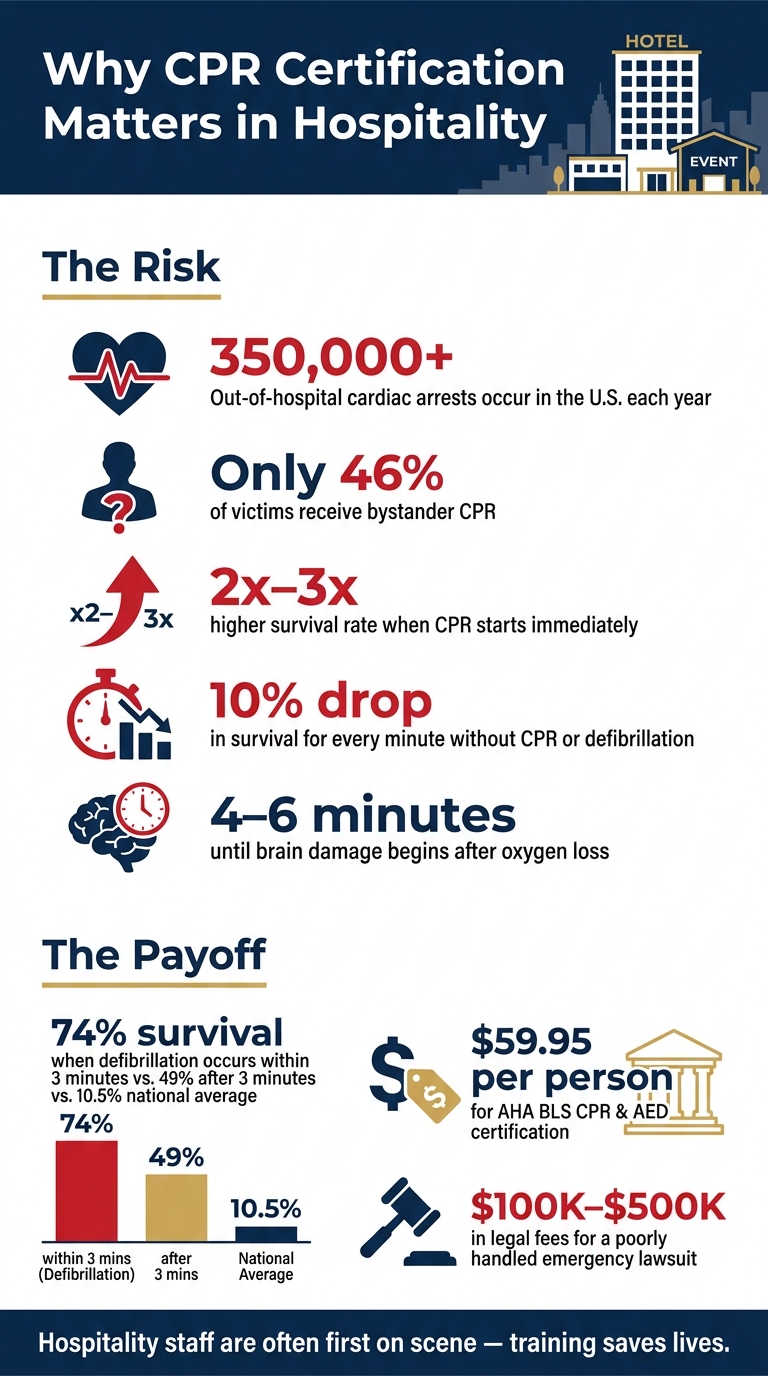
CPR in Hospitality: Key Stats That Make the Case for Certification
The Problem: Medical Emergencies Do Happen in Hospitality Settings
Hospitality properties bring together heavy foot traffic, all kinds of guests, and several high-risk areas where emergencies can unfold fast. Older guests with pre-existing heart conditions, families with young children, and guests recovering from medical procedures all add to the odds that someone may need immediate help. Pools, fitness centers, kitchens and restaurants, stairways, and crowded event spaces can turn a small incident into a serious one in minutes.
The risk gets even higher when guest activity, location, and response times differ across the property. In those moments, the first few minutes often separate a controlled situation from a full-blown crisis.
Some of the hardest risks to manage are the ones staff don’t see right away. Limited housekeeping schedules can mean fewer room checks, so a guest in distress may be found later than anyone would want. Properties that host guests recovering from surgeries or addiction treatment may also deal with more drug-related medical events. That’s why staff need a plan before EMS gets there.
Why the First Few Minutes Matter Before EMS Arrives
Survival chances drop by 10% for every minute that passes without CPR or defibrillation. Brain damage can begin within 4 to 6 minutes of oxygen loss. That’s a brutally short window.
And at some properties, EMS may not reach the scene in time to act within those first minutes. When that happens, the outcome often depends on the people already on-site.
Other Medical Incidents Staff May Face Beyond Cardiac Arrest
Cardiac arrest gets most of the attention, but it isn’t the only emergency hospitality teams may face. Choking is common in dining areas and can turn fatal within minutes without immediate action. Pools bring drowning risk. Fitness centers can see overexertion and heat exhaustion. Stairways and busy common areas are common spots for slips, falls, and trauma injuries.
The table below shows how adult out-of-hospital cardiac arrest (OHCA) cases break down by cause. It gives a clearer view of the kinds of emergencies staff may need to respond to:
| Emergency Type | Share of Adult OHCA Cases |
|---|---|
| Cardiac cause | 84% |
| Respiratory / asphyxia | 9.7% |
| Drug overdose | 4.5% |
| Hemorrhage | 0.8% |
| Drowning / submersion | 0.5% |
That broader risk picture is why CPR certification matters even when the emergency isn’t cardiac arrest. A trained staff member can step in fast, stay calm, and start the right response while every second still counts.
sbb-itb-161ccc1
The Solution: How CPR-Certified Staff Improve Guest Outcomes
When EMS can’t get there in the first few minutes, CPR-certified staff step in. Their training gives them a clear process: spot the emergency, call 911, start chest compressions, and use an AED. That step-by-step flow helps cut hesitation when every second counts. And that brief window is often where trained staff make the biggest difference.
Certified staff also know how to work with dispatchers in real time. That matters during longer CPR events, where keeping compressions steady can make a big difference.
What the Data Shows About Bystander CPR and Survival Rates
Immediate bystander CPR can double or triple a cardiac arrest victim’s chance of survival. In a 32-property casino study, survival was 74% when the first shock came within three minutes of collapse, versus 49% after three minutes. By comparison, the national average for out-of-hospital cardiac arrest survival to hospital discharge is about 10.5%.
| Defibrillation Timing | Survival Rate |
|---|---|
| Within 3 minutes of witnessed collapse | 74% |
| After 3 minutes | 49% |
| National average (general OHCA survival to discharge) | 10.5% |
That’s the point: speed changes outcomes. Training helps staff act fast instead of freezing up.
How Certification Leads to a More Consistent Emergency Response
Formal training gives staff a set response they can fall back on under pressure. When people have practiced assessment, communication, crowd control, and AED use, they’re more likely to respond in a steady way when the moment hits.
At a Hampton Inn in Greenville, North Carolina, a front desk employee called 911 and performed 20 minutes of dispatcher-guided CPR until help arrived.
That kind of readiness can also lower operator risk, which the next section addresses.
Risk, Liability, and Brand Protection for Hospitality Operators
A medical emergency on your property can create legal, financial, and reputational risk. In many cases, liability comes down to a simple question: did the response make the outcome worse?
And the price of getting that wrong can be steep.
Defending a single lawsuit tied to a poorly handled emergency can cost $100,000 to $500,000 in legal fees alone. A wrongful death lawsuit can range from $500,000 to more than $5,000,000. Next to those figures, CPR training is a small line item in a risk plan. Costs start at $59.95 per person for AHA BLS CPR & AED certification or about $79.95 for a CPR + First Aid combined class.
For luxury properties, the risk doesn’t stop in the courtroom. It can hit reviews, referrals, and repeat bookings too. One viral post or news story can do damage that goes far beyond direct legal defense costs. On the other hand, visible safety readiness helps protect trust and peace of mind. That can support guest loyalty and stronger word-of-mouth referrals.
Regulatory Guidance and Due Diligence for Hospitality Operators
This is why training records matter. They’re part of due diligence.
There isn’t a single federal law that says all hospitality staff must hold CPR certification. But OSHA‘s 29 CFR 1910.151(b) does require trained first aid and CPR personnel when a hospital or clinic is not nearby. OSHA can also issue steep penalties. As of 2025, a serious violation can bring a fine of up to $16,550, while willful or repeated violations can reach $165,514.
The issue goes beyond fines. If you don’t have documented emergency protocols, it’s much harder to show that your team took reasonable precautions during litigation. Keeping current certification records on file, including digital eCards, helps build that paper trail.
Benefits and Challenges of Running a CPR Certification Program
The trade-off is pretty direct: training takes time, but it lowers exposure.
Yes, it adds scheduling work. Yes, recertification has to be tracked. But the payoff is clear: faster response, stronger compliance, and better guest trust.
A practical baseline is to keep at least two CPR-certified employees per shift to cover breaks, illness, and vacations. Pair that with written, site-specific emergency protocols, and operators have both a working response plan and a documented record of due diligence.
How to Put CPR Certification Into Practice at Luxury Properties and Events
The next step is simple to say and harder to do: turn training into actual shift coverage, AED access, and a clean EMS handoff. CPR readiness has to become part of day-to-day operations, not something that sits in a training file.
A practical way to do that is to run 3- to 3.5-hour on-site classes by department or shift, then back them up with annual drills.
Which Staff Roles Should Be Certified First
Start with the teams most likely to be first on scene or first to get the call. That includes security, front desk and concierge, housekeeping and facilities, food and beverage and event staff, spa and fitness staff, and managers.
Coverage matters just as much as training. Keep at least two certified responders per shift, with coverage mapped across day, night, overtime, and holidays.
Training also needs to line up with where your equipment lives. AEDs should be within quick reach of lobbies, front desks, dining areas, event spaces, banquet halls, pools, spas, and fitness rooms. At the same time, assign one person to meet EMS at the entrance so responders don’t lose time finding the scene.
How Essentialyfe Can Build Emergency Readiness Across Its Properties

For a distributed portfolio, the plan needs to work one property at a time. For Essentialyfe‘s luxury homes, event venues, and film locations, that means tracking certified staff, expiration dates, and incident logs by property.
Conclusion: CPR Certification Is a Clear Safety Standard for Hospitality
The data point in one direction: CPR certification should be a basic safety standard in hospitality. Medical emergencies don’t wait for the right moment, and in many cases, hospitality staff are the people on the scene before EMS gets there.
Training helps close that gap. It gives staff the speed and confidence to step in right away during those first critical minutes. It also supports duty of care, helps lower liability exposure, and can protect a property’s reputation.
For Essentialyfe‘s properties and events, this standard should cover every property and every shift. At about $59.95 per person, CPR/AED certification is a low-cost step that helps protect guests, staff, and the property. The aim is simple: make sure someone on every shift is ready to act when it matters most.
FAQs
Who should get CPR certified first?
Experts suggest starting with managers and guest-facing teams. Front desk and guest services staff are often the first to get emergency alerts, and they usually help coordinate what happens next.
It also makes sense to focus early on housekeeping, facilities, food, beverage, and event staff. These teams move across the property all day and interact with a large number of guests. A phased rollout by department or shift can help you cover more of the property without trying to do everything at once.
How often should staff renew CPR certification?
Hospitality staff should renew their CPR certification every two years.
It also helps to run refresher courses and drills on a regular basis. That way, employees stay sharp, calm, and ready to act when the pressure is on. For Essentialyfe, up-to-date certifications help support a safe, professional setting for guests.
Where should AEDs be placed on a property?
AEDs should be placed so someone can reach them within a 1.5- to 2.5-minute walk, which allows for a 3- to 5-minute round trip. Just as important, the unit should be easy to spot and simple to access. If people have to hunt for it, that costs time you may not have.
Good spots often include lobbies, fitness centers, pool areas, and conference rooms. It also helps to think through obstacles like furniture, locked doors, or layout features that could slow someone down. And if a unit is in a place exposed to harsh weather or big temperature swings, make sure it’s protected.