When several vendors share one deadline, the guest sees one result, not six separate teams. In practice, that means I need clear role owners, one lead contact, one shared timeline, written change rules, and a fast path for fixing disputes.
Here’s the short version:
- Set roles early. I assign each vendor a clear scope, owner, and handoff point.
- Use one lead coordinator. One person sends directions and controls updates.
- Keep one shared plan. The timeline, run-of-show, files, and change log stay in one place.
- Match channels to urgency. Chat for low-priority notes, phone for urgent issues, email for formal approval.
- Put dependencies in contracts. If one team cannot start until another finishes, I state that in writing.
- Track delay and cost risk early. One study cited in the article found 95% of multi-vendor luxury interior projects finished 4–8 weeks late, and 60% went over budget by 15%–30%.
- Score vendors the same way. I review timing, communication, defect rate, scope control, and closeout speed.
- Use a fixed escalation path. Small issues get handled fast before they hit the client or guest experience.
A few numbers stand out. Structured vendor governance was linked to a 34% higher chance of hitting original scope, schedule, and budget targets. And structured communication was reported to improve event efficiency by 30%+. That tells me the biggest wins often come from control, not from adding more tools.
If I had to sum up the whole article in one line, it would be this: multi-vendor work goes better when every gap has an owner, every change is logged, and every issue has a clear next step.
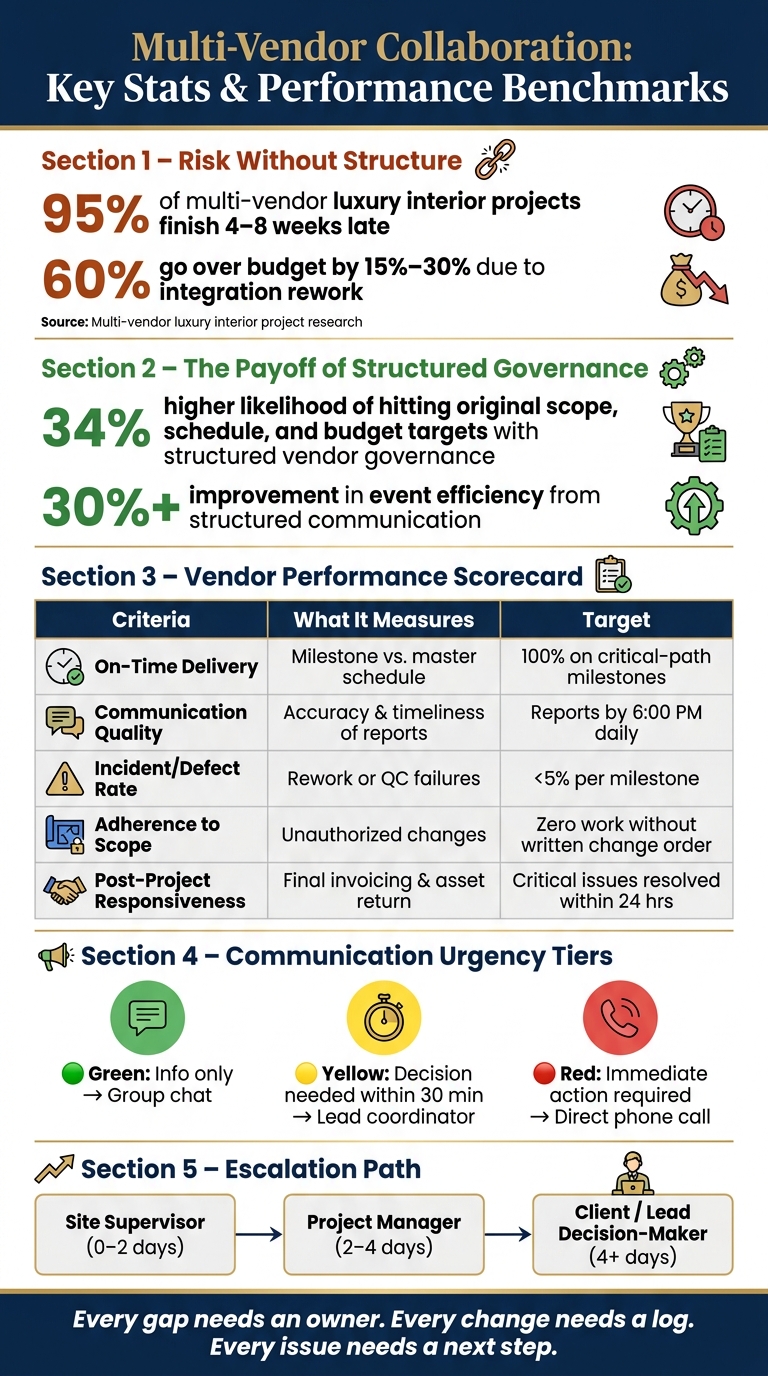
Multi-Vendor Collaboration: Key Stats & Performance Benchmarks
Vendor Roles and the Coordination Model That Keeps Work Aligned
Map Each Vendor Role, Owner, and Handoff Point
Spell out who owns venue access, catering, security, setup, and breakdown. Do it early, and make any dependency gaps easy to spot before execution starts.
A Responsibility Assignment Matrix, or RACI, gives each task a clear home. It shows who does the work, who owns the outcome, who gives input, and who needs updates. Without that clarity, it’s easy for two vendors to assume the other person has a key detail covered – and then nobody handles it.
After roles are set, define every handoff. Put those handoffs on one master timeline. That way, each team knows not just what they own, but when their part starts and ends.
For example, the AV team must finish rigging before decor installation can start. And the tent lead must clear the interior before AV rigging begins. Each transition should have one named owner. That simple step helps protect timing, safety, and service quality.
Assign one Lead Coordinator to send all vendor instructions. This keeps vendors from getting mixed messages and keeps the chain of command clean. But that setup only holds if meetings and approvals happen on a steady rhythm.
Use One Operating Cadence for Meetings, Approvals, and Status Updates
Use one fixed cadence for the whole project: weekly planning calls starting 12 weeks before load-in, a final coordination call 48–72 hours before load-in, and a clear day-of command structure. That same 48- to 72-hour window also works well for a final readiness check-in to confirm logistics, staffing, and equipment readiness.
Be clear about who can approve schedule changes and how those approved changes get to every vendor affected. If that path isn’t clear, updates get missed.
Hold one kickoff meeting with all vendors before work begins. It gives everyone the same view of the project’s goals, key dependencies, and success benchmarks. In plain terms, it cuts down on rework and confusion.
With roles and cadence in place, the next layer is update control – how information moves, where files live, and how status changes reach the full team.
sbb-itb-161ccc1
Ep. #201 – Working with Vendors: What Every Event Planner or Producer Should Know – Better Events
Research Findings on Communication, Workflow, and Shared Planning Tools
Once roles and handoffs are clear, the next job is simple: make sure nothing falls through the cracks.
Good communication speeds things up. But vendor coordination is still one of the hardest parts to get right.
Set Communication Rules by Channel, Urgency, and Audience
A tiered urgency system helps teams send each message through the right channel, so urgent updates don’t get buried under routine chatter.
| Urgency Level | Definition | Channel |
|---|---|---|
| Green | Information only; no response needed | Group chat |
| Yellow | Decision needed within 30 minutes | Lead planner/coordinator |
| Red | Immediate action required | Direct phone call to lead planner |
Use email for formal contracts and confirmations. Use WhatsApp or phone for time-sensitive day-of updates. In loud event settings, two-way radios help teams coordinate in real time.
Formal confirmations should go out 14 days before the event. If no one replies within 24 hours, follow up by phone.
These rules work best when every update also ends up in the same shared file system. Otherwise, people talk in one place and work from another, and that’s where mistakes start.
Keep One Source of Truth for Schedules, Files, and Change Logs
Scattered files lead to setup mistakes when vendors are working from different versions of the timeline or floor plan. A central platform like Monday.com or Asana keeps everyone aligned around the same set of details.
That shared hub should store the master timeline, run-of-show, dependency map, and setup checkpoints. Each vendor should only see the tasks assigned to them. It also helps to add "Setup Complete" checkpoints so one team can confirm its work is done before the next setup window begins.
Example: Coordinating Luxury Property, Event, and Concierge Services
For Essentialyfe projects that combine a luxury property, event venue, and concierge services, it helps to keep the master timeline, run-of-show, dependency map, and setup checkpoints in one shared hub managed by a single coordinator. That setup prevents version drift across all service teams.
The same structure also supports contracts, budgets, and schedule risk.
Contract, Budget, Timeline, and Performance Controls
With roles, communication, and file control set, the next step is to lock down the rules that shape execution: the contract, the budget, the timeline, and how performance will be judged.
Write Contracts Around Deliverables, Dependencies, and Change Control
Each vendor contract should spell out measurable deliverables, SLAs, clear dependencies, and written change-control rules.
"A well-drafted contract serves as the operational playbook for your relationship. It protects your business, ensures service quality, and provides a clear framework for resolving disputes." – Ian Ferrell, Global Property Management
SLAs need hard benchmarks, not vague promises. That could mean a cleaning crew turns over a space in less than four hours, or an emergency maintenance team responds within two hours. If one vendor depends on another, put that in writing too. A florist can’t set tables before the rental company delivers them, and that order of work should be enforceable in the contract.
Change-control rules should require written approval before any scope shift moves ahead. They should also include an impact review for other vendors and clear rules for who decides what happens next. For key vendors, add audit rights, termination terms, notice periods, and return rules for data or physical assets. And every vendor should provide a Certificate of Insurance (COI) that lists the client as an additional insured.
Track Budget and Schedule Risk Before It Affects the Guest Experience
Once the obligations are locked in, track the schedule and cash pressure they create.
Research found that 95% of multi-vendor luxury interior projects ran 4–8 weeks late, and 60% went over budget by 15%–30% because of integration rework. That’s a warning sign. A master Gantt schedule with a marked critical path and 2-week buffers between dependent trades helps spot trouble before it spills into the event or project experience.
On U.S. projects, one late team can trigger expensive overtime for everyone behind them. So overtime risk deserves just as much attention as the calendar. A 5–10% financial contingency gives you room to absorb those costs without scrambling. Milestone payments should only be released after the dependent vendor confirms the work is correct.
Review Vendor Performance With Clear Criteria
Set performance criteria before the project starts, then score every vendor against the same yardstick. That keeps reviews consistent and cuts down on gut-feel decisions. The table below shows the core metrics experienced planners use across engagements:
| Criteria | What It Measures | Target |
|---|---|---|
| On-Time Delivery | Milestone completion vs. master schedule | 100% on-time critical-path milestones |
| Communication Quality | Accuracy and timeliness of status reports | Reports submitted by 6:00 PM daily |
| Incident/Defect Rate | Rework requests or quality control failures | <5% defect rate per milestone |
| Adherence to Scope | Unauthorized changes or verbal work orders | Zero work without a written change order |
| Post-Project Responsiveness | Speed of final invoicing and asset return | Critical issues resolved within 24 hours |
Projects with structured vendor governance frameworks are 34% more likely to meet their original scope, schedule, and budget targets.
Conflict Resolution and Key Takeaways
Resolve Disputes With Predefined Escalation and Decision Rules
Even well-run projects hit friction. That part is normal. What matters is how your team responds when scope, schedule, or budget starts to slip.
A written escalation path helps stop small issues from turning into long delays. It also makes the response faster and more predictable. A simple three-tier path works well: Site Supervisor for issues that need action within 0–2 days, Project Manager for issues that stretch into 2–4 days, and the client or lead decision-maker for anything at 4+ days.
Time-boxed deadlines also keep disputes from drifting. And if a dependency misses a milestone by more than 5 business days, escalate the conflict right away.
The Lead Coordinator should stay neutral, look at the impact, and pick the fastest fix.
After any major conflict, run a post-incident review against the original SLAs and document the fix.
Key Takeaways for Smoother Multi-Vendor Collaboration
Once escalation rules are set, the day-to-day playbook is pretty simple:
- Lock roles and handoffs before launch so every dependency has a clear owner.
- Centralize communication. Use one channel matrix and one source of truth for schedules and change logs. Structured vendor communication has been reported to improve event efficiency by more than 30%.
- Put scope and changes in writing. Use detailed contracts and written approvals so deliverables and responsibility stay clear.
- Track schedule and payment dependencies closely. Tie payments to verified milestones and confirm downstream work is compatible before moving ahead.
- Review performance consistently. Use the same criteria for every vendor, every time, and compare results against the original SLAs.
Strong multi-vendor teams deal with conflict fast and keep the coordination system in place.
FAQs
How do I choose the lead coordinator?
Choose one execution lead to make final calls and serve as the main point of contact. That keeps mixed signals and day-to-day slowdowns from creeping in.
Look for someone who can guide the big picture, turn creative goals into technical requirements, and keep the whole project in view. They should stay calm under pressure, make clear decisions, and keep vendors aligned and accountable.
What should be included in a vendor change log?
A vendor change log should formally track any change to the original scope, deliverables, or timeline. That helps prevent unauthorized scope creep and protects the budget from slipping away bit by bit.
For technical integrations, the log should also record API contract changes, including endpoint updates and schema changes, through a formal request process. Keeping that history alongside vendor contact details and performance notes makes accountability a lot easier and gives your team a clear record to refer back to later.
When should a vendor issue be escalated?
Escalate a vendor issue when the people handling it day to day, or a local supervisor, can’t get it fixed. This usually happens after attempts to resolve delays, quality problems, or conflicts have fallen short, and the issue is at risk of causing more setbacks.
Use a clear escalation path with set timelines. For example, you might allow minor issues up to two days for resolution before bringing in project management or the client.