If you want a luxury activation to feel private, hard to ignore, and worth the spend, a castle can do that faster than a standard venue.
From my read of this piece, the case is simple: castles help with brand story, guest memory, privacy, photo and video output, and tiered VIP flow. But they also come with limits, like lower guest counts, older power setups, tighter load-in paths, and more rules tied to historic sites.
Here’s the article in plain English:
- Castles stand out faster than hotel ballrooms or rooftop venues
- The building helps tell the brand story before the event starts
- Guests tend to remember the setting more, especially when the event uses different rooms and grounds well
- Private estates help with access control, VIP zoning, and press separation
- The space can improve social posts and campaign imagery because the backdrop already looks polished on camera
- The tradeoff is planning pressure: AV, power, weather backup, transport, stairs, and site limits all need early review
- A castle fits best when the venue supports the campaign idea, not when it is used just for show
A lot of luxury events spend $100,000+ and still blur together when the venue feels standard. This article argues that castles help solve that problem by making the setting part of the event itself.
| Area | Castle | Standard luxury venue |
|---|---|---|
| First impression | Strong from arrival | Often polished but familiar |
| Story fit | Built into the property | Usually added through staging |
| Privacy | Often easier to control | More shared space |
| Guest recall | Higher destination feel | More likely to feel routine |
| Production ease | More site limits | Usually simpler |
Bottom line: I’d use a castle when I need the venue to do more than hold guests. It should support the message, shape the guest journey, and justify a premium event budget without relying only on decor.
How castles solve the visibility and memorability problem
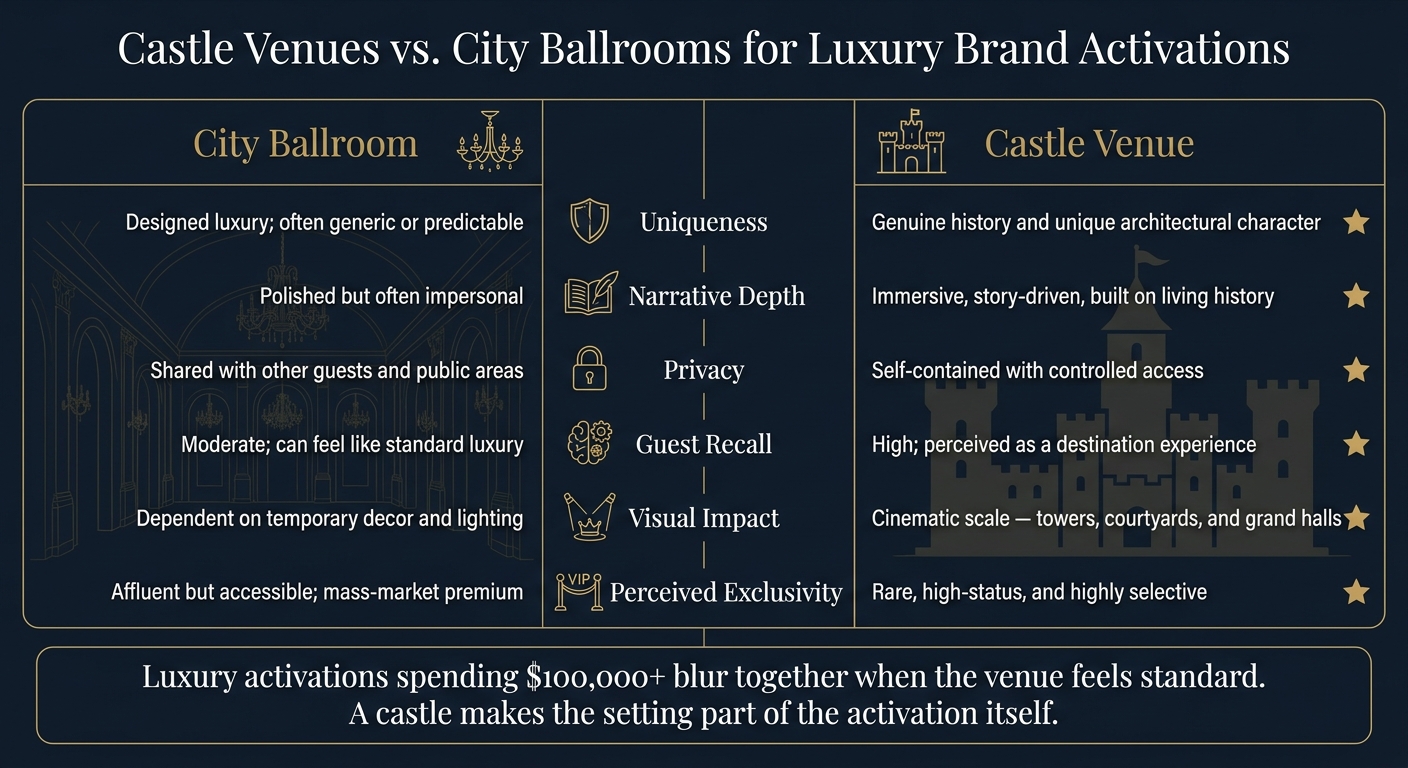
Castle Venues vs. City Ballrooms: Luxury Brand Activation Comparison
A castle doesn’t need much help to make an impression compared to other luxury venues. The building does that work before guests even step inside. Towers, stone facades, grand halls, and enclosed courtyards create an immediate sense of scale that temporary installations usually can’t match. And that scale makes the event feel rare and hard to forget.
For luxury activations, that matters. It can lead to stronger recall before the program even starts.
That immediate impact gives brands a stronger story from the very beginning.
How architecture and history support brand storytelling
Each part of a castle already carries meaning. A keep suggests permanence. A great hall suggests ceremony. A turret suggests rarity.
That gives brands something powerful to work with. Instead of trying to build a narrative from scratch with decor and staging, they can plug into one that’s already there. Castles come with built-in story and history, which helps the brand message feel immediate and credible.
City ballroom vs. castle setting: a side-by-side comparison
The contrast stands out fast when you put the two settings next to each other.
| Feature | City Ballroom | Castle Venue |
|---|---|---|
| Uniqueness | Designed luxury; often generic or predictable | Genuine history and unique architectural character |
| Narrative depth | Polished but often impersonal | Immersive, story-driven, and built on living history |
| Privacy | Shared with other guests and public areas | Often self-contained, with controlled access |
| Guest recall | Moderate; can feel like standard luxury | High; perceived as a destination experience |
| Visual impact | Dependent on temporary decor and lighting | Cinematic scale – towers, courtyards, and grand halls |
| Perceived exclusivity | Affluent but accessible; mass-market premium | Rare, high-status, and highly selective |
A full buyout sends a clear signal: this is private, rare, and tightly controlled. Guests notice that right away. And once they do, the venue stops being just a backdrop and becomes part of the activation itself.
sbb-itb-161ccc1
How castles improve guest engagement and content quality
Getting attention is only the first step. After that, the real question is whether the venue pulls people in and keeps them there.
Affluent guests have been to polished events before. That part doesn’t stick. What stays with them is the rare stuff: a tasting in a turret suite, a reveal inside a keep, a moment that feels like it could only happen there. That’s where castles stand apart.
How private estates support immersive VIP experiences
A castle isn’t just one room. It’s a set of very different spaces, and each one brings its own mood. Private rooms, gardens, towers, and salons give brands room to shape an experience in stages instead of hosting one flat reception.
Guests can move through invitation-only moments that build on each other:
- a small-group performance in a salon
- a product preview in a library
- a late-evening gathering in a turret suite
Each stop feels more exclusive than the last.
That range of spaces also helps brands separate guest tiers in a natural way. The layout does a lot of the work on its own, so guests feel the shift in access without anyone spelling it out.
How cinematic backdrops raise social and campaign content value
The same variety of spaces also changes the kind of content guests create and share. Castle venues produce imagery that standard event photography just can’t match. Spiral staircases, battlements, and great halls give each frame a sense of purpose. The result feels editorial rather than staged.
That matters even more when high-net-worth attendees are posting from the event. A castle setting helps generate editorial-grade imagery that continues to work after the event ends. A centuries-old estate can give that content a longer shelf life. And when a property is both event-ready and filming-ready, brands can capture live activation moments and a branded shoot in the same booking.
Engagement goals matched to castle spaces
The best activations pair each part of the castle with a clear guest goal.
| Engagement Goal | Castle Space | Programming Format |
|---|---|---|
| Product discovery | Great Hall, Library | Product reveals, brand storytelling |
| Private client entertaining | Private Dining Rooms, Salons | Private dining, champagne service |
| Social content creation | Spiral Staircases, Courtyards (Bailey) | Influencer shoots, editorial portraits |
| Exclusivity & bonding | Secret Passageways, Private Gardens | Private previews, intimate performances |
| Media moments | Battlements, Moats, Turrets | Hero shots, aerial filming, sunset capture |
That kind of guest experience depends on tight control over flow, access, and service.
Balancing exclusivity with the operational demands of a castle
Castles make an impression fast. The setting feels private, high-end, and hard to forget. But that upside comes with a tradeoff: they usually need tighter execution than a city ballroom.
In plain terms, castles often demand more hands-on control than standard luxury venues. Historic properties may need outside AV support and added power. Preservation rules can also limit what your team can install. That’s why venue research needs to start early. Narrow entrances, uneven floors, restricted rooms, curfews, and install limits can all affect the plan.
"Venue accessibility, demographic alignment, and infrastructure capabilities that enable the execution of brand activations typically outweigh cost considerations when measuring long-term campaign success." – Activate
How self-contained estates help manage flow, privacy, and zoning
Once the layout is clear, the next focus is movement: who goes where, when, and how. Castle estates are often well suited for this. They make it easier to separate arrivals, product displays, press areas, and VIP spaces without forcing everything into one shared room.
Travel timing matters too. If guests are coming from nearby airports or city centers, plans should factor in parking limits, valet capacity, and the venue’s remote location. Historic interiors may have limited climate control, so comfort can become an issue fast. And if any part of the program happens outdoors, a weather backup should be set early, not at the last minute.
Power and AV also need an early audit. Older venues may require outside generators or added lighting and sound support to meet production needs.
Castle venues: strengths and tradeoffs
| Factor | Strength | Tradeoff |
|---|---|---|
| Exclusivity | Restricted access reinforces brand prestige | Tight guest caps limit reach |
| Capacity flexibility | Multiple rooms and grounds support tiered experiences | Total headcount is often lower than in city venues |
| Technical demands | Dramatic historic backdrops strengthen storytelling | Older power, sound, and AV systems may need external upgrades |
| Guest comfort | Immersive atmosphere | Limited restrooms, no elevators, and uneven surfaces can affect comfort |
| Access & load-in | Private grounds allow controlled entry | Narrow entrances and structural constraints complicate delivery |
| Security | Self-contained areas support more controlled access | Restricted historic areas need specialized monitoring |
How Essentialyfe can reduce execution risk
At this level, small details can shape the whole event. A strong venue helps, but it doesn’t solve execution on its own. The right partner helps bridge that gap.
Essentialyfe can support venue sourcing, event management, security, shuttle service, and concierge support. That kind of help can lower execution risk for castle activations, especially when the venue itself comes with more moving parts.
Conclusion: When a castle is the right venue for a luxury activation
A castle works for a campaign when the setting does more than look good. It should act as a direct extension of what the brand stands for.
That matters because the venue may need to do a lot at once: drive visibility, stick in people’s minds, and keep guest movement smooth. In that kind of setup, a castle can give the brand a level of meaning that a standard venue often can’t.
The best luxury activations are clear, not loud.
So fit matters more than spectacle. A castle should only be part of the plan when its atmosphere directly supports the launch, dinner, or press moment.
Essentialyfe can handle planning, security, shuttle service, and on-site coordination when the property brings the added complexity of a historic site.
Use the checklist below to confirm the property can support both brand impact and execution.
| Criteria | What to Confirm |
|---|---|
| Brand-story fit | History and aesthetic fit |
| Privacy level | Controlled access |
| Content potential | Strong photo/video backdrops |
| Guest capacity | Headcount fit |
| Access | Load-in access |
| Production support | AV/power support |
| Full-service coordination | End-to-end coordination |
If most answers are yes, the castle is the right venue.
FAQs
When is a castle the right fit for a luxury activation?
A castle is the right fit when it helps create an immersive, emotionally clear experience that reflects the brand’s identity.
It tends to work best when the setting lines up with the feeling or idea you want people to walk away with, like craftsmanship, heritage, or intimacy. It also helps when the space gives you room to shape the design in a way that feels intentional, not forced.
What are the biggest logistical risks of using a castle venue?
The biggest logistical risks include:
- Maintenance issues, like leaky roofs and crumbling stonework
- Accessibility challenges due to heritage restrictions
- Slow or unreliable Wi-Fi
- Limited bathroom facilities
- Restrictions on modifications or decorations
These problems can make catering, staffing, and event setup much harder.
How can a castle improve guest experience and brand content?
A castle can make the guest experience feel far more immersive by placing people in a setting that feels rooted in history and culture. That kind of atmosphere helps turn a simple visit into a story people remember. It also adds a sense of exclusivity, which can help a brand stand out in a crowded market.
The architecture and mood of a castle can also give brands a strong setting for photos, video, and other content. Stone walls, grand halls, and historic details create eye-catching backdrops that people are more likely to share on social media, which can lead to more visibility and engagement.