Luxury events demand flawless execution, but when things go wrong, the stakes are high. From security threats to medical emergencies, poor crisis management can damage reputations and disrupt experiences. This guide outlines the key protocols to ensure safety and smooth operations for high-profile events:
- 4 Phases of Crisis Management: Identify risks, prepare targeted drills, respond with clear workflows, and conduct post-event debriefs.
- VIP Safety: Tailored threat assessments, discreet security, and rapid evacuation plans.
- Crowd Control: Tiered credentialing, real-time monitoring, and AI-driven density tracking to prevent bottlenecks.
- Crisis Communication: Unified messaging to avoid confusion, with multi-channel updates for guests and staff.
- Staff Training: Role-specific preparation, scenario-based drills, and vendor alignment under a shared action plan.
Preparation is the key to protecting your guests and your brand. With these protocols, you can manage crises effectively while maintaining the elegance and discretion expected at luxury events.
Crisis Management in the Hospitality Industry: Handling the Unexpected
sbb-itb-161ccc1
Core Principles of Luxury Event Crisis Management
Managing crises for luxury events involves a structured approach that’s both systematic and repeatable. The process hinges on four key phases, assembling a specialized crisis team, and conducting thorough risk assessments well before the event.
The 4 Phases of Crisis Management
Effective crisis management unfolds in four distinct phases: pre-crisis, preparedness, response, and recovery.
- Pre-crisis: This phase focuses on identifying vulnerabilities that are unique to high-end events, such as potential VIP-targeted threats, paparazzi disruptions, or press leaks.
- Preparedness: Teams are formed, roles are clearly assigned, and concise, targeted drills are conducted instead of lengthy training sessions. This ensures everyone knows their responsibilities without unnecessary complexity.
- Response: When a crisis occurs, a clear workflow is followed. This includes assessing the situation from a secure location, escalating issues as needed, activating the crisis team, securing the area, communicating essential updates, and documenting every step of the process.
- Recovery: Within 24 to 72 hours after the event, a post-event debrief is conducted. The goal is to capture lessons learned and update the Emergency Action Plan for future use.
Building a Dedicated Crisis Management Team
A luxury event crisis team needs clearly defined roles, with each member focusing on a specialized area. Here’s what a well-rounded team might look like:
- Incident Commander: The ultimate decision-maker during a crisis.
- Safety Lead: Oversees risk assessments and ensures safety protocols are followed.
- Communications Lead: Manages updates for both attendees and staff.
- Operations Lead: Handles resource allocation during an incident.
- Technical Lead: Focuses on AV, IT, and power requirements.
- Venue Liaison: Serves as the bridge between the team and the venue staff.
For high-end events, additional roles are often necessary. These include Executive Protection (EP) agents for safeguarding high-net-worth individuals and a Law Enforcement/Medical Liaison to coordinate with public services. The goal is to establish a Unified Command, ensuring that every contractor – whether handling production, talent, or security – operates under the same Incident Action Plan before the event begins. As Michael D. Julian, Founder of MPS Security & Protection, puts it:
"The events that go best are the ones where every contractor on site… was working from the same incident action plan before doors opened."
Once the team is in place, the next step is conducting detailed risk assessments.
Risk Assessments and Scenario Planning
Risk planning for luxury events requires more than a standard checklist. It involves evaluating risks across five categories: life safety, weather, infrastructure, security, and operations. Each risk is rated on a 1–5 scale for both its likelihood and impact. These scores are multiplied to determine priority and recorded in a formal risk register.
For high-priority risks, planners should create one-page playbooks. These documents outline:
- The trigger for action
- Immediate response steps
- The responsible team member
- Tools required (e.g., PA systems or SMS platforms)
Walkthroughs of luxury event venues are another essential part of preparation. These help identify secondary exits, AED locations, and potential bottlenecks. Security contractors should be engaged early – 60–90 days ahead for single-night events and at least six months in advance for multi-day gatherings. As noted by Third Excursion Group (TXG):
"Exclusive venues are often less prepared for emergencies than public ones, simply because they assume discretion equals immunity."
This assumption underscores the importance of thorough scenario planning to address potential gaps in preparation.
VIP and High-Profile Guest Safety Protocols
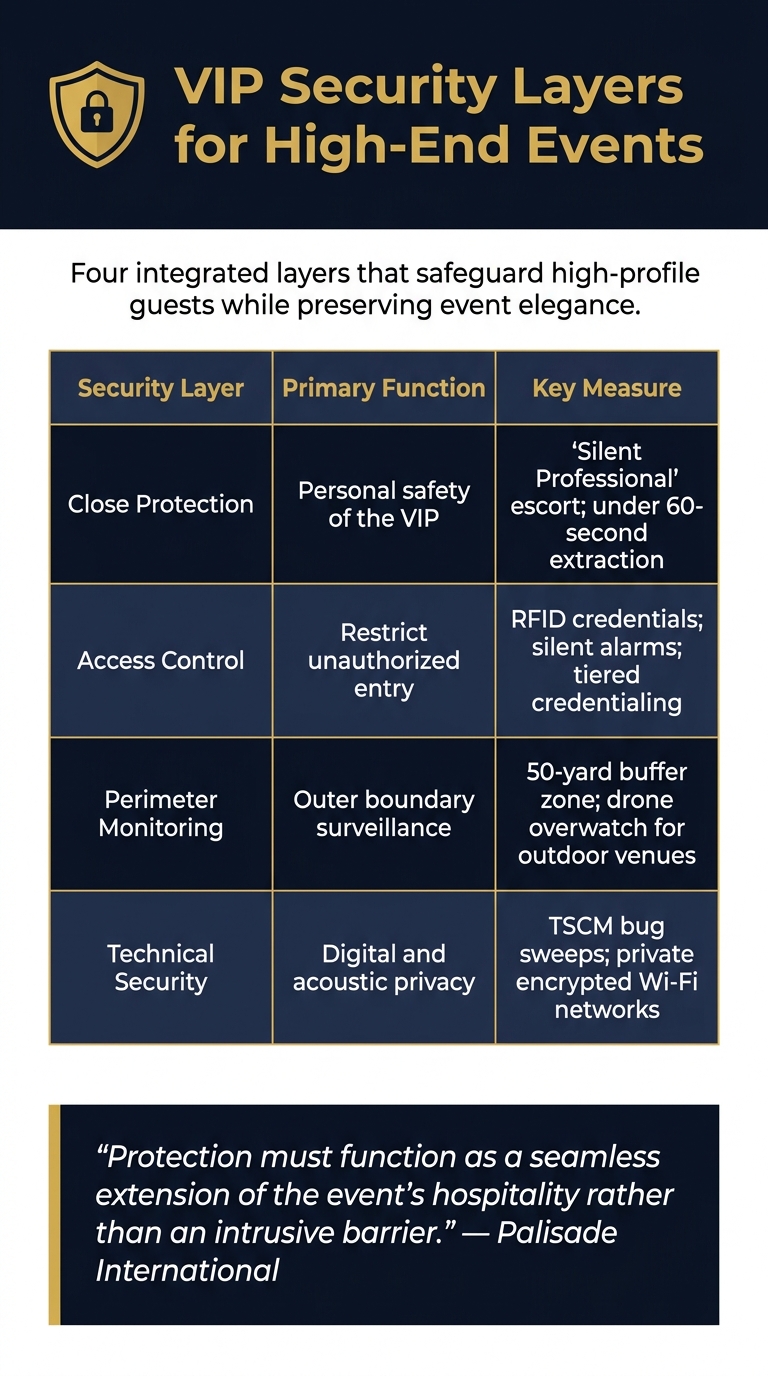
VIP Security Layers for High-End Events: A Complete Breakdown
Ensuring the safety of high-profile guests involves much more than simply stationing guards at the door. It demands a multi-layered approach, combining strategic planning, intelligence gathering, and a discreet execution that maintains the event’s smooth and polished atmosphere.
VIP Risk Assessments and Threat Profiling
Each VIP requires a tailored threat assessment, which includes analyzing their public visibility, media exposure, fan interactions, and any known adversaries. Tools like Open-Source Intelligence (OSINT) are frequently employed to monitor social media for potential threats, such as stalkers or organized groups targeting specific individuals.
A physical site visit should be conducted at least 45 days before the event. This allows security teams to identify potential vulnerabilities, such as blind spots, unsupervised staircases, and elevated areas that might pose risks. These early evaluations lay the groundwork for creating precise arrival and movement strategies.
Arrival, Movement, and Evacuation Planning
Once the VIP threat profile is complete, detailed transit and movement plans become critical for safeguarding guests during their most vulnerable moments.
"The most vulnerable moments at any event are arrivals and departures. Principals are transitioning between the vehicle and the venue, their location is predictable, and crowds tend to cluster near entrances." – Christopher Smith, Founder, Praetorian Executive Protection
To mitigate risks, security teams should clear entry points before the VIP’s vehicle arrives and guide them through private routes. Staggering arrival and departure times is another effective way to reduce crowding and enhance safety.
Unauthorized individuals and media must be kept at least 50 yards away from VIP entrances. For emergencies, an evacuation plan should aim to relocate the VIP to a secure extraction point in under 60 seconds – a standard upheld by elite protection teams.
Discreet Medical and Security Measures
Integrating medical and technical security seamlessly into event operations is essential to ensure guest safety without disrupting the event’s ambiance. According to Palisade International:
"Protection must function as a seamless extension of the event’s hospitality rather than an intrusive barrier."
This philosophy underpins the "Silent Professional" approach, where agents in formal attire use encrypted earpieces and subtle communication methods. Additional precautions include TSCM bug sweeps in VIP areas and securing digital communications with private, encrypted Wi-Fi networks to prevent data breaches.
Advanced Life Support-certified agents should be on-site to provide immediate medical assistance until public emergency services arrive. It’s also crucial to identify the nearest Level 1 trauma center and pre-plan at least two evacuation routes. For private venues, like those offered by Essentialyfe, which include specialized security services, these pre-planned medical logistics are even more critical, as such locations may be farther from public emergency facilities.
The table below outlines the four key layers of security used in high-end VIP protection:
| Security Layer | Primary Function | Key Measure |
|---|---|---|
| Close Protection | Personal safety of the VIP | "Silent Professional" escort; <60-second extraction |
| Access Control | Restrict unauthorized entry | RFID credentials; silent alarms; tiered credentialing |
| Perimeter Monitoring | Outer boundary surveillance | 50-yard buffer; drone overwatch for outdoor venues |
| Technical Security | Digital and acoustic privacy | TSCM bug sweeps; private encrypted Wi-Fi networks |
Crowd Management and Emergency Evacuation Protocols
Building on thorough risk assessments and the work of dedicated crisis teams, these strategies are designed to ensure smooth emergency evacuations.
Access Control and Credential Management
Managing access at a luxury event involves much more than checking names at the door. A tiered credentialing system is essential, with separate, secure identification for groups like talent, production teams, vendors, sponsors, press, VIPs, and general attendees. Every transition between zones should require ID verification, while sensitive areas like backstage must have strict controls, including audited access logs to keep unauthorized individuals out.
Ditch outdated paper "will call" lists. Instead, use digital verification systems in real time, allowing staff to quickly identify discrepancies and manage access points efficiently, even under high-pressure scenarios.
Crowd Monitoring and Capacity Management
Focusing only on capacity isn’t enough – it’s just as important to monitor how people move through the space.
"Most festivals plan capacity (the total number of people the venue holds) but not throughput (how fast they arrive). When 18,000 people arrive in a 30-minute window through three magnetometers, the chokepoint is at the gate, not in the bowl." – Michael D. Julian, Founder and Principal, MPS Security & Protection
The solution? Crowd-flow engineering. This involves using maximum-density modeling to pinpoint bottlenecks at entrances and zone transitions. Adjusting the physical layout can then help redirect movement away from these pressure points. One key metric to monitor is 4–5 people per square meter – once density surpasses this, the risk of crowd crush increases significantly. AI-driven heat-mapping tools can track density in real time, enabling staff to take action before a situation escalates.
Staffing ratios also play a critical role. General security coverage typically ranges from 1 staff member per 75–250 attendees, with higher concentrations needed at gates and stage barriers where crowd density tends to peak.
With proper monitoring, the next step is ensuring a rapid and orderly evacuation plan is ready to go.
Evacuation and Shelter-in-Place Procedures
Effective evacuation planning starts with a hands-on approach. Security teams should physically walk through the luxury venues, rather than relying solely on floor plans, to document every entrance, exit, service corridor, and loading dock. This helps predict how people will move under stress. Each major zone, including VIP areas, should have at least two alternate evacuation routes mapped out.
A Unified Incident Action Plan (IAP) is the backbone of any evacuation strategy. This single, shared document aligns the efforts of venue staff, production teams, local police, and fire/EMS, ensuring that everyone follows pre-determined protocols. This eliminates the need for on-the-spot improvisation during critical moments.
Pre-scripted responses for events like severe weather, lightning, or a sudden medical surge should be practiced in advance. On the day of the event, maintaining detailed logs – covering radio communications, medical incidents, and weather-related decisions – creates a record that can be invaluable if actions are later reviewed or questioned.
Crisis Communication and Information Management
Once evacuation and crowd-flow plans are in place, it’s time to focus on creating clear and effective crisis communication protocols.
Pre-Planned Crisis Communication Frameworks
The cornerstone of any effective crisis communication plan is a single source of truth – a unified narrative that your PR, security, production, and legal teams all adhere to. Without it, mixed messages can spread quickly, and at a luxury event, this kind of confusion can harm your brand’s reputation just as much as the crisis itself.
A strong response plan typically includes three steps: start with an immediate holding statement, follow up with verified details, and finally, provide a thorough briefing for key stakeholders. To ensure your team stays calm under pressure, prepare message templates in advance for common scenarios like severe weather, medical emergencies, or security threats. As Arielle Monroe, Senior Luxury Editorial Strategist, advises:
"The first communication should be accurate enough to reduce harm, not performative enough to satisfy vanity metrics."
It’s also essential to designate specific spokespeople, such as the Event Director or Brand Operations Lead, before the event begins. A predefined escalation matrix can outline when an incident warrants public communication, eliminating any guesswork in the heat of the moment. Events with structured crisis playbooks have reduced average first-response times from 25 minutes to just 8 minutes.
These frameworks work hand-in-hand with on-site communication tools to keep everyone on the same page during a crisis.
On-Site Communication Tools and Systems
Reliable on-site communication tools are key to coordinating responses quickly and effectively. Radios and headsets connect staff and security teams instantly, while event apps can provide real-time updates to both employees and attendees. Digital signage can assist with wayfinding and share status updates across the venue. To prepare for potential network failures, consider using satellite uplinks or mobile hotspots to keep your command center operational.
Discreet communication is also important. Use predefined emergency codes so staff can relay information without alarming attendees. Before the event starts, test all hardware thoroughly. A quick "who owns what" drill during rehearsals can expose issues like dead zones in radio coverage or app glitches – problems you don’t want to encounter during a real crisis.
Redundancy in communication systems can make a huge difference. During event drills, setups with proper backup systems have maintained a 97% uptime rate, ensuring critical channels remain operational.
Communicating with Attendees During a Crisis
When a crisis unfolds, clear communication with attendees is just as important as internal coordination. While speed is critical, accuracy matters even more. Rushing to release a vague or incorrect message can erode trust. Instead, focus on verified updates that explain what happened, what is being done, and when more information will be shared. This transparency builds confidence far better than a polished but evasive statement.
To ensure guests receive the message, use multi-channel delivery methods. SMS alerts, push notifications, PA announcements, and digital signage can work together to reach attendees no matter where they are. Floor marshals can also reinforce key messages in person.
When crafting messages for attendees, use guest-focused language. For example, instead of saying, "security protocols have been activated", frame it as, "we’ve added assistance points throughout the venue for your comfort." This approach keeps guests informed without alarming them and demonstrates the high level of care they expect at luxury events. Events that maintain this type of clear, real-time communication during disruptions have reported a 12% improvement in attendance retention. By staying disciplined and transparent, you not only manage the crisis effectively but also uphold the exceptional service standards that define high-end events.
Staff Training, Drills, and Ongoing Improvement
Building on the earlier discussion of crisis management phases and unified command structures, effective staff training and seamless vendor coordination are key to a well-rounded response strategy. Even the most meticulously crafted crisis plan can fall apart without a team that knows exactly how to act when it matters most. Clear communication tools and evacuation protocols only work if every team member understands their role.
Role-Specific Crisis Training
Training should address the unique risks and responsibilities of each staff group:
- Security personnel need training in medical response, AED operation, weapons authorization, and VIP/talent protection protocols.
- Guest services and check-in staff must be skilled in spotting falsified credentials – whether RFID, biometric, or QR-based – and detecting suspicious behavior before issues escalate.
- General event staff should be equipped with de-escalation techniques to manage confrontations, protests, or unauthorized gatherings calmly.
For high-profile corporate events, additional training is essential to secure encrypted private Wi-Fi networks and combat digital threats like phishing attacks or unauthorized USB drives.
Customizing training to these roles ensures staff are equipped to handle their specific challenges, laying the groundwork for effective drills and post-event evaluations.
Drills and Post-Event Reviews
Scenario-based drills are crucial for preparing teams to respond to medical emergencies, security breaches, or evacuations. These exercises test and reinforce protocols, ensuring staff can execute them confidently during real crises. For example, practicing "dynamic-stop" protocols – used in situations like lightning storms or medical surges in crowds – clarifies who makes decisions and how announcements are handled.
After each event, debriefings provide an opportunity to assess what worked, identify weaknesses, and refine protocols. Real-time logs, such as those tracking radio communications, medical incidents, and weather-related decisions, are invaluable during these reviews. They not only guide improvements but also serve as legal documentation for the venue. Additionally, post-event cybersecurity audits should be standard practice to review digital logs for any attempted breaches.
"You can’t control every variable, but you can control how prepared your team is when something happens." – Princess Castleberry, Global Speaker and Risk-Management Expert
While internal readiness is essential, aligning external vendors and partners is equally critical to ensure a unified response.
Vendor and Partner Alignment
One common pitfall in crisis management is a lack of coordination among vendors, each operating from separate plans. To avoid this, all vendors must work under a shared, signed, and rehearsed Incident Action Plan (IAP). This plan should clearly designate roles, including the unified incident commander, law enforcement liaison, medical liaison, and artist-side contact for each act.
Unlike internal training, vendor alignment focuses on integrating external players – such as production teams, talent managers, local police, and fire/EMS – into a cohesive operational framework. For arena-scale events, security partners should be engaged 60 to 90 days in advance, and for multi-day luxury festivals, at least six months prior. Each vendor should have a designated liaison with defined escalation triggers, ensuring there’s no confusion about who makes decisions and when.
Conclusion: Building a Safer Luxury Event Experience
Key Takeaways from Top Crisis Protocols
At the heart of every effective safety protocol lies one essential truth: preparation is key. From managing crowd flow to maintaining secure access points, each measure contributes to a seamless and safe event. Crowd-flow engineering ensures smooth movement and avoids congestion. Tiered credentialing safeguards access to critical areas, maintaining order across talent, VIPs, press, and vendors. Predefined decision-making authority eliminates delays during emergencies. And a unified Incident Action Plan – signed and rehearsed by all contractors before the event begins – ensures a coordinated response, avoiding the missteps that have led to past tragedies.
Clear and disciplined communication weaves all these elements together. Aligning PR, security, production, and legal teams under a single, consistent message prevents mixed signals. As Arielle Monroe, Senior Luxury Editorial Strategist, aptly states:
"The first communication should be accurate enough to reduce harm, not performative enough to satisfy vanity metrics."
By implementing these protocols, organizers not only ensure safety but also preserve the reputation and values their brand represents – standards that Essentialyfe consistently upholds.
How Crisis Preparedness Protects Reputation and Guest Experience
These strategies go beyond logistics; they define how a brand is perceived. In 2026, safety has become more than an operational concern – it’s a reflection of your brand’s identity. Guests at luxury events notice how disruptions are handled. Features like discreet medical stations, thoughtfully designed wayfinding, and strategically placed crowd marshals don’t detract from the ambiance – they enhance it. Competence in handling unexpected situations becomes part of the premium experience.
Additionally, real-time documentation of key decisions – whether related to communications, medical incidents, or weather challenges – provides organizers with legal and operational protection long after the event concludes. When preparedness is woven into every stage of planning, from vendor meetings to post-event evaluations, it safeguards both the guest experience and the brand’s hard-earned reputation.
"Prestige today means preparedness." – Arielle Monroe, Senior Luxury Editorial Strategist
For those organizing high-end events, Essentialyfe offers a comprehensive suite of services, from event planning to professional security and concierge support. Every detail, including safety, is meticulously managed to meet the expectations of your most discerning guests. Learn more at Essentialyfe.
FAQs
How do I choose which crisis scenarios to plan for first?
To ensure your event runs smoothly and safely, start with a thorough risk assessment. Consider the attendee profile, venue location, and any current threats that could pose challenges. Pay special attention to high-risk moments, such as arrivals and departures, which often require extra precautions.
Focus on scenarios that could have a major impact on safety, security, or your event’s reputation. Some key steps to include in your planning:
- Develop secure staging areas and well-thought-out routes for attendees.
- Account for potential issues like public health concerns or severe weather conditions.
- Work closely with local law enforcement and venue staff to address and reduce critical risks.
By addressing these elements early, you can create a safer and more secure environment for everyone involved.
What’s the minimum crisis team needed for a luxury event?
A well-rounded crisis team for a luxury event should consist of security personnel, medical staff, and communication or press representatives. This combination ensures that safety concerns, medical emergencies, and public messaging are all addressed effectively. Customizing the team based on the unique requirements of the event can improve readiness and the ability to respond efficiently.
How can security stay discreet without reducing safety?
Security can stay behind the scenes while still keeping people safe by using smart, layered strategies. For instance, setting up an outer perimeter for monitoring combined with inner perimeter teams for close protection ensures VIP safety without drawing attention.
Access control can also be handled subtly through methods like digital check-ins with photo verification or tiered credential systems, which manage who gets in without obvious displays of security.
During arrivals and departures – often high-risk moments – pre-staged vehicles and carefully planned routes help reduce visible security activity while keeping everything secure. These measures strike a balance between discretion and protection.