Your cancellation policy directly impacts your rental revenue. Striking the right balance between flexibility and strictness is essential. Here’s why:
- Flexible policies attract more bookings but increase the risk of last-minute cancellations, leaving properties vacant.
- Strict policies protect revenue by reducing cancellations but may deter potential guests who value flexibility.
- Luxury rentals face higher stakes due to larger financial losses from cancellations and operational costs.
Key Takeaways:
- Flexible policies work well in off-seasons or competitive markets but risk higher cancellation rates.
- Strict policies are better for peak seasons, high-end properties, or events but may reduce booking conversions.
- Offering both non-refundable and flexible rates can cater to different traveler preferences.
- Adjust policies based on seasonal demand and rebooking data to optimize revenue.
Tailoring policies to your market, season, and property type ensures you protect your income while meeting guest expectations.
Your Strict Airbnb Cancellation Policy is LOSING You Money (Here’s Proof)
sbb-itb-161ccc1
Revenue Risks of Poor Cancellation Policies
When it comes to cancellation policies, striking the right balance is critical. Both overly lenient and excessively strict policies can create financial headaches, directly affecting your revenue and operational stability.
Problems with Overly Lenient Policies
Allowing guests to cancel with just 24 to 48 hours’ notice can wreak havoc on your booking schedule. For luxury properties, in particular, this is a major issue. High-end homes often require longer planning periods, as guests booking these stays tend to prepare well in advance.
A sudden cancellation at the last minute can leave a luxury property sitting empty, throwing off income projections and disrupting operational plans. While flexible policies might make your property more attractive on booking platforms, they can also undermine your ability to cover significant operating expenses. Interestingly, luxury travelers are typically more accepting of stricter terms, unlike budget travelers who may prioritize flexibility.
But swinging too far in the other direction – with rigid policies – comes with its own set of challenges.
Problems with Overly Restrictive Policies
Excessively strict cancellation policies can scare off potential guests. Revenue management expert Massimiliano Terzulli explains it clearly:
"Whenever you impose a restriction, you reduce your target market".
If your policy is stricter than comparable properties, even a competitive nightly rate might not be enough to win over travelers. Consider this: 39% of U.S. Airbnb cancellations happen within the 7 to 30-day window. A policy that offers no flexibility during this timeframe could alienate travelers who value some level of cancellation freedom. This lack of flexibility can lead to fewer bookings, lower occupancy rates, and ultimately, lost revenue.
Overly harsh policies can also harm your reputation. Guests who feel locked into "unfair" terms are more likely to leave negative reviews or escalate disputes. Recognizing this, platforms like Airbnb now guarantee guests at least a 50% refund for cancellations made 7 to 30 days before arrival, signaling a shift away from rigid policies. Sticking to ultra-strict terms in this environment could leave you at a competitive disadvantage.
The real challenge lies in crafting a cancellation policy that protects your revenue while also keeping guests satisfied.
How Cancellation Policies Affect Revenue
Your cancellation policy has a direct impact on your revenue, shaping who books, when they cancel, and how much income you ultimately retain.
Booking Conversion Rates and Lost Revenue
Your policy’s strictness plays a big role in shaping guest behavior, influencing both booking rates and cancellations. Flexible policies – like allowing cancellations with just 24–48 hours’ notice – make booking less risky for guests, encouraging them to book quickly. However, data from the Berlin rental market reveals that listings with flexible policies also see the highest cancellation rates. On the other hand, properties with stricter policies tend to achieve better occupancy rates, followed by moderate, fixed, and then flexible options.
The type of traveler you attract also depends on your policy. Flexible terms often appeal to guests who are less committed and more likely to cancel if they find a better deal. Stricter policies, however, attract more serious travelers – those less likely to cancel – leading to more predictable revenue. For instance, Airbnb offers a non-refundable rate option where guests receive a 10% discount. This approach guarantees income for hosts while appealing to budget-conscious travelers.
A smart strategy is to offer both discounted non-refundable rates and premium flexible rates. This setup caters to two types of guests: those looking for the best deal and those willing to pay extra for flexibility. Instead of using a one-size-fits-all approach, this dual model allows the market to self-select, balancing revenue security with guest preferences.
But your cancellation policy shouldn’t be static – it should evolve with seasonal demand.
Seasonal Demand and Policy Changes
Using the same cancellation policy year-round could mean missing out on revenue opportunities. High-demand seasons call for stricter policies, while quieter periods benefit from greater flexibility. For example, during peak times – when luxury vacation rentals can achieve net margins as high as 45% – a stricter cancellation window of 14–30 days helps protect against last-minute cancellations and ensures enough time to rebook.
In contrast, during slower months, loosening the policy to allow cancellations 3–5 days – or even 24–48 hours – before check-in can reduce barriers to booking and help fill vacancies in a competitive market. Some hosts even offer free cancellations during extreme weather conditions as a way to maintain goodwill during low-demand periods. To strike the right balance, keep an eye on your average resell lead time. If you can typically rebook a canceled property within five days, you can afford to be more flexible. But if rebooking takes closer to two weeks, stricter policies are the safer bet.
Special events also call for tailored policies. For high-profile occasions like New Year’s Eve or major conferences, consider requiring full pre-payment or a 50% non-refundable deposit to secure your revenue.
Types of Cancellation Policies and Their Tradeoffs
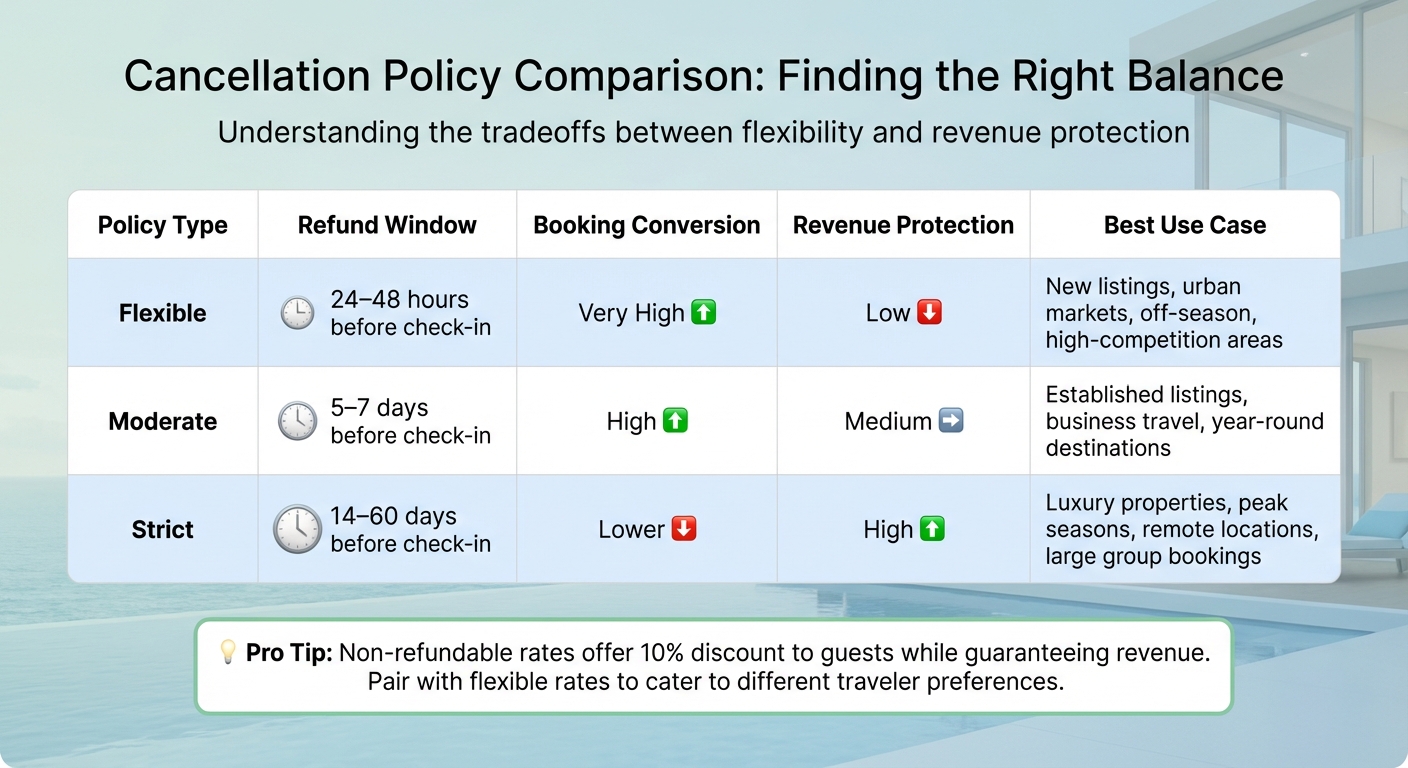
Comparison of Flexible, Moderate, and Strict Cancellation Policies for Rental Properties
Flexible, Moderate, and Strict Policies Compared
When it comes to luxury rentals, choosing the right cancellation policy is a balancing act between attracting bookings and safeguarding revenue. Each policy type comes with its own tradeoffs, and understanding these can help property owners find the sweet spot between flexibility and profitability.
Luxury rental platforms generally offer three cancellation policy options. Flexible policies allow guests to cancel up to 24–48 hours before check-in and still receive a full refund. These policies are attractive to travelers because they reduce the risk of booking, which can lead to a noticeable boost in reservations. However, the downside is an increased risk of cancellations, often resulting in last-minute vacancies.
Tessa Eskin, Product Marketing Content Writer at Guesty, highlights the challenge:
"Finding the right policy means balancing two competing forces: flexible policies attract more bookings but carry higher cancellation risk, while stricter policies protect your revenue but may deter spontaneous travelers."
Moderate policies provide a middle ground. They require guests to cancel at least 5–7 days before check-in to qualify for a refund. This gives property owners more time to rebook canceled stays, offering a reasonable balance between guest appeal and revenue protection. Moderate policies are particularly well-suited for established properties in year-round destinations or those catering to business travelers.
On the other end of the spectrum are strict policies, which require 14–60 days’ notice for any refund. These prioritize revenue stability, making them ideal for high-end properties where last-minute cancellations can lead to significant financial losses. While these terms might deter spontaneous bookings, they align well with the expectations of luxury travelers, who tend to value service quality over flexibility.
Here’s a quick comparison of these policies and their tradeoffs:
| Policy Type | Refund Window | Booking Conversion | Revenue Protection | Best Use Case |
|---|---|---|---|---|
| Flexible | 24–48 hours before check-in | Very High | Low | New listings, urban markets, off-season, high-competition areas |
| Moderate | 5–7 days before check-in | High | Medium | Established listings, business travel, year-round destinations |
| Strict | 14–60 days before check-in | Lower | High | Luxury properties, peak seasons, remote locations, large group bookings |
There’s also a non-refundable rate option, which offers guests a 10% discount in exchange for waiving their right to a refund. This guarantees revenue for the property owner and works particularly well when paired with a flexible rate. By offering both options, property owners can cater to budget-conscious travelers while still appealing to those who prioritize flexibility.
How to Balance Flexibility and Profitability
Use Different Policies by Season
Adjusting cancellation terms based on seasonal demand can help protect your revenue while maintaining flexibility. For peak times – like holidays, major local events, or summer months – stricter policies requiring 14–30 days’ notice for refunds can safeguard income. During slower periods, consider more lenient policies, such as allowing cancellations with 3–5 days’ notice, to attract more bookings. You can also incentivize longer stays during off-peak times by offering flexible terms for guests booking 14 or more nights.
A tiered refund structure is another effective strategy. For instance, you could provide a full refund for cancellations made 60 days in advance, a 50% refund at 30 days, and no refund within 7 days of check-in. For high-demand events, increasing non-refundable deposits to 50% of the booking value can further secure your revenue. Regularly analyze data to refine these seasonal policies and ensure they align with market trends.
Use Data to Improve Policies
Data is a powerful tool for fine-tuning cancellation policies. By tracking patterns, such as when cancellations occur and how quickly you can rebook, you can decide whether stricter terms are necessary. For example, Q4 2024 data revealed that 39% of U.S. Airbnb cancellations happened within the 7–30 day window, with 16% occurring 7–14 days before check-in and 23% happening 14–30 days prior.
Flexible cancellation policies can boost conversion rates significantly – by as much as 35%. To measure the impact on revenue and bookings, conduct 28-day A/B tests comparing flexible and moderate policies. Automated tools can also help by sending reminders about upcoming cancellation deadlines, reducing disputes and increasing the likelihood of rebooking.
Add Value with Concierge Services
Providing premium services can reduce cancellations by making the booking feel more like an experience than just a stay. Services like private chefs, exotic car rentals, or in-home massages – offered through platforms like Essentialyfe – can elevate the guest experience and increase their commitment to the reservation. Guests are less likely to cancel when their stay includes these added perks.
You can also offer two pricing options: a higher-priced flexible rate and a discounted non-refundable rate bundled with concierge services. This approach caters to both cautious travelers and those ready to commit. Highlighting cancellation deadlines and associated fees alongside these premium offerings builds trust and sets clear expectations for guests. By integrating concierge services, you not only enhance guest satisfaction but also protect your revenue.
Conclusion
Creating the right cancellation policy is all about striking a balance – keeping guests happy while protecting your revenue. A flexible yet strategic approach can help you attract bookings while minimizing losses from last-minute cancellations.
Tailor your policies to match seasonal demand. For high-demand times like holidays or big local events, stricter terms requiring 14–30 days’ notice can safeguard your income. During quieter months, a more lenient approach can help you maintain occupancy and keep your calendar filled.
Data should drive your decisions, not guesswork. Track trends like when cancellations occur and how quickly you can rebook those dates. Running 28-day A/B tests, for example, has shown the potential to boost conversion rates by up to 35%. This kind of insight can help you refine your policies to maximize revenue per available room (RevPAR).
You can also reduce cancellations by offering added value. Services like private chefs, exotic car rentals, or in-home massages – such as those available through Essentialyfe – can turn a simple booking into an experience guests won’t want to miss. Combine these perks with clear communication about cancellation deadlines and refund policies to build trust and minimize disputes.
Leading luxury property managers treat cancellation policies as adaptable tools. By aligning them with market trends, guest preferences, and your property’s unique needs, you can protect your bottom line while delivering the kind of guest experience that keeps bookings rolling in.
FAQs
How do I choose the best cancellation policy for my market?
Finding the right cancellation policy is all about balancing guest convenience with protecting your revenue. For example, offering a flexible policy – like allowing cancellations up to 24 hours before check-in – can encourage more bookings. However, it also opens the door to last-minute cancellations, which can leave you scrambling.
On the other hand, stricter policies, such as non-refundable bookings, provide more financial security but might turn away potential guests who value flexibility. To make the best choice, think about factors like the level of demand in your area, seasonal trends, and the typical behavior of your guests. Tailoring your policy to fit your market can help you attract bookings while safeguarding your income.
When should I switch between flexible and strict policies?
Switching between flexible and strict cancellation policies often hinges on factors like market demand, where your property is located, and how much risk you’re comfortable taking. If you’re aiming to attract more guests during busy times or peak seasons, a flexible policy can help fill your calendar. On the other hand, stricter policies are better for reducing the financial impact of last-minute cancellations and ensuring more predictable revenue. Think about your priorities – whether it’s maximizing occupancy or maintaining steady income – and adjust your policy accordingly.
Should I offer both refundable and non-refundable rates?
Offering both refundable and non-refundable rates can strike a balance between flexibility for guests and steady income for property owners. Refundable rates appeal to guests who value the option of canceling within a set window for a full refund, making it easier to secure more bookings. On the other hand, non-refundable rates provide a more reliable revenue stream since they guarantee income regardless of cancellations. This strategy works particularly well in the luxury rental market, where guest preferences and booking habits often vary significantly.