When emergencies happen at luxury venues, event staff and property staff play distinct but equally important roles. Event staff focus on guest safety, managing crowds, and ensuring smooth evacuations. Property staff handle infrastructure protection, risk assessments, and long-term recovery. Both teams must work together to prevent chaos and protect the venue’s reputation.
Key Differences:
- Event Staff: Immediate response, crowd control, guest-focused, trained in FEMA IS-15.b, and manage incidents in real-time.
- Property Staff: Long-term recovery, asset protection, infrastructure-focused, skilled in ASIS CPP, and oversee post-crisis operations.
Quick Comparison:
| Feature | Event Staff | Property Staff |
|---|---|---|
| Primary Goal | Guest safety and movement | Asset protection and recovery |
| Focus | Immediate response and evacuation | Long-term planning and infrastructure |
| Key Skills | Communication, crowd management | Risk assessment, technical expertise |
| Training | FEMA IS-15.b, first aid | ASIS CPP, security protocols |
| Time Horizon | During the event | Pre- and post-event |
Clear role definitions and communication between teams ensure crises are handled effectively, safeguarding both people and property.
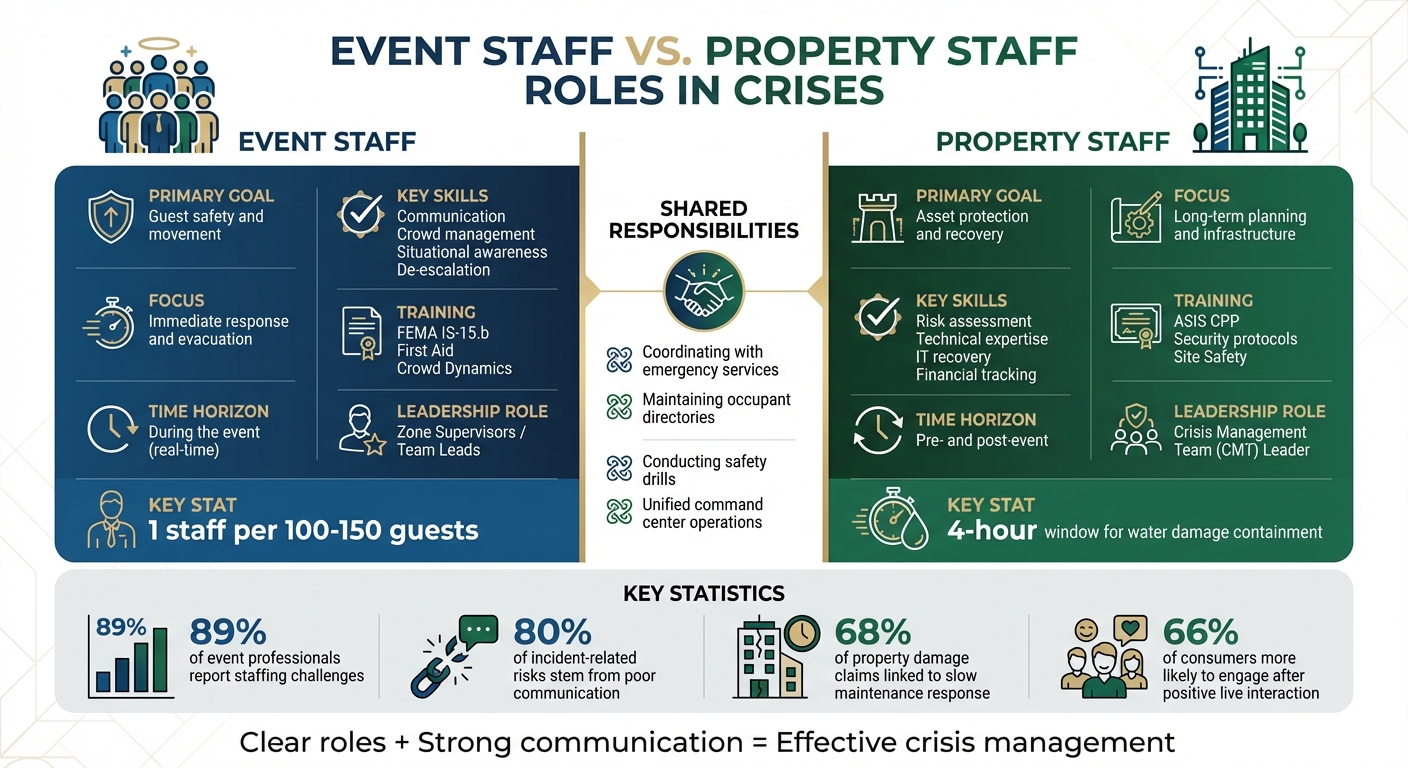
Event Staff vs Property Staff Crisis Roles Comparison
Event Staff Crisis Responsibilities
Event staff are the first line of defense during crises at events. Unlike property management teams, whose focus is on long-term asset protection, event staff must make quick decisions that directly impact guest safety.
Handling On-Site Incidents
When an incident arises – be it a medical emergency, a fire alarm, or a security breach – event staff step in as first responders. Their main goal is to ensure safety by seeking medical help, dialing 911 for severe injuries, and avoiding moving injured individuals unless there’s an immediate threat. The process of documenting the incident begins right away, capturing important details like witness statements, photos of the scene, and environmental conditions.
Incidents are generally classified into three levels of severity:
- Level 1: Minor issues, such as spilled drinks, that staff can handle independently.
- Level 2: Situations like guest complaints or minor injuries that require a supervisor’s involvement.
- Level 3: Serious injuries or security threats that demand immediate management attention and emergency services.
"The measure of any event partner is how they perform in a crisis. A last-minute gap requires calm, precision, and an insured bench."
- Daniel Muersing, Founder, Event Staff
After managing the incident, staff focus on maintaining order through effective crowd control.
Crowd Control and Evacuation Procedures
Managing large crowds during emergencies requires constant vigilance and strategic positioning. Staff are stationed at key areas like escalator landings, restroom corridors, and session entrances to prevent congestion and dangerous crowd compression. A general rule is to have one staff member for every 100–150 guests.
Keeping fire lanes and exit routes clear is crucial, especially during peak capacity. Staff use quick, clear instructions – such as "keep right" or "move forward" – to ensure smooth movement and avoid bottlenecks. Once a venue reaches 90% capacity, active crowd management becomes essential to maintain safety.
"Hallways are the arteries of an event. If they clog, the schedule dies. Floor support involves more than just directing attendees to the restroom; it involves actively managing the crowd’s movement against the venue’s friction."
- Daniel Muersing, CEO, EventStaff
Coordinating with Vendors and Guests
During a crisis, a designated event captain acts as the central point of communication for floor staff, vendors, and production teams, ensuring clear and composed coordination . Event staff must also work with performers, vendors, and key stakeholders to manage activities safely and efficiently.
When speaking with guests after an incident, staff should focus on being helpful without making statements that might imply legal liability. The 15–30–60 Backup Rule is a useful framework: floaters redeploy within 15 minutes, standby staff step in within 30, and full replacements or zone restructuring happens within 60 minutes.
Assigning specific zones to senior staff – such as registration desks, VIP areas, or lounges – helps streamline responses and manage pressure effectively. Similarly, guest services staff stationed at high-traffic areas provide directions and prevent crowds from blocking registration desks or emergency exits.
sbb-itb-161ccc1
Property Staff Crisis Responsibilities
Property staff play a crucial role in maintaining infrastructure and ensuring that operations can quickly return to normal after an emergency. While event staff focus on immediate guest safety, property teams handle the bigger picture – protecting assets, managing recovery efforts, and ensuring the building remains functional long-term. Effective planning is the foundation of their ability to act swiftly and decisively during a crisis.
Emergency Planning and Preparedness
Effective emergency planning revolves around four key elements: identifying critical systems, keeping a detailed occupant directory, cataloging assets, and creating a thorough emergency checklist.
Regularly scheduled drills, conducted quarterly, are essential for testing response times and decision-making under stressful conditions. As IFMA Long Island aptly puts it, "The facility manager truly becomes the building’s guardian". These drills highlight weaknesses in protocols and prepare staff to handle emergencies at any time of day or night. A dedicated command center – equipped with phones, computers, and monitors – acts as the central hub for managing crises.
Another vital preparation step is securing vendor relationships in advance. Having agreements in place with emergency plumbers, HVAC contractors, and restoration specialists ensures help is available when it’s needed most. Sandra Reyes, CPM, Senior Property Manager & Risk Consultant, underscores this point: "Your emergency plan is only as strong as what happens at 2 a.m. on a Sunday".
Protecting Infrastructure and Assets
During emergencies, property staff follow a tiered approach to handle different levels of urgency:
- Tier 1: Life-safety threats like fires or gas leaks.
- Tier 2: Operational failures such as HVAC outages or water damage.
- Tier 3: Non-urgent repairs.
To mitigate damage effectively, staff need a detailed understanding of utility shutoffs. This includes isolating systems like emergency power, communication networks, water lines, HVAC units, and fire protection systems . Delayed responses can be costly – 68% of property damage claims are linked to slow or poorly documented maintenance actions.
Water intrusion, in particular, demands immediate attention. James Kowalski, Facilities Risk Manager, highlights the urgency: "The four-hour window for water damage containment is not a guideline – it is a hard operational threshold". After four hours, costs can triple, and moisture can seep into walls, causing severe structural issues.
Keeping detailed equipment records – covering make, model, service history, and warranties – helps technicians address issues faster by eliminating delays in retrieving critical information. Automated dispatch platforms further streamline responses, reducing technician mobilization times from 20–45 minutes to under 5 minutes. This approach has been shown to resolve 54% of after-hours emergencies more quickly.
Post-Crisis Recovery and Support
Once the immediate crisis is contained, property staff shift focus to assessing damage and coordinating repairs. Their responsibilities include evaluating structural integrity, working with insurance adjusters, and overseeing restoration efforts to bring the facility back to full operation. This long-term recovery role sets property staff apart from event staff, who primarily handle immediate safety concerns.
Accurate and timely documentation is critical during this phase. Photos, timestamps, and moisture readings taken during the response are essential for recovery and insurance claims. Delayed or incomplete documentation is a factor in 91% of insurance disputes. David Mercer, Director of Facilities Operations, highlights the importance of integrating documentation into the response itself: "The single biggest shift in our emergency performance came when we stopped treating documentation as a post-response task and embedded it into the response itself". Mobile-first workflows allow technicians to create a real-time incident record, reducing reliance on memory.
Within 48 hours, property teams review the root causes of the incident and implement preventive measures. This process often involves updating maintenance schedules to avoid similar issues in the future. For residential properties, the stakes are even higher – HVAC failures during extreme weather can lead to habitability violations within 24 to 72 hours. Quick repairs and thorough system knowledge are not just practical but legally required.
Event Staff vs. Property Staff: Key Differences
Immediate Response vs. Long-Term Recovery
When a crisis hits, the roles of event staff and property staff diverge significantly. Event staff are all about handling the here and now. Their job revolves around immediate incident management – guiding guests to safety, avoiding bottlenecks, and ensuring calm during evacuations. Their ultimate goal? A smooth and injury-free evacuation process.
Property staff, on the other hand, take on the long game. They implement detailed Crisis Management Plans (CMPs), coordinate with law enforcement, and work to keep critical systems like power, water, and HVAC running. Their focus lies in securing the property and maintaining business operations well after the initial emergency. As IFMA-LI aptly states, "In a crisis, the facility manager truly becomes the building’s guardian." These clearly defined roles are essential for managing crises effectively, especially in luxury villas and event venues.
Because of these distinct timelines, the training and skills required for each role are equally specialized.
Required Skills and Training
The nature of their responsibilities shapes the skillsets of event staff and property staff. Event staff rely heavily on soft skills. They need sharp situational awareness, the ability to de-escalate tense situations, and clear communication – especially in chaotic environments. Their training focuses on crowd dynamics, guest flow management, and conflict prevention. Many event staff pursue FEMA IS-15.b certification, which specializes in crowd management.
In contrast, property staff need a deep understanding of technical systems and regulations. They’re responsible for knowing venue capacity limits, performing risk assessments, and collaborating with local authorities. Senior property staff often hold ASIS Certified Protection Professional (CPP) certification, and in many states, a Security Guard License is required for roles involving enforcement.
"Crowd management is no longer a staffing afterthought; it is one of the most operationally critical functions in any large-scale event. The professionals in these roles make the difference between a venue that feels controlled and one that feels reactive."
Meanwhile, property staff are tasked with making tough, high-stakes decisions – like closing off access points or reallocating personnel – while ensuring compliance with legal and operational standards. Their training prepares them for these high-pressure scenarios.
Comparison Table: Crisis Duties by Staff Type
Here’s a side-by-side look at the roles of event staff and property staff during a crisis:
| Feature | Event Staff | Property Staff |
|---|---|---|
| Primary Goal | Immediate attendee safety and efficient flow control | Asset protection and business continuity |
| Key Responsibility | Directing guests, managing surges, and de-escalation | Activating CMPs, ensuring legal compliance, and handling media relations |
| Time Horizon | Real-time response during the event | Pre-event planning and post-event recovery |
| Required Skills | Situational awareness, effective communication, and stamina | Risk assessment, IT recovery, and financial tracking |
| Core Training | Crowd Management (FEMA IS-15.b), First Aid, Crowd Dynamics | ASIS CPP, Security Guard Licensing, and Site Safety |
| Leadership Role | Zone Supervisors / Team Leads | Crisis Management Team (CMT) Leader |
Research shows that about 80% of incident-related risks at events stem from poor communication and a lack of environmental awareness. These are areas where event staff’s proactive crowd management skills can make a huge difference. On the other hand, property staff focus on keeping the facility operational and secure long after the immediate threat has passed.
How Event Staff and Property Staff Work Together
Shared Duties and Communication
When emergencies arise, event and property staff must work as a cohesive unit despite their distinct responsibilities. Both teams share critical tasks, such as coordinating with emergency services, maintaining accurate directories of on-site occupants, and conducting safety drills to test their readiness. This collaboration ensures that property owners and event managers align their priorities to maintain both safety and service quality.
The secret to this partnership lies in clear role definitions, not just the number of personnel. For instance, crowd management staff focus on guiding guest flow and wayfinding, while security personnel handle access control and emergency responses. By clearly delineating these roles, teams can avoid confusion and reduce operational missteps.
At high-end venues, like those operated by Essentialyfe, even minor disruptions can tarnish reputation and erode client trust. A unified command center equipped with phones, computers, and communication tools ensures both teams can share real-time updates and devise coordinated strategies during crises. Regular joint risk assessments also help identify potential vulnerabilities, keeping response plans aligned with the latest property conditions and regulatory requirements.
Effective Handoff Strategies
Once shared responsibilities are established, smooth handoff protocols between event and property staff are essential for effective crisis management. These handoffs bridge the gap between immediate response efforts and the long-term restoration of the property.
Structured protocols and strong communication channels are key to seamless transitions. Tools like the "Run of Show" – a detailed event timeline – allow property staff to anticipate high-traffic periods and potential bottlenecks, enabling proactive planning instead of last-minute scrambling.
An onsite Event Captain should act as the central point of contact, ensuring real-time problem-solving and coordination between the two teams. For urgent issues, such as structural damage or biohazards, property staff should maintain a list of specialized professionals (e.g., structural engineers or cleanup services) who can be activated immediately. In the luxury real estate world, having these experts ready to respond ensures swift action when time is critical.
In times of crisis, effective communication becomes your greatest asset.
To support this, use multiple channels – email, phone, and in-person meetings – for timely and accurate updates. Pre-event briefings that outline roles, schedules, and logistics also help event staff integrate seamlessly with the property’s established protocols.
Conclusion
In luxury properties, having well-defined roles is key to handling crises efficiently. Event staff focus on the immediate needs – managing crowds, directing evacuations, and ensuring guest safety – while property staff tackle infrastructure protection, work with specialized contractors, and oversee long-term recovery efforts. This clear division of responsibilities helps prevent small issues from spiraling into major problems.
The challenges of crisis management are evident in the numbers: 89% of event professionals report staffing challenges during live events, while 14% of property management professionals cite similar issues. At high-end venues, such as those managed by Essentialyfe, even minor delays can harm reputations and weaken the trust that luxury clients demand. This highlights the importance of thorough and strategic preparation.
Collaboration is another critical component. Unified command centers and structured handoff protocols allow teams to combine their strengths, creating a robust safety net. An onsite Event Captain, as detailed in the event staff section, can bridge tactical gaps, while property managers maintain relationships with experts ready to restore the venue to peak condition. This cohesive approach ties together immediate responses and long-term recovery, forming a solid crisis management framework.
Success in crisis response depends on clear roles, cross-training, and proactive planning. Whether it’s using the 15–30–60 method to quickly reassign staff during emergencies or keeping updated contact information for structural engineers and cleanup services, careful preparation safeguards people and property. In luxury hospitality, where 66% of consumers are more likely to engage after a positive live interaction, every crisis offers a chance to showcase professionalism and resilience.
For venues hosting events or managing premium properties, the takeaway is simple: invest in your teams, define roles clearly, and ensure smooth coordination to handle crises with confidence.
FAQs
Who leads during a crisis: event staff or property staff?
In times of crisis, property staff are generally the ones stepping up to take charge. Their training specifically prepares them to handle emergencies related to safety, security, and the venue’s operations. While event staff contribute by focusing on the guest experience and offering assistance during such situations, the responsibility for making critical decisions and leading the response typically falls to the property team. They have both the training and the authority needed to manage these situations efficiently.
What information should be documented during an incident?
During an incident, it’s crucial to document key details to ensure accurate reporting and an effective response. Make sure to note the date and time, location, a clear description of what occurred, and the individuals involved or affected. Also, include any actions taken, witness statements, and observations of injuries or damages. Thorough documentation not only helps manage the situation but also serves as an important record for legal or insurance purposes.
How do teams coordinate a handoff from evacuation to recovery?
Teams make sure the transition from evacuation to recovery goes smoothly by sticking to clear procedures and communication protocols. This process includes assigning specific roles – like team leaders – to manage the handoff effectively and using dependable communication tools to keep everyone updated. When a crisis management team is well-organized, they can bridge evacuation and recovery efforts seamlessly, reducing confusion and prioritizing safety during critical situations.