Luxury travel is shifting focus from extravagance to meaningful experiences. Travelers now prioritize connections with history, local traditions, and unique craftsmanship. This change is driving economic benefits for communities while redefining how luxury properties operate. Key trends include:
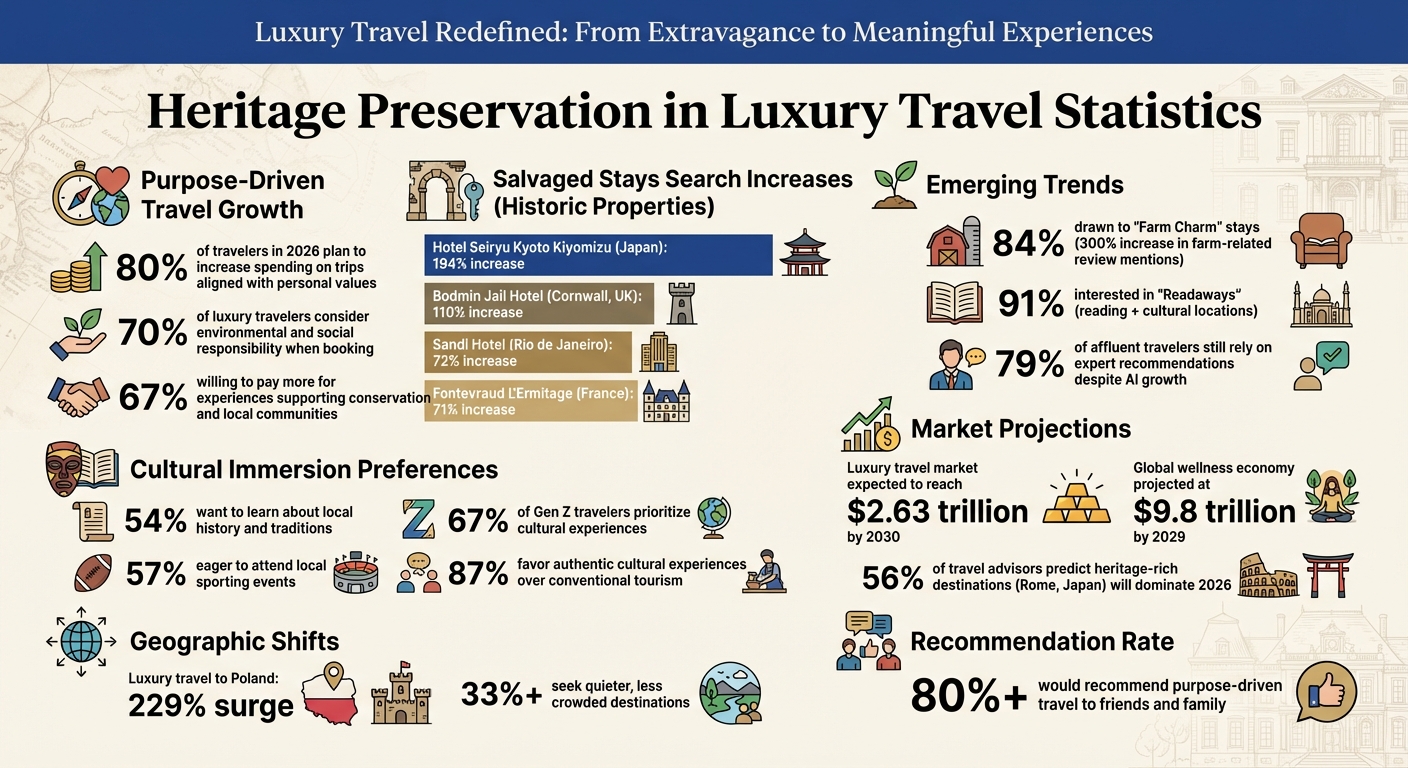
- Purpose-Driven Travel: 80% of travelers in 2026 plan to increase spending on trips that align with personal values and support local communities.
- Salvaged Stays: Historic properties, like former prisons or schools, are being transformed into sought-after vacation rentals, with some seeing search increases of over 100%.
- Heritage-Led Tourism: Programs like exclusive museum tours and traditional craft workshops are becoming central to luxury travel experiences.
- Sustainability Meets Preservation: Hotels are restoring historic buildings, reducing carbon footprints, and supporting artisans to keep local skills alive.
Luxury travelers increasingly seek emotional connections and purpose in their journeys. For providers, blending heritage preservation with guest experiences is now a crucial part of meeting these expectations.
Heritage Preservation in Luxury Travel: Key Statistics and Trends 2026
Cultural Immersion and Heritage Preservation Trends
The Growth of Purpose-Driven Travel
Luxury travel is evolving, with travelers prioritizing meaningful experiences over traditional symbols of status. By 2026, 80% of travelers plan to increase their travel spending, but their focus has shifted. Instead of chasing glamorous resorts, they’re seeking experiences that align with their personal values and leave a positive mark on local communities.
This trend is backed by hard data. In October 2025, Expedia Group’s "Unpack ’26" report highlighted a surge in interest for historic properties. For example, the Hotel Seiryu Kyoto Kiyomizu in Japan, a former schoolhouse turned luxury hotel, saw a staggering 194% increase in global searches. Similarly, the Bodmin Jail Hotel in Cornwall, U.K., a repurposed prison, experienced a 110% rise in searches. Other places like the Sandi Hotel in Rio de Janeiro (once a mint and school) and Fontevraud L’Ermitage in France (a former abbey) also saw search increases of 72% and 71%, respectively. This movement, dubbed the "Salvaged Stays" trend, underscores a growing preference for accommodations steeped in history and authentic narratives over newly built resorts.
Robin Lawther, VP of Expedia TAAP, sums up this transformation perfectly:
"In 2026, luxury is no longer defined by the most glamorous destinations and opulent hotels, but rather by meaningful, mindful, and culturally rich experiences".
The luxury travel market is expected to hit $2.63 trillion by 2030, driven by this rising demand for purpose-driven travel. Naturally, this focus on authenticity and history has paved the way for immersive, heritage-based programs.
Heritage-Led Tourism Programs
As travelers lean into purpose-driven experiences, they’re actively participating in the preservation of local heritage. Research shows that 54% of travelers want to learn about local history and traditions during their trips, and 57% are eager to attend local sporting events to connect with community rituals and stories. For Gen Z travelers, this figure jumps to 67%.
The "Fan Voyage" trend embodies this shift perfectly. Instead of passively watching sports, luxury travelers are immersing themselves in cultural traditions through events like Sumo wrestling in Japan or Muay Thai in Thailand. As Expedia Group explains:
"Explorers seek stories, rituals, and realness… prioritizing cultural experiences that offer a front-row seat to the heart of a community".
To meet this demand, Expedia has teamed up with the World Travel & Tourism Council (WTTC) to create the "Smart Travel Health Check" framework. This tool helps identify destinations that balance sustainable tourism with the protection of cultural and natural heritage. Christopher Imbsen, Vice President Policy at WTTC, explains:
"This innovative initiative reflects the urgent need to embrace responsible growth models that safeguard communities, protect cultural and natural heritage, and ensure the long-term resilience of destinations".
Other data further illustrates this trend. A remarkable 84% of travelers are drawn to "Farm Charm" stays, with mentions of farm-related experiences in guest reviews surging 300% year-over-year on luxury vacation rentals platforms. Additionally, 91% of travelers are showing interest in "Readaways" – trips that combine reading and relaxation in historically or culturally significant locations. These shifts show how heritage preservation in luxury travel now extends beyond traditional attractions, encompassing agricultural practices, literary traditions, and the charm of rural cultural landscapes.
sbb-itb-161ccc1
Case Studies of Luxury Properties Supporting Heritage Preservation
Conservation-Focused Design
Luxury properties are increasingly embracing designs that celebrate and protect local heritage. Take Kisawa Sanctuary in Mozambique, for example. This stunning retreat spans 300 hectares on Benguerra Island and was built using methods that minimized environmental disruption while honoring the region’s heritage. The construction process itself became an act of preservation: 80% of the workforce was hired locally, with women making up half of that group. Traditional skills played a central role, as local weavers, thatchers, and carpenters brought their craftsmanship to life. To further root the sanctuary in its cultural context, African antiques were sourced, and regional artists were commissioned to contribute their work.
Cheval Blanc Seychelles on Mahé Island offers another example of this thoughtful approach. Home to 52 villas, the property blends contemporary luxury with Creole traditions. The design features site-specific art, such as a glazed ceramic fresco by Maximilien Pellet and pieces by Madagascan artist Joël Andrianomearisoa, creating a seamless connection between modern aesthetics and tropical heritage. This artistic integration not only enhances the guest experience but also keeps local traditions alive.
Local Culture Programming for Guests
Preserving heritage goes beyond architecture – it’s also about creating meaningful cultural experiences for guests. Kisawa Sanctuary excels in this area by employing a team that is 90% local African talent. One standout is in-house artist Floyd Jorge, who leads programs for children, including art lessons and traditional island songs. The sanctuary also operates a "resort to research" model, where profits support Africa’s first permanent ocean observatory. Guests can even join conservation efforts, such as shark tagging alongside scientists.
The dining experience at Kisawa is another nod to sustainability and local traditions. With a zero-waste approach, the chefs source ingredients from local farmers and fishermen, engaging with them daily to create fresh, seasonal menus. As the property eloquently puts it:
"Kisawa means unbreakable, and this defines our commitment: to build a bond between people and place, life and land".
Cheval Blanc Seychelles also offers personalized cultural experiences, with its staff curating daily activities to immerse guests in Seychellois traditions.
These examples highlight how luxury travel is evolving to include heritage preservation at its core. For those seeking culturally rich and carefully curated stays, Essentialyfe provides a collection of luxury properties that honor local traditions while offering modern comforts.
Orient Express: Heritage, Innovation & the Future of Luxury Travel | By CEO Gilda Pérez Alvarado
Sustainability in Heritage Preservation
Preserving historic properties has taken on a new dimension as sustainability becomes a core aspect of heritage-led cultural programming.
Eco-Certifications and Standards
Luxury properties are proving that environmental responsibility can go hand-in-hand with the preservation of cultural and architectural heritage. The Green Globe Gold certification, for instance, has become a trusted standard for historic hotels looking to validate their sustainability efforts while maintaining their architectural essence. A great example is The Dylan Amsterdam, a boutique hotel with 41 rooms housed in a 1638 stone theater. In October 2025, during Amsterdam’s 750th anniversary celebrations, the hotel reaffirmed its Green Globe Gold certification. This property also preserves an 18th-century bakery, now home to the two-Michelin-starred Restaurant Vinkeles, showing how environmental standards can harmonize with centuries-old structures.
These certifications require hotels to demonstrate measurable progress in areas like energy efficiency, waste management, and water conservation – all while ensuring the protection of historic features. For travelers who value heritage-rich accommodations, such certifications offer reassurance that their stay supports both environmental and cultural preservation efforts. They also pave the way for innovative adaptive reuse practices, which are becoming a cornerstone of modern heritage tourism.
New Practices in Heritage Tourism
Adaptive reuse is transforming how historic spaces are revitalized. A standout example is URBN Hotel Shanghai, which was converted from a 1970s post office using reclaimed and locally sourced materials. This approach not only reduces environmental impact but also preserves the cultural essence of the property.
Another compelling case is the Imperial Hotel in Kyoto, scheduled to open in March 2026. This project highlights the use of specialized restoration techniques, such as the ikedori technique, which allowed for the meticulous preservation of 16,387 original tiles from the 1936 Yasaka Kaikan theater. Spearheaded by the Obayashi Corporation and designer Tomoyuki Sakakida, the 55-room luxury hotel successfully renews a nationally registered cultural property while maintaining its historical charm.
In Costa Rica, Hotel Belmar offers a model of sustainability through its carbon-neutral farm, Finca Madre Tierra, which supports a circular agricultural system. Recent renovations by NAAS Interior Culture incorporated Costa Rican hardwoods and low-VOC finishes, ensuring the preservation of the architectural integrity of the Monteverde cloud forest region while meeting modern environmental standards. Luxury travel writer Matthew Kennedy aptly captures the shift in design philosophy:
"Adaptive reuse is no longer a design choice – it’s a philosophy".
Future Projections for Heritage Preservation in Luxury Travel
The future of luxury travel is set to intertwine advanced technology with the growing demand for meaningful, culturally immersive experiences. This shift builds upon ongoing efforts to balance cultural preservation with evolving consumer preferences.
Technology’s Role in Preserving Heritage
Emerging technologies are playing a critical role in protecting fragile heritage sites while enhancing the travel experience. Tools like AR/VR platforms and digital archiving enable travelers to explore delicate archaeological sites virtually, reducing physical impact on these locations. For example, the Destination Climate RiskScan helps urban destination managers design climate risk profiles that safeguard heritage assets while maintaining visitor interest.
Generative AI is also becoming a key player in travel planning. In late 2025, its usage in travel jumped by 64% year-over-year, with the same percentage of travelers open to using AI assistants for planning and support. However, while AI excels at logistics and data-driven suggestions, it doesn’t replace the human touch. 79% of affluent travelers still rely on expert recommendations, valuing the trust and adaptability that only human advisors can provide. As Debbie Flynn from FINN Partners puts it:
"The luxury of authenticity meeting hyper-personalization – now supercharged by AI".
The consensus within the industry is clear: AI handles the practical details, while human experts provide the nuanced, personal experiences that algorithms cannot replicate. These include arranging private access to artisan workshops or adapting itineraries to meet a traveler’s changing emotional needs.
At the same time, consumer demand for locally curated and personalized experiences continues to evolve.
Consumer Demand for Locally Curated Experiences
Luxury travelers are shifting their focus from material indulgence to emotional fulfillment, prioritizing experiences that connect them deeply with local cultures. In fact, 87% of luxury travelers now favor authentic cultural experiences over conventional tourism, and 56% of travel advisors predict that destinations with rich histories, like Rome and Japan, will dominate in 2026.
This trend has also given rise to "Heritage Travel 2.0", where travelers collaborate with historians to uncover family roots and participate in ancestral traditions. The emphasis is on intention over intensity, with success measured by meaningful connections rather than the number of destinations visited. This approach not only enriches the travel experience but also helps preserve local traditions and historic sites by fostering deeper engagement with cultural narratives and artisan communities.
Geographic preferences are also shifting. For example, luxury travel to Poland has surged by 229%, as travelers look beyond Western Europe for authentic historical experiences. Additionally, over 33% of travelers now seek quieter, less crowded destinations, viewing solitude as a new marker of luxury. By 2030, the industry anticipates a rise in "unlimited luxe" – comprehensive, ultra-private travel experiences tailored to personal passions like art, cuisine, and entertainment rather than traditional sightseeing. With the global wellness economy projected to hit $9.8 trillion by 2029, heritage-inspired wellness experiences are expected to play a significant role in shaping this transformation.
Conclusion
Heritage preservation has become a key element in the world of luxury travel. According to recent research, 70% of luxury travelers now consider environmental and social responsibility when making booking decisions. Additionally, 67% are prepared to pay more for experiences that contribute to conservation and support local communities. This marks a shift in how affluent travelers perceive value – moving beyond material indulgence to seek deeper cultural connections.
The message is clear: luxury travel providers embracing their role as guardians of cultural heritage are meeting the expectations of today’s travelers. A November 2025 study by Voyagers Travel Company revealed that over 80% of participants would recommend purpose-driven travel to friends and family, highlighting how heritage preservation has become a defining aspect of luxury travel. As Stephen Sancho, CEO of Voyagers Travel Company, aptly put it:
"Conscience is now a component of luxury. Travelers expect their journey to leave a positive mark on the destinations they visit".
This transformation is visible in both data and industry practices. Many luxury properties now emphasize hiring locally and collaborating with community artisans, ensuring that tourism directly contributes to preserving cultural heritage.
For luxury providers, the path forward is clear: incorporating adaptive reuse, partnering with local artisans, and offering immersive cultural experiences can deliver the emotional fulfillment that modern travelers seek. These trends, supported by both research and real-world examples, show that today’s luxury travel is about more than exceptional service – it’s about safeguarding cultural legacies. The modern definition of exclusivity lies in access to meaningful experiences rather than just private spaces or high-end amenities. By embracing this approach, luxury travel not only redefines itself but also creates lasting value for travelers and destinations alike. As these trends continue to evolve, Essentialyfe remains dedicated to curating experiences that celebrate heritage while delivering unparalleled luxury.
FAQs
How can I tell if a “historic hotel” is preserving heritage responsibly?
When choosing a historic hotel, keep an eye out for recognition from respected programs like Historic Hotels of America or certifications from groups like the National Trust for Historic Preservation. These endorsements confirm that the hotel preserves its historic character, architecture, and unique atmosphere. It’s also worth checking if the property is a National Historic Landmark or included in the National Register of Historic Places – both are strong indicators of its historical significance.
Do salvaged historic stays really lower carbon footprints versus new builds?
Repurposing historic structures for luxury stays has been shown to significantly reduce carbon footprints when compared to constructing new buildings. By giving old buildings a new purpose, the need for material extraction, manufacturing, and extensive construction is minimized, which cuts down on environmental impact. Beyond the ecological benefits, restoring these buildings also helps preserve heritage and history, offering travelers an experience that blends eco-consciousness with a sense of connection to the past. This approach combines sustainability with a unique and meaningful travel experience.
How can travelers ensure local artisans and communities benefit from luxury trips?
Travelers have the power to make a real difference by supporting local artisans and communities. This can be done by focusing on preserving heritage, participating in meaningful cultural exchanges, and opting for experiences that promote community-driven efforts. Recent travel trends highlight the growing emphasis on responsible, immersive travel that not only enriches the travel experience but also directly contributes to sustaining local economies and traditions.