Carbon offsets help event venues neutralize emissions by funding projects like reforestation, renewable energy, and methane reduction. While they don’t directly reduce emissions, they balance out unavoidable ones, such as those from attendee travel or energy use.
Key Points:
- The events industry contributes over 10% of global CO2 emissions.
- Offsets fund verified projects that remove or prevent 1 metric ton of CO2 per credit.
- Popular project types include reforestation, wind farms, and energy efficiency programs.
- Costs for offsetting a 100-person event range from $200 to $400.
- Measuring emissions (travel, energy, catering) is the first step to offsetting.
Why It Matters:
81% of consumers expect businesses to act on climate issues, and venues that adopt offsets can attract eco-conscious clients while improving their reputation. Start by calculating your venue’s carbon footprint, choose verified offset providers like Gold Standard or VCS, and transparently report your results to clients.
For venues, offsets complement direct emissions reductions (e.g., switching to LED lighting or using renewable energy) and position them as leaders in climate responsibility.
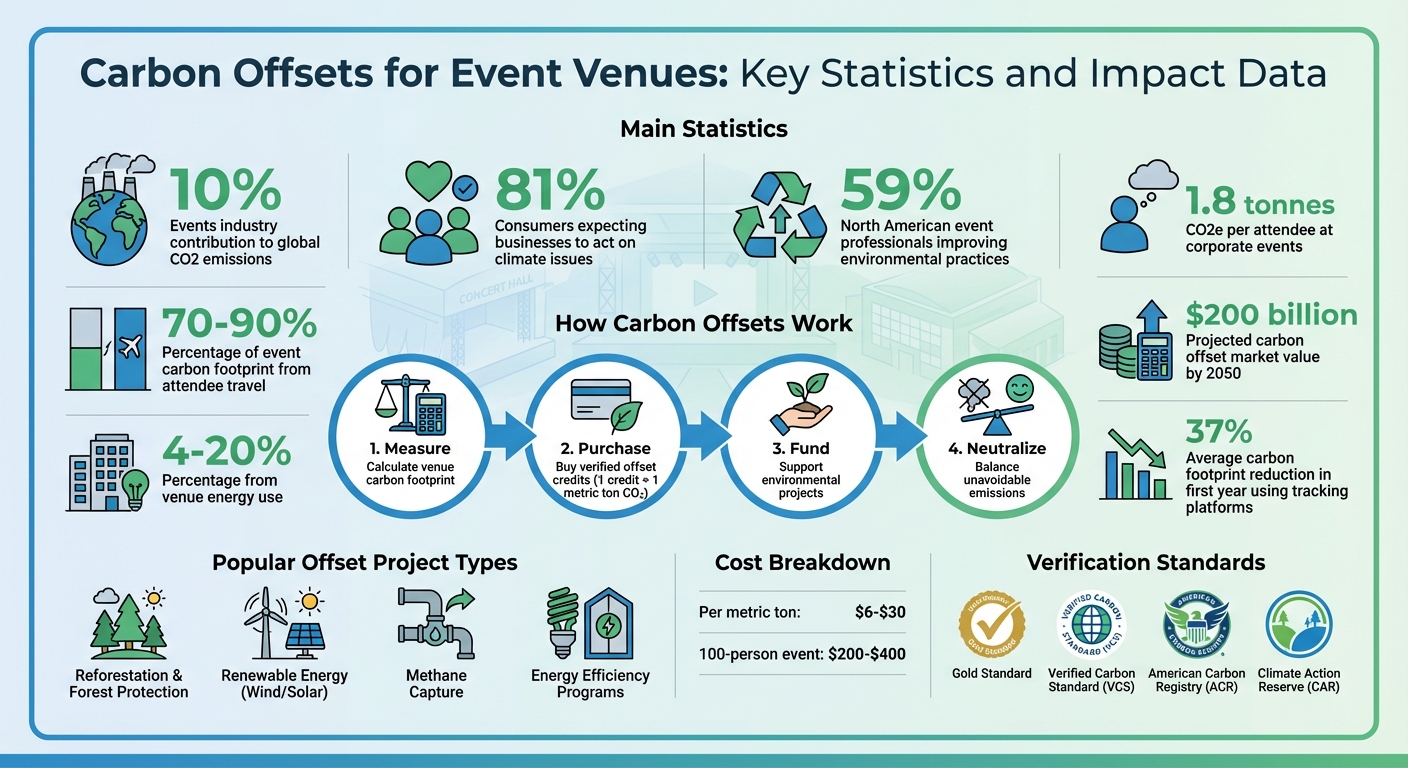
Carbon Offsets for Event Venues: Key Statistics and Impact Data
atmosfair CO₂ event calculator – a step-by-step guide
sbb-itb-161ccc1
What Are Carbon Offsets and How Do They Work
A carbon offset is essentially a certificate that represents the reduction, removal, or avoidance of one metric ton of carbon dioxide (CO2) or equivalent greenhouse gases from the atmosphere. When you buy carbon offset credits, you’re funding projects designed to counterbalance your venue’s emissions.
Think of it as balancing the scales. If your venue emits 50 metric tons of CO2, purchasing 50 credits supports initiatives that neutralize that same amount of emissions. While offsets don’t directly eliminate what your venue produces, they help reduce the overall impact by backing verified environmental projects.
As mentioned earlier, offsets work best when paired with direct efforts to reduce emissions, like upgrading to energy-efficient systems, switching to LED lighting, or using renewable energy sources. They’re especially useful for addressing emissions that are currently unavoidable.
The Mechanics of Carbon Offsets
Understanding how carbon offsets work means diving a little deeper into how credits are validated. Verified projects generate credits that you can purchase to account for emissions you can’t eliminate. Each credit equals one metric ton of CO2 or its equivalent.
For an offset to be legitimate, it needs to meet two key criteria: additionality and permanence. Additionality ensures that the project wouldn’t happen without the funding from offset purchases, making sure your contribution leads to new environmental benefits. Permanence guarantees that the carbon reductions are long-lasting – think of reforested areas that won’t get cut down later.
To maintain credibility, independent third-party organizations verify these projects against strict standards. Some of the most recognized certification bodies include the Gold Standard, Verified Carbon Standard (VCS) by Verra, and the American Carbon Registry.
"Quality considerations beyond the level of the standard can get quite technical quite quickly. There is a broad range of project types and approved methodology under each standard, which each have their own requirements and equations."
- Sarah Leugers, Director of Communications, Gold Standard
Common Carbon Offset Project Types
Carbon offset projects come in various forms, each tackling emissions in a unique way:
- Nature-Based Solutions: These include reforestation (planting new trees), avoided deforestation (protecting existing forests), and blue carbon initiatives like restoring coastal ecosystems such as mangroves.
- Renewable Energy Projects: These focus on funding wind, solar, and hydroelectric power to replace fossil fuel–based energy. For example, the Crow Lake Wind Project in South Dakota generates clean energy for about 129,000 homes and has been a key offset source for the Austin Convention Center since 2013. Similarly, the Larimar Wind Farm in the Dominican Republic uses sea breezes to reduce dependence on imported fossil fuels.
- Methane Capture Initiatives: Methane, a powerful greenhouse gas, is captured from sources like landfills, livestock manure, and wastewater treatment facilities. Take the Vietnam Biogas Project, for instance – it installs biodigesters that convert manure into biogas, providing rural households with clean energy while cutting methane emissions.
- Energy Efficiency Programs: These include distributing clean cookstoves, LED lighting, and upgrading industrial systems to lower overall energy consumption.
| Project Type | Primary Mechanism | Example |
|---|---|---|
| Nature-Based | Sequestration/Avoidance | Reforestation, mangrove restoration |
| Renewable Energy | Displaces fossil fuels | Wind farms, solar infrastructure |
| Methane Capture | Destroys potent GHGs | Landfill gas capture, biodigesters |
| Energy Efficiency | Reduces demand | Clean cookstoves, LED lighting |
These projects not only address emissions but also bring additional benefits to your venue and the surrounding community.
Benefits of Carbon Offsets for Event Venues
Carbon offsets offer more than just environmental perks – they can also elevate your venue’s reputation. For event spaces, embracing offsets enhances sustainability credentials, which is increasingly important for corporate clients and event planners.
Offsets offer a practical way to tackle emissions that can’t be cut immediately through operational changes. For a 100-person event, offset costs typically range from $200 to $400. At the same time, they strengthen your venue’s corporate social responsibility profile and appeal to eco-conscious clients.
The Radisson Hotel Group provides a great example of this approach. In October 2021, the group introduced a program across more than 400 EMEA properties to achieve "carbon negative" status. They did this by purchasing offsets for double the calculated emissions of every event. This bold step not only reduced their environmental impact but also created a strong marketing message for clients who prioritize sustainability.
Choosing offsets with added benefits, like protecting biodiversity, creating jobs, or improving community health, can also align your strategy with broader climate justice goals. With the global carbon offsets market projected to grow to around $200 billion by 2050, adopting these practices now positions your venue as a forward-thinking leader in the hospitality space.
Measuring Your Event Venue’s Carbon Footprint
Before you can offset emissions, you need to figure out exactly what you’re working with. Measuring your venue’s carbon footprint is the first step in building a credible sustainability plan. As Climate Vault puts it, "You can’t manage what you don’t measure."
The process of measurement is broken into three categories, or scopes. Scope 1 focuses on direct emissions from sources you control, such as natural gas for heating or fuel for generators. Scope 2 deals with indirect emissions from purchased electricity – think lighting, HVAC systems, and audio-visual equipment. Scope 3, which is often the largest, includes everything else in your value chain: attendee travel, catering, hotel stays, and waste management. This framework helps pinpoint major sources of emissions, which we’ll dive into next.
"The carbon footprint from the natural gas used in the facilities is now the largest percentage of our total carbon emissions."
- Camala Jones, Environmental Compliance Specialist, Austin Convention Center
Collecting accurate data is key to creating effective reduction strategies and determining how many offset credits you’ll need. For example, corporate events typically generate 1.8 tonnes of CO₂e per attendee. However, your event venue’s footprint will vary depending on factors like energy efficiency, travel distances, and catering choices.
Main Sources of Venue Emissions
Transportation is usually the biggest contributor, making up 70% to 90% of an event’s total carbon footprint. When attendees travel long distances – especially by air – the impact quickly adds up, with daily individual travel emissions ranging from 200 kg to 1,000 kg of CO₂.
Energy use at the venue itself typically accounts for 4% to 20% of the total footprint. This includes electricity for lighting and AV equipment, along with heating and cooling, which often spike during setup and teardown days.
| Emission Source | Typical Contribution | Key Data to Collect |
|---|---|---|
| Attendee Travel | 70% – 90% | Travel mode (air, rail, car), distance, and number of attendees |
| Venue Energy | 4% – 20% | Kilowatt-hours of electricity, therms of natural gas, generator fuel |
| Catering | ~5% – 30% | Number of meals, meat vs. plant-based ratio, food waste weight |
| Waste | ~5% | Total weight of trash, recycling, and compost |
To identify emission hotspots, start by gathering data from utility bills, attendee registration records (to estimate travel distances), catering orders, and waste management reports. For travel estimates, collecting attendee ZIP codes or countries during registration can provide a clearer picture. When it comes to catering, ask your vendors for detailed information on food sourcing and transportation distances to help fill in Scope 3 data gaps.
Carbon Footprint Calculation Tools
Once you’ve identified your key emission sources, the next step is converting that data into actionable CO₂e figures. This involves using emission factors, which translate activities – like electricity usage or miles traveled – into greenhouse gas output.
Here are some tools that can help:
- Sustainable Travel International: A free Event Carbon Footprinting Tool that covers venue energy, meals, and travel.
- ClimateTrade‘s Events Calculator: Designed with the Greenhouse Gas Protocol for precise measurements.
- Myclimate‘s Event Calculator: A free tool for estimating emissions from travel, catering, and logistics.
For more advanced tracking, platforms like Scope Carbon Tracking allow suppliers to input data directly, streamlining the reporting process. Another option is EventZero, which provides real-time sustainability metrics and lets you model "what-if" scenarios to test different strategies before committing. Interestingly, venues using specialized tracking platforms have reported cutting their event carbon footprint by an average of 37% in the first year.
To ensure your calculations are reliable, align your data with international standards like ISO 20121 or the Greenhouse Gas Protocol. Use past data to establish a baseline and track your progress over time instead of relying solely on industry averages. And when in doubt, slightly overestimate your emissions to ensure your offsets cover all potential impacts.
Steps to Implement Carbon Offsets at Your Venue
Once you’ve calculated your carbon footprint, it’s time to take action with offsets. This involves selecting a reliable provider, integrating offsets into your daily operations, and showcasing your efforts to clients. The priority should always be to reduce emissions first – through energy efficiency and waste reduction – then offset the remaining emissions.
"The progress only comes when you make commitments that are rooted in deep de-carbonization, and that involves making hard choices about reevaluating operations, supply chains, and entire business models." – Amy Moas, Greenpeace USA
Choosing a Carbon Offset Provider
Not all carbon offset providers are the same. Look for projects certified by trusted organizations like Gold Standard, Verra (Verified Carbon Standard), American Carbon Registry (ACR), or Climate Action Reserve (CAR). These certifications ensure projects meet stringent quality standards.
When assessing providers, focus on five key criteria:
- Additionality: Is the project only possible because of carbon credit funding?
- Quantification: Are emissions reductions calculated conservatively and accurately?
- Permanence: How secure are the reductions? For instance, could a forest project be undone by wildfires?
- Double-counting: Are credits tracked in a public registry and retired after purchase?
- Social and environmental impact: Does the project benefit local communities and ecosystems?
"The most important step in determining the efficacy of a project for offsets is by using internationally recognized standards." – Sarah Leugers, Director of Communications, Gold Standard
Ask providers about their process for retiring credits. Each credit should have a unique serial number and proof of retirement tied to your venue. Also, consider projects offering extra benefits, such as creating jobs, protecting biodiversity, or improving air quality. While local projects can enhance community engagement, global initiatives often help developing nations that face severe climate challenges.
For example, since 2013, the Austin Convention Center has purchased offsets from the Crow Lake Wind Project in South Dakota (powering 129,000 homes) and the GreenTrees Forestry Project in the Mississippi Alluvial Valley.
"Some of the key points we look at when purchasing carbon offset credits are if the project is in or near Texas or in the United States, and that the projects may have other beneficial attributes such as providing local employment." – Camala Jones, Environmental Compliance Specialist, Austin Convention Center
| Quality Criterion | Key Question for Venue Operators |
|---|---|
| Additionality | Would this project have happened without selling these credits? |
| Permanence | What’s the risk that reductions could be reversed (e.g., due to wildfires)? |
| Quantification | Are the baseline emissions realistic, or are they inflated to generate more credits? |
| Leakage | Does protecting one area shift emissions or deforestation elsewhere? |
| Verification | Has a third-party auditor confirmed the emissions reductions? |
Once you’ve chosen a credible provider, the next step is weaving offsets into your operations.
Ways to Integrate Offsets into Your Operations
Offsets can support your venue’s carbon neutrality in several ways. The most straightforward approach for luxury venues is direct venue offsetting – conducting a full carbon footprint assessment and offsetting all emissions to achieve carbon-neutral status. This includes everything from energy use to waste management.
For client-facing options, you could add a sustainability fee to event proposals. This fee, used to offset the event’s carbon footprint, also shows transparency in your commitment. Another idea is to offer attendee add-ons. For instance, you could include carbon calculators on event websites, letting guests calculate and offset their travel emissions. In 2021, the Geological Society of America gave attendees at its Portland meeting the option to add offset fees ranging from $4 for domestic travel to $30 for international trips from Asia or Australia.
Alternatively, create bundled packages with offset costs built into event pricing. For example, in October 2021, the Radisson Hotel Group made all meetings and events at 400+ of its EMEA properties carbon negative by purchasing offsets equal to twice the carbon footprint of each meeting. This approach simplifies the process for clients and makes sustainability a standard feature.
Working with caterers and transport providers who already use offsets or eco-friendly practices can further lower event emissions. The fewer emissions you generate through renewable energy, local sourcing, and waste reduction, the fewer offsets you’ll need to buy. Offsetting one metric ton of CO₂ typically costs between $6 and $30, depending on the provider and project type.
Marketing Your Carbon-Neutral Events
Once you’ve implemented offsets, communicating your efforts effectively can amplify their impact. Transparency is key – use retirement certificates and public registry links to prove that credits have been officially retired for specific events. Displaying recognized logos like Green-e on your materials can also help establish credibility, especially for corporate clients.
After events, share detailed impact reports highlighting environmental outcomes, such as tons of CO₂ offset or trees planted. Visual elements like infographics, videos, and signage can make these achievements more relatable for attendees. For example, showcasing how funds support wind farms or reforestation projects can make the benefits feel tangible.
It’s also important to emphasize that you prioritize reducing emissions before offsetting. This builds trust with clients. With 81% of consumers expecting businesses to take environmental action and 59% of North American event professionals actively improving their environmental practices, this messaging resonates.
Consider offering "Carbon-Neutral Event Packages", where offset costs are included in the venue hire fee. You could also integrate carbon footprint calculators on your website, allowing clients and attendees to estimate emissions tied to their travel and participation. During registration, provide an opt-in option for a sustainability fee or offset contribution.
Highlighting co-benefits in your marketing can make your efforts even more engaging. Projects that create jobs, protect ecosystems, or improve public health tell a stronger story than just carbon reduction numbers. Modern platforms like Carbonmark enable instant retirement certificates with blockchain verification, allowing you to share real-time proof of impact on social media or in reports.
Verifying and Reporting Your Carbon Offset Results
After implementing carbon offsets, proving their validity and sharing results is crucial. It builds trust and shows measurable impact. Without proper verification and transparent reporting, even well-meaning offset programs can face skepticism. The solution? Use recognized standards and provide detailed, traceable documentation.
Checking Offset Credibility
Verification begins with independent audits. Every offset project is reviewed by a third-party Validation/Verification Body (VVB) to ensure accurate emissions reductions. In addition to audits, look for alignment with the Core Carbon Principles (CCPs), introduced by the Integrity Council for the Voluntary Carbon Market (ICVCM) in 2024. Independent rating agencies – like Sylvera, BeZero Carbon, Calyx Global, and Renoster – also play a role by assigning quality scores to credits. This is critical because studies show that 60–70% of credits in some programs may not accurately reflect emissions reductions. For instance, in October 2024, U.S. federal agencies accused a major developer of fraudulently generating about 6 million carbon credits through false data.
When buying offsets, always request details such as the crediting period (usually 10 years), the vintage year, and a direct link to the public registry where the unique serial number confirms the credit’s retirement.
"The registry publicly documents all of the registration and verification information related to each credit and the unique serial numbers trace the ownership and verification down to the metric ton level." – Kennedy Ricci, 4AIR
Once you’ve verified the credibility of your offsets, the next step is to share these verified results with your stakeholders.
Sharing Your Sustainability Results
As mentioned earlier, transparency in offset verification is key to building credibility. Once your offsets are verified, communicating the results effectively can turn your environmental actions into a competitive advantage. Share retirement certificates with unique serial numbers and detailed impact reports that explain the emissions offset and the benefits of the supported projects. For instance, instead of simply stating "500 metric tons offset", elaborate by sharing that the funds contributed to a wind farm in South Dakota powering 129,000 homes or a reforestation project planting 12,000 native trees. Adding visual elements – like infographics, photos, or videos – can make these achievements more relatable.
Also, include the methodologies used to calculate emissions, the standards followed (like VCS or Gold Standard), and how the projects ensure additionality. Highlighting co-benefits – such as job creation, biodiversity preservation, or health improvements – can further enrich your sustainability story. Many projects also align with UN Sustainable Development Goals (SDGs), adding another layer to your impact narrative.
"Transparency begins with clearly articulating how carbon credits are selected, how they support overall climate goals, and how they are retired." – Laura Salazar, Carbon Markets Expert, CarbonBetter
For public-facing communications, consider aligning your reports with established frameworks like the Carbon Disclosure Project (CDP) or the Task Force on Climate-Related Financial Disclosures (TCFD). With 81% of consumers expecting businesses to take environmental action, transparent reporting isn’t just ethical – it’s a smart business move. Verified and well-communicated results can make your efforts more appealing to eco-conscious clients.
Conclusion
Carbon offsets provide event venues with an actionable way to address emissions that can’t be eliminated immediately, while also laying the groundwork for long-term environmental responsibility. They aren’t a substitute for reducing emissions directly – like upgrading to energy-efficient systems or minimizing waste – but they complement these efforts. For emissions that are unavoidable, offsets allow venues to take immediate steps toward climate action while waiting for cleaner technologies to become more widely accessible.
The numbers back this up. A whopping 81% of consumers expect businesses to actively contribute to environmental improvement, and 59% of North American event professionals are already adopting greener practices. Carbon offset programs can help venues meet these demands while distinguishing themselves in a competitive market. For luxury venues, such as those offered by Essentialyfe, incorporating verified offset programs into their offerings not only aligns with client expectations but also highlights a commitment to meaningful environmental progress. When clients know their events are tied to projects that expand renewable energy capacity, it demonstrates a venue’s dedication to making a difference.
The financial aspect is equally compelling. Offsetting a 100-person event typically costs between $200 and $400 – a small investment compared to the reputational value it brings. With the carbon offset market projected to hit $200 billion by 2050, it’s clear this approach is more than a fleeting trend; it’s becoming a cornerstone of responsible event management.
To put this into practice, start by calculating your venue’s carbon footprint, partner with verified offset providers adhering to standards like Gold Standard or Verified Carbon Standard (VCS), and ensure transparency in sharing your results. As Dr. Jane Goodall wisely said:
"What you do makes a difference, and you have to decide what kind of difference you want to make".
For venues aiming to lead the way, taking responsibility for every ton of emissions is the first step toward making that difference.
FAQs
Are carbon offsets the same as being carbon neutral?
Carbon offsets and carbon neutrality are connected concepts, but they’re not the same. Carbon offsets refer to supporting projects that cut or prevent greenhouse gas emissions to make up for emissions created elsewhere. On the other hand, being carbon neutral means achieving a balance by measuring your emissions, reducing them as much as possible, and then offsetting what remains. While offsets are a key part of reaching carbon neutrality, the process of being carbon neutral involves a more comprehensive effort to reduce and minimize emissions at their source.
How do I estimate attendee travel emissions accurately?
To estimate the travel emissions of attendees, start by gathering details about their travel methods – whether they’re flying, driving, or taking trains – and their starting and ending locations. Calculate the total distance traveled, taking into account factors like fuel efficiency, the number of people traveling together, and specific details such as flight distances or potential delays. For flights, don’t forget to include extra considerations like layovers and emissions tied to specific airports. Once you’ve compiled this information, use carbon footprint calculators or relevant formulas to get an accurate estimate of the emissions generated.
How can I avoid low-quality or double-counted offsets?
To make sure your carbon offsets are effective and trustworthy, focus on high-quality carbon credits that give you an exclusive claim to the reduction of greenhouse gases. Look for offsets that are independently certified and retired after use. Be cautious of credits that could involve double issuance (where the same reduction is counted multiple times) or double use (where multiple parties claim the same credit). Taking these steps ensures your offsets are both reliable and impactful.