Island resorts are proving that tourism and conservation can go hand in hand. Resorts are using their resources to protect marine life, restore habitats, and involve local communities in sustainable practices. Here’s how:
- Marine Protected Areas (MPAs): Resorts like Misool in Indonesia and Six Senses Laamu in the Maldives fund patrols, enforce fishing restrictions, and monitor ecosystems, leading to increases in fish biomass and coral cover.
- Tourism Revenue for Conservation: Profits fund initiatives like coral reef restoration, ranger patrols, and wildlife rehabilitation, as seen with Four Seasons Maldives and Misool Resort.
- Community Engagement: Resorts create jobs, train locals in conservation, and offer economic alternatives to harmful practices, transforming communities into stewards of nature.
- Guest Participation: Visitors join hands-on activities like coral planting and mangrove reforestation, directly contributing to habitat recovery.
- Wildlife Protection: Resorts avoid exploitative practices, focusing on respectful, natural wildlife interactions and rehabilitation programs.
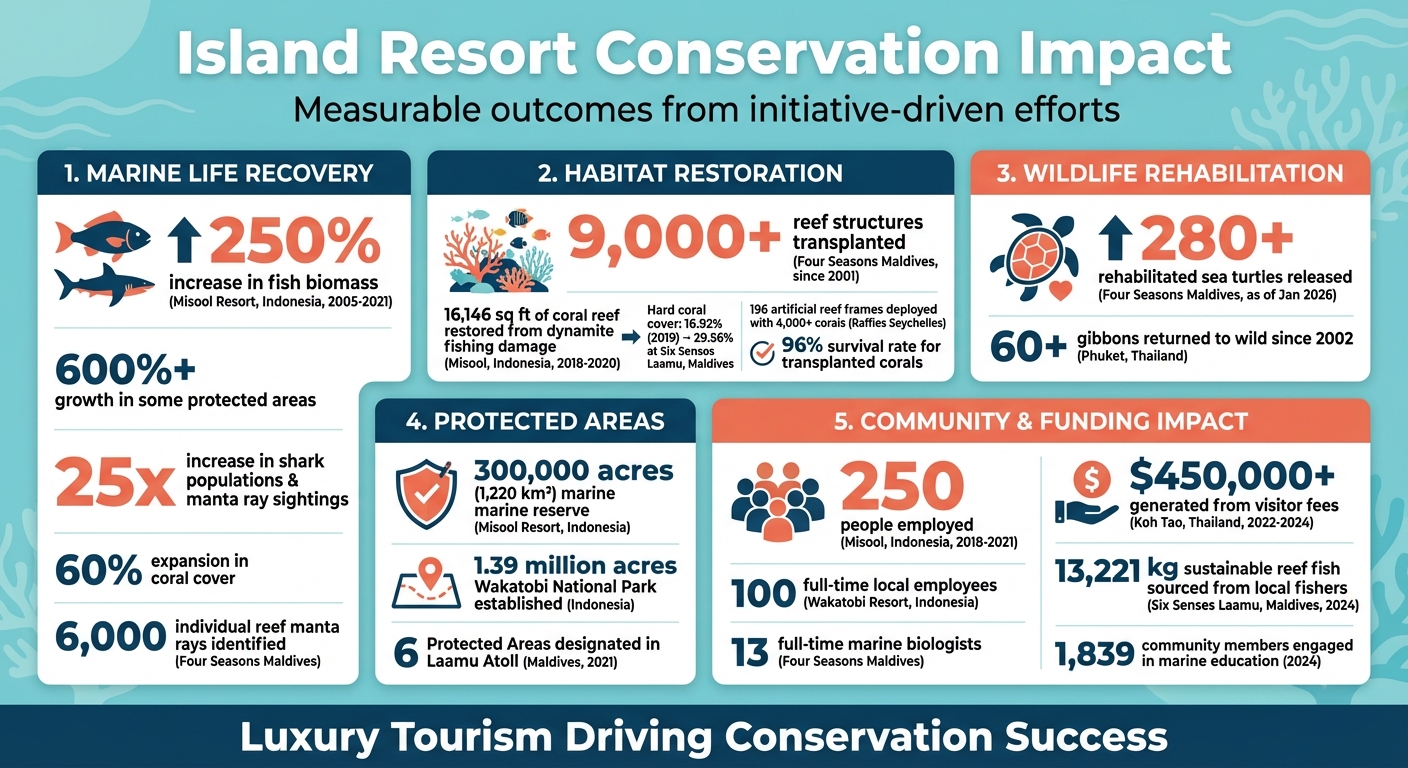
Island Resort Conservation Impact: Key Statistics and Outcomes
Marine Protected Areas and Habitat Preservation
How Resorts Support Marine Protected Areas
Resorts play a key role in safeguarding Marine Protected Areas (MPAs) through strategic investments and partnerships with local communities. A prime example is Misool Resort in Raja Ampat, Indonesia. Back in 2005, founders Andrew and Marit Miners worked with local communities to lease a massive 300,000-acre (1,220 km²) marine area. The resort channels its revenue into funding three ranger patrol stations, which oversee the coastline and enforce fishing restrictions.
Another standout example is Wakatobi Dive Resort in Sulawesi, Indonesia. Over two decades ago, founder Lorenz Mäder partnered with 17 local villages to establish a 6 km no-fishing zone. In return for their cooperation, the resort provides round-the-clock electricity to a nearby village of 500 residents. This initiative was so successful that it became the blueprint for the Wakatobi National Park, a 1.39-million-acre protected area officially designated by the Indonesian government in 2002. Mäder summed up the approach well:
"You can’t pack up and move your resort when the diving is no longer good. So it’s better to do what you can to protect it, to enjoy it now and in the future".
In the Maldives, Six Senses Laamu offers another example of how resorts can drive conservation efforts. Through its Maldives Underwater Initiative, the resort teamed up with the Blue Marine Foundation in 2016 to conduct biodiversity research. This work directly contributed to the formal designation of six Protected Areas in Laamu Atoll by 2021.
Documented Recovery of Marine Life
The benefits of resort-driven MPAs are evident in the recovery of marine ecosystems. At Misool Resort, monitoring from 2005 to 2021 revealed a 250% increase in fish biomass, with some areas seeing growth exceeding 600%. Shark populations and manta ray sightings surged by 25 times compared to unprotected zones, while coral cover expanded by 60%.
Similarly, the Four Seasons Resort Maldives at Landaa Giraavaru has made significant contributions through its Maldives Manta Conservation Programme, launched in 2005. Led by Senior Marine Biologist Guy Stevens, the program has identified nearly 6,000 individual reef manta rays using over 90,000 photo-ID sightings – the largest recorded population of its kind. The resort’s Reefscapers initiative has also transplanted more than 9,000 reef structures since 2001, while its Turtle Rehabilitation Centre has released over 280 rehabilitated sea turtles back into the ocean as of January 2026.
At Six Senses Laamu, efforts to protect marine habitats have shown measurable results. Hard coral cover in the Protected Areas has grown from 16.92% in 2019 to 29.56% by 2024, showcasing the positive impact of these conservation measures.
sbb-itb-161ccc1
Funding Conservation Through Tourism Revenue
How Tourism Revenue Supports Conservation
Tourism profits often play a key role in funding conservation efforts. Take Misool Resort in Indonesia, for example. Revenue from this private island resort helps fund ranger patrols across a massive 471-square-mile (1,220 km²) marine reserve. Between 2018 and 2020, the resort employed 250 people and restored 16,146 square feet (1,500 m²) of coral reef that had been damaged by dynamite fishing. This cycle – better conservation attracting more ecotourists – creates a system where tourism boosts revenue, which can then be reinvested into further conservation.
Another example is the Four Seasons Resort Maldives at Landaa Giraavaru, which shows how luxury tourism can support long-term scientific initiatives. Since 2001, the resort’s Marine Discovery Centre has employed 13 full-time marine biologists. Their work supports programs like Reefscapers, which has transplanted over 9,000 reef structures, and the Turtle Rehabilitation Centre, which has released more than 280 rehabilitated turtles as of January 2026.
In Fiji, Ahura Resorts takes a different approach by contributing a percentage of its sales as royalties and rentals to local landowners. This funding helps maintain the "Na Tabu" marine protected area while also supporting community development.
These direct investments from tourism profits work alongside visitor fees to address critical gaps in conservation funding.
Filling Conservation Budget Shortfalls
Visitor fees are another way tourism helps close funding gaps in conservation. Koh Tao in Thailand introduced a 20 baht (around $0.60) visitor fee in April 2022, backed by the UNDP’s Biodiversity Finance Initiative. By October 2024, this fee had generated over $450,000, which was used for coral reef restoration and waste management. With a four-year budget of $290,000, this initiative achieved a 55% return on investment and inspired three other island municipalities to adopt similar fees.
The Galapagos Islands provide a larger-scale example of how entrance fees can fund conservation. Foreign visitors currently pay $100 per park entrance (with plans to increase this to $200), and the revenue is distributed across several agencies. For instance, 10% goes to the Ecuadorian Navy for marine surveillance and patrolling, while 40% is allocated to the Galapagos National Park Directorate to manage both marine and terrestrial reserves. Tourism revenue is vital here, as over 80% of the Galapagos economy depends on it, either directly or indirectly.
Wakatobi Collaborative Reef Conservation Program
Community Involvement in Conservation Efforts
Island resorts are doing more than just funding conservation – they’re actively involving local communities in sustainable practices, creating a ripple effect of positive change.
Jobs Created by Ecotourism
One of the most impactful ways these resorts contribute is by creating jobs that directly support conservation and provide stable income for locals. A great example comes from Misool Resort in Indonesia. Between 2018 and 2021, the resort and the Misool Foundation employed 250 people, many of whom were former shark-finners turned conservation rangers. This shift transformed individuals who once posed a threat to marine life into its protectors.
Similarly, Wakatobi Resort in Indonesia employs around 100 locals full-time, offering equal pay. They also support 50 widows by hiring them to craft natural roof tiles from sago palm leaves, providing financial stability to some of the community’s most vulnerable members. Over in the Maldives, Four Seasons Resort Maldives at Landaa Giraavaru has a team of 13 full-time marine biologists, working alongside local interns and apprentices, creating career paths in marine conservation.
Some resorts go even further by establishing programs that foster sustainable markets. For instance, Six Senses Laamu in the Maldives runs the "Laamaseelu Masveriya" (Exemplary Fisher) program, led by Director of Sustainability Lawrence Menz. In 2024 alone, this initiative sourced 13,221 kilograms of reef fish from local fishers using sustainable methods. The program also engaged 1,839 community members in marine education and hosted 180 students for hands-on conservation training.
These job opportunities not only provide income but also encourage communities to move away from practices that harm the environment.
Shifting Away from Harmful Practices
Resorts are also offering economic alternatives that help reduce dependence on destructive activities like poaching and overfishing. At Misool Resort, co-founder Marit Miners established a women’s cooperative in a nearby village to cultivate fruit orchards and vegetable gardens. The cooperative supplies the resort with items like banana chips and fresh produce, creating a steady income stream that lessens the need for illegal fishing.
"By engaging more women from the community in a sustainable economy, we can improve the local economy while simultaneously reducing fishing pressure." – Marit Miners, Co-founder, Misool Resort
Wakatobi Resort has taken a unique approach by providing 24-hour electricity to a village of 500 people. In return, the villagers agree to maintain a 3-kilometer no-take reef sanctuary within their traditional fishing grounds. Meanwhile, in Kenya, the Oceans Alive Foundation employs 38 staff members and collaborates with 500 community members on reef restoration projects. One standout example is Katana Ngala, a former fisherman who now leads a coral restoration program.
These initiatives demonstrate how resorts can empower communities to protect their natural resources while building sustainable livelihoods.
Guest Participation in Ecosystem Restoration
Expanding on resort-led conservation and community projects, involving guests directly in restoration efforts has proven to be a powerful way to revive ecosystems. Many island resorts now offer hands-on programs where visitors actively contribute to habitat recovery, producing tangible improvements in damaged environments.
Coral Reef Restoration Programs
A growing number of resorts are inviting guests to take part in coral restoration initiatives. For instance, at InterContinental Fiji Golf Resort & Spa, visitors can join "Coral Planting Safaris", a program introduced in 2023 in collaboration with Reef Safari. Participants learn how to craft cement "cookies", rescue coral fragments displaced by storms, and attach these fragments to underwater frames. The resort’s marine biologist tracks the progress of these corals every six months by sharing updated photos, allowing guests to see how their efforts are paying off. Within six months, transplanted corals begin forming new branches, and within a year, they can grow up to 15 centimeters (about 6 inches).
At Raffles Seychelles, the focus is on creating artificial reefs using iron rebar "spider" frames. Since 2021, the resort has deployed 196 frames in Anse Takamaka Bay, housing over 4,000 corals from five different genera. To celebrate its 13th anniversary in February 2024, staff and guests placed 13 coral spiders in a single day. This initiative, supported by Nature Seychelles, has achieved an impressive 96% survival rate for the transplanted corals.
Similarly, Nanuku Resort in Fiji offers twice-weekly coral planting sessions led by marine scientist Waseroma Sigavou. By June 2025, the resort had planted over 600 fragments of heat-resistant coral species like Acropora cerealis and Pocillopora. Recently, 100 fragments were successfully transplanted back into the natural reef, resulting in a noticeable increase in fish populations around the nursery site.
These marine-focused programs are paving the way for more land-based restoration activities.
Reforestation and Habitat Recovery Projects
In addition to marine restoration, resorts are engaging guests in reforestation projects to revitalize island ecosystems. Machchafushi Island Resort in the Maldives, for example, involves visitors in planting trees to support the country’s national reforestation goals. Between March and November 2025, the resort and its guests planted five coral frames containing 400 fragments, restoring 20 to 25 square meters (roughly 215 to 269 square feet) of reef. The resort also incorporates mangrove planting to safeguard coastal areas from erosion.
These initiatives not only aid in ecological recovery but also foster a deeper appreciation for nature among participants. By involving guests in these efforts, resorts are strengthening the bond between sustainable tourism and conservation, creating a model where visitors play an active role in preserving the environment.
Responsible Wildlife Tourism Practices
Island resorts are reshaping wildlife tourism by focusing on respectful, natural encounters that prioritize animal welfare. This approach moves away from staged performances and physical interaction with animals, instead promoting observation that honors the dignity and natural behaviors of wildlife. The philosophy is simple: conservation is about more than preserving habitats – it’s about protecting the animals themselves.
Why Resorts Avoid Captive Wildlife Activities
Traditional wildlife tourism often exploits animals through forced performances and unnatural contact. These activities frequently involve removing animals from their natural environments and subjecting them to harsh training methods. For example, many animals used in tourist photos, such as white-handed gibbons, are poached from the wild. This practice has contributed to local extinctions in areas like Phuket before rehabilitation efforts began.
Resorts are rejecting this outdated model in favor of rehabilitation and release programs. In Phuket and the Maldives, such initiatives have had a meaningful impact: over 60 gibbons have been returned to the wild since 2002, and more than 280 rehabilitated sea turtles have been released. These efforts go beyond habitat restoration, reflecting a commitment to ethical practices. Vincent Delsol, General Manager at Pullman Phuket Panwa Beach Resort, captured this sentiment:
"Protecting Phuket’s vibrant ecosystem and marine biodiversity has always been at the heart of our philosophy… Alone, we can’t achieve much, but together, we can do great things".
By moving away from exploitative practices, resorts are now creating opportunities for guests to observe wildlife in ways that respect the animals’ natural behaviors.
Encouraging Respectful Wildlife Observation
Instead of orchestrating forced interactions, resorts emphasize teaching guests how to observe animals in their natural settings without causing harm. This involves expert guidance and carefully managed protocols. For instance, in January 2026, Four Seasons Resort Maldives at Landaa Giraavaru introduced a "Manta On Call" program. With the help of 13 full-time marine biologists, the program monitors manta activity in real time, allowing guest visits only during natural activity peaks. This ensures the animals remain undisturbed while guests enjoy an authentic experience.
Strict "No Touch" policies are also enforced in Marine Protected Areas, where activities like fishing, shell collecting, and coral removal are prohibited. In March 2026, St. George Island Villas in Florida launched an eco-tourism guide tailored to sea turtle nesting season. The guide educates visitors on recognizing nests, maintaining safe distances, and reporting sightings to local authorities instead of intervening. CEO John Lyotier highlighted the importance of these efforts, which include reducing outdoor lighting to prevent disorienting hatchlings – a simple step that greatly increases their chances of survival.
Some resorts are also leveraging technology to create immersive wildlife experiences without disturbing animals. For example, Four Seasons has developed hologram rooms and virtual reality apps that let guests "swim" alongside life-size manta rays and whale sharks. These experiences are based on scientific data, ensuring they are both educational and non-invasive. This innovative approach aligns with the evolving preferences of modern travelers. As Anchalika Kijkanakorn, Founder and Managing Director of AKARYN Hotel Group, explained:
"Guests love the idea and are very supportive. We believe that the new generation of travellers want to not only experience a new destination, but also want to feel good about how they are doing it".
Conclusion
Main Points
Luxury tourism and conservation can thrive together. By establishing Marine Protected Areas, resorts create safe havens where marine ecosystems can recover. For instance, Misool Resort’s protected zone now boasts record-high species counts. Community involvement plays a vital role too – former shark finners become rangers, and local widows find employment in sustainable cooperatives, steering entire communities away from harmful practices [9,16]. Guests also contribute directly to conservation, participating in activities like mangrove planting and coral monitoring, which lead to measurable ecological improvements [2,8].
Tourism revenue bridges critical funding gaps by supporting full-time marine biologists, creating community jobs, and financing essential conservation research. These efforts extend beyond environmental benefits; some resorts provide 24-hour village electricity in exchange for reef protection [4,16]. The scale of these contributions is impressive – Four Seasons Maldives has transplanted over 9,000 reef structures and rehabilitated nearly 500 sea turtles, while Wakatobi Resort powers a 500-person village to safeguard a 1.9-mile reef sanctuary [4,16].
These examples highlight the impact of thoughtful travel choices.
Choosing Conservation-Focused Travel
To support conservation through your travels, focus on resorts with a proven commitment to environmental stewardship. Look for properties employing full-time environmental staff rather than relying on seasonal consultants. Ensure they have formal Marine Protected Areas and strong community partnerships to secure long-term ecological health [3,4,19]. As Marit Miners, co-founder of Misool Resort, explains:
"If tourism businesses and governments view nature as a central asset, conservation becomes a clear path to better returns".
Opt for destinations offering hands-on conservation activities like coral gardening, mangrove planting, or citizen science initiatives. These programs not only provide critical labor for restoration but also channel funding into conservation [4,8]. Resorts located within UNESCO Biosphere Reserves or those collaborating with established research organizations ensure scientific credibility in their efforts [4,12]. For example, when exploring luxury accommodations curated by Essentialyfe (https://essentialyfe.com), consider asking about their conservation initiatives and community impact to ensure your stay contributes to meaningful environmental work.
The message is clear: resorts that prioritize healthy ecosystems as a core business strategy create a cycle where conservation success fuels profitability, which then funds further conservation [9,14]. By choosing these destinations, your travel becomes an investment in a healthier planet.
FAQs
How can I verify a resort’s conservation claims?
To assess a resort’s conservation efforts, check for third-party certifications from reputable organizations like EarthCheck or awards from groups such as National Geographic. These serve as strong indicators of genuine eco-friendly practices. You can also look for reports or case studies published by conservation organizations or covered by media outlets. Resorts actively involved in initiatives like marine protection often work alongside local authorities, with their efforts reflected in visible outcomes such as sanctuaries or community-focused programs.
Do guest conservation activities really make a difference?
Guest participation in conservation activities can play a big role in protecting wildlife and maintaining healthy ecosystems. Actions like planting mangroves, assisting with coral reef restoration, or organizing beach clean-ups tackle pressing issues such as coastal erosion and habitat destruction. These efforts lead to visible outcomes – like helping release endangered turtles or clearing marine debris – and also encourage travelers to become more aware of environmental challenges. This growing awareness often results in a ripple effect, boosting the reach and effectiveness of conservation efforts.
How does resort tourism revenue actually fund protection efforts?
Resort tourism contributes to conservation efforts in several impactful ways, including entrance fees, eco-friendly activities, and direct funding for protection initiatives. For instance, some resorts channel a portion of their profits into marine protected areas, ranger patrols, and local community projects. This approach supports biodiversity efforts like marine sanctuaries and educational programs about the environment, all while engaging local communities in the process. By blending tourism with conservation, island resorts help safeguard both wildlife and ecosystems.