Filming in remote locations is challenging. You’re dealing with unpredictable weather, limited infrastructure, and tough terrain. Proper logistics planning can save time, money, and ensure the safety of your crew. Here’s a quick breakdown of what you need to know:
- Location Access: Evaluate road conditions, parking, and terrain. Use tools like drones or apps (e.g., Sun Seeker) to assess lighting and obstacles.
- Weather Prep: Plan for delays caused by extreme conditions. Scout locations a year in advance and build buffer days into your schedule.
- Power and Utilities: Bring portable generators, solar chargers, and check power capacity. Ensure access to clean water and restrooms.
- Transportation: Match vehicles to terrain – 4x4s for rugged areas, helicopters for hard-to-reach spots. Use specialized logistics for delicate equipment.
- Crew Comfort: Book accommodations close to the site. Luxury rentals with kitchens and laundry can improve morale during long shoots.
- Safety and Communication: Train crew for emergencies, use satellite phones, and establish clear evacuation plans.
- Contingency Planning: Allocate 10% of your budget for unforeseen issues. Keep backup gear and alternative shooting locations ready.
Remote filming requires careful planning, but with the right steps, you can avoid costly delays and keep your production on track. Let’s dive into the details.
Filmmaking at 14,000 Feet: How MASV Powered a Pikes Peak Film Crew
sbb-itb-161ccc1
Evaluating Remote Location Access
Careful evaluation of remote filming locations is crucial to avoid unexpected challenges. This process lays the groundwork for every decision that follows, from transportation logistics to on-site accommodations. By thoroughly assessing the site, you can ensure your crew and equipment reach the filming area smoothly, avoiding costly delays or surprises. Elements like road conditions and power availability should be addressed well in advance to keep production on track.
Conducting Site Surveys and Terrain Assessment
On-site visits with key team members, such as the Director of Photography, Gaffer, and Key Grip, allow you to identify potential technical issues firsthand. Schedule these visits at the same time of day you plan to shoot to observe natural lighting and shadow patterns accurately. Tools like Sun Seeker and Helios can predict lighting conditions, while apps such as Cadrage or Artemis Pro help visualize camera angles.
Pay attention to obstacles that could slow down equipment transport. Measure the distance from parking areas to the set, and take note of potential barriers like stairs, narrow doorways, or elevators. Confirm that roads can accommodate production vehicles, and if parking is far from the site, determine whether shuttle services are necessary. For large or rugged locations, drones or 360° cameras can provide a bird’s-eye view of access routes and help identify hidden challenges.
Don’t forget to assess the acoustic environment. Stand still for a minute and listen for ambient noise – such as HVAC systems, traffic, airplanes, or nearby construction – that could interfere with audio recordings. Additionally, check power sources with a $10 outlet tester to ensure proper grounding and wiring before plugging in expensive gear. Remember, standard circuits generally support 15–20 amps at 120 volts, but for safety, use only 80% of the circuit’s capacity.
Weather and Seasonal Considerations
Weather can dramatically impact your production schedule. For instance, in extreme conditions like heavy snow, tasks may take approximately 30% longer to complete. What might normally be a five-day shoot could stretch to eight days, with preparation time increasing from one week to ten days.
During the production of HBO‘s The Last of Us in Waterton Park, Alberta, unexpected snow melt forced the crew to bring in 400 truckloads of snow and use industrial fans to replicate local wind conditions.
"We are walking in at least a foot of snow, so everything is about 30% slower. It’s not appealing to them, but we say your five-day shoot is more like eight days."
- Elli Cassata, Senior Location Manager, Pegasus Pictures
Scout locations at least a year in advance to understand seasonal conditions like lighting, snow levels, and terrain challenges. Build extra buffer days into your schedule to account for unpredictable weather, such as blizzards or fog, which could strand your crew. Prepare backup indoor locations or less weather-dependent sets to keep production moving if outdoor sites become unusable. In extreme cold, crew safety becomes a priority – temperatures between -35°F and -40°F can cause exposed skin to freeze in just 20 seconds.
Infrastructure and Utility Assessment
Remote locations often lack the infrastructure necessary for a smooth production, requiring careful planning to fill the gaps. During site surveys, count available power outlets and check the capacity of breaker boxes. In areas without access to grid power, portable generators, solar chargers, and high-capacity power banks will be essential. Be aware that generators lose efficiency at high altitudes (above 7,000 feet) and may require derating to function properly.
Check cellular signal strength throughout the area, as remote locations frequently have limited or no service. In such cases, satellite phones or radio kits are critical for maintaining communication. Ensure access to clean, potable water and adequate restroom facilities – SAG-AFTRA guidelines typically require one bathroom for every 15 crew members. If facilities are unavailable, plan to bring portable toilets or honeywagons.
Lastly, evaluate whether there’s enough space near the filming site to set up a base camp for catering, dressing rooms, makeup stations, and equipment storage. Map out the nearest medical facilities and establish clear emergency evacuation routes for added safety. Once these factors are addressed, you’ll be ready to focus on organizing transportation for your crew and gear.
Planning Transportation for Crew and Equipment
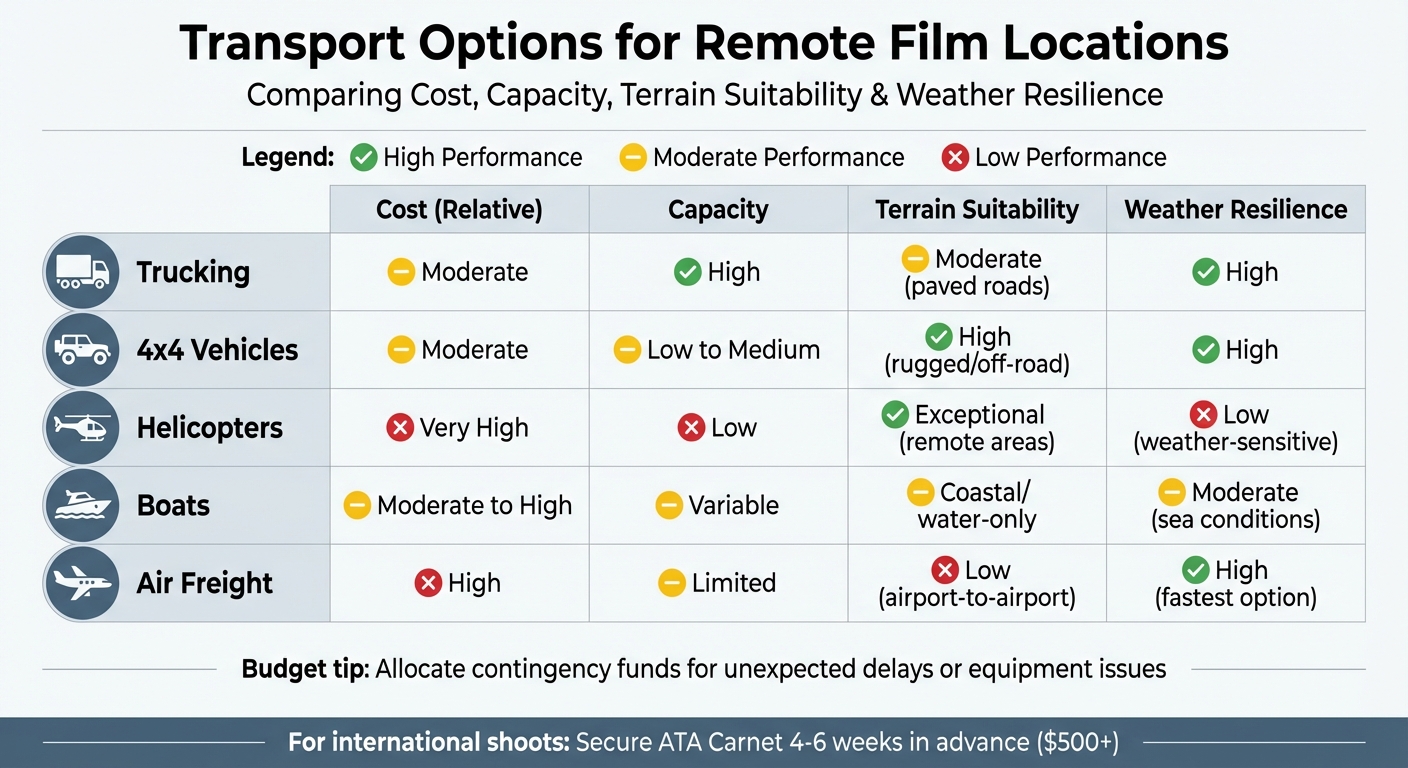
Remote Film Location Transport Options: Cost, Capacity & Terrain Comparison
Once you’ve assessed your remote filming location, the next step is organizing transportation for both your crew and equipment. Remote shoots often require multi-modal transport, meaning you’ll need to combine various methods – like helicopters, 4x4s, boats, or specialized trucks – since standard roads may not lead to your destination. The key is to align your transport choices with the terrain, your budget, and your schedule.
Multi-Modal Transport Options
Each location comes with its own set of challenges, and the right vehicles can make all the difference. For instance:
- Helicopters are perfect for hard-to-reach spots like mountains or remote areas. They’re quick and can carry small crews or talent, but they have limited cargo space and are weather-dependent.
- 4x4s and ATVs handle rugged terrains like mud, snow, or sand with ease, making them ideal for transporting both people and gear in off-road conditions.
- Luxury SUVs and vans are better suited for paved roads, offering comfort and privacy for directors or cast members.
- Grip and camera trucks can carry heavy equipment but need proper roads and loading docks around 4 to 4.5 feet high.
- If your location involves water access, boats are the go-to option for coastal or island shoots.
For added convenience, services like Essentialyfe provide luxury shuttles, ensuring your team arrives ready to work, especially when frequent trips between base camp and the set are necessary.
When it comes to high-value gear, standard shipping isn’t enough. Use entertainment logistics providers with shock-absorbing, climate-controlled trucks to protect sensitive equipment like cameras and lights. As EFM Global puts it:
"Shipping for film production is more than just moving boxes; it’s a logistics challenge that demands precision, foresight, and industry expertise".
With these options in mind, evaluate the costs, capacities, and terrain compatibility of each transport mode to refine your plan further.
Cost, Capacity, and Terrain Suitability
Choosing the right transport involves balancing cost, capacity, and terrain performance. Here’s a quick comparison:
| Transport Mode | Cost (Relative) | Capacity | Terrain Suitability | Weather Resilience |
|---|---|---|---|---|
| Trucking | Moderate | High | Moderate (paved roads) | High |
| 4×4 Vehicles | Moderate | Low to Medium | High (rugged/off-road) | High |
| Helicopters | Very High | Low | Exceptional (remote areas) | Low (weather-sensitive) |
| Boats | Moderate to High | Variable | Coastal/water-only | Moderate (sea conditions) |
| Air Freight | High | Limited | Low (airport-to-airport) | High (fastest option) |
Be sure to set aside a contingency budget for unexpected delays or equipment issues. For international shoots, secure an ATA Carnet at least 4–6 weeks in advance. This customs document, which costs $500 or more depending on the value of your gear, allows temporary import/export of equipment for up to 12 months without duties.
Coordinating Crew Transfers and Equipment Shipping
A staggered approach works best when managing crew and equipment logistics. For example:
- Ship non-essential equipment a day ahead of time.
- Deliver critical gear 2–3 hours before call time.
- Schedule perishables and talent to arrive just-in-time.
This method prevents congestion and avoids costly overtime fees.
Provide all cast and crew members with a clear itinerary, including travel dates, routes, and lodging details, to keep everyone on the same page. If parking is limited near your filming site, set up a base camp nearby. This can serve as a hub for catering, dressing rooms, and equipment charging, reducing daily transit times and improving efficiency.
For international shipments, precision is crucial. Document each piece of equipment with its serial number and declared value to avoid customs delays, which can last weeks. Also, confirm that your production insurance covers "transit", including loading, unloading, and temporary storage – these phases are often excluded from standard policies.
In remote areas with limited cell service, GPS tracking and project management apps can help you monitor equipment movement in real time, allowing for quick adjustments if delays occur.
Securing Accommodations and Local Support
Booking Luxury Accommodations with Essentialyfe
When it comes to remote shoots, your crew’s comfort can directly influence their on-set performance. Luxury villas and serviced apartments often outshine traditional hotels, offering features like private bedrooms for better rest, kitchens for customized meals, and laundry facilities – key conveniences for long stays. As Carla Andre-Brown aptly puts it:
"Ensuring your film crew is comfortable and happy will pay off in spades when it comes time to film".
To keep things running smoothly, look for accommodations within a 30-minute drive of your shoot location. Properties with high-speed internet, fitness centers, pools, and round-the-clock support can help your team stay refreshed and focused.
That’s where Essentialyfe steps in. Their curated collection of over 5,000 luxury properties caters specifically to film crews. From exclusive villas to spacious mansions, they offer production-friendly services like security coordination and shuttle logistics. Additional perks include a price-match guarantee on overnight stays and complimentary airport pickups. However, with rental costs rising 5–10% in 2024 due to increased demand, booking early is key. Always request a detailed breakdown of costs to identify potential extra charges for things like taxes, parking, or property restoration.
Working with Local Guides and Fixers
For shoots in unfamiliar or remote locations, local fixers are indispensable. These professionals help navigate everything from securing permits across multiple government levels to uncovering hidden filming spots. They also connect you with trusted local drivers, terrain-appropriate vehicles, and essential off-grid tools like satellite Wi-Fi and mobile power.
Fixers typically charge $750 to $1,000 per day, but their expertise goes far beyond logistics. They tap into networks of skilled local crew members – like DPs, grips, and sound mixers – and use their relationships with rental houses to negotiate local rates and ensure equipment is insured. In challenging environments, such as high-altitude locations, fixers also coordinate emergency medical plans and acclimatization strategies. Engaging a fixer early in pre-production can streamline scouting, permitting, and travel arrangements, ensuring your production runs as smoothly as possible.
With top-notch accommodations and experienced local support, your production is well-prepared to tackle the complexities of on-set logistics.
Safety, Communication, and Contingency Planning
When filming in remote locations, managing risks effectively is just as important as securing transportation and accommodations.
Crew Safety Measures
Before heading out, conduct a detailed risk assessment to identify potential environmental hazards, health risks, and political issues in the area. Equip your crew with specialized training, such as Remote First Aid or Hostile Environment First Aid Training (HEFAT), to prepare them for emergencies like trauma, hypothermia, or shock – especially in situations where medical help might be hours away.
Create a comprehensive evacuation plan that includes trail access, nearby medical facilities, and potential airfields. As BBC Safety highlights:
"The 60 minutes after a traumatic injury is sometimes referred to as the golden hour, a window of time in which a victim is thought to have the greatest chance of survival if given medical attention".
Keep essential documents in a waterproof bag to ensure they’re accessible during an evacuation, even if other gear is lost.
To avoid being stranded, follow the two-vehicle rule – always have a backup in case one vehicle breaks down. Train drivers to handle 4×4 vehicles on rugged terrain. Establish a strict communication protocol with a base Support Team, including regular check-ins, and have a clear emergency response plan in case of missed check-ins. Also, limit the weight of equipment each crew member carries to one-third of their body weight to reduce fatigue and injury risks.
With safety measures in place, maintaining reliable communication becomes the next critical step.
Maintaining Reliable Communication
Staying connected in remote areas requires a solid plan, and the PACE strategy (Primary, Alternative, Contingency, Emergency) can help ensure continuous communication. Satellite phones are a primary option, offering global or regional coverage depending on the provider. For example, Iridium offers global coverage, Inmarsat provides stable geostationary signals, and Thuraya covers regional areas, with monthly fees ranging from $49.95 to $57.00 plus a $50.00 activation charge. For a more lightweight option, satellite messengers like the Garmin inReach allow two-way texting and GPS tracking, with some models even supporting photo and voice messaging.
In February 2026, the iPhone Emergency Satellite feature played a pivotal role in rescuing six avalanche survivors in the Sierra Nevada. A guide used the satellite feature to communicate with rescue personnel over four hours, coordinating the entire operation. This example underscores how smartphone satellite technology can be a lifeline in emergencies.
For short-range communication, use UHF/VHF handheld radios – UHF (PMR446) models are license-free. Digital tools like STUDIOVITY AI can also integrate location data and call sheets in real time. Always store essential contact numbers in your devices and keep a laminated hard copy as a backup in case electronics fail. To keep devices powered during long shoots, invest in portable solar chargers or high-capacity power banks like the Anker PowerCore or Goal Zero Yeti.
Planning for Delays and Unexpected Problems
Even with strong safety and communication measures, unexpected delays can still occur. Being prepared ensures your production stays on track.
Have an indoor "Plan B" ready and schedule weather-independent shots to avoid interruptions. Use weather-resistant gear like waterproof camera covers, pop-up canopies, and weighted sandbags to protect vital equipment. Follow a "double up" rule for essential gear by keeping backup cameras, lenses, and microphones on hand. Allocate 10% of the location budget to handle unforeseen issues and delays.
To safeguard your footage, duplicate data from memory cards using portable backups to prevent loss due to damage or corruption. In areas without reliable power, solar chargers with built-in batteries can provide a steady energy supply. As Gavin Priestley from The Production Dept. puts it:
"Success on location doesn’t come from avoiding problems altogether – it comes from how well a team can anticipate, prepare for, and respond to unexpected challenges".
| Contingency Category | Essential Backup Measures | Recommended Tools |
|---|---|---|
| Power | Solar chargers, extra batteries, portable generators | Anker PowerCore, Goal Zero Yeti |
| Communication | Satellite phones, VHF radios, emergency beacons | Sat phones, GPS tools |
| Weather | Indoor "Plan B" sites, alternative shot lists | Waterproof covers, clear umbrellas |
| Data | Live footage duplication, multiple memory cards | Portable backup drives, card readers |
| Medical | Medevac plans, on-set medic, survival training | First-aid kits, satellite phones |
Conduct a tech scout with department heads about a week before filming to finalize plans for power, sound, and lighting needs. Set up a functional base camp as a central hub for catering, equipment charging, and emergency response. Lastly, ensure all vehicles are suited to the terrain, equipped with spare tires and fuel, and that crew members are familiar with basic mechanical repairs.
Conclusion
Planning crew logistics for remote locations demands careful attention to detail. From assessing power availability and terrain access during site surveys to managing complex transportation needs for delicate equipment, every choice influences both your budget and the success of your shoot. As Brands & Films aptly puts it:
"Logistics play an essential behind-the-scenes role in ensuring that production runs efficiently, minimizing delays, and preventing costly disruptions".
To stay ahead, book travel and accommodations 4–6 weeks in advance. This not only helps secure better rates but also provides a buffer for handling essential tasks like obtaining visas, equipment carnets, and permits. Working with local fixers can be invaluable – they’ll help you navigate regional regulations and ensure your schedule stays on track. For accommodations, partnering with Essentialyfe offers your crew a comfortable stay in luxury properties near shooting locations, complete with concierge services such as private chefs, transportation coordination, and security. These extras go a long way in keeping morale high during challenging assignments.
Be prepared for the unexpected by including backup equipment, alternative shot lists, and a 10% contingency budget. This approach can turn potential setbacks into manageable adjustments. Filmmaker Trent Peek highlights the importance of thorough planning:
"Location scouting isn’t just about finding pretty backgrounds. It’s about understanding what a space costs – in time, money, logistics, and sanity".
When you address every logistical detail – whether it’s site preparation, accommodations, or contingency plans – you create the conditions for your creative vision to thrive. Remote filming pushes your production skills to the limit, but with strong planning, reliable local partnerships, and a well-supported crew, you set the stage for success. With logistics running smoothly, your team can focus on what truly matters: capturing the footage that brings your vision to life.
FAQs
What should I check first when scouting a remote film location?
When searching for a remote film location, the first step is to determine how well it fits your production’s needs. Look into key factors like accessibility, lighting conditions, sound quality, and the visual appeal of the site. These elements are crucial to ensuring the location aligns with your creative vision.
It’s also important to identify potential challenges early on. Consider issues like unwanted noise, weather conditions, and logistical hurdles, as these can heavily influence the outcome of your shoot. Addressing these factors upfront ensures the location works for both the artistic and technical aspects of your project.
How do I choose the best transport mix for crew and gear?
When planning transport for remote film locations, it’s crucial to evaluate your production’s specific needs. Consider factors like the size of your crew, the fragility of your equipment, and how accessible the location is. A smart approach involves using a mix of vehicles: box trucks for heavy gear, vans for transporting the crew, and specialized trucks for handling delicate equipment. For areas that are harder to reach, shuttle buses can be a practical solution to move the crew efficiently. This tailored combination ensures your logistics remain smooth and dependable throughout the production.
What’s the minimum safety and comms setup for remote shoots?
For remote film shoots, the bare essentials include strong communication systems and strict safety protocols. A steady digital connection is crucial for coordinating the crew and transferring content, while remote video monitoring allows for real-time oversight and alerts. To keep communication seamless and ensure safety, consider using a reliable two-way radio system. Options like licensed UHF/VHF frequencies or Push-to-Talk over Cellular (PoC) are excellent for maintaining clear communication, even in tough or unpredictable conditions.