Renting a canal yacht in Europe is a unique way to travel through scenic waterways while enjoying flexibility and privacy. Here’s what you need to know to plan your trip:
- Costs: Weekly rentals range from $2,800 to $3,800, averaging $50–$68 per person per night for a group of eight. Security deposits are $1,100–$3,500.
- Licenses: Most boats under 49 feet in France don’t require a license, but some countries may need an ICC with CEVNI endorsement and a VHF radio certificate.
- Paperwork: Valid passports, rental agreements, and insurance documents are mandatory. Cross-border travel may require additional customs clearance.
- Onboard Checks: Inspect living spaces, safety equipment, and kitchen amenities. Boats may have narrow or wide layouts, with cabins varying in size and setup.
- Packing: Use soft-sided luggage, bring weather-appropriate clothing, non-slip shoes, sunscreen, and biodegradable toiletries.
- Provisioning: Stock up on essentials for at least two days, then shop locally along the way.
- Route Planning: Research locks, moorings, and attractions ahead of time. Allow for delays during busy seasons.
Preparation is key to ensuring a smooth and enjoyable canal yacht adventure. Follow this checklist to make the most of your journey.
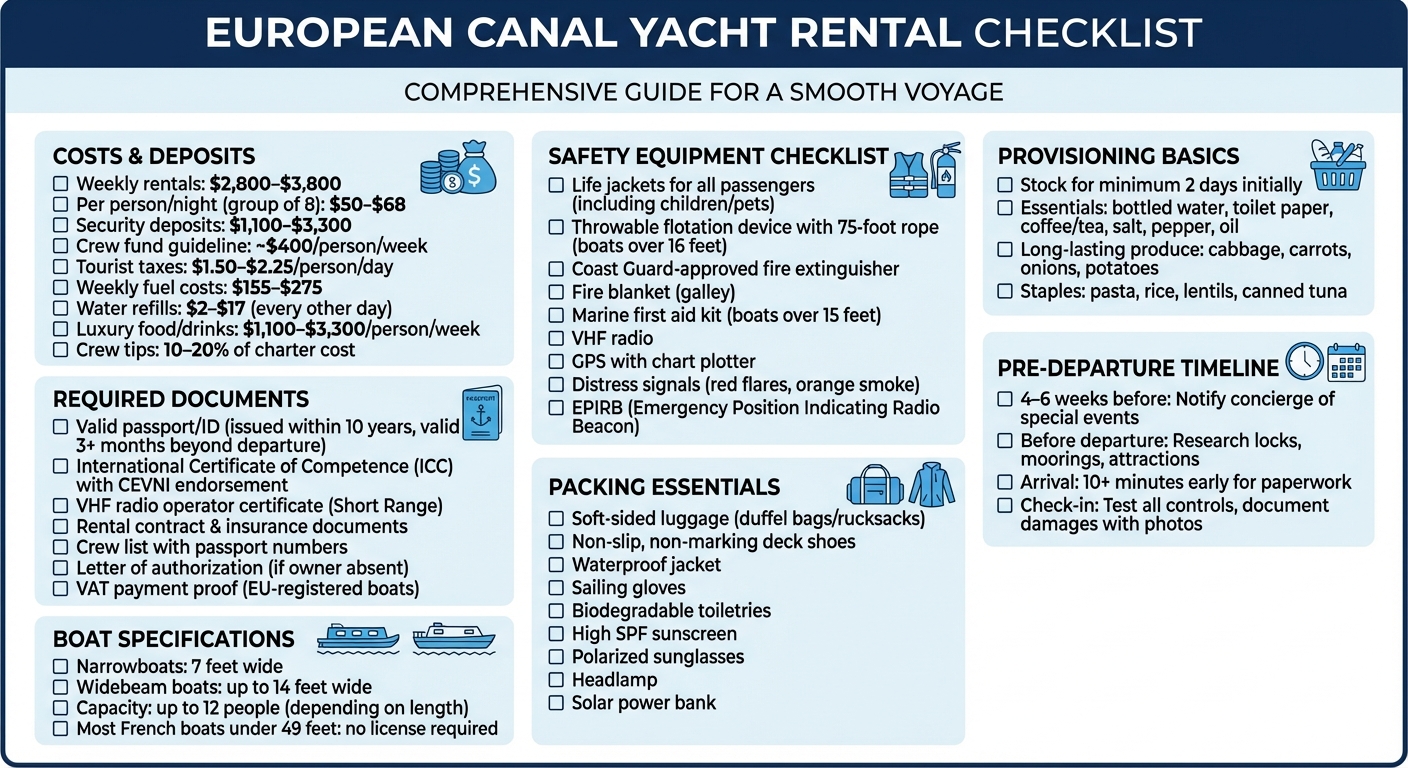
Essential Checklist for Renting Canal Yachts in Europe
10 Things We Wish We’d Known Before Renting a Canal Boat in France
sbb-itb-161ccc1
Documentation and Legal Requirements
Before setting sail, gather all necessary documents to avoid any last-minute surprises. Each crew member must carry a valid passport or national ID that complies with Schengen Area rules. This means the document must have been issued within the last 10 years and remain valid for at least three months beyond your departure date. If you’re traveling with a child and only one parent is present, some authorities might request a signed consent form from the absent parent. Below is a breakdown of the essential paperwork for a smooth trip.
ID and Boating Licenses
If you’re renting a bareboat, you’ll need to prove your boating skills. This typically requires the International Certificate of Competence (ICC) with a CEVNI endorsement for navigating inland waterways. Double-check that your license covers the specific type and size of the boat. Additionally, at least one crew member must hold a VHF radio operator’s (Short Range) certificate; failing to meet this requirement could result in fines or even being denied departure. Fred from Borrow A Boat emphasizes:
The truth is that while chartering a yacht is not complicated, the paperwork can catch people out. What counts as a valid boat license changes from country to country, and so do the penalties if you get it wrong.
It’s also wise to carefully review your rental contract and insurance details before your trip.
Rental Contracts and Insurance Coverage
Your charter agreement should clearly outline the rental period, total costs, liability terms, and cancellation policies. Security deposits typically range between $1,100 and $3,300, often secured through a credit card authorization. Make sure your insurance covers key areas like third-party damages, personal injury, and vessel damage. Some insurance policies include deposit coverage that reduces your deductible from 20% to 10%. Always carry the original insurance and registration documents onboard, and if necessary, provide official translations. Be aware of potential hidden costs such as fuel, port taxes, transit logs, and tourist taxes (approximately $1.50–$2.25 per person per day). During the handover, inspect the yacht thoroughly to protect your deposit. If required, supply translated copies of your boating license.
Cross-Border Travel Requirements
Crossing borders via canals or coastal waters involves additional regulations. You’ll need to follow the rules of both the Flag State and the Coastal State. Prepare a formal crew list that includes names, passport numbers, and emergency contact details. If the boat owner isn’t present, the skipper must carry a letter of authorization. For EU-registered boats, you’ll need proof of VAT payment, such as the original certificate or builder’s receipt. Non-EU residents can import a boat into the EU tax-free for up to 18 months within a two-year period. When entering a new customs area, raise the yellow "Q" flag until clearance is granted. Keep both digital and printed copies of all critical documents readily available.
Onboard Amenities and Features
Before setting sail, take time to inspect key onboard systems to ensure a smooth and comfortable journey. Start with the refrigerator, often considered the most important amenity after the engine. Make sure it cools properly and that the temperature can be adjusted [10,31]. Test the stove burners and confirm the oven heats up by using a lighter [10,31]. Check that gas cylinders are full, valves operate smoothly, and a gas detector is installed [10,31]. Afterward, review the cabin layout, kitchen facilities, and safety equipment to ensure everything is in order.
Cabins and Living Spaces
Canal yachts come in two main widths: narrowboats (7 feet wide) and widebeam boats (up to 14 feet). Despite their compact size, narrowboats can accommodate up to 12 people, depending on length, though safety limits often cap the number at this maximum [24,26,28]. Most boats feature a combination of fixed cabins and convertible saloon berths, with the latter requiring daily setup but offering a more budget-friendly option. Be sure to check berth sizes to ensure they meet your comfort needs.
Cabin layouts can vary widely. Master suites offer the most space and scenic views, while VIP suites provide added amenities compared to standard guest cabins. Twin cabins are equipped with two single beds, making them ideal for kids or friends, and some even include Pullman berths – fold-down beds integrated into the wall to save space. Convertible cabins allow twin beds to be joined into a double bed. As Chrisna Nesbitt, Sales Agent at Le Boat, points out:
Some people choose a boat that has one more cabin than they need for sleeping, to give them space to store bags and clothes.
For larger groups, boats with split layouts – cabins at both the front and rear, separated by the kitchen and saloon – can provide added privacy. Once you’ve assessed the living spaces, move on to checking the kitchen setup.
Kitchen and Dining Options
Most bareboat charters are self-catering, meaning you’ll need to bring your own provisions. Essentials like tea towels, dishwashing liquid, sponges, and basic spices (salt, pepper, oil, and vinegar) are often not provided, so pack these items in advance. A general guideline for a crew fund is about $400 per person per week to cover shared costs like port fees, fuel, and food.
For those seeking a more luxurious experience, professional chefs are available on crewed charters to prepare meals using local ingredients [30,34]. Some charter packages also offer meal plans, such as half-board (breakfast and lunch) or full-board (all meals) options [33,34]. To keep things simple in the compact galley, consider preparing one-pot meals like stews or pasta, which reduce cleanup.
Safety Equipment and Special Accommodations
Safety gear is a must. Ensure there are life jackets for all passengers, including appropriately sized options for children and pets [35,37]. Boats over 16 feet must carry a throwable flotation device, such as a lifebuoy with a lighting device and a 75-foot rope [36,37]. Verify the presence of at least one Coast Guard-approved, fully charged fire extinguisher and keep a fire blanket in the galley for small cooking fires [35,37]. Additionally, vessels over 15 feet need a marine first aid kit stocked with essentials like bandages, antiseptics, painkillers, and seasickness remedies [36,37].
Other crucial emergency tools include a VHF radio, GPS with a chart plotter, and distress signals like red handheld flares and orange smoke signals [35,36]. An EPIRB (Emergency Position Indicating Radio Beacon) is essential for transmitting distress alerts to rescue agencies, especially in remote areas. For accessibility, ensure the yacht has features like accessible showers, handrails, and same-level cabins [10,27,31]. Lastly, inform your charter company of any special dietary or mobility needs well in advance. With these checks complete, you’ll be ready to move on to pre-departure preparations.
Pre-Departure Preparation
With your yacht inspected and safety equipment checked, it’s time to focus on the practical details that will set the tone for your canal adventure. Getting everything ready means packing wisely, stocking up on supplies, and planning your route before you cast off.
What to Pack
European waterways can be unpredictable, so pack clothing for all conditions. Bring summer essentials like shorts and T-shirts, but also include warmer layers such as sweatshirts, fleeces, or merino base layers. A waterproof jacket and long-sleeve tops for sun protection are must-haves. For footwear, choose non-slip, non-marking shoes like sneakers or deck shoes for onboard use, sturdy shoes for walking towpaths, and slippers for relaxing in the cabin. Sailing gloves are also useful to protect your hands from rope burns.
Don’t forget the extras: a headlamp for navigating dark towpaths, polarized sunglasses, wide-brimmed hats, and SPF-rated lip balm. Use biodegradable toiletries to minimize environmental impact, as greywater often drains directly into the canal. High SPF sunscreen, insect repellent for mosquitoes, and a personal first aid kit should also be on your list.
Luggage choice is important in the tight quarters of a canal boat. As Yachting.com notes:
"One of the most important pieces of information you must pass on to all crew members is about luggage… A sports bag is ideal, while a hard-shell suitcase is the least suitable."
Stick to soft-sided, foldable duffel bags or rucksacks that fit easily into cabin lockers. Once unpacked, stow empty bags to free up space. A solar power bank or car charger can be handy since 220V power is often only available when docked. To protect against water damage, scan or photograph essential documents – like IDs, licenses, and contracts – and store them digitally. With your packing done, you can shift your attention to provisioning.
Provisioning Food and Drinks
Canal boats are self-catering and come with basic cooking facilities. Stock up on enough food for at least two days, then enjoy exploring local markets and waterside pubs as you travel. Check if your rental company offers grocery starter packs or supermarket delivery to the dock.
Start with essentials like bottled water, sunblock, toilet paper, matches, coffee or tea, and basic spices (salt, pepper, oil). For fresh produce, choose longer-lasting options like cabbage, carrots, onions, garlic, potatoes, and lemons. Supplement these with canned or dried staples like pasta, rice, lentils, tuna, and soup. Stick to low-power appliances to avoid overloading the boat’s limited 240V outlets.
You’ll need to refill the water tank every other day, which costs around $2–$17. Diesel is usually delivered by truck to the quay, with weekly fuel costs ranging from $155 to $275. To conserve battery power, charge electronic devices while the engine is running.
Planning Your Route
Plan your journey ahead of time to pinpoint local markets, restaurants, and attractions along the way. European canals pass through historic towns, picturesque countryside, and iconic landmarks. Research locks, moorings, and must-see spots, and allow extra time for lock operations and securing mooring spaces – especially during busy seasons. Arrive at the dock at least 10 minutes early to handle paperwork and review safety instructions. With these steps in place, your canal adventure will be off to a smooth start.
Tips for a Smooth Journey
Working with Concierge Services
A skilled concierge can transform your canal yacht adventure into a stress-free escape. They handle everything – from meal preparation and stocking provisions to planning special events – leaving you free to enjoy the experience. According to Europe Yachts Charter, a hostess ensures the yacht stays clean, manages logistics, and anticipates your needs before you even notice them.
For a luxury charter, be upfront about your preferences during the initial briefing. Share details like dietary restrictions (vegan, allergies, or specific cuisines), desired activity levels, and how much privacy your group wants. Expect to spend between $1,100 and $3,300 per person per week on premium food and drinks, which might include indulgences like Wagyu beef or vintage Champagne. Planning a special occasion, such as a birthday or anniversary? Notify your concierge 4–6 weeks in advance to arrange extras like live music or custom decorations.
Concierges are also invaluable for their local knowledge. They can guide you to hidden beaches, secure reservations at Michelin-starred restaurants perched on cliffs, or adjust your itinerary if bad weather disrupts your plans. Don’t forget to budget for tips – 10% to 20% of the total charter cost is customary for the yacht crew.
While concierge services elevate your journey, being prepared for unexpected challenges on board is equally important.
Handling Problems on the Water
Most technical hiccups are minor and can be resolved quickly if you familiarize yourself with your boat’s systems. During check-in, physically test every control – don’t just rely on verbal instructions. Flip every switch, operate the bilge pump, and test the anchor windlass. If the engine doesn’t start, check the fuel line for a secure connection (listen for a "click"), ensure the kill cord or key is properly engaged, and inspect the engine fuses. Regularly monitor the exhaust to confirm water discharge, which indicates the cooling system is working.
To protect your security deposit, document any damages with timestamped photos or videos during check-in. Capture the hull, deck, and interior from multiple angles. Sandra-Valeska Bruhns from SeaHelp advises:
Always record all damages in writing and have the record signed by one of the charter staff… The verbal statement of the agency, the damage is already known, is not enough.
Most reputable charter companies offer 24/7 support for mechanical issues, and services like SeaHelp provide assistance with problems like grounding, propeller entanglements, or running out of fuel. If something goes wrong, immediately note the time and location, take photos of the damage, and contact the charter base for assistance.
Conclusion
Navigating the canal yacht rental process can be straightforward and hassle-free if you follow a solid checklist. Start by ensuring all crew members have valid passports or IDs, and confirm that you hold a certified sailing license, such as an ICC or RYA Day Skipper. Depending on the region, you might also need certifications like a VHF radio certificate. Plan for a security deposit ranging from €1,000 to €3,000 (around $1,050 to $3,150) and arrive early to complete the necessary pre-departure briefings.
Before setting off, take time to inspect the yacht. Check the engine’s cooling system by observing water discharge, test the anchor windlass, and take timestamped photos of the hull to document its condition.
As Yachting.com wisely advises:
Taking over the boat before you set sail is one of the most important tasks if you want your voyage to go without a hitch.
- Yachting.com
Pack smartly with soft-sided luggage, non-slip deck shoes, and gloves for rope handling. Stock up on provisions before departure, and consider using apps like Windy or Savvy Navvy for weather updates and navigation. Be mindful of local rules, such as penalties for excessive noise, to avoid unnecessary fines.
FAQs
Do I need an ICC and CEVNI to rent a canal yacht?
Yes, you’ll generally need both an ICC (International Certificate of Competence) and CEVNI (European Code for Inland Waterways) to rent a canal yacht in Europe. The ICC serves as proof that you have the necessary boating skills, while the CEVNI confirms your knowledge of inland waterway rules, which is especially important for navigating areas like the French canals.
What extra fees should I budget beyond the rental price?
When planning your yacht rental, remember that the rental price is just one part of the total cost. You’ll also need to account for fuel, docking or marina fees, provisioning costs, security deposits, local taxes, crew tips, and any extra charges for water toys or special amenities. These additional expenses can differ depending on the yacht type and location, so it’s a good idea to clarify all details with the provider before making your booking.
How many miles can you realistically cruise per day on canals?
You can usually cover 30–40 miles per day when cruising on canals, moving at an average speed of 3–4 miles per hour. This estimate factors in stops and the time needed to navigate locks, though the exact distance may vary based on your route and conditions.