Maximizing revenue for luxury rentals requires more than adjusting rates – it’s about maintaining your property’s prestige while ensuring consistent income year-round. Here’s how you can achieve that:
- Peak Seasons: Charge premium rates by setting minimum-night stays (3–7 nights), using rate floors, and bundling exclusive services like private chefs or luxury car rentals. Monitor booking pace to avoid underpricing.
- Shoulder Seasons: Avoid drastic discounts. Instead, offer value like "Stay 4, Pay 3" deals or curated packages (e.g., wine tastings). Target flexible travelers like remote workers and retirees with shorter stays and updated seasonal photos.
- Off-Peak Seasons: Focus on niche groups like digital nomads or locals seeking staycations. Highlight features like home offices or cozy amenities (fireplaces, hot tubs). Offer tiered discounts for extended stays.
- Event-Based Demand: Plan for local events 12–18 months in advance. Adjust pricing dynamically, enforce minimum stays, and market your property as an event-friendly option.
- Dynamic Pricing Tools: Automate rate adjustments based on real-time data like local events and booking trends. Properties using these tools often see revenue increases of 10–40%.
Luxury rentals thrive by selling experiences, not just accommodations. Tailor offerings to guest preferences, use data to guide pricing, and protect your brand’s high-end image. With the right strategies, you can maximize revenue across all seasons while delivering exceptional guest experiences.
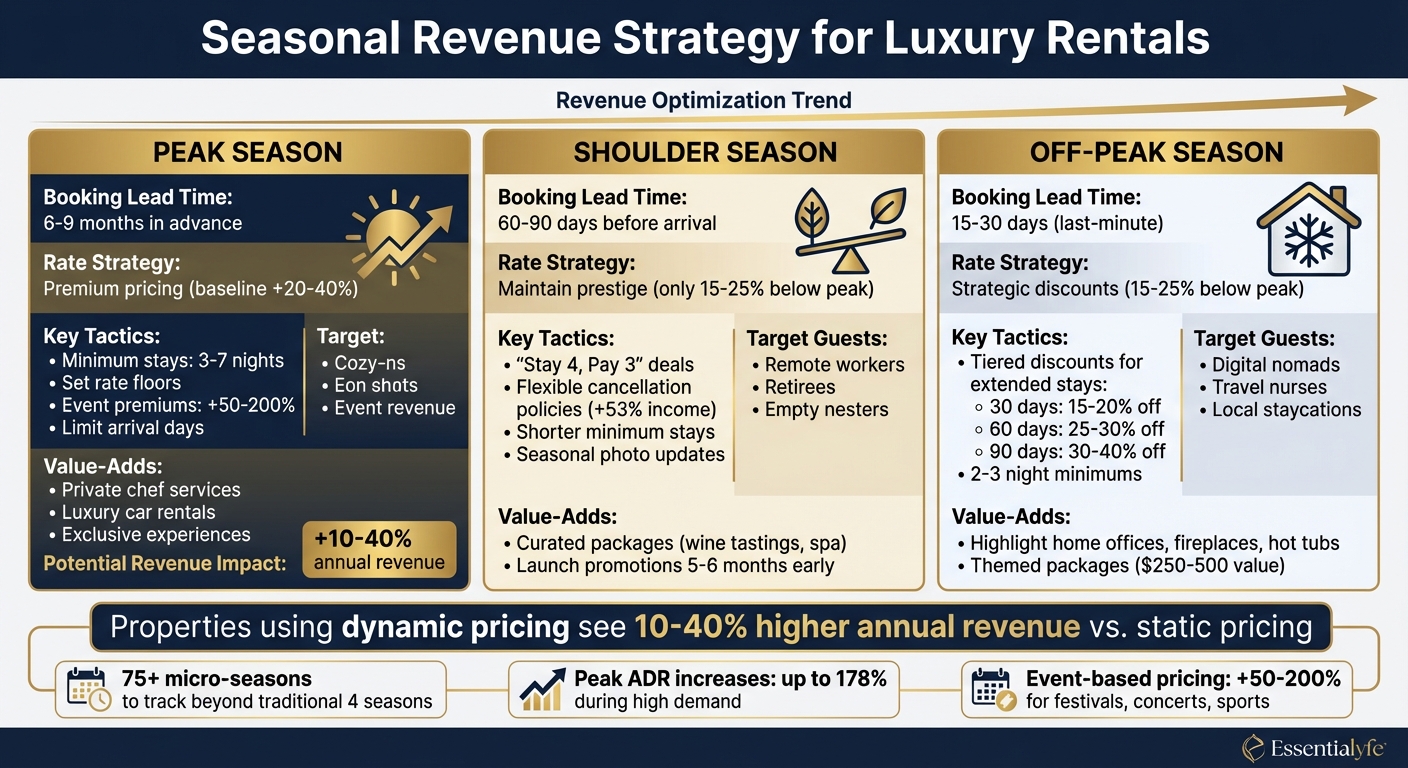
Luxury Rental Pricing Strategy by Season: Peak, Shoulder & Off-Peak Revenue Optimization
How to Maximize Revenue on Luxury STR with Bill Faeth
sbb-itb-161ccc1
How Seasonal Demand Works in Luxury Markets
Luxury rental demand tends to follow consistent, predictable patterns each year, shaped by more than just weather. As Jordan Locke, Founder of RevPARTY Consulting, explains, it’s all about “the property demand that occurs, consistently, on a calendar basis”. Recognizing these patterns is crucial – properties that adopt data-driven seasonal strategies can see up to 40% higher annual revenue compared to those sticking with static pricing.
What sets luxury rentals apart from standard ones is the timing of bookings and guest behavior. For high-end properties, peak season reservations are often made 6–9 months in advance. Shoulder season bookings happen closer to 60–90 days before arrival, while off-peak reservations are typically last-minute, within 15–30 days. This means pricing strategies need to be prepared well ahead of time to attract early planners in the luxury market. Now, let’s dig into the forces shaping these patterns and how data can unlock revenue opportunities.
What Influences Luxury Traveler Demand by Season
Seasonal cycles are just the starting point. To refine your pricing strategy, you need to understand the specific factors driving demand. For affluent travelers, three main elements come into play: weather, major holidays, and exclusive events. For instance, beach properties see their busiest times in summer, while mountain rentals thrive in winter for skiing and in summer for hiking.
One of the biggest revenue boosters comes from compression events – special occasions that turn regular weekends into premium pricing opportunities. For example, Taylor Swift’s 2023 U.S. tour led to 250,000 Airbnb guest check-ins and a $77 million economic impact. Similarly, the Ultra Music Festival in Miami pushed nightly rates up by over 110%, while the Leeds Music Festival caused a 17.7% increase. Sporting events like Formula 1 races can nearly triple rental prices. These events create micro-seasons, even during typically slower periods.
Guest demographics also shift throughout the year. Families dominate summer and school break periods, while empty nesters and remote workers prefer quieter escapes in the fall and winter. Recognizing these trends allows you to fine-tune your marketing and services to match guest preferences.
Using Data to Pinpoint Revenue Opportunities
The clearer picture of seasonal demand emerges when you dive into booking data. Analyzing historical booking trends from the past 2–3 years is key to forecasting demand accurately. But don’t stop at monthly trends – break the data down by day to uncover differences, like how Tuesdays might perform compared to Saturdays.
Market pacing provides a valuable early indicator. By tracking how quickly future dates are booking compared to historical patterns, you can adjust rates in real time – raising them when bookings are ahead of pace or reevaluating pricing when demand lags. Pair this with a 12-month event calendar to monitor upcoming festivals, conventions, concerts, and sporting events well in advance.
Tracking the "Big Three" metrics – Occupancy Rate, Average Daily Rate (ADR), and Revenue per Available Rental (RevPAR) – is another must. Properties that analyze daily data trends, rather than relying on annual averages, often achieve 10–25% more revenue than those relying on guesswork. This approach allows for more precise rate adjustments, critical for maintaining a luxury brand’s reputation. As Jordan Locke puts it, “More people ‘flat price’ than you think. So if you implement seasonal pricing, you’re already doing better than half the vacation rental market”.
How to Maximize Revenue During Peak Season
Peak season is the golden opportunity to boost annual revenue, often making up a significant portion of the year’s earnings. By leveraging data-driven insights and focusing on premium experiences, you can see revenue increases ranging from 10% to 40% during this period. For example, this could mean the difference between earning $15,000 and $25,000 in a single season.
The trick lies in finding the balance between charging premium rates and maintaining rate integrity. Instead of simply hiking up nightly rates, consider strategies like minimum-night requirements of 3 to 7 nights during peak weeks. This approach not only attracts higher-value guests but also reduces turnover costs and prevents awkward gaps in your calendar. Another key tactic is setting rate floors, which ensure your pricing algorithm doesn’t drop below a certain threshold, even if there are gaps in bookings. Let’s dive into the specifics of these strategies.
Setting Premium Rates
Establishing rate floors ahead of peak season is crucial to maintaining your property’s value, especially for last-minute bookings. Properties that adopt this strategy see an average 10.7% boost in Revenue per Available Room (RevPAR) compared to those without dynamic pricing.
Keep an eye on your booking pace. If you’re already 90% booked two months before peak season, your rates may be too low. In popular vacation spots, Average Daily Rates (ADR) often spike by as much as 178% during peak periods. To further optimize your calendar, limit arrivals to specific days, like Fridays and Mondays, to avoid unprofitable gaps between bookings.
Building Exclusive Service Packages
Luxury travelers are drawn to experiences, not just accommodations. By bundling exclusive services, you can justify higher nightly rates. For instance, concierge services can increase rates by 10% to 25%, while amenities like a private pool can command a 20% to 35% premium.
Tailor value-added packages to the season. For summer, consider bundling perks like private chef dinners, exotic car rentals, or curated wine tastings. These offerings don’t just enhance the guest experience – they also support premium pricing. A "stay 4, pay 3" deal, for example, can maintain your ADR while increasing perceived value. Companies like Essentialyfe have mastered this by offering concierge services such as in-home massages, private chefs, and luxury car rentals.
Pricing Around Local Events and Holidays
Special events and holidays are prime opportunities for premium pricing. Major occasions like Christmas, New Year’s Eve, and Thanksgiving often support rate increases of 20% to 40% over base rates. Global events can push rates even higher – Formula 1 races, for instance, can nearly triple rental prices, while the Indianapolis 500 typically drives rates up by 45%.
Consider the economic ripple effects of events like the Ultra Music Festival in Miami, which has led to nightly rate increases of over 110%. Taylor Swift’s 2023 U.S. tour alone generated $77 million in Airbnb-related economic impact, with 250,000 guest check-ins. To capitalize on these opportunities, map out local events like festivals, marathons, and graduations at least a year in advance. Apply event premiums of 50% to 100% over base rates and enforce minimum-night stays – 3 nights for long weekends and 7 nights for major holidays.
Maintaining Revenue in Shoulder Seasons
Shoulder seasons require a thoughtful approach to sustain premium pricing. Luxury properties, for instance, can often keep rates at 15–25% below peak levels, while average properties may slash rates by 70–80%. High-end properties achieve this balance by adapting their strategies without diluting their brand value.
Instead of dropping a $1,200 nightly rate to $750, consider maintaining a $1,050 rate and including a free night for a four-night stay. This approach preserves the perception of exclusivity while offering value. Properties that use dynamic seasonal pricing models have been shown to generate up to 40% more annual revenue compared to those with static pricing.
Reaching Luxury Travelers Seeking Value
During shoulder seasons, focus on attracting travelers like remote workers, retirees, empty nesters, and wellness enthusiasts – individuals with flexible schedules who value luxury but are also looking for deals. While they might be price-conscious, they still expect an upscale experience.
Seasonal updates to property photos can make a big difference. Replace summer-centric poolside images with visuals of cozy indoor spaces and features like hot tubs, saunas, or fireplaces. These seasonal touches set the tone for pricing strategies that appeal to this audience.
Flexibility is another key tactic. Shorten minimum stay requirements and allow more flexible arrival dates to capture spontaneous weekend getaways. Additionally, offering flexible cancellation policies can increase income by as much as 53%. Pair these adjustments with creative promotions to maximize occupancy during slower periods.
Using Promotions to Drive Bookings
For luxury properties, value-added packages often outperform simple rate discounts. Instead of lowering nightly rates, bundle services like private chef experiences, guided tours, or spa treatments. For instance, Essentialyfe offers concierge services such as in-home massages, private chefs, and exotic car rentals – perfect enhancements for shoulder-season packages that justify premium pricing while elevating the guest experience.
Promotions like "Stay 4, Pay 3" or "Stay 7, Pay 5" encourage longer stays without undermining your rates. For extended visits, tiered discounts can be effective: offer 15–20% off for 30-day stays, 25–30% off for 60 days, and 30–40% off for 90 days. These deals are particularly appealing to digital nomads and sabbatical travelers, who provide steady, low-turnover revenue.
"In shoulder season, being behind pace is dangerous. Discounts and tactics need to come earlier to protect occupancy." – Eduardo Mandri, Co-founder and CEO, Angel Host
Timing is crucial. Launch promotions early – 5 to 6 months in advance – to secure bookings and avoid last-minute rate cuts. Re-engage past guests with exclusive "members-only" booking windows through email campaigns. This proactive approach helps build a solid occupancy foundation before the season even begins.
Generating Revenue During Off-Peak Seasons
Off-peak seasons can bring in a different crowd – think remote workers, retirees, or even locals looking for a quick, relaxing getaway. These travelers often seek thoughtfully curated experiences that cater to their unique needs. For instance, remote workers might book month-long stays to combine work and leisure, while retirees could escape colder climates for a peaceful retreat. The trick lies in identifying these groups and tailoring your offerings to suit them.
"Off-season demand exists. It comes from different travelers seeking different experiences than peak-season visitors."
- Jessica Hopkins, Hostfully
Luxury properties often maintain their off-peak rates at about 15–25% below peak pricing, avoiding drastic price cuts common in non-luxury markets. Instead of competing solely on cost, successful hosts focus on selling an experience – something that feels exclusive and memorable.
Attracting Niche Guest Segments
Remote workers and digital nomads are among the most valuable off-peak guests. They’re looking for amenities like high-speed Wi-Fi, ergonomic workspaces, and even laundry facilities . Highlight features like a dedicated home office setup or proximity to coworking spaces to appeal to this group.
Other niche audiences, such as travel nurses, corporate relocations, or sabbatical travelers, often seek medium-term rentals of 28 days or more. To attract these guests, consider offering tiered discounts, such as 15–20% off for 30-day stays, 25–30% off for 60 days, and up to 40% off for 90-day stays. For spontaneous local trips, reduce your minimum stay to 2–3 nights . Listing on platforms like Furnished Finder or American Snowbird can also help you connect with these niche markets.
Don’t forget locals looking for a "staycation." Empty nesters, retirees, or couples might seek a nearby escape during the off-season . Update your listing photos to showcase cozy indoor features like fireplaces, hot tubs, or home theaters – elements that emphasize comfort and relaxation year-round .
Creating Off-Season Packages
Themed packages are a great way to keep rates steady while adding value. Think "Winter Wellness Retreat" or "Fall Culinary Escape", including extras worth $250–$500. For example, Essentialyfe enhances its offerings with concierge services, such as private chefs, in-home massages, or exotic car rentals, to justify premium pricing even during slower months.
Collaborations with local businesses can also elevate your property’s appeal. Arrange private wine tastings, exclusive gallery tours, or chef-prepared dinners featuring regional ingredients . These partnerships can turn your property into more than just a place to stay – it becomes a destination in itself. These types of packages also pave the way for flexible pricing strategies, ensuring you’re maximizing revenue throughout the year.
Using Dynamic Pricing Tools
Manually updating your rental rates just can’t keep up with the fast-paced shifts in the market. That’s where dynamic pricing software steps in. These tools automatically adjust your rates every 24 hours, factoring in real-time data like competitor occupancy, local events, booking speed, and even flight patterns that hint at incoming traveler interest. They also break down demand into over 75 micro-seasons influenced by local patterns.
For property owners, the payoff is clear. Rentals using dynamic pricing often see annual revenue increases of 10% to 40%. During peak demand, these algorithms can push the average daily rate (ADR) up by as much as 178%. For luxury properties, this means you’re maximizing your earnings when nearby inventory hits about 80% occupancy.
"Your vacation rental market doesn’t actually have four seasons. It has 75+ micro-seasons driven by local events, holidays, conferences, and demand patterns you’re probably not tracking manually."
Dynamic pricing tools don’t just tweak rates – they fine-tune them in real time, ensuring you’re always aligned with seasonal and market demands. Let’s break down how they deliver such precision, especially for luxury rentals.
Why Dynamic Pricing Works for Luxury Rentals
Dynamic pricing algorithms analyze thousands of data points at once – competitor pricing, booking trends, local events, and occupancy levels. When supply tightens, like when 80% of nearby listings are booked, the system raises your rates to capitalize on the demand. On the flip side, if bookings slow down, the tool identifies gaps like single unbooked nights (orphan nights) and applies discounts to fill those dates.
One major benefit is the ability to maintain your property’s premium image while maximizing income. By setting a "floor" price to protect your margins and a "ceiling" to avoid overpricing, you can adjust rates dynamically without risking your brand reputation. Property managers often report managing over 75 unique pricing windows with these tools.
Timing also plays a big role. Algorithms charge higher rates for early bookings when demand is high, but they’ll lower prices closer to check-in dates to fill unsold inventory. This approach balances early revenue with last-minute bookings.
Next, let’s look at how to implement these strategies with seasonal pricing rules tailored to your property.
Setting Up Seasonal Pricing Rules
Start by reviewing 2–3 years of historical data – like occupancy trends, rental rates, and booking lead times – to uncover patterns unique to your property. This beats relying on generic high/low season templates. For instance, you might find that your mountain cabin sees a spike in fall or that your beachfront home commands premium rates during spring break.
To make pricing scalable, use percentage-based adjustments instead of fixed amounts. For example, you could set a rule like "+20% for Christmas week" or "–15% for midweek dates in January." You can also add manual overrides for specific dates you know will perform well.
Monitor your weekly booking pace. If you’re filling up too quickly, your rates might be too low. If bookings are lagging behind historical trends, it could be time to lower prices. Dynamic pricing tools handle these adjustments daily and sync them across platforms.
For luxury rentals, fine-tuning your minimum stay requirements can also make a big difference. For example, during peak summer, you could enforce a 5–7-night minimum to encourage week-long bookings. In slower shoulder seasons, you might drop this to 2–3 nights to fill your calendar more efficiently. Combining dynamic pricing with flexible stay rules ensures you’re optimizing revenue year-round without constant manual effort.
Taking Advantage of Event-Based Demand
Seasonal pricing and dynamic adjustments are great, but tapping into event-based demand can take your revenue to the next level. A single concert, festival, or sporting event can turn an otherwise slow week into a major money-maker. For example, when Taylor Swift announced her 2024 U.S. tour dates, vacation rental searches in Miami skyrocketed by 1,400% for concert weekends. Similarly, during the 2024 solar eclipse, properties in the path of totality saw occupancy rates soar to 92%, compared to the usual 30% for that week.
"Major events are becoming the new seasonality in travel, creating concentrated bursts of demand, higher occupancy and stronger pricing power for vacation rentals year-round."
- Hostaway, Summer Snapshot Report 2025
The trick lies in spotting these opportunities early and adjusting your pricing to match the demand. Events don’t just fill your calendar – they can let you charge 50% to 200% more than your usual rates. For luxury rentals, this means understanding which events attract high-end travelers and positioning your property as their top choice.
Finding High-Demand Events
To stay ahead, you need to track events well in advance – ideally 12 to 18 months out. Keep an eye on major ticketing platforms like Ticketmaster and StubHub for concerts and sporting events. Local tourism board calendars, community event listings, and convention center schedules are also goldmines for spotting upcoming opportunities. Don’t ignore niche events either – natural phenomena like solar eclipses or the Northern Lights can drive just as much demand as big-name festivals.
Analyzing past booking data (2–5 years) can also reveal patterns. You might notice that an annual marathon or food festival consistently brings in premium bookings. Many dynamic pricing tools now automate this process, flagging key events on your calendar to save you time.
Expand your focus to include events within a 60- to 180-minute drive of your property. Travelers often prefer quieter alternatives to crowded host cities. For instance, during the King’s Coronation in London, short-term rental rates jumped by 16%, contributing to over $265 million in tourism revenue – much of it captured by properties outside the city center.
Open your calendar 18 months ahead for mega-events like the FIFA World Cup or major championship games. Early planners book far in advance, so if your rates are too low or dates aren’t available, you could miss out. Setting a higher price floor for dates beyond 180 days helps avoid underpricing.
Keep an eye on booking pace as the event nears. If reservations are filling up faster than usual, your rates might be too low. For example, occupancy for the 2026 Gulf Coast Jam hit 15% to 20% six months out – double the pace of the previous year – indicating strong demand and room for price increases. Also, consider adjusting your minimum stay requirements to match the event’s duration. A two-night premium booking during a high-demand weekend can generate as much revenue as a standard five-night stay.
Marketing Properties Around Local Attractions
Once you’ve identified an event, update your property listing to attract event-goers. Include the event name in your title or description – phrases like "Near Stadium" or "World Cup Rental" can boost your visibility on booking platforms. Update your photos to highlight relevant features. For a summer music festival, showcase outdoor spaces or a pool.
Highlight your property’s location. If you’re close to the venue, emphasize conveniences like parking or easy access to transportation. If you’re farther away, position your property as a quieter alternative or an "overflow option" for travelers looking to avoid crowds. Many international travelers prefer high-end accommodations outside the hustle and bustle, which can work in your favor.
Create event-specific packages to stand out. Add-ons like private shuttles, pre-stocked kitchens with local favorites, or themed decorations can elevate the guest experience. For luxury rentals, consider offering premium services like private chefs, exotic car rentals, or in-home massages – amenities that justify higher rates.
Collaborate with local businesses to enhance your offerings. Partner with nearby restaurants, cafes, or tour operators to provide exclusive deals or packages. For instance, with 57% of travelers (and 68% of Gen Z and Millennials) likely to attend a local game while on vacation in 2026, positioning your property as the perfect base for exploring the area can make a big difference.
Use social media to target international travelers months in advance. Platforms like Facebook and Instagram let you create ads aimed at fans planning trips for specific events. Direct them to your booking site to avoid OTA fees. Starting early increases your chances of locking in high-value guests who book well ahead. By aligning your marketing with event-specific pricing and branding, you can deliver a consistent, premium experience year-round.
Key Takeaways for Seasonal Revenue Success
To maintain strong revenue across all seasons, it’s crucial to understand demand trends, use strategic pricing, and focus on adding value instead of simply cutting rates. Go beyond the typical seasonal approach by tapping into over 75 micro-seasons tied to events, holidays, and demand surges. Properties using dynamic pricing strategies often see impressive results, with some reporting up to 40% increases in annual revenue.
"Peak season is easy money. The real pros make it year-round."
- Adam Knight, Founder & CEO, Recreation Stays
During peak seasons, maximize your earnings by pushing rates higher. In shoulder seasons, avoid unnecessary discounts – offer added perks like private chefs or wine tastings to enhance value instead. For off-peak periods, target niche markets with extended stays or unique experiences that justify premium pricing. Refresh your property listings 60–90 days ahead of seasonal shifts – highlight features like fireplaces for winter or pools for spring to align with guest preferences.
AI-powered revenue management tools can boost revenues by 10–25% compared to manual methods. Setting minimum price floors ensures operational costs are covered, while scheduling major maintenance during low-occupancy periods keeps disruptions minimal.
Essentialyfe provides tailored solutions to help luxury property managers stay ahead. From curating signature experience packages to coordinating premium amenities like private chefs, exotic car rentals, and in-home massages, Essentialyfe ensures properties maintain their high-end appeal and deliver consistent value throughout the year.
FAQs
How do I set my peak-season rate floor and ceiling?
To determine your peak-season rate floor and ceiling, start by examining demand patterns and market trends. This helps you identify the lowest and highest rates that can maximize revenue without sacrificing bookings. Leverage dynamic pricing tools to fine-tune your rates based on real-time factors like demand shifts, competitor pricing, and local events.
Your rate floor should at least cover your costs while ensuring a reasonable occupancy level. On the other hand, your rate ceiling should align with peak demand, staying competitive but still profitable. Make it a habit to review and adjust these rates regularly to stay in sync with market changes.
What’s the best way to price and market for a major local event?
To set the right price and market effectively for a big local event, consider using dynamic pricing. This approach lets you adjust rates in response to demand surges during holidays, festivals, or conferences. Make sure to spotlight your property’s location – especially if it’s close to the event – and emphasize any exclusive amenities or concierge services you offer.
Additionally, targeted ads can help you reach attendees directly, ensuring your property stands out. These tactics not only keep your pricing competitive but also boost revenue and make your property more appealing during peak demand times.
Which metrics should I track weekly to adjust rates fast?
Tracking key metrics like occupancy rate, average daily rate (ADR), revenue per available rental (RevPAR), lead time, and market demand trends on a weekly basis is essential. Keeping a close eye on these figures allows you to fine-tune pricing strategies in real time, ensuring you can align with market demand and optimize revenue effectively.